
Snow plow trigger depth by property type in 2026 runs from under 1 inch for zero-tolerance sites to 3 inches for seasonal contracts — the depth that governs your lot isn't a rule of thumb, it's whatever line item sits in your contract.
- Zero-tolerance sites (hospitals, data centers, senior living) trigger plows at 1 inch or less in 2026.
- Standard commercial retail, office, and bank properties use a 2 inch trigger depth as the baseline.
- Seasonal contracts for warehouses, construction sites, and self-storage tolerate up to 3 inches before mobilization.
- Trigger depth is a negotiated contract term, not a fixed regulation, so it varies by lease and insurance language.
- St. Louis Snow Removal documents trigger depth against geo-stamped clock-ins, not a verbal promise.
Why this matters
Property managers get burned two ways on trigger depth: paying zero-tolerance rates for a lot that only needed a seasonal contract, or signing a 3-inch seasonal deal for a site with fall-liability exposure that needed 1 inch. Neither mistake shows up until a storm hits or a slip-and-fall claim lands on a desk.
St. Louis Snow Removal builds every commercial agreement around a documented trigger depth, tied to the property's actual risk profile, not a generic template. Get the trigger depth wrong in 2026 and you're either overpaying for plows on a warehouse lot that didn't need one, or under-covered on a sidewalk that just failed an ADA compliance check.
Snow plow trigger depth by property type: the benchmark table
Trigger depth is the accumulation threshold, measured in inches, that activates a plow dispatch under a snow removal contract. The overall commercial average across property types sits at 2 inches — that's the baseline most retail, office, and general commercial lots use in 2026.
High-liability and life-safety properties trigger well below that average. Lower-liability, access-only properties tolerate more snow before a crew rolls.
| Property Type | Typical Trigger Depth | Contract Model | Why |
|---|---|---|---|
| Hospitals / healthcare campuses | 1" or less | Zero-Tolerance | 24/7 access, life-safety liability |
| Data centers | 1" or less | Zero-Tolerance | Zero downtime tolerance on critical access roads |
| Senior living facilities | 1" or less | Zero-Tolerance | High fall-risk population |
| Grocery stores | 1-2" | Zero-Tolerance / Per-Occurrence | High foot traffic, slip-fall exposure |
| Banks and credit unions | 1-2" | Zero-Tolerance | Public-facing, liability-sensitive |
| Schools and daycares | 1-2" | Zero-Tolerance / Per-Occurrence | Child safety, licensing requirements |
| All commercial properties (average) | 2" | — | Baseline standard |
| Retail centers / restaurants | 2" | Per-Occurrence | Customer traffic, moderate liability |
| Office campuses | 2" | Seasonal / Per-Occurrence | Standard commute-hour traffic |
| Auto dealerships | 2" | Per-Occurrence | Lot visibility for sales traffic |
| Municipal contracts | 2" | Per-Occurrence | Public right-of-way standards |
| HOA / residential snow routes | 2-3" | Seasonal | Scheduled route passes, not on-demand |
| Manufacturing plants | 2-3" | Seasonal | Industrial vehicle traffic tolerant of snowpack |
| Self-storage facilities | 2-3" | Seasonal | Low foot traffic |
| Warehouses / distribution | 2-3" | Seasonal | Truck traffic, lower liability standard |
| Construction sites | 3" | Per-Occurrence | Access-only, no public foot traffic |
Hospitals, data centers, and senior living facilities lead at a 1-inch trigger — the lowest threshold on the table, because life-safety and fall-risk exposure don't leave room to wait. Construction sites and warehouses trail at 3 inches, the highest tolerance, because access-only lots with no public foot traffic can absorb more accumulation before a plow becomes necessary.
The gap between those two ends is 2 full inches, and it's not arbitrary — it maps directly to who's walking or driving on the surface and what a fall or a blocked dock costs the property owner.
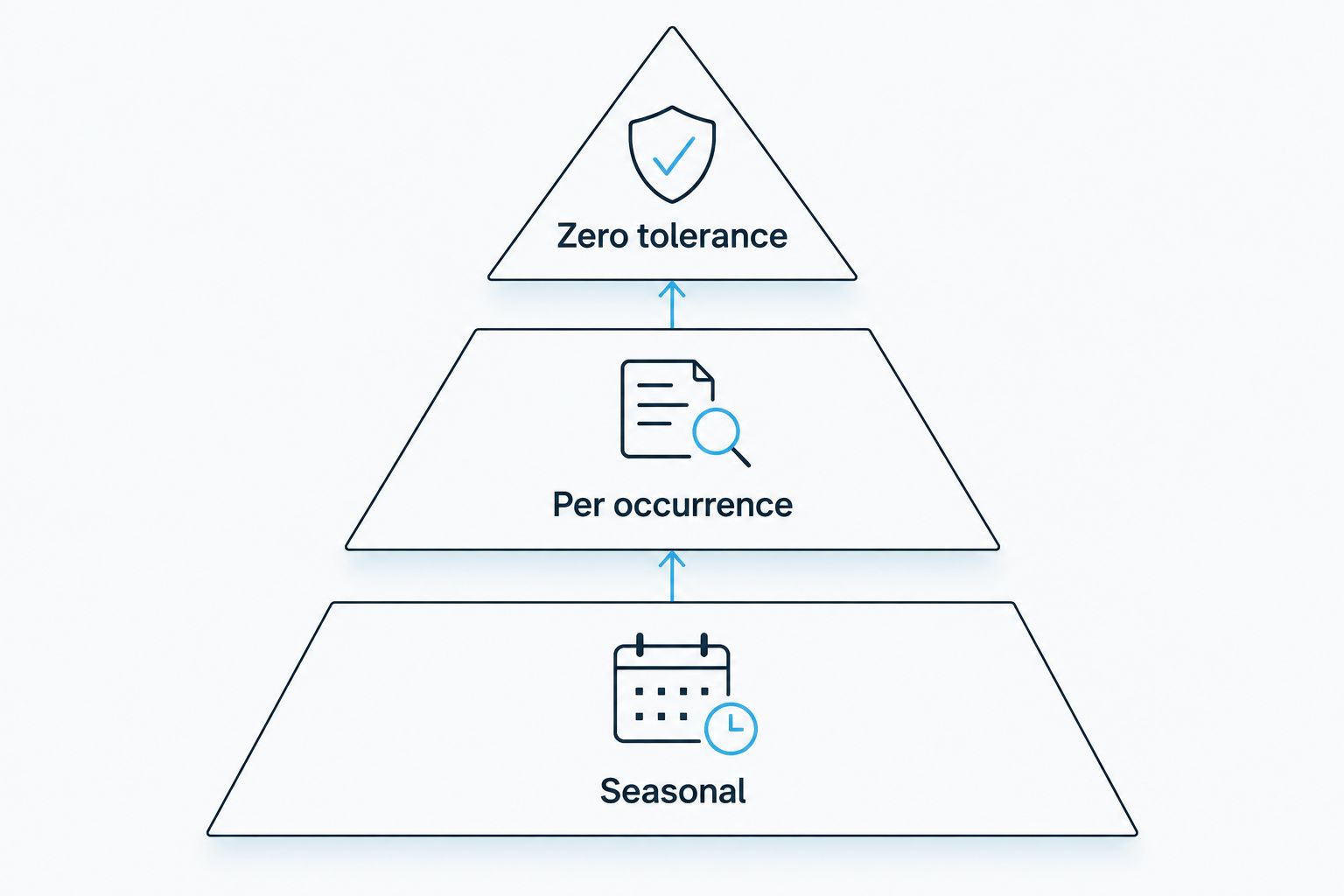
Methodology and limitation: these depths reflect how commercial snow contracts are typically structured across the St. Louis metro and Metro East Illinois under Zero-Tolerance, Seasonal, and Per-Occurrence agreements — not a fixed regulation. The one thing this table can't tell you: your specific lease, insurance policy, or municipal code may set a stricter trigger than the property-type default, so the contract language always overrides the benchmark.
How to use these benchmarks
- Match the trigger to your liability, not your budget. A 3-inch seasonal contract on a hospital access road is a liability exposure, not a savings.
- Check your lease and insurance language before you sign a trigger depth. Some commercial leases specify a trigger depth in writing — the benchmark is a starting point, the lease is the rule.
- Ask for documentation, not a promise. A contract that clock-ins geo-stamped and logs snowfall against the trigger depth gives you proof if a slip-and-fall claim shows up later.
- Re-check trigger depth annually. Foot traffic, tenant mix, and insurance requirements change — a 2-inch trigger that fit your office campus in 2024 might not fit it in 2026.
If you manage a property where trigger depth decisions feed directly into audit files, the snow depth trigger to dispatched plow crew workflow breaks down how the threshold connects to actual crew dispatch, storm by storm.
Get your trigger depth reviewed
See which contract model fits your property's liability profile in 2026.
For hospital-specific trigger and dispatch requirements, the hospital campus snow removal guide covers the tighter zero-tolerance standard those sites need in 2026. And if trigger depth is one line item in a larger budget conversation, the St. Louis commercial snow removal cost guide breaks down how contract model affects total spend for the season.
FAQ
What is a snow plow trigger depth?
Trigger depth is the snowfall accumulation, measured in inches, that activates a plow dispatch under a commercial or residential snow contract. In 2026, most commercial lots use a 2-inch trigger, while zero-tolerance sites use 1 inch or less.
What trigger depth should a hospital use?
Hospitals typically use a 1-inch or lower trigger depth under a Zero-Tolerance contract in 2026, because 24/7 access and life-safety liability leave no room to wait for deeper accumulation.
Is 2 inches a standard trigger depth for commercial properties?
Yes, 2 inches is the baseline commercial trigger depth for retail, office, and general commercial lots in 2026. It balances plow frequency against cost for properties without elevated liability exposure.
Can a warehouse use a 3-inch trigger depth?
Warehouses and distribution centers commonly use a 2 to 3-inch trigger under a Seasonal contract in 2026, since truck traffic and access-only lots tolerate more accumulation than public-facing retail.
Does trigger depth override my lease agreement?
No. Trigger depth benchmarks are a starting point, but your specific lease or insurance policy can require a stricter threshold. Always check the written agreement before assuming the property-type default applies.
What's the difference between Zero-Tolerance, Seasonal, and Per-Occurrence contracts?
Zero-Tolerance triggers at the lowest depth (1 inch or less) for high-liability sites, Per-Occurrence charges per storm event at a moderate trigger like 2 inches, and Seasonal covers the whole season at a set price with a higher trigger, often 2 to 3 inches.
Should a school use the same trigger depth as an office park?
No. Schools and daycares typically use a 1 to 2-inch trigger due to child-safety requirements and licensing standards, while office parks generally use the standard 2-inch commercial trigger.
How often should a property review its trigger depth?
Review trigger depth annually, since tenant mix, foot traffic, and insurance requirements shift. A trigger depth set in a prior season may not match the property's 2026 liability profile.
One last thing
The biggest trigger depth mistake isn't picking the wrong number — it's picking a number with no documentation behind it. A 2-inch trigger written into a contract means nothing in a slip-and-fall claim without a geo-stamped log proving when the crew arrived relative to that depth. If your current provider can't produce that record on request, the trigger depth on paper isn't protecting you in 2026.