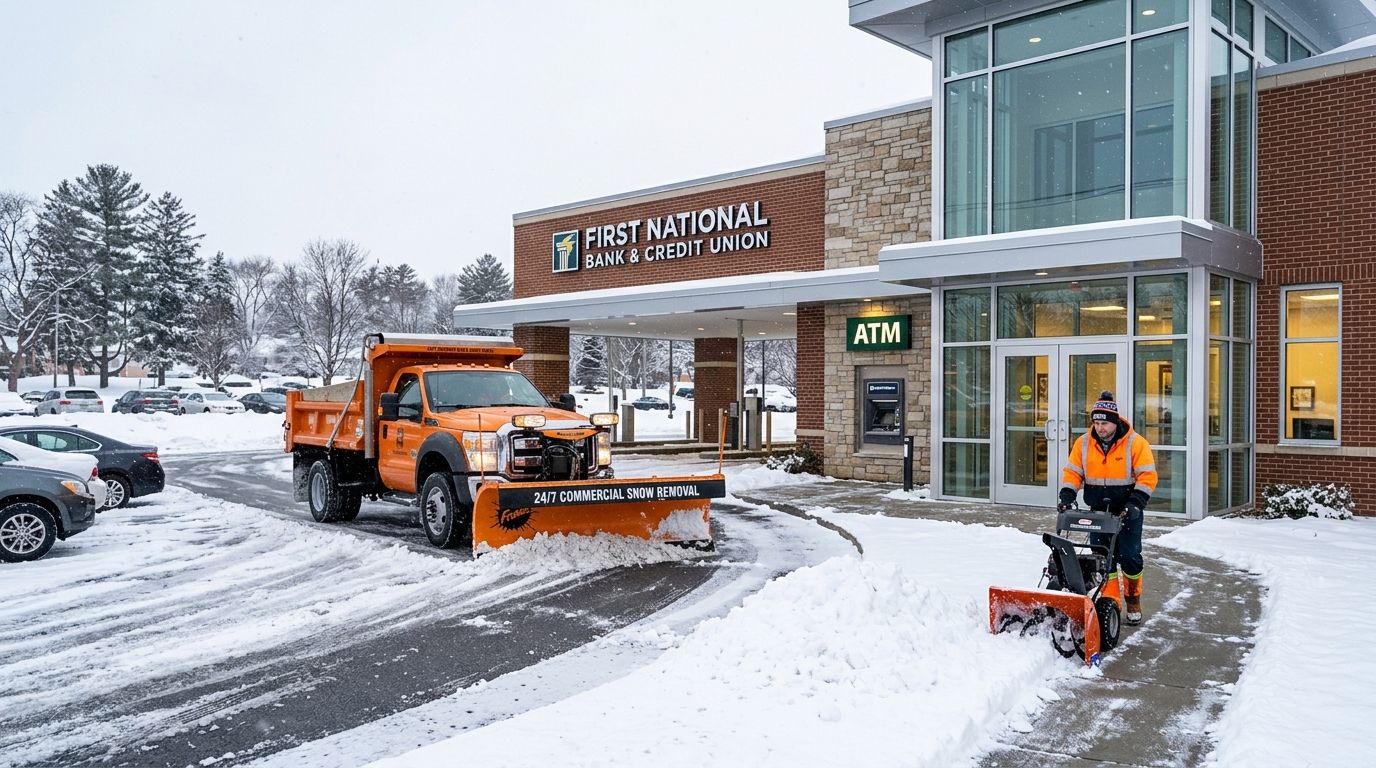
Snow removal for banks and credit unions is documented commercial plowing, de-icing, sidewalk clearing, and lot striping timed to fixed branch-opening hours, with the aim of keeping tellers, ATMs, and drive-thru lanes safe before the first customer pulls in. A bank branch doesn't operate like a retail strip mall: the ATM vestibule runs 24/7, the drive-thru opens before the lobby, and a slip-and-fall claim against a federally regulated institution draws sharper scrutiny than one against a corner shop.
- Snow removal for banks and credit unions means clearing teller lanes, ATM walkways, and drive-thru lanes before a fixed 7:30 or 8 a.m. open, not just plowing after the storm passes.
- Zero-Tolerance contracts triggered at 1/4 inch of accumulation fit branch risk profiles better than flat-rate seasonal deals sized for retail lots.
- Geo-stamped clock-in logs matter more for banks than most commercial tenants because liability review teams expect a documented paper trail.
- St. Louis Snow Removal logs every visit with time-stamped photos and GPS data, the same trail a bank's risk officer already asks vendors for.
Why snow removal matters for banks and credit unions
A branch opens on a schedule a retail tenant doesn't have to keep. Tellers are behind the counter at a set time, the drive-thru lane is live before the lobby doors unlock, and the ATM vestibule has been running unattended since the last transaction the night before. Ice that forms overnight on a night-deposit approach or an ATM walkway isn't a maintenance inconvenience — it's a liability exposure that sits there for hours before anyone notices.
Multiple-branch operators add a second layer: five branches under five separate snow vendors means five different trigger depths, five different response times, and five different documentation standards when a claim comes in. St. Louis Snow Removal treats each branch as a zone under one contract so the paper trail looks the same across every location a bank or credit union operates in the metro.
Set a zero-tolerance trigger depth for teller lanes and ATM walkways
A branch can't wait for two inches of accumulation before a crew shows up. The lobby door, the drive-thru lane, and the ATM approach need a lower bar than a warehouse parking lot.
- Measure accumulation every two hours during active snowfall, not once at the start of a shift
- Pretreat with liquid brine ahead of a forecasted ice event, before the first flake falls
- Walk ATM vestibules and night-deposit boxes as a separate zone from the main lot
- Log trigger-depth readings with a timestamp for every visit
- Treat drive-thru lanes on the same clock as the teller lane doors, not as an afterthought
Document every clock-in and clock-out with geo-stamped logs
A log that says "lot plowed" isn't documentation. A log with a GPS-stamped arrival time, a departure time, and a photo of the cleared surface is what holds up when a claim gets filed six weeks after the storm.
- Assign one crew per branch cluster so the same team knows the site's pinch points
- Require photo timestamps at both arrival and departure, not just one
- Store logs for the full season, not only the storm in question
- Share logs with the branch manager or risk officer on request, without a delay
- Flag any gap longer than the trigger window as an exception, not a silent miss
Clear ADA-compliant paths to entries and drive-thru lanes before open
A branch that opens with an icy curb cut isn't just risking a fall — it's risking an access complaint on top of it. ADA paths get cleared first, not last.
- Shovel and de-ice ramps and curb cuts before the main lot gets a second pass
- Keep a 36-inch clear path to every entry point, including secondary doors
- Treat handrails separately from pavement; ice on a rail is its own hazard
- Clear night-deposit box approaches even when the lobby stays locked
- Re-check paths after the morning rush, since foot traffic packs slush into refreeze
De-ice ATM vestibules and drive-up lanes on their own schedule
ATMs run all night. By the time a plow crew hits the main lot at 5 a.m., the vestibule approach has already had eight hours to ice over from foot traffic and meltwater refreeze.
- Apply calcium chloride or a magnesium blend below 15°F, where rock salt stops working
- Check vestibule mats and thresholds separately from the lot surface
- Keep drive-up lane islands clear of windrows pushed off the main lot
- Note any ice-melt product switch on the visit log when temperature triggers force a change
- Walk the ATM approach on its own inspection pass, not as part of the general lot sweep
Coordinate multi-branch service under one contract
A credit union with six branches across St. Louis County and Metro East doesn't need six vendors. It needs one route map and one standard.
- Request a single point of contact across every branch in the market
- Ask for a route map showing which crew covers which branch and in what sequence
- Require the same trigger depth and labor floor at every location, not a per-branch variation
- Consolidate invoicing so the finance team reconciles one bill instead of five
- Build in an after-hours escalation contact for a branch that gets missed
Cost is a real variable here, and it swings with lot size, trigger depth, and how many branches are bundled into one contract. The cost breakdown for commercial snow removal in St. Louis covers the drivers in detail, including how per-occurrence pricing compares to a seasonal flat rate.
Keep parking lot striping visible through a full salt season
Salt eats paint. A branch that repaints ADA stalls once every three years is running faded lines through two winters of plow blade contact and brine spray.
- Repaint high-traffic ADA stalls and van-accessible aisles before the season starts
- Use a striping product rated for salt exposure, not standard latex
- Check crosswalk and stop-bar paint at mid-season for wear
- Re-stripe drive-thru lane markings first; they fade fastest under repeated plow passes
- Schedule striping work in the shoulder months, when the lot is dry and traffic is lower
Contract models for banks and credit unions compared
| Option | Best for | Labor floor | Key limitation |
|---|---|---|---|
| Zero-Tolerance | Branches with 24/7 ATM or drive-thru exposure | $90/hr documented plow floor, $180/hr emergency de-icing floor | Costs more per storm than a flat seasonal rate |
| Seasonal flat-rate | Single-branch sites with predictable, low-traffic lots | Set at contract signing | Doesn't scale response for ATM vestibules that ice overnight |
| Per-Occurrence | Branches wanting storm-by-storm billing without a season commitment | Same labor floors as Zero-Tolerance | No guaranteed response window without an SLA add-on |
| In-house maintenance staff | A single small lot with no drive-thru or 24/7 exposure | No vendor labor floor applies | No geo-stamped documentation trail if a claim is filed |
Zero-Tolerance is the right call for any branch with a drive-thru or ATM vestibule running outside staffed hours. Seasonal flat-rate works only when the lot is small, low-traffic, and closes with the branch.
Common mistakes banks and credit unions make
- Treating a branch lot like a retail lot with one wide plow pass instead of zoning ATM, drive-thru, and teller approaches separately
- Signing a seasonal flat-rate contract sized for a strip mall when the branch runs a 24-hour ATM footprint
- Skipping documentation until after a slip-and-fall claim is already filed
- Letting parking lot striping fade through three winters of salt exposure until ADA stall lines are unreadable
- Running one vendor per branch across a multi-location market, which breaks consistency in trigger depth and response time
A branch that gets its de-icing right but ignores winter ice damage on curbs and pavement still ends up with a spring repair bill. The commercial ice management contractors in St. Louis guide breaks down how ice-specific service differs from general plowing.
Get a branch snow contract quote
Documented service across every branch, one contact, one standard.
FAQ
What's the best snow removal contract for a bank branch with a drive-thru?
A Zero-Tolerance contract with a 1/4-inch trigger depth is the best fit for a branch with a drive-thru or ATM vestibule, since those areas need clearing before a set opening time, not after a storm ends. Seasonal flat-rate contracts work only for single-branch sites with low, predictable traffic.
Is a Zero-Tolerance contract better than seasonal pricing for credit unions?
Yes, for any credit union branch running an ATM or drive-thru outside staffed hours. Seasonal pricing doesn't scale response time for overnight ice, which is where most branch liability exposure sits.
How much does commercial snow removal cost for a bank branch in St. Louis?
Cost depends on lot size, trigger depth, and how many branches get bundled into one contract. A full cost breakdown is available in the St. Louis commercial snow removal cost guide, which covers per-occurrence versus seasonal pricing.
Do ATMs need separate de-icing from the parking lot?
Yes. ATM vestibules and drive-up lanes run 24/7 and ice over from foot traffic and refreeze hours before the main lot gets its first plow pass of the day. Treating them as a separate zone with their own inspection catches ice the main lot sweep misses.
How fast should a bank branch parking lot be cleared before opening?
Teller lanes, ATM walkways, and drive-thru lanes should be clear before the branch's fixed opening time, typically 7:30 or 8 a.m., which means overnight and pre-dawn service, not a same-day plow after staff arrive.
What documentation should a bank require from its snow removal vendor?
Geo-stamped clock-in and clock-out logs with photo timestamps at arrival and departure, stored for the full season and shareable with a risk officer on request. A log without a timestamp doesn't hold up if a claim gets filed weeks later.
Can one vendor service multiple branch locations under one contract?
Yes, and it's the better setup for any operator with more than one branch in a market. One contract means one trigger depth, one labor floor, and one documentation standard across every location instead of five inconsistent vendor relationships.
Does parking lot striping need to be redone every year for ADA compliance?
Not every year, but ADA stalls and van-accessible aisles fade fastest under salt exposure and plow blade contact, so a branch lot typically needs repainting well before a standard retail lot does. Checking crosswalk and stop-bar paint at mid-season catches wear before it becomes a compliance issue.
One last thing
Most branch snow contracts get written around the main lot and forget the night-deposit box and ATM approach entirely. Those two spots ice over first, sit unattended longest, and carry the highest liability per square foot of any surface on the property — they belong on the contract as a named line item, not folded into "lot service" and hoped for.