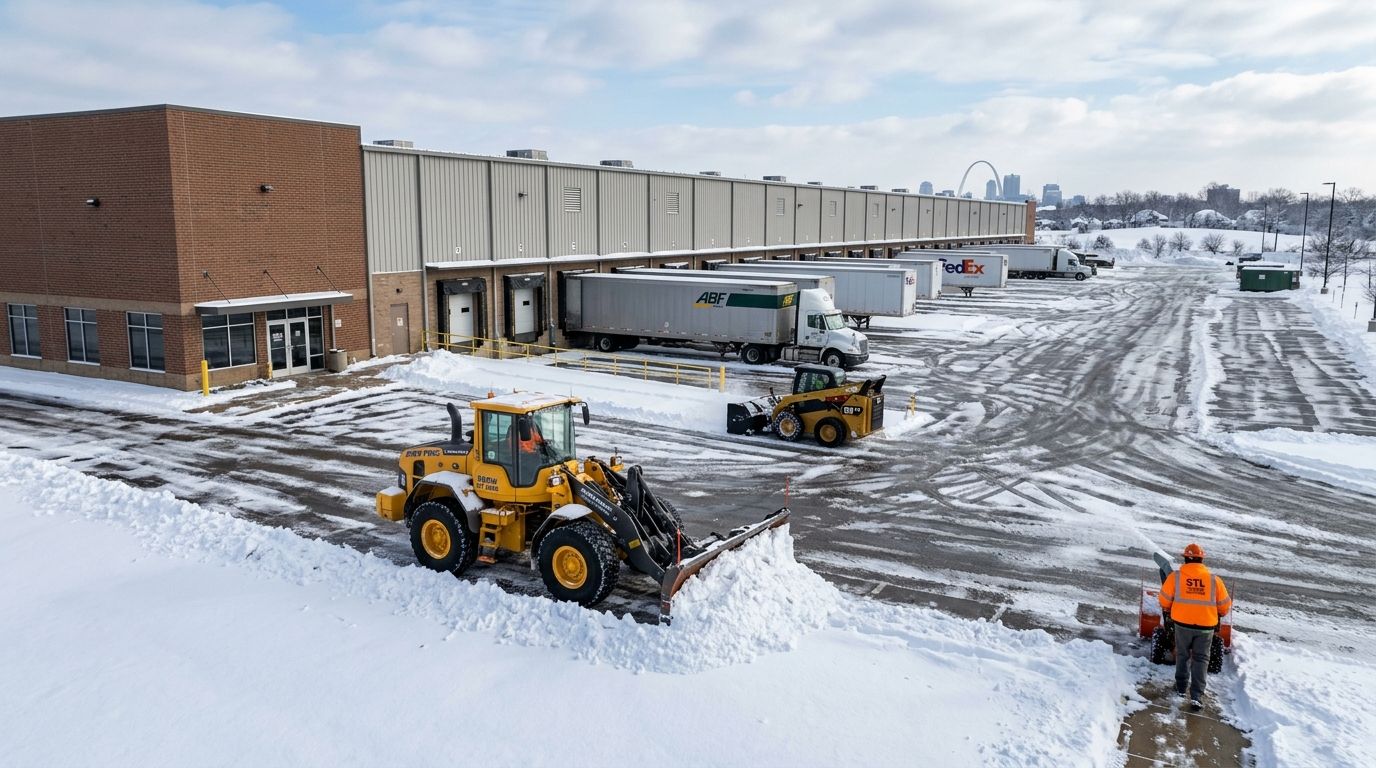
Warehouses lose more to a blocked dock door than to a slick sidewalk — a stalled trailer at 4 a.m. costs more than any invoice line for salt. Best overall for warehouse dock operations in 2026: St. Louis Snow Removal's Zero-Tolerance contract, which dispatches on trigger depth with no phone call required. Best for predictable annual budgeting: the Seasonal contract. Best for single-tenant, low-traffic warehouses: the Per-Occurrence contract. In-house crews and national broker networks round out the list, each with a narrow use case and real drawbacks.
- Zero-Tolerance dispatch wins for 24/7 distribution centers where a blocked dock costs more than the plow bill.
- Seasonal contracts fit warehouses that need one line item for budget season instead of storm-by-storm invoices.
- Per-Occurrence pricing works for single-tenant sites with light truck traffic, not multi-dock hubs.
- National broker networks standardize paperwork across states but subcontract the actual plow crew, which weakens on-site accountability.
- Documentation — geo-stamped clock-ins, trigger-depth logs — matters more for warehouses than for retail because slip-and-fall liability at a loading dock is a workers' comp claim, not a shopper claim.
Why this matters
A warehouse isn't a retail lot. Forklift traffic, trailer staging, and dock apron ice create liability exposure that a strip mall never sees, and OSHA's walking-working-surfaces rule puts documentation burden on the property, not the plow vendor. St. Louis Snow Removal treats every warehouse account as a liability file first and a plowing job second — trigger depths, clock-ins, and salt application rates get logged per site, per storm.
The choice isn't really "which company" in a market this size — it's which contract structure matches how your warehouse actually operates. A 24-hour cross-dock facility and a single-tenant cold-storage building need different dispatch logic even from the same vendor.
What makes the best snow removal for warehouses
- Trigger-depth dispatch — service starts automatically at a set snow depth (commonly 1-2 inches for high-liability sites), not on a phone call
- Dock apron and trailer lane clearance — separate from general lot plowing, since trailers can't maneuver on packed snow
- De-icing chemical program — salt or brine application matched to pavement temperature, not a flat spread rate
- Geo-stamped documentation — timestamped, location-tagged proof of every clock-in and application, not a verbal summary after the storm
- Response time commitment — a stated window from trigger to arrival, written into the contract
- Multi-site consistency — one point of contact if the warehouse portfolio spans more than one address
At a glance
| Option | Best for | Standout feature | Key limitation |
|---|---|---|---|
| Zero-Tolerance Contract | 24/7 distribution centers, cold-chain warehouses | Automatic dispatch on trigger depth | Costs more than storm-by-storm billing for low-traffic sites |
| Seasonal Contract | Fixed annual budgets across multiple lots | One predictable line item for the season | Overpays in a light-snow winter |
| Per-Occurrence Contract | Single-tenant, low-traffic warehouses | Pay only for storms that actually hit | No cost ceiling in a heavy-snow winter |
| In-house grounds crew | Sites with year-round maintenance staff already on payroll | Full control over timing | Equipment downtime and staff overtime during multi-day events |
| National broker/franchise network | Multi-state portfolios standardizing paperwork | One vendor contract across states | Subcontracted local crews, thinner on-site accountability |
1. St. Louis Snow Removal — Zero-Tolerance Contract: best for 24/7 distribution centers
This is dispatch on trigger depth, full stop — no on-demand ambiguity, no waiting for a manager to call it in. Crews move once the snow hits the contracted depth at the dock apron, trailer lanes, and drive aisles, and every clock-in is geo-stamped for the liability file.
Zero-Tolerance pros:
- Dock aprons and trailer lanes get cleared before the first shift truck arrives
- Geo-stamped logs give property managers a defensible paper trail if a slip-and-fall claim comes in
- No dependency on someone remembering to call for service at 3 a.m.
Zero-Tolerance cons:
- More active dispatches per season than a Per-Occurrence site would generate
- Requires the property to define trigger depth and priority zones up front, which takes a site walk
Zero-Tolerance contract terms: billed against the season's actual trigger events, not a flat seasonal fee.
Best for: warehouses running shifts around the clock or handling cold-chain freight where a blocked dock stalls a trailer that can't sit idle.
Verdict: Buy — if your warehouse runs multiple shifts or cold-chain freight, this is the contract that matches the liability exposure.
2. St. Louis Snow Removal — Seasonal Contract: best for fixed annual budgeting
One number, agreed before the season starts, covering plowing and de-icing across the contracted footprint regardless of how many storms hit St. Louis in 2026. Property managers who need to close out a budget line in October use this structure so finance doesn't get a surprise invoice in February.
Seasonal pros:
- Budget certainty for property managers reporting to ownership groups
- No storm-by-storm invoice review
- Works across a multi-site warehouse portfolio under one master agreement
Seasonal cons:
- A mild winter means the property pays for service it barely used
- Less flexible if a warehouse's footprint changes mid-season (new tenant, expanded yard)
Seasonal contract terms: locked in before the season, structured around the property's historical storm exposure.
Best for: property managers overseeing multiple warehouse or industrial sites who need one predictable line item.
Verdict: Buy — for portfolios where budget predictability outweighs paying only for what gets used.
3. St. Louis Snow Removal — Per-Occurrence Contract: best for single-tenant, low-traffic warehouses
This is pay-per-storm billing: the crew only invoices when a trigger event actually happens. It suits a single-tenant building with light forklift traffic and no dock-to-dock trailer choreography to coordinate.
Per-Occurrence pros:
- No payment in a light-snow winter
- Simple to reconcile against a small number of invoices
- Lower commitment for a warehouse without 24/7 operations
Per-Occurrence cons:
- No cost ceiling if St. Louis gets hit with a heavy-snow winter
- Weaker fit for high-traffic docks where every hour of delay compounds
Per-Occurrence contract terms: billed per triggered storm event against the documented cost breakdown for the site.
Best for: single-tenant warehouses with predictable, lower-volume truck traffic and no round-the-clock operation.
Verdict: Buy for light-traffic sites; Skip if your dock runs multiple shifts, where Zero-Tolerance is the safer structure.
4. In-house grounds crew: best for sites with existing year-round maintenance staff
Some warehouse operators already run a maintenance crew for landscaping, sweeping, and general upkeep, and try to fold snow into that team's job. It can work — if the equipment and headcount actually exist for it.
In-house crew pros:
- Full control over timing and priority zones
- No third-party contract to negotiate
In-house crew cons:
- Multi-day storm events push maintenance staff into overtime fast
- Owned plow equipment sits idle 10 months a year and still needs maintenance
- No independent documentation trail for a liability dispute
Best for: warehouses with maintenance staff and owned equipment already budgeted for outside of snow season.
Verdict: Hold — only makes sense if the equipment and labor already exist; buying both just for snow rarely pencils out against a contracted crew.
5. National broker/franchise network: best for multi-state portfolio standardization
Broker-model providers sell one master agreement across states, then subcontract the actual plow work to local operators. It solves a paperwork problem for portfolio managers juggling five states, but it adds a layer between the property and the crew on the ground.
Broker network pros:
- One contract, one invoice format, across multiple states
- Useful for corporate real estate teams standardizing vendor management
Broker network cons:
- The subcontracted crew, not the brand you signed with, actually shows up
- Documentation quality varies by which local sub gets assigned
- Slower escalation path when a single St. Louis site needs a fast answer
Best for: multi-state warehouse portfolios that need one paperwork format more than they need site-level accountability.
Verdict: Skip for a single St. Louis warehouse — the accountability gap isn't worth the paperwork convenience for one site.
How we ranked
Each option was weighed against the six criteria above: trigger-depth dispatch, dock/apron clearance, de-icing program, documentation, response time, and multi-site consistency. Zero-Tolerance and Seasonal contracts score highest on documentation and dispatch reliability; broker networks lose points on accountability; in-house crews lose points on multi-day storm capacity.
Get a warehouse snow contract reviewed
Trigger depths, dock apron coverage, and geo-stamped logs mapped to your site.
Which snow removal option should you choose for your warehouse?
If your warehouse runs shifts around the clock or handles cold-chain freight, the Zero-Tolerance contract is the default answer for 2026 — it removes the guesswork of who calls for service and puts a geo-stamped log behind every clock-in. If your priority is one predictable budget number across a multi-site portfolio, the Seasonal contract fits better. Single-tenant, lower-traffic buildings can run Per-Occurrence without overpaying for capacity they don't use. In-house crews and broker networks are the exceptions, not the defaults, and both come with real trade-offs spelled out above.
FAQ
What's the best snow removal contract for a warehouse in St. Louis?
A Zero-Tolerance contract is the best fit for warehouses running 24/7 or handling cold-chain freight in 2026, since it dispatches automatically on trigger depth instead of waiting for a phone call. Lower-traffic, single-tenant buildings often do better on a Per-Occurrence contract.
Is Zero-Tolerance better than Seasonal pricing for a warehouse?
Zero-Tolerance is better when dock uptime is the priority, since dispatch happens automatically at trigger depth. Seasonal pricing is better when budget predictability matters more than paying only for storms that occur.
How much does commercial snow removal cost for a warehouse?
Cost depends on lot size, dock configuration, and contract structure — the full breakdown of pricing models is covered on the St. Louis snow removal cost page rather than a single flat number.
Do warehouses need separate dock apron clearance from lot plowing?
Yes. Trailers can't maneuver on packed snow the way a passenger vehicle can, so dock aprons and trailer lanes typically get prioritized ahead of general lot plowing in a warehouse contract.
Are national broker networks a good fit for a single warehouse?
Not usually. Broker networks subcontract the actual plow crew to local operators, which adds a layer between the property and the crew on the ground. They fit multi-state portfolios standardizing paperwork better than a single St. Louis site.
What documentation should a warehouse snow contract include?
Geo-stamped clock-ins, trigger-depth logs, and salt or brine application records give a property manager a defensible file if a slip-and-fall or workers' comp claim comes in. Verbal summaries after a storm don't hold up the same way.
Can an in-house maintenance crew handle warehouse snow removal?
It works only if the crew already has plow equipment and enough headcount to cover multi-day storm events without pushing into heavy overtime. Buying equipment solely for snow season rarely pencils out against a contracted crew.
What trigger depth should a warehouse contract use?
High-liability sites like distribution centers commonly set the trigger between 1 and 2 inches so dispatch starts before snow compacts on dock aprons and trailer lanes.
One last thing
The detail most warehouse operators skip until after a claim: dock apron ice forms differently than lot ice because of trailer idling and diesel exhaust heat cycling the pavement temperature. A de-icing program that treats the apron the same as the general lot misses that variable, and it's the reason apron-specific chemical rates matter more at a warehouse than at almost any other commercial property type.