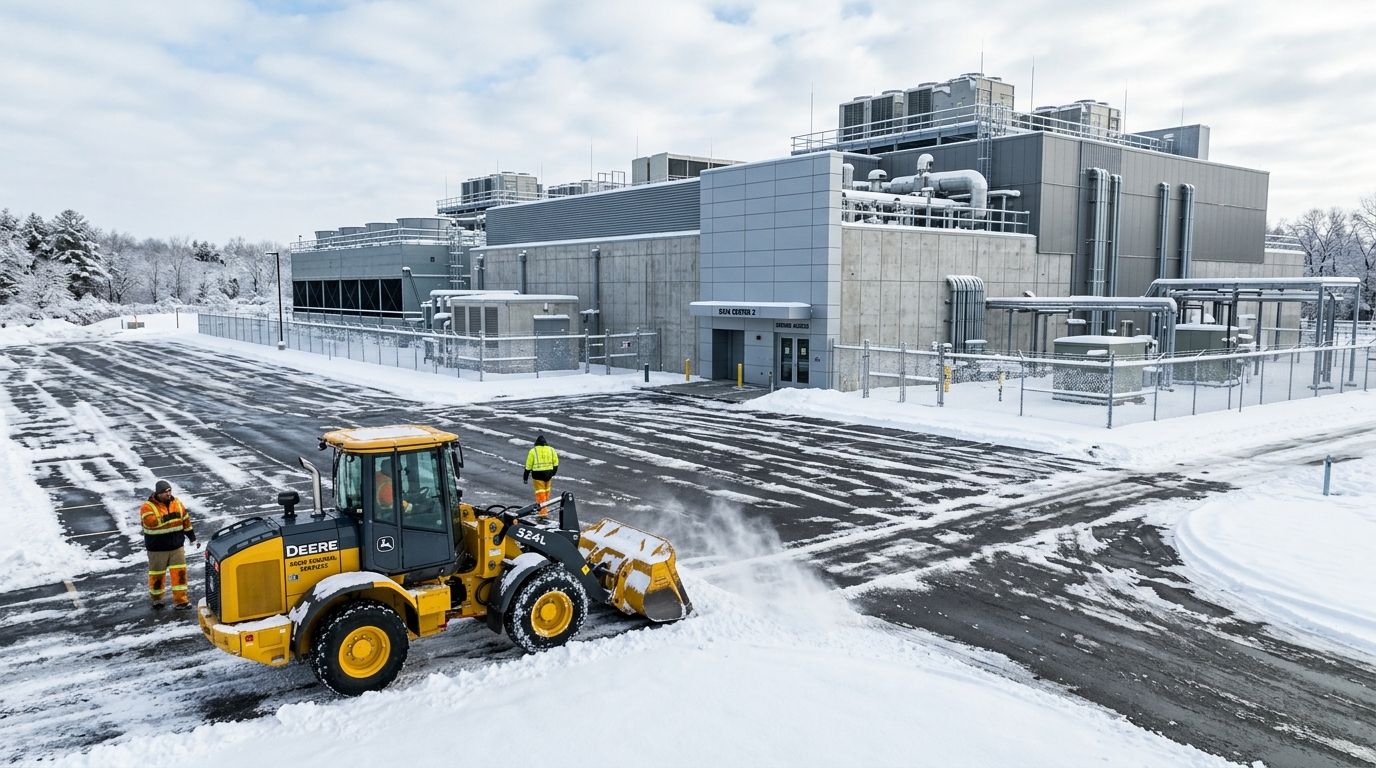
When snow starts falling on a St. Louis property, someone has to decide the exact moment a plow crew rolls out — and if that decision depends on a property manager eyeballing the lot or waiting for a phone call, the lot is already behind. A documented snow removal trigger dispatch workflow replaces that guesswork with a fixed depth threshold, a monitoring source, and a crew assignment sequence that fires automatically once the threshold is hit.
- A snow removal trigger dispatch workflow moves crews at a fixed depth, not a phone call or a foreman's guess.
- 1-inch trigger depths dominate Zero-Tolerance contracts in 2026; 2-3 inch triggers fit Seasonal and Per-Occurrence agreements.
- Geo-stamped clock-ins and timestamped depth readings replace verbal assurance with a record a property manager can audit.
- St. Louis Snow Removal dispatches from National Weather Service data plus on-site depth checks, not visual estimation.
- Mismatched trigger depth to contract type is the most common dispatch failure in the St. Louis metro.
Why this matters
Slip-and-fall liability at commercial properties usually turns on one question: when did the property know conditions were hazardous, and what did it do about it? A trigger dispatch workflow answers that question before a claim ever gets filed, because the depth reading and the dispatch timestamp already exist on paper.
Manual dispatch also wastes labor. A crew sent out at half an inch burns a $90/hr plow rate on a lot that didn't need clearing yet; a crew held back past the trigger depth on a Zero-Tolerance contract risks the penalty clause and the liability exposure both. The snow removal contractors in St. Louis ranked by response time comparison shows how much variance exists in dispatch speed across the metro — most of that variance traces back to whether a contractor runs a documented trigger or a judgment call.
Before you start
- Confirm your contract's trigger depth in writing. Zero-Tolerance contracts typically trigger at 1 inch; Seasonal and Per-Occurrence agreements often sit at 2 to 3 inches. If your contract doesn't state a number, the workflow has nothing to fire on.
- Pick a monitoring source and stick to it. National Weather Service forecasts, a third-party snow data feed, or an on-site depth stake — mixing sources mid-storm creates disputes about which reading governs.
- The gotcha: snow that falls, melts, and refreezes doesn't reset the trigger clock the way most property managers assume. A lot that hit its 1-inch trigger at 6 a.m., melted by noon, and refroze at 4 p.m. needs a second dispatch decision, not a continuation of the first one. Build that branch into the workflow now, or you'll be arguing about it during a storm.
Set your trigger depth and contract type
- Pull the trigger depth clause from the signed contract. Look for the word "trigger" or "threshold" — not "as needed," which is not a trigger.
- Match the depth to the contract model:
- Zero-Tolerance — trigger fires at 1 inch, crew dispatches regardless of time of day.
- Seasonal — trigger fires at 2 inches, service bundled into a flat-rate season.
- Per-Occurrence — trigger fires at 2-3 inches, billed per storm event.
- Record the trigger depth and contract model in the property's dispatch profile before the season starts, not during the first storm.
Expected result: every property on the route has a single, unambiguous depth number tied to it — no crew has to guess which contract governs which lot.
Configure the monitoring and alert layer
- Set the monitoring source to check conditions at a fixed interval — hourly during an active storm watch, every 15 minutes once snowfall starts.
- Log the reading with a timestamp every time the depth check runs, whether it's a forecast pull or a physical stake reading at the site.
- Flag the property the moment the logged depth reading equals or exceeds its contract trigger.
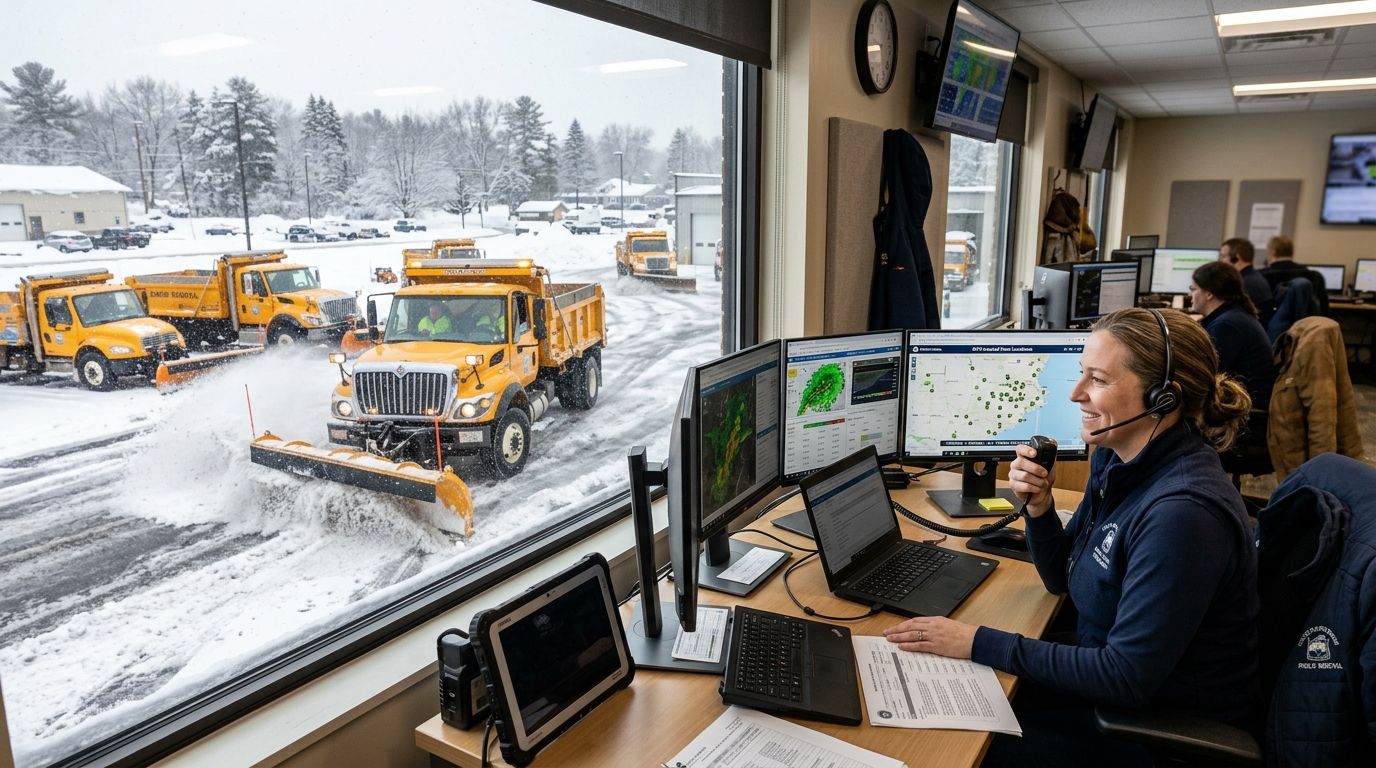
- Route that flag to the dispatcher, not directly to the crew — the dispatcher confirms the reading against current radar before mobilizing.
Expected result: a flagged property sits in a queue with a timestamp and a depth reading attached, ready for dispatch confirmation.
Build the dispatch and crew assignment step
- Confirm the flagged reading against a second data point (radar trend, adjacent property reading) before assigning a crew — a single stale reading shouldn't move a plow.
- Assign the nearest available crew based on route sequencing, not first-come order. Commercial lots with ADA-mandated accessible routes and healthcare or grocery accounts typically move to the front of the queue.
- Clock the crew in at the property with a geo-stamped check-in the moment they arrive — this is the record that proves the crew was physically on-site, not just dispatched.
- Clock out with a second geo-stamp and a post-service depth or condition note.
Expected result: a documented pair of geo-stamped timestamps bracketing the actual service window, tied to the original trigger reading.
De-icing triggers work on a different threshold
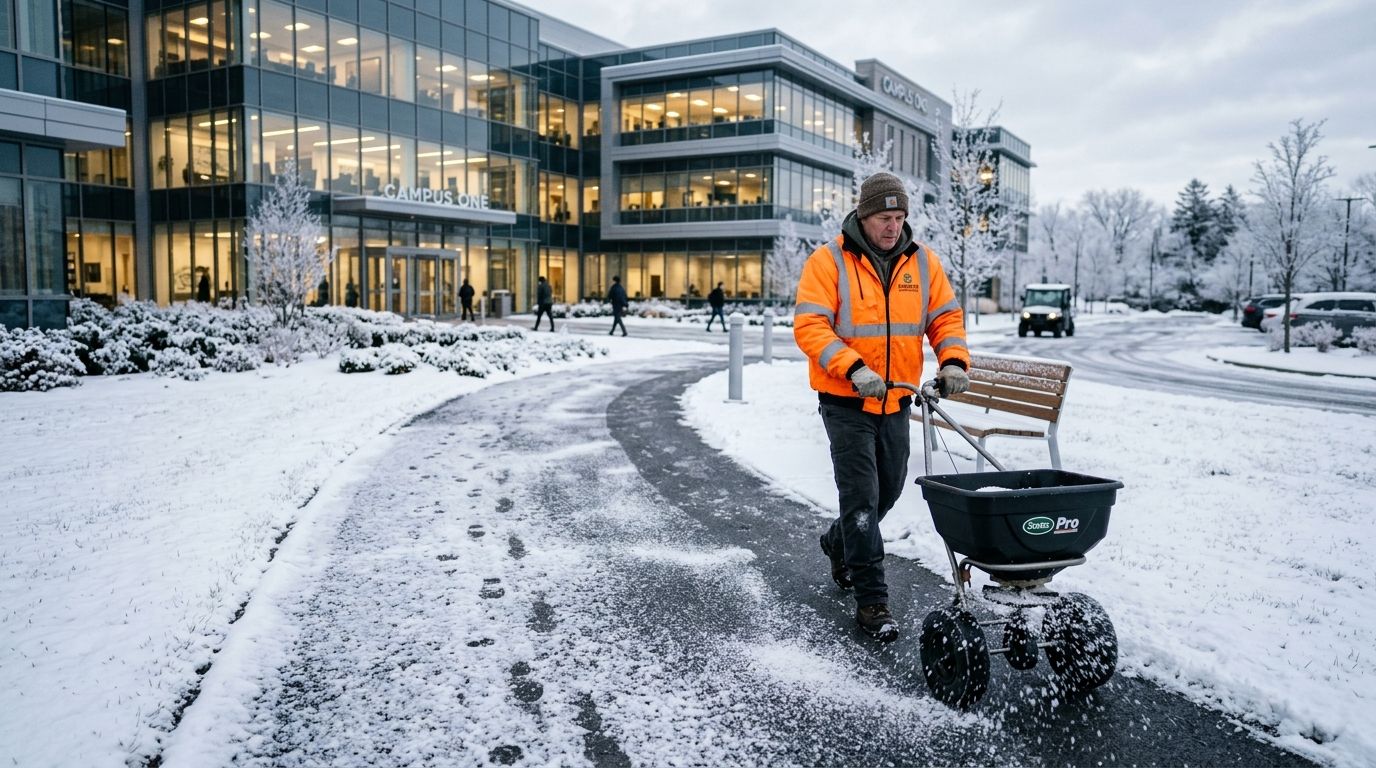
Plow dispatch runs on depth. De-icing dispatch runs on pavement temperature and precipitation type, and the two triggers don't fire together.
- Set the de-icing trigger to fire when pavement surface temperature drops toward freezing with precipitation forecast or falling — not on a depth reading, since black ice and light freezing drizzle carry zero measurable depth.
- Pre-treat ahead of the storm when the forecast confirms freezing precipitation within a defined window (commonly 12-24 hours out).
- Log the pre-treatment application the same way as a plow dispatch: timestamp, crew, material applied.
Properties like grocery stores and bank branches run both triggers simultaneously during mixed-precipitation events — the de-icing and salting for grocery stores guide breaks down why entrance zones need a separate trigger from the main lot.
Comparing the three trigger-to-contract models
| Contract model | Typical trigger depth | Best for | Trade-off |
|---|---|---|---|
| Zero-Tolerance | 1 inch | High-liability sites: hospitals, grocery, banks | Highest per-storm activation count, highest cost predictability |
| Seasonal | 2 inches | Office parks, HOAs, retail centers with steady foot traffic | Flat-rate budgeting, but fewer marginal-storm dispatches |
| Per-Occurrence | 2-3 inches | Warehouses, self-storage, low-traffic industrial | Lowest per-season cost, slower response on light events |
Zero-Tolerance wins for any site where a slip-and-fall claim carries real exposure — schools, medical offices, senior living. Per-Occurrence wins for sites where a half-inch of untouched snow overnight doesn't create a liability problem, like a fenced self-storage yard. Neither model is wrong; the mismatch happens when a high-traffic retail lot gets stuck on a Per-Occurrence trigger it never should have signed.
“If the dispatch record shows a timestamp but not a depth reading, it isn't documentation — it's an assertion.”
Troubleshooting
- Crew dispatched, but the storm stalled below trigger depth. Confirm the monitoring source logged an actual reading, not a forecast projection treated as a reading. Forecasts move dispatch planning; only a logged reading should fire the trigger.
- Property disputes the trigger was hit. Pull the geo-stamped clock-in and the depth log together — a dispatch record without both is not defensible in a dispute.
- Refreeze after a melt cycle isn't triggering a second dispatch. The workflow needs an explicit reset condition (temperature drop below 32°F after measurable melt) or it will treat the day as "already serviced."
- Multiple properties flag at the same time. Route sequencing should already rank properties by contract tier and ADA exposure before the storm — building that ranking mid-storm is how response times slip.
- Crew arrives but conditions have changed since dispatch. Require a post-arrival condition note before plowing begins, so the record reflects what the crew actually found, not just what triggered the call.
Customize the workflow for your property type
A single trigger depth doesn't fit every site on a portfolio. Multi-building campuses, parking garages, and construction sites each need a variant:
- Parking garages need a separate trigger for ramp surfaces, which ice before open lots do — see ice management for parking garages.
- Active construction sites need trigger logic tied to work-crew schedules, not just depth — see snow removal for construction sites.
- Portfolios spanning multiple contract types need one dispatch queue with per-property trigger profiles, not one blanket depth for every address — see best commercial snow removal companies for large property portfolios.
Get your trigger depth documented
Confirm your contract's trigger, dispatch, and proof layer before the next storm hits.
FAQ
What is a snow removal trigger dispatch workflow?
It's a documented process that dispatches a plow crew automatically once snow depth or pavement condition crosses a contract-defined threshold, replacing phone-call or judgment-based dispatch. In 2026, most St. Louis commercial contracts specify the trigger depth in writing.
What's the standard trigger depth for commercial snow removal in St. Louis?
Zero-Tolerance contracts trigger at 1 inch; Seasonal and Per-Occurrence contracts typically trigger at 2 to 3 inches. The right depth depends on the site's liability exposure and traffic volume.
How is snow depth measured for dispatch triggers?
Depth is confirmed through a combination of forecast data, radar trend, and physical on-site readings logged with a timestamp. A single forecast projection is not treated as a confirmed reading.
What's the difference between Zero-Tolerance and Per-Occurrence contracts?
Zero-Tolerance fires at a low trigger depth (commonly 1 inch) regardless of time of day, built for high-liability sites. Per-Occurrence fires at a higher depth (2-3 inches) and bills per storm event, built for lower-traffic properties.
How fast should a plow crew arrive after the trigger is hit?
Response time depends on route sequencing and contract tier, but the dispatch record should show a geo-stamped clock-in shortly after the trigger flag confirms. Slower response times usually trace back to unranked route queues.
Does de-icing use the same trigger as plowing?
No. De-icing dispatch fires on pavement temperature and precipitation forecast, not snow depth, because black ice and freezing drizzle carry no measurable depth.
What proof should a snow removal company provide after each dispatch?
A defensible record includes the logged depth reading, the dispatch timestamp, a geo-stamped crew clock-in and clock-out, and a post-service condition note.
How much does commercial snow removal cost in St. Louis in 2026?
Cost depends on contract model, trigger depth, and lot size — Zero-Tolerance contracts generally cost more per season than Per-Occurrence billing because of the lower trigger and higher dispatch frequency.
One last thing
The most expensive dispatch mistake in 2026 isn't a late plow — it's a trigger depth that was never matched to the right contract in the first place, because a Per-Occurrence lot with heavy foot traffic sits exposed for hours past the point a Zero-Tolerance neighbor would already be cleared.