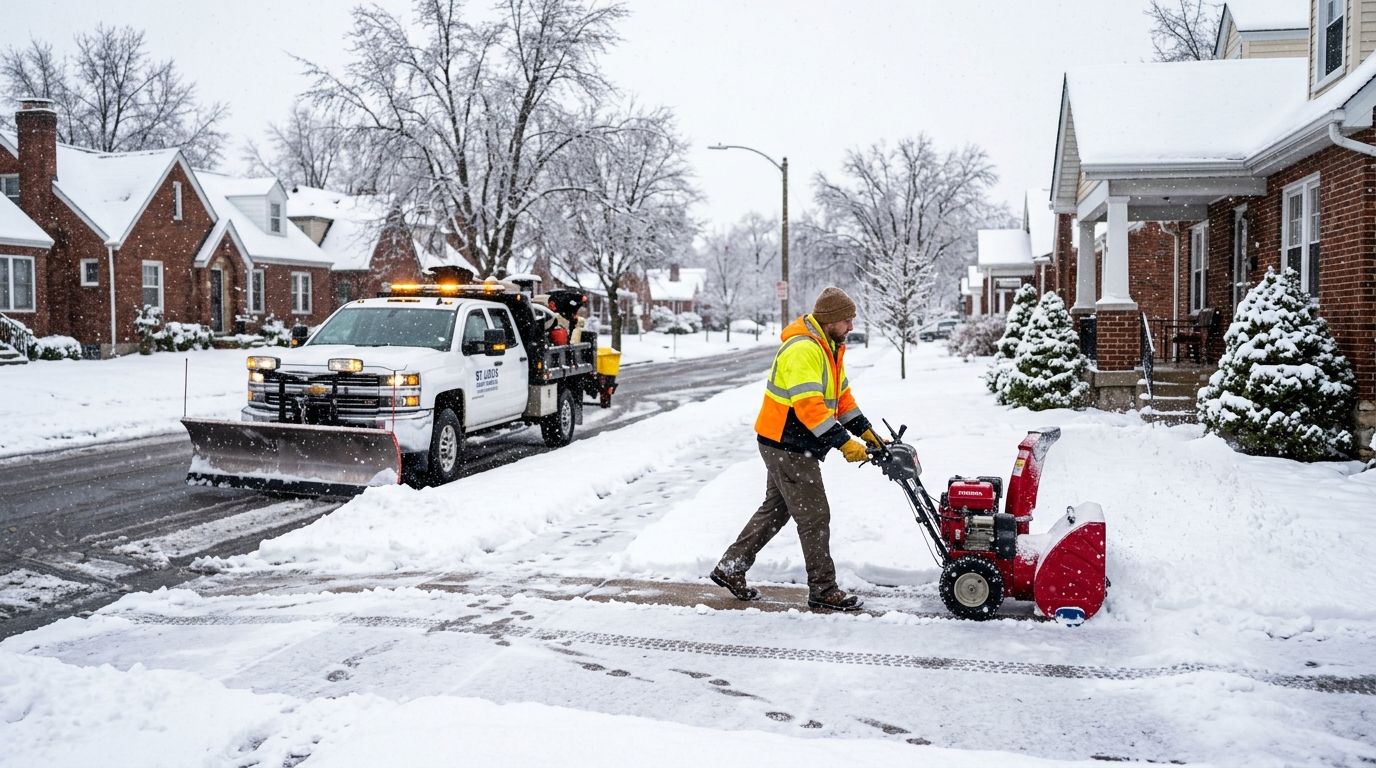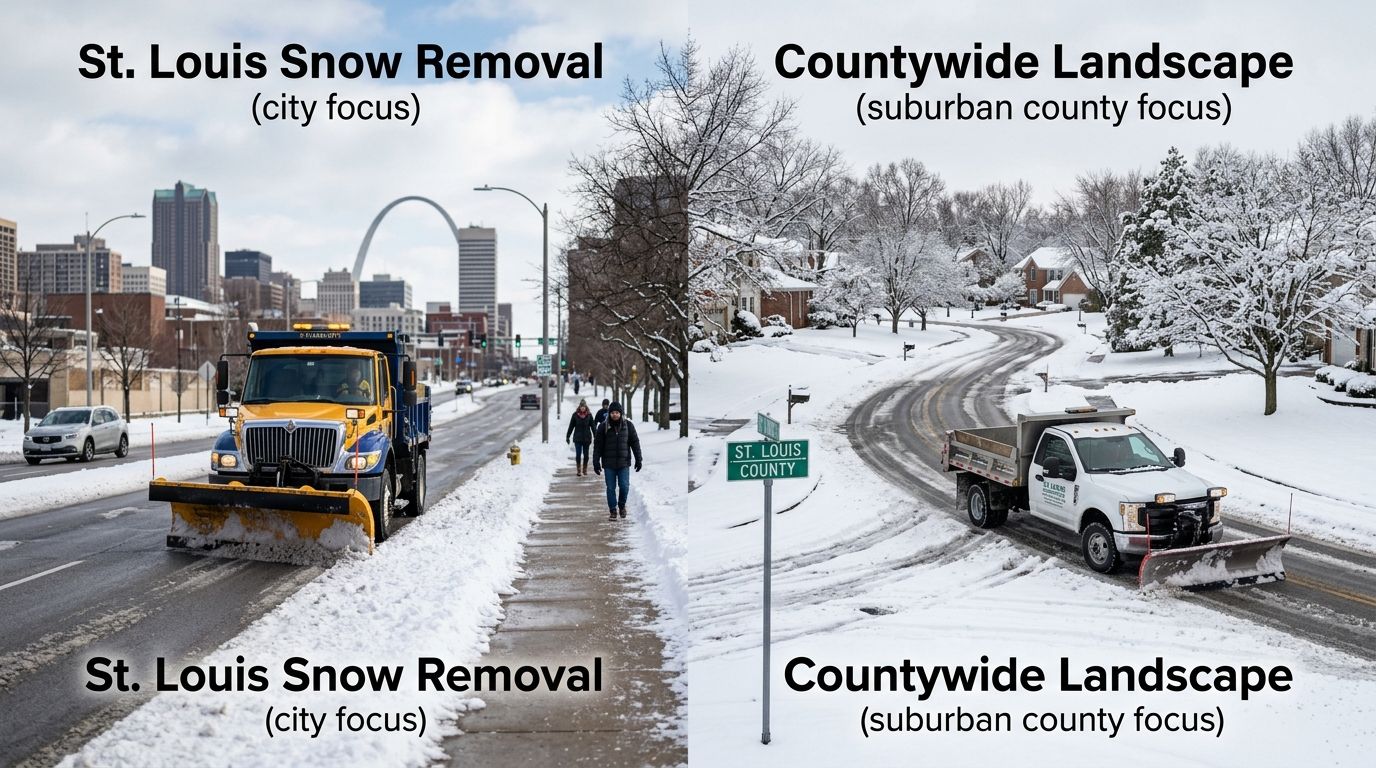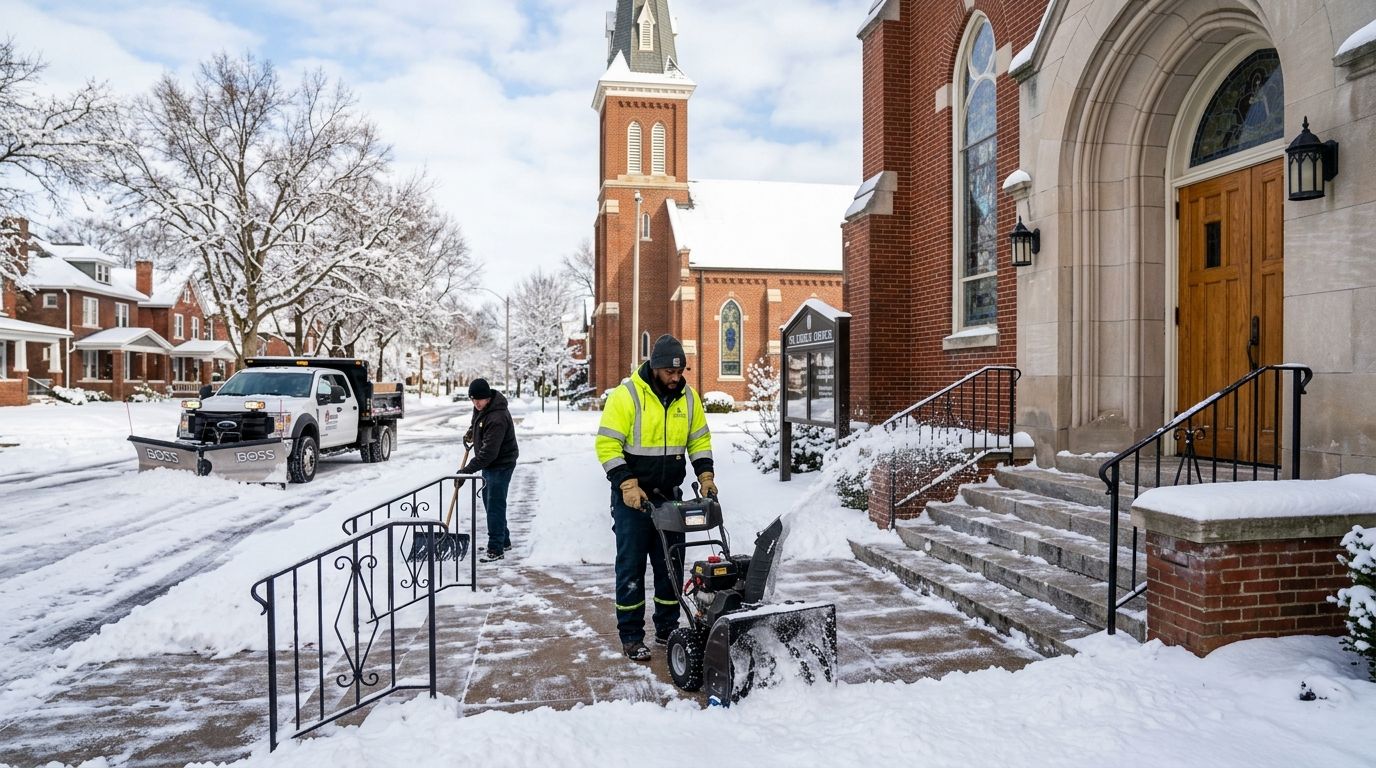
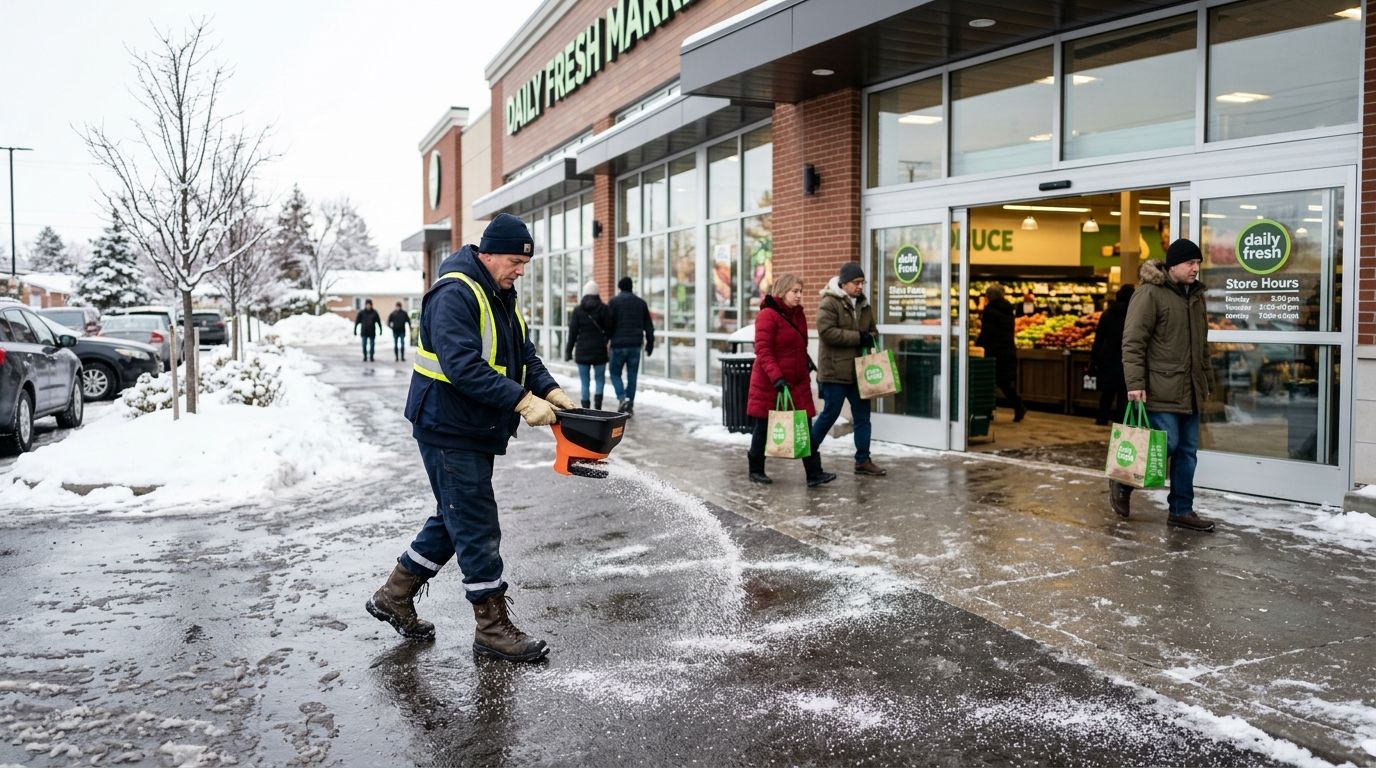
De-icing and salting for grocery stores means pre-treating parking lots, cart corrals, and entry doors before the first shopper arrives, then documenting every application well enough to survive a slip-and-fall claim filed months later. A grocery store runs different traffic patterns than a bank branch or a warehouse — doors cycle every 30 seconds, carts compact snow into ice on lanes a plow truck never touches, and liability exposure starts the second a customer steps out of a car in the lot.
That difference is why a generic snow contract built for a 9-to-5 office building fails a 24-hour or early-open grocery store. The trigger depths, the treatment order, and the documentation standard all need to match a retail floor plan, not an office parking garage. Commercial ice management contractors in St. Louis that specialize in retail know this before the first flake falls.
- Grocery store de-icing and salting requires pre-treatment before opening, not reactive plowing after a complaint call.
- St. Louis Snow Removal documents every application with geo-stamped clock-ins — no 'trust me, we were there' after the fact.
- Zero-Tolerance contracts fit 24-hour and early-open grocery stores; Per-Occurrence fits stores with fixed overnight closures.
- Labor floors in the St. Louis market run $90/hr for sidewalk crews and $180/hr for plow trucks in 2026.
- Cart corrals and ADA ramps need separate trigger depths from the main lot and should be treated before it, not after.
Why de-icing and salting matters for grocery stores
A grocery store parking lot generates more foot traffic per square foot than almost any other commercial property type, and every one of those trips crosses pavement a delivery truck, a shopping cart, and a customer with groceries all use within minutes of each other. A slip near the cart corral doesn't just risk a claim — it risks a claim with a documented pattern if the same spot ices over during every storm.
Property managers overseeing grocery accounts in 2026 are also fielding tighter insurance scrutiny than five years ago. Carriers increasingly ask for time-stamped service records, not a verbal assurance that "the lot got plowed." That shift is exactly why property manager snow removal contracts built around documentation, not just a truck showing up, matter more for grocery than for most property types.
Map your high-traffic zones and entry points
Start with a zone map, not a lot-wide treatment plan. A grocery store has at least four distinct surfaces that ice differently and get walked differently.
- Main entrance vestibules and automatic doors
- Cart corral lanes and the aisles between them
- ADA ramps and van-accessible parking rows
- Loading dock aprons and the truck court behind the store
- Fuel center islands, if the store has one
- Overflow parking rows used only during peak hours
Each of these needs its own trigger depth and its own place in the treatment sequence — treating them all the same way is how a lot passes a windshield inspection but still has a slick patch by the cart corral at 7 a.m.
Set trigger depths and treatment thresholds for retail flow
A grocery store's trigger depths should be tighter than a standard office lot because the store opens earlier and stays open later. Set thresholds before the season starts, not during the first storm.
- Pre-treat when the forecast shows precipitation and pavement temperatures near freezing, ahead of the first flake
- Set a 1-inch accumulation trigger for plowing on drive lanes and the main lot
- Set a tighter reapplication threshold — roughly a quarter inch of new accumulation — for cart corrals and entrance aprons
- Check for refreeze at dawn, before the first shift and the first customers arrive
- Adjust salt application rates when pavement temperature drops below 15°F, since standard rock salt loses effectiveness at that range
Treat cart corrals and ADA ramps before the main lot
The main lot gets the visual attention because it's the biggest surface. The highest liability risk sits somewhere else.
- Salt cart corral lanes first — compacted snow under cart wheels turns to ice faster than open pavement
- Clear ADA ramps and van-accessible spaces before general parking rows, since accessibility complaints carry separate compliance exposure
- Treat the walkway between the corral and the first set of doors as its own zone, not an extension of the lot
- Re-check entrance mats and vestibule flooring, which track in more moisture than any other single spot in the store
Document every application with geo-stamped clock-ins
This is where a documented service model earns its cost over a handshake plow contract. St. Louis Snow Removal logs every crew clock-in with a geo-stamp and timestamps every salt application, so a property manager pulling records after an incident sees exactly when a zone was treated — not a vague assurance.
- Time-stamp every plow pass and every salt application by zone, not by the whole property
- Photograph high-risk areas — cart corrals, ADA ramps, entrance aprons — at the start and end of each visit
- Log salt tonnage or material used per visit, not just "salted"
- Keep a weather log tied to each service record, showing the trigger condition that prompted the visit
Coordinate salting with plow timing so it doesn't wash away
Salting before a plow pass wastes material; salting too long after one lets ice re-form before the salt takes effect.
- Plow first to clear bulk snow, then apply salt to the residual layer rather than salting on top of several inches
- Reapply salt after each plow pass during multi-hour storms, not just once at the start
- Avoid salting immediately before a forecasted temperature drop below the salt's effective range
- Track brine pre-treatment separately from post-storm salting in the service log
Separate loading docks and vestibules from customer-facing zones
A loading dock apron takes different traffic than a customer entrance — heavier trucks, tighter turning radii, and different liability if a delivery driver goes down instead of a shopper.
- Apply a heavier salt concentration on dock aprons where truck weight compacts ice faster
- Clear dock ramps before the first delivery window of the day, not after
- Keep vestibule flooring and dock flooring on separate treatment logs since insurers may ask about each independently
Match the contract model to your store's operating hours
A 24-hour grocery store and a store that closes at 11 p.m. need different contract structures. St. Louis Snow Removal runs three models built around this: Zero-Tolerance, Seasonal, and Per-Occurrence.
- Zero-Tolerance fits stores that never fully close — trigger depths stay tight and treatment happens continuously through a storm
- Seasonal (flat-rate) fits budget-driven property managers who want one number regardless of how many storms hit
- Per-Occurrence fits stores with a fixed overnight closure window, where treatment can happen in a defined gap between last customer and first delivery
Comparison: which contract model fits your store
| Option | Best for | Key limitation |
|---|---|---|
| Zero-Tolerance contract | 24-hour or early-open grocery stores | More line items per storm since triggers fire more often |
| Seasonal flat-rate contract | Predictable year-over-year budgeting | Doesn't adjust for an unusually light or heavy snow year |
| Per-Occurrence contract | Stores with a fixed overnight closure window | Needs precise trigger-depth language to avoid disputes over what counts as a qualifying event |
Check current commercial snow removal cost in St. Louis before locking in a model — labor floors of $90/hr for sidewalk crews and $180/hr for plow trucks in 2026 shift the math depending on how many zones your store needs treated separately.
Get a grocery lot assessed
Walk your zones with a crew that documents every clock-in and application.
Common mistakes grocery stores make
- Salting only the fire lane and ignoring cart corral lanes, where wheel compaction turns snow to ice faster than open pavement.
- Waiting for the snowfall to finish before the first treatment, missing the pre-treat window that would have kept the lot passable before opening.
- Not logging application times by zone, leaving no record to point to if a claim surfaces months after the storm.
- Using the same salt blend on dock aprons and sales-floor entrances, when truck traffic on a dock apron needs a heavier concentration than foot traffic at the front door.
- Applying an office-building per-occurrence contract to a 24-hour store, where the trigger language doesn't account for continuous operating hours.
FAQ
What's the best way to de-ice a grocery store parking lot in 2026?
Pre-treat before the store opens and before accumulation starts, then salt cart corrals and ADA ramps ahead of the main lot. Log every application by zone so there's a record if a slip-and-fall claim comes in later.
How much does commercial snow removal cost for a grocery store in St. Louis?
Costs depend on lot size, contract model, and how many zones need separate treatment. Labor floors in the St. Louis market run $90/hr for sidewalk crews and $180/hr for plow trucks in 2026 — check a full cost breakdown before signing a contract.
Is rock salt or calcium chloride better for a grocery store lot?
Rock salt works down to roughly 15°F for most standard applications, while calcium chloride stays effective at lower temperatures. Grocery stores in exposed lots with early morning refreeze often need the calcium chloride option on the coldest nights.
How often should cart corrals be salted during a storm?
Cart corrals need reapplication at a tighter threshold than the main lot, roughly every quarter inch of new accumulation, since wheel traffic compacts snow into ice faster than open pavement.
What contract type fits a 24-hour grocery store?
A Zero-Tolerance contract fits stores that never close, since it keeps trigger depths tight and treatment continuous through a storm rather than waiting for a scheduled visit.
Do grocery stores need documented proof of snow removal?
Yes — insurers increasingly ask for time-stamped service records rather than a verbal confirmation. Geo-stamped clock-ins and zone-by-zone application logs are what hold up if a claim is filed months after a storm.
How fast should a grocery store lot be treated after snow starts?
Pre-treatment should happen before the first flake when the forecast shows freezing pavement temperatures and precipitation, with plowing triggered at roughly 1 inch of accumulation on drive lanes.
Can grocery stores get emergency snow removal outside business hours?
24-hour emergency crews exist specifically for stores that can't wait for a scheduled morning visit, covering overnight and early-morning treatment ahead of the first shift.
One last thing
The highest-risk stretch of pavement at most grocery stores isn't the open lot — it's the 15 feet between the last cart corral row and the first set of doors, where compacted snow under cart wheels turns slicker than the asphalt around it. Crews that treat that strip as its own zone, separate from the general lot pass, catch the spot that actually generates claims in 2026.