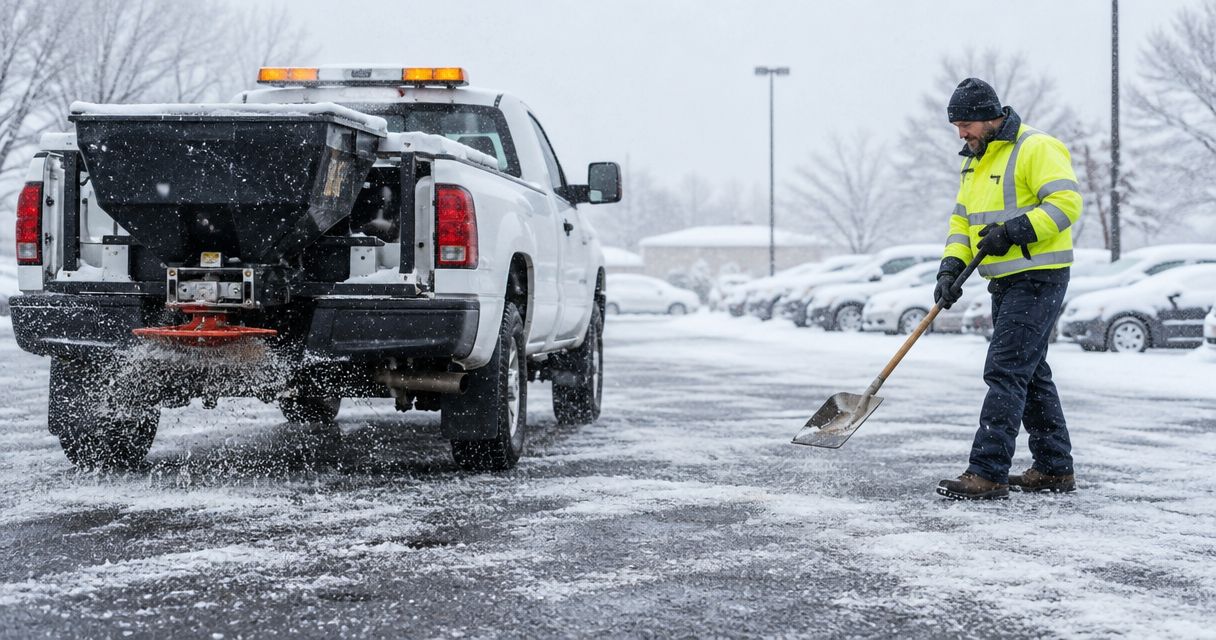
Salt a parking lot during a snowstorm when inspections show renewed ice, deteriorating traction, or conditions that require another treatment—not on a universal hourly schedule. Reassess after plowing and changes in precipitation or pavement temperature; an earlier salt application does not establish that the lot remains safe.
- How often to salt a parking lot during a snowstorm depends on pavement conditions, precipitation, and treatment performance.
- St. Louis Snow Removal provides documented commercial snow plowing, de-icing, and sidewalk clearing.
- Separate inspection frequency from salt application frequency: checking the lot does not automatically require another treatment.
- Remove accumulated snow mechanically, evaluate remaining ice, and record the reason for each treatment.
How often should a lot be salted during a snowstorm?
Reapply salt when conditions justify treatment, not simply because time has passed. A parking lot needs a monitoring and response plan that connects observed conditions to an action. An inspection can lead to plowing, targeted treatment, broader treatment, or continued monitoring.
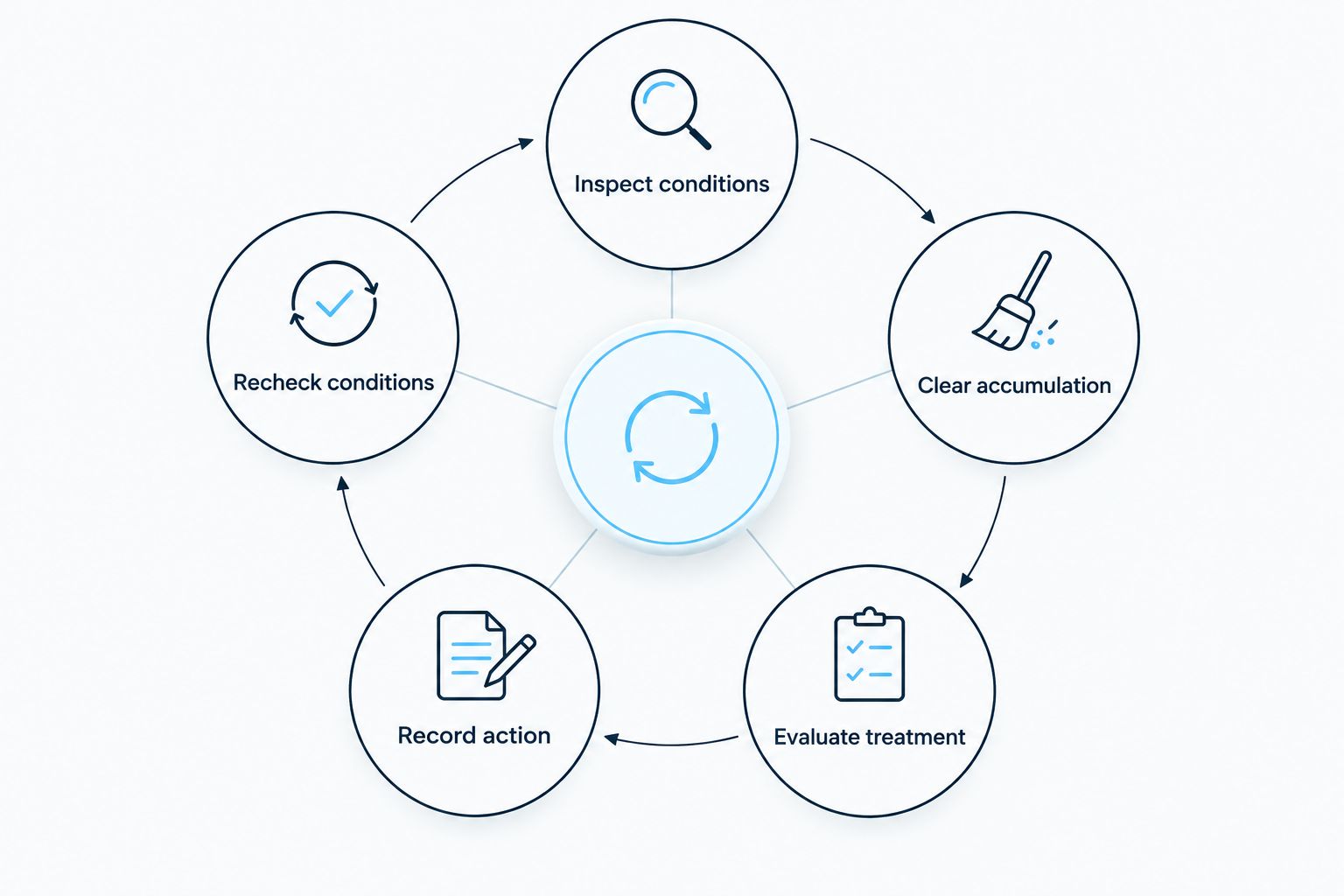
Use this sequence for your 2026 snow-response plan:
- Inspect conditions. Check pavement temperature, precipitation, existing ice, and the routes people actually use.
- Clear accumulation. Plow or shovel accumulated snow rather than relying on salt to remove the snow load.
- Evaluate treatment. Check whether remaining ice requires treatment and whether the selected material suits the conditions.
- Record action. Document the location, observed condition, work performed, and reason for treating or withholding treatment.
- Recheck conditions. Reassess as the storm changes, after clearing, and before important occupancy periods.
Application rate is a separate decision from application frequency. Use the salt application rate benchmarks guide alongside the selected material's instructions; a rate alone does not establish a return interval.
Why this matters
A schedule tells you when someone plans to arrive. It does not tell you what the pavement needs when that person arrives. Repeated treatment without inspection misses that distinction.
During an active storm, new precipitation, plowing, traffic, and drainage change the surface. Your operating plan must address those changes rather than treat the initial visit as the end of the job.
For 2026 service specifications, separate these commitments: who inspects, what triggers treatment, who authorizes additional work, and how completed work gets documented. A promise to salt regularly leaves all of those questions unanswered.
Which response fits the condition you find?
Inspection and salting are not interchangeable. Use the observed condition to select the response, then verify its result. The following table compares operational options, not guaranteed outcomes.
| Response | Best for | Main advantage | Limitation |
|---|---|---|---|
| Continue monitoring | Pavement without a current treatment need | Avoids unnecessary application | Requires a defined next check and responsibility |
| Plow or shovel | Accumulated snow | Removes snow mechanically | Does not by itself resolve remaining ice |
| Targeted de-icing | Localized ice or refreeze | Directs material to the affected area | Does not address untreated hazards elsewhere |
| Broader de-icing | Ice affecting multiple operating areas | Addresses a widespread treatment need | Requires suitable material, application control, and follow-up |
| Pre-treatment | Suitable conditions before snow or ice bonds to pavement | Helps limit bonding | Does not replace clearing or later assessment |
Best for an operating commercial lot: condition-based inspections with a documented response. The inspection establishes which action fits; the clock establishes when the next inspection is due.
Do not interpret a completed treatment as permission to stop checking. De-icing is a response to conditions, not a permanent surface condition or a guarantee against slips.
Why parking lot salting frequency varies
These factors explain why a fixed interval cannot answer every storm. Put them in the inspection checklist so the decision has a recorded basis.
- Precipitation: Continuing snow adds material to clear. Freezing rain and mixed precipitation require reassessment of existing treatment and surface conditions.
- Pavement temperature: The surface temperature affects melting and refreezing. Air temperature alone does not describe the pavement.
- Plowing and shoveling: Mechanical clearing changes what remains on the surface. Reassess exposed pavement rather than automatically repeating the previous application.
- Traffic and occupancy: Vehicle movement and pedestrian activity affect where inspections matter most. Check entrances, turning areas, and walking routes rather than only the main drive aisle.
- Drainage and meltwater: Water flowing from snow piles or across low areas creates a separate refreeze concern. Inspect the water's path, not just its source.
- Material and existing treatment: De-icers have different operating guidance. Check the product instructions and current surface condition before deciding that another application is appropriate.
A storm does not affect every part of a property identically. Treat a shaded walkway, a loading approach, and an open parking aisle as inspection locations with their own conditions—not proof that the entire property needs the same response.
What should happen after each plow pass?
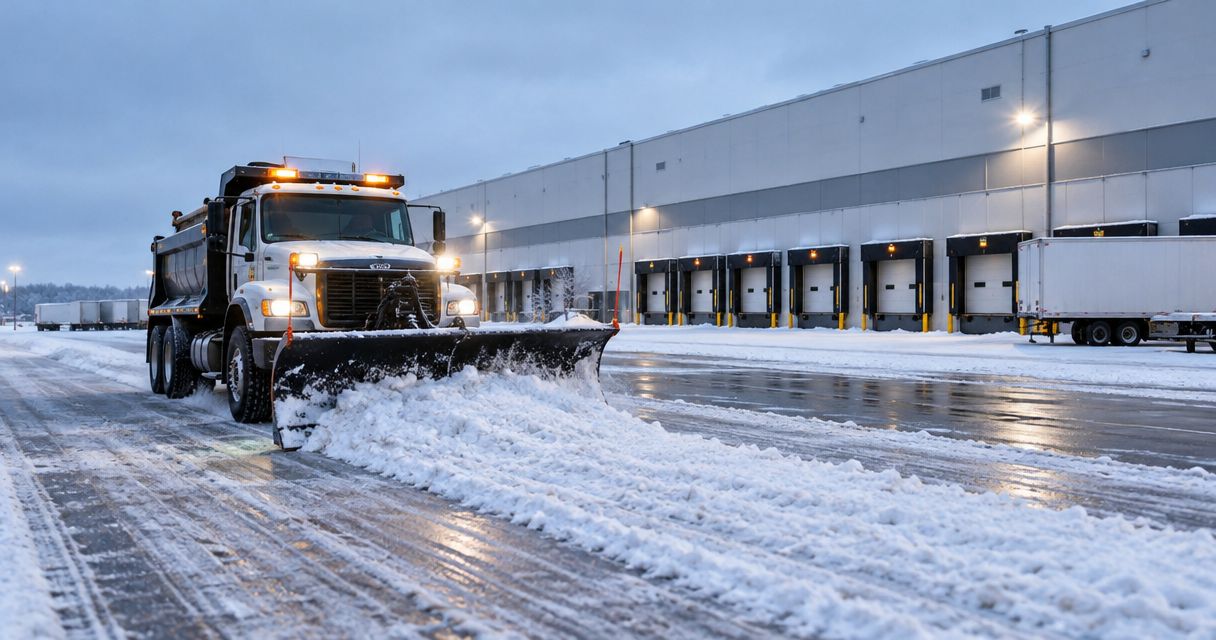
Inspect after plowing; do not automatically salt after every pass. Clearing removes accumulated snow and exposes the surface that needs evaluation. The next action depends on what remains.
Check for bonded snow, ice, slush, and water movement. Look beyond the route the truck just cleared: parked vehicles, curb returns, pedestrian crossings, and entrance transitions need attention too.
If the surface needs treatment, select the material and application approach for that condition. If it does not, record the finding and identify the next inspection trigger. A documented decision not to apply material is more useful than an unexplained gap in the service record.
Keep the response loop intact
Use the same sequence throughout the event: Inspect conditions, Clear accumulation, Evaluate treatment, Record action, Recheck conditions. Skipping the final check leaves the application unverified; skipping the record leaves the reason for the application unclear.
Does colder weather mean you should salt more often?
Colder weather means you must reassess material suitability and surface conditions—not automatically increase application frequency. Water's freezing point is 32°F, or 0°C, under standard conditions; a salt solution behaves differently depending on its concentration and temperature.
That freezing point is not a universal de-icing performance threshold. Do not use it to infer that every product works equally well on every cold surface. Follow the selected material's operating guidance.
Measure pavement temperature where decisions matter. A weather app's air-temperature reading does not establish the temperature of a shaded entrance or a sun-exposed drive aisle.
If treatment is not producing the intended result, investigate before adding more. Check the material, pavement temperature, remaining accumulation, water, and application method. Repetition is not a substitute for diagnosing the problem.
Should you salt before snow starts or wait until after plowing?
Pre-treatment and post-clearing de-icing serve different purposes. Pre-treatment aims to limit bonding before accumulation; de-icing addresses ice already present. Neither removes the need for mechanical clearing when snow accumulates.
Best for limiting bonding: a suitable pre-treatment plan. Best for accumulated snow: mechanical clearing followed by inspection. These are complementary actions, not competing promises that one visit will handle an entire storm.
Before pre-treatment, consider the forecast, pavement conditions, product guidance, and the possibility of rain washing material away. After clearing, inspect the remaining surface before selecting the next action.
Write these responsibilities into the 2026 scope separately. “Salting included” does not establish whether the agreement covers pre-treatment, follow-up inspection, post-plow treatment, or localized refreeze response.
What should your contractor document at every visit?
A visit record should explain what happened on the pavement, not merely confirm that a vehicle reached the property. Arrival establishes presence. It does not establish the condition of every area or the effectiveness of treatment.
Require the following fields in your 2026 service log:
- Arrival and departure: Record when the crew was on site.
- Inspection locations: Identify the areas checked, including pedestrian routes.
- Observed conditions: Describe precipitation, accumulation, ice, and water movement.
- Temperature observations: Record pavement measurements when taken and distinguish them from air readings.
- Work performed: Identify cleared areas, treated areas, material, and recorded application quantity.
- Remaining concerns: Note blocked access, untreated areas, drainage issues, or conditions needing another check.
- Follow-up responsibility: State who receives the record and who owns the next action.
Photographs support this record, but framing matters. An image of a clear entrance does not establish the condition of the loading area. Match each image to a location and the condition it documents.
For a disputed visit, a useful record connects the observation, decision, and completed action. A timestamp alone cannot make that connection.
How should a property manager specify repeat service?
Specify the decision process before asking for a return interval. Identify your operating hours, pedestrian entrances, accessible routes, loading areas, drainage concerns, and authorization contacts. Then require the proposal to explain how those conditions affect inspection and response.
St. Louis Snow Removal is best for property managers seeking documented commercial snow and ice service in the St. Louis metro and Metro East Illinois. Its stated services include commercial plowing, de-icing/salting, and sidewalk clearing. Those services fit the combined clearing-and-treatment workflow described here.
The boundary is equally important: a service description does not establish a guaranteed salting interval or a condition-free lot. Confirm the property-specific scope, follow-up responsibilities, and treatment authorization in the written agreement.
St. Louis Snow Removal provides documented commercial snow and ice services; use your site assessment to define what documentation and coverage your property requires.
Request a site-specific snow scope
Identify plowing, de-icing, sidewalk clearing, and documentation needs for your property.
What should you do if ice returns between visits?
Report the location and observed condition immediately through the agreed contact process. Say whether the issue affects an entrance, pedestrian crossing, loading approach, or broader area. A specific report supports a specific response.
Follow your property's procedure for restricting access to an affected area while the responsible party arranges assessment. Do not describe an area as safe solely because it was salted earlier.
After follow-up work, retain the observation, dispatch communication, and completion record together. This closes the operational loop and gives the next shift useful information rather than an isolated message saying the contractor visited.
FAQ
Should I have my parking lot salted every hour during a storm?
Do not use hourly salting as a universal rule. Set inspection responsibilities and reapply when observed conditions and material guidance justify treatment.
Does my parking lot need salt after every plow pass?
Your parking lot needs inspection after a plow pass, not automatic salting. Evaluate remaining ice, pavement conditions, and the selected material before deciding on treatment.
Can one salt application last through the whole snowstorm?
Do not assume one application will remain effective throughout a snowstorm. Continuing precipitation, clearing, and changing surface conditions require follow-up assessment.
Should I use air temperature or pavement temperature for salting decisions?
Use pavement temperature to assess the surface being treated, alongside precipitation and material guidance. Air temperature alone does not establish pavement temperature.
Is adding more salt the right response when ice is not melting?
Adding more salt is not automatically the right response when ice remains. Check pavement temperature, product guidance, accumulation, and water movement before repeating treatment.
Does St. Louis Snow Removal provide both plowing and salting?
St. Louis Snow Removal provides commercial snow plowing, de-icing/salting, and sidewalk clearing across the St. Louis metro and Metro East Illinois. Confirm your property's included services and follow-up responsibilities in the written scope.
What should my 2026 snow contract say about repeat salting?
Your 2026 snow contract should define inspection responsibility, treatment triggers, authorization, and documentation. Keep the inspection schedule separate from the decision to apply salt.
One last thing
The most useful repeat-service instruction is not “come back and salt.” It is “reinspect this location and document the response.” That wording leaves room for the correct action: clearing accumulation, treating ice, addressing a localized concern, or continuing to monitor.
Add a separate inspection location for meltwater leaving snow piles. The main lot can look clear while water reaches another walking or driving surface. Follow the water before closing the storm record.