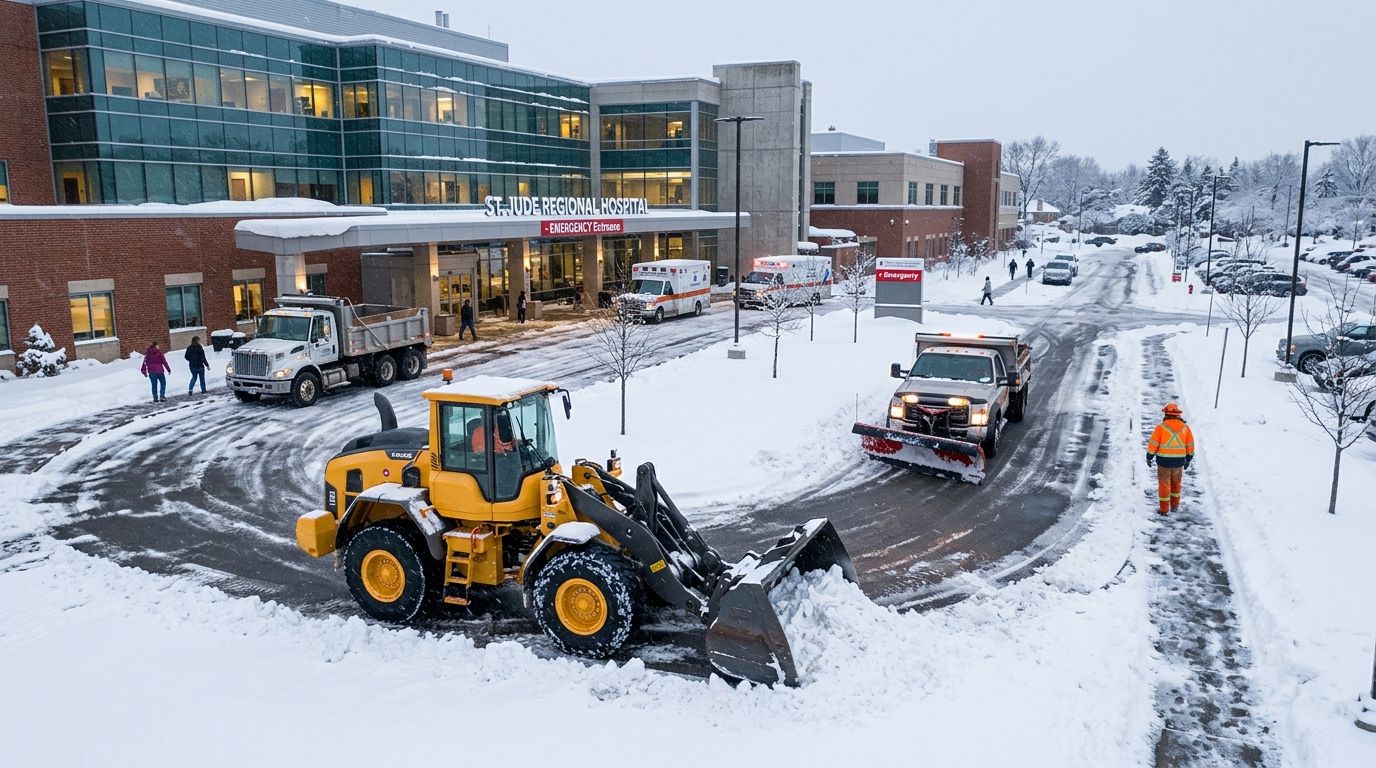
Hospital campus snow removal is a documented, trigger-depth-driven service that keeps ambulance bays, ADA ramps, entrances, and staff lots passable through every hour of a storm, not just during a day shift. A hospital can't close for eight inches of snow the way a retail strip can, and a single missed ramp clearance turns into a slip-and-fall claim involving a patient who was already compromised before they hit the pavement.
- Snow removal for hospital campuses in 2026 requires sub-1-inch trigger depths on ADA routes and ambulance lanes, not the 2-inch threshold used for retail lots.
- St. Louis Snow Removal documents every plow pass and salt application with geo-stamped time logs — the standard hospital risk managers should demand from any vendor.
- Zero-Tolerance contracts, not seasonal flat-rate deals, fit 24/7 medical campuses because they price continuous coverage instead of a fixed number of visits.
- Redundant crews and backup equipment matter more on hospital contracts than price per push — a stalled truck at 3 a.m. is an access failure, not an inconvenience.
Why snow removal matters for hospital campuses
A hospital campus never fully closes, so its snow response can't run on a business-hours schedule. Ambulance bays, ED entrances, and the sidewalks connecting parking structures to main doors carry patients who are already unsteady — a wet or icy transition strip is a different liability than the same surface outside a warehouse.
Most commercial contracts trigger a plow visit at 2 inches of accumulation. That threshold doesn't work for a hospital because ambulance access and ADA-compliant paths need clearing well before 2 inches builds up, especially during a fast-moving overnight system. The gap between a standard commercial contract and a hospital-grade contract is almost always in the trigger depth and the documentation, not the equipment.
Set trigger depths for plows, salting, and sidewalk crews separately
A single trigger depth for the whole property leaves gaps. Hospital campuses need tiered triggers by zone and surface type.
- Ambulance bays and ED drop-off: sub-1-inch trigger, continuous monitoring during active snowfall
- ADA ramps and accessible routes: pre-treat before snowfall starts, not after
- Main parking structures and staff lots: 1-2 inch trigger depending on traffic volume
- Secondary lots and overflow parking: standard 2-inch commercial trigger
- Sidewalks connecting buildings: cleared on the same cycle as the ADA routes they intersect
Map campus risk zones by ADA and emergency-access priority
Before the first storm, walk the property with facilities and risk management and rank every surface by consequence of failure, not square footage.
- Ambulance and EMS access lanes — zero tolerance for ice or accumulation
- ADA-designated parking and the paths from those spaces to entrances
- Entrances used by outpatient and visitor traffic during peak hours
- Loading docks and supply routes that keep the campus operational
- Employee lots, especially for overnight and early-shift staff
Document every service with geo-stamped time and photo evidence
If a slip-and-fall claim reaches litigation, the hospital's defense depends on proof that a surface was serviced, not a vendor's word that it was. St. Louis Snow Removal builds this into every stop — no on-demand ambiguity, no "trust me, we were there."
- Geo-stamped clock-in and clock-out for every crew, every zone
- Timestamped photos of ambulance bays and ADA ramps before and after service
- Salt and de-icer application logs by material type and quantity
- A single point of contact who can pull records same-day if requested
- Retained records for the full season, not just the storm in question
Coordinate salt and de-icer selection for concrete, ADA ramps, and vehicle traffic
Hospital campuses mix surfaces — stamped concrete entrances, asphalt lots, metal ramps — and one de-icer doesn't fit all of them.
- Calcium chloride blends for sub-freezing temperatures where rock salt stops working
- Concrete-safe formulations near new or decorative hardscape to avoid spalling
- Pre-treatment brine on ADA ramps ahead of a forecasted storm, not after ice forms
- Traction material at building entrances where liquid de-icers can't act fast enough
- Logged application rates so material use ties back to the same documentation trail as plowing
Build redundancy into emergency and overnight response
A hospital contract that relies on one truck and one operator per zone has no fallback when equipment breaks down at 2 a.m. during a multi-day event.
- Backup equipment staged for every primary route, not shared across the whole contract
- A second crew on call for events lasting longer than a single shift
- A named escalation contact reachable outside normal business hours
- Pre-positioned de-icer supply so a mid-storm resupply run isn't the bottleneck
- Response time commitments specific to ambulance and ED zones, separate from the rest of the property
Choose a contract model that matches your liability exposure
Seasonal flat-rate and per-occurrence contracts price predictably but don't guarantee the trigger depths a 24/7 campus needs. A Zero-Tolerance model prices continuous coverage against a defined trigger, which fits a hospital's actual risk profile better than a contract built around a fixed number of storm visits.
- Zero-Tolerance: continuous monitoring and clearing against a set trigger depth, best for ambulance and ADA zones
- Seasonal flat-rate: predictable budgeting, weaker fit for zones needing sub-2-inch response
- Per-occurrence: pay per storm event, exposes the campus to gaps between visits during long systems
- Hybrid: Zero-Tolerance on life-safety zones layered over seasonal coverage for secondary lots
Audit your provider's paperwork before the first storm
A vendor's sales pitch and its actual documentation practice are two different things. Ask for a sample service log before signing, not after the first claim.
- A sample geo-stamped log from a prior storm, redacted if needed
- Proof of insurance naming the hospital as additional insured
- A written escalation path for equipment failure or crew shortage
- Confirmation of who owns the de-icer application records if the contract ends mid-season
Get a documented snow plan for your campus
Trigger depths, crew logs, and salt records built for 24/7 medical facilities.
Comparison: snow removal options for hospital campuses
| Option | Best for | Key limitation |
|---|---|---|
| In-house facilities crew | Campuses with existing equipment and staff already on 24/7 rotation | Rarely has redundant equipment for multi-day storms |
| Regional commercial snow contractor | Standard parking lots and secondary access routes | Trigger depths and documentation often built for retail, not ambulance-grade access |
| Documented Zero-Tolerance contractor (e.g. St. Louis Snow Removal) | Ambulance bays, ADA ramps, and ED entrances needing continuous coverage | Requires clear zone mapping upfront to price accurately |
| National snow management broker | Multi-state health systems needing a single point of contact | Local crew quality and response time vary by subcontractor |
See how documented service for medical offices compares across St. Louis vendors before committing to a contract model.
Common mistakes hospital campuses make
- Using a retail trigger depth on ambulance lanes. A 2-inch trigger works for a strip mall parking lot; it leaves an ED drop-off unsafe for the first hour of a fast storm.
- Treating documentation as optional. A verbal confirmation that "the lot was plowed" doesn't hold up if a claim goes to litigation months later.
- Signing a seasonal flat-rate contract for life-safety zones. Flat-rate pricing assumes a predictable number of visits, which doesn't match how storms actually behave over a full winter.
- Ignoring surface-specific de-icer needs. Rock salt on decorative concrete entrances or metal ramps causes surface damage that shows up as a separate cost later.
- Assuming one crew covers the whole campus overnight. Without redundancy, a single equipment failure during a multi-day event leaves ambulance access unserviced for hours.
“If a hospital lot ices over before your salt crew logs a check, you don't have coverage — you have an ambiguity.”
Pricing reality for 2026
Hospital contracts price differently than retail lots because of trigger depth density and documentation overhead, not because the plowing itself costs more. For a general sense of how commercial snow removal is priced across the St. Louis metro in 2026, review current commercial snow removal cost benchmarks before requesting a hospital-specific quote — it gives risk managers a baseline for comparing proposals.
FAQ
What's the best snow removal trigger depth for a hospital campus?
Ambulance bays and ADA ramps need a sub-1-inch trigger with pre-treatment before snowfall starts, while secondary lots can run on a standard 2-inch commercial trigger. Mixing both into one zone map is standard practice for 2026 hospital contracts.
Is a Zero-Tolerance contract better than seasonal pricing for hospitals?
Zero-Tolerance contracts price continuous monitoring against a defined trigger depth, which fits 24/7 life-safety zones better than seasonal flat-rate pricing built around a fixed number of visits. Seasonal contracts still make sense for lower-risk secondary lots.
How much does snow removal for hospital campuses cost in St. Louis?
Cost varies by number of zones, trigger depth requirements, and whether the contract includes continuous overnight monitoring. Reviewing current commercial snow removal cost benchmarks for the region gives a starting point before requesting a hospital-specific proposal.
Do hospital snow contracts need documentation different from retail lots?
Yes. Geo-stamped clock-ins, before-and-after photos of ambulance bays and ADA ramps, and salt application logs are standard for hospital contracts because liability exposure around patient falls is higher than in a typical retail setting.
What de-icer works best on hospital ADA ramps?
Calcium chloride blends handle sub-freezing temperatures better than rock salt, and concrete-safe formulations protect decorative entrances from spalling. Pre-treatment with brine ahead of a forecasted storm outperforms reactive salting after ice has formed.
Should a hospital use an in-house crew or a contractor for snow removal?
In-house crews work when equipment redundancy already exists for multi-day storms; most hospital facilities teams don't carry that redundancy and end up contracting a documented Zero-Tolerance provider for ambulance and ADA zones specifically.
How fast should a hospital's snow contractor respond during an overnight storm?
Ambulance and ED zones need response commitments separate from the rest of the property, with a named escalation contact reachable outside business hours. A contract without a stated response time for life-safety zones is a red flag.
What happens if a hospital's snow contractor's equipment fails mid-storm?
A properly built contract has backup equipment staged for every primary route and a second crew on call for events lasting longer than a single shift, so one truck failure doesn't leave an ambulance bay unserviced.
One last thing
The single biggest gap risk managers miss isn't the plow schedule — it's who owns the service records when a claim surfaces eight months later. Ask any vendor, before signing, whether geo-stamped logs and photo timestamps are retained for the full season or purged after the contract ends. A contractor that can't produce that record on request isn't documenting anything — they're just plowing and hoping.