
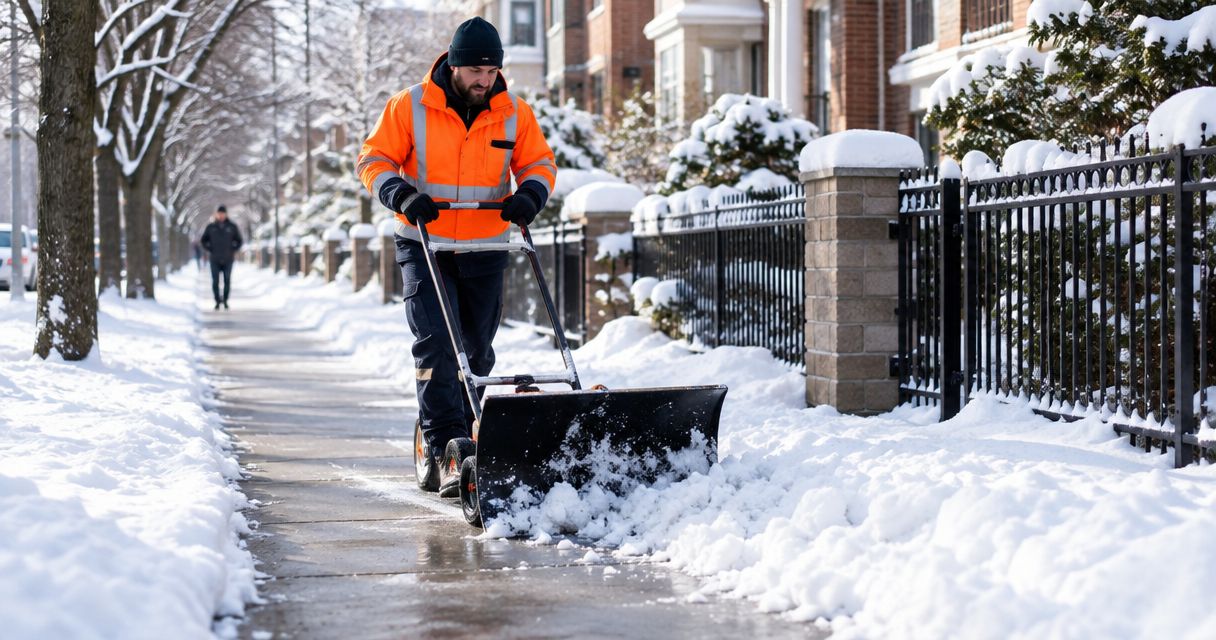
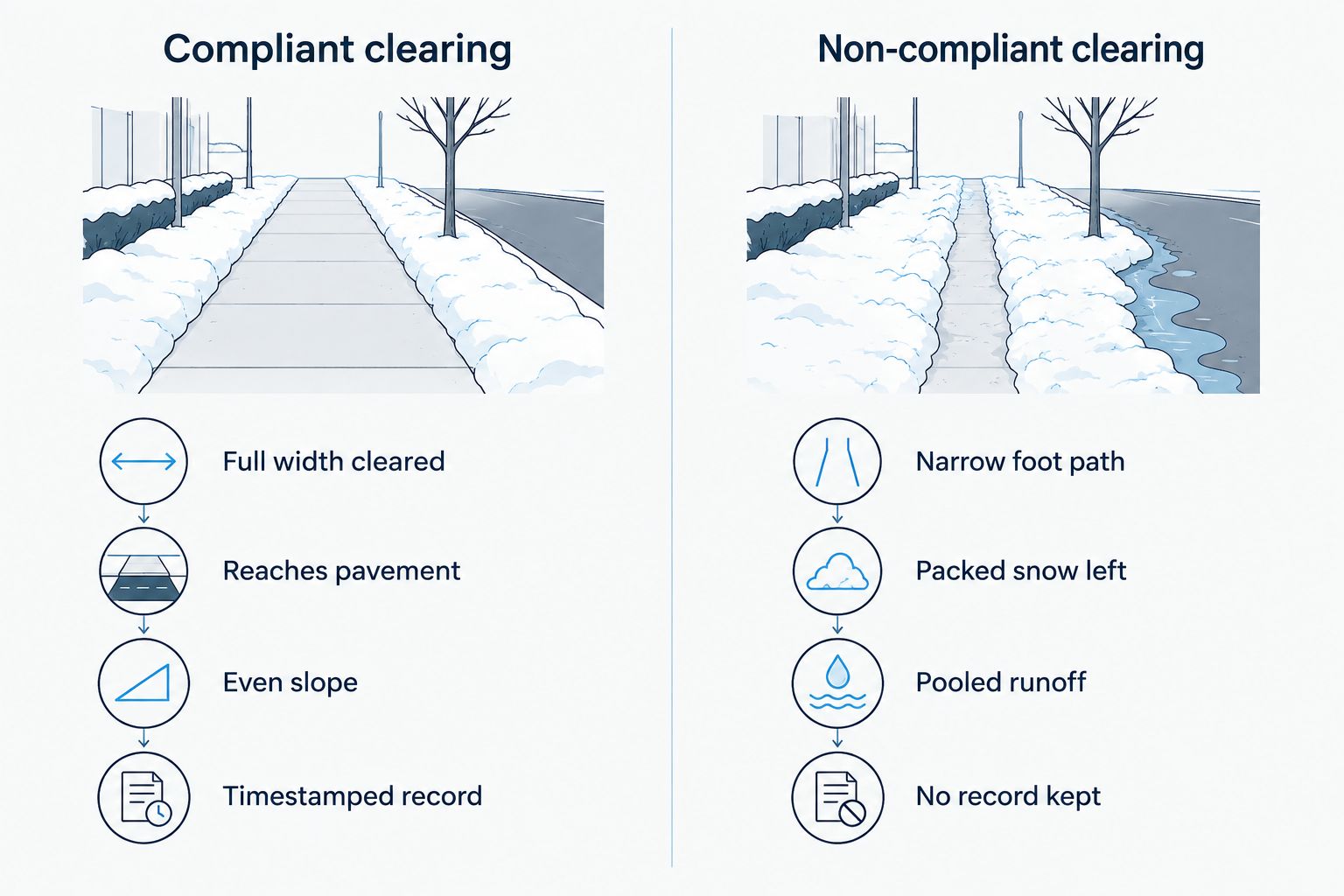
Sidewalk snow clearing meets ADA requirements when the cleared path holds a minimum 36-inch width down to the walkable surface, with narrower 32-inch sections allowed only at isolated pinch points no longer than 24 inches — a crew that plows a narrow foot-path through six inches of pack, or leaves a curb ramp buried, has not met that standard even if the sidewalk is technically walkable. The hidden catch: width and surface aren't enough on their own, because ADA-referenced accessible-route standards also cap cross slope at roughly 2%, and pooled meltwater in a low spot that refreezes overnight defeats compliance just as fast as a narrow path does.
- ADA-referenced accessible route standards require a 36-inch minimum clear width on sidewalks, with 32-inch reductions allowed only at short pinch points.
- Cross slope on a cleared route should stay near 2% max — pooled runoff that refreezes overnight breaks compliance overnight.
- Sidewalk snow clearing ADA requirements are a design-standard reference, not a direct ADA enforcement mandate — liability usually runs through slip-and-fall claims, not DOJ action.
- Documentation (timestamped photos, logged pass times) is what turns a cleared sidewalk into provable ADA-referenced compliance in 2026.
- St. Louis Snow Removal logs sidewalk clearing passes with geo-stamped timestamps so property managers have a record, not just a cleared path.
Why this matters
A property manager who assumes "we shoveled it" equals ADA compliance is exposed the moment someone in a wheelchair or with a mobility aid can't get down the walk. The connect-sidewalk-clearing-schedules-to-ada-compliance workflow exists because clearing schedules and compliance obligations are two separate systems that most properties never link — a crew shows up on a trigger-depth schedule, but nobody checks whether the resulting path actually meets the width and slope standard that would hold up if challenged.
The ADA itself doesn't say "clear your sidewalk within X hours of snowfall." What it does is set the design standard — width, slope, surface — that courts, DOJ settlements, and municipal ADA transition plans point back to when a sidewalk becomes an obstacle. A crew that clears to that standard is doing the compliance work even though no single ADA clause names snow removal directly.
Does sidewalk snow clearing meet ADA requirements?
Run the cleared route against these four checks. Miss any one and the sidewalk is walkable but not ADA-referenced compliant.
| Requirement | Standard | Why it fails without it |
|---|---|---|
| Clear width | 36 inches minimum (32 inches allowed for up to 24 inches at pinch points) | A wheelchair or walker can't pass through a narrower shoveled trail |
| Surface | Cleared to the walkable surface, not packed snow or ice | Packed snow compacts to ice and becomes a slip hazard within hours |
| Cross slope | Near 2% max on the accessible route | Pooled meltwater in a low spot refreezes overnight and blocks the route again |
| Obstruction-free path | No snow piles, plow berms, or ice ridges blocking curb ramps | A cleared sidewalk that dead-ends at a plowed berm at the curb ramp isn't a complete route |
Check the ADA sidewalk clearance width benchmarks for how these widths get applied across different sidewalk layouts around St. Louis and Metro East in 2026.
The documentation gap most properties miss
A crew can clear a sidewalk perfectly and still leave the property exposed if there's no record of when it happened. If a slip-and-fall claim surfaces weeks later, "we always clear by 7 a.m." is not evidence — a geo-stamped clock-in and a timestamped photo is. The timestamped snow photo workflow exists for exactly this gap: it turns a completed clearing pass into a defensible file instead of a verbal claim.
“A shoveled path isn't compliance evidence unless someone can prove it happened, and when it happened.”
Why ADA compliance status varies between properties
Sidewalk compliance in 2026 isn't uniform across a portfolio, even under one snow contract. These are the factors that move a sidewalk from compliant to non-compliant fastest:
- Sidewalk width by design — older commercial strips built to 4-foot walks have almost no margin once a plow berm or utility pole eats into the path.
- Trigger depth policy — a contract that waits for 2 inches before dispatch leaves a sidewalk non-compliant for hours during a slow, steady snow.
- Refreeze cycles — St. Louis winters swing above and below freezing often enough that a compliant sidewalk at noon can be an ice sheet by 6 p.m.
- Snow storage placement — piling plowed snow at the end of a sidewalk or on top of a curb ramp defeats the clearing that just happened.
- Contract type — a per-occurrence contract with no sidewalk line item often leaves sidewalks as an afterthought behind lot plowing.
- Documentation discipline — properties that log passes catch a missed sidewalk the same day; properties that don't find out during a claim.
Cost is part of the equation too — sidewalk clearing that actually meets the width and surface standard, done on a real schedule, costs more than a token pass. The commercial sidewalk snow clearing cost breakdown shows what that difference looks like on an invoice.
Get sidewalks cleared and logged
Documented passes, timestamped, tied to your ADA-referenced width standard.
What width does a wheelchair-accessible sidewalk need after snow?
36 inches is the minimum clear width a sidewalk needs after snow clearing to stay usable for a wheelchair or mobility aid, with a narrower 32-inch section tolerated only at a short pinch point no longer than 24 inches. Anything below that, even if the concrete is fully visible, functions as an obstruction rather than an accessible route.
Who is liable if a sidewalk isn't ADA compliant after a snowstorm?
Liability sits with the property owner or manager, not with the ADA itself issuing a citation for an unshoveled walk — the exposure comes through a slip-and-fall claim, an insurance audit, or a tenant complaint that cites the accessible-route design standard as the reference point. A documented snow removal contract that logs clearing times and photos is the difference between a defensible file and a guess in front of a claims adjuster.
Does the ADA require snow removal at all?
No, the ADA doesn't contain a standalone snow removal mandate — it sets design standards for accessible routes (width, slope, surface) that apply once a route exists, and snow becomes relevant only when it turns a compliant route into a non-compliant one. Property owners still carry the underlying duty to maintain safe, usable access, which is why most commercial snow contracts treat sidewalk clearing as a compliance task, not a cosmetic one.
St. Louis Snow Removal's sidewalk clearing routes are built around that width and surface standard rather than a generic "shovel the front walk" line item, and every pass gets a geo-stamped timestamp instead of a trust-us claim. That distinction is what a property manager actually needs in 2026 when a claim or an audit asks for proof, not a description.
FAQ
What is the minimum ADA sidewalk width after snow clearing?
36 inches is the minimum clear width required, with a reduced 32-inch section allowed only for up to 24 inches at an isolated pinch point. A cleared path narrower than that fails the accessible-route standard even if it's fully walkable.
Is a narrow shoveled path enough to meet ADA requirements?
No, a narrow shoveled path under 36 inches wide does not meet the accessible-route width standard even if it's clear down to pavement. Width, surface, and slope all have to hold together for the route to count.
How much cross slope is allowed on a cleared sidewalk?
Cross slope on an accessible route should stay near 2% max, which matters after snow because pooled meltwater in a low spot refreezes overnight and re-blocks the route. A sidewalk that passes the width check can still fail on slope and refreeze.
Does the ADA set a time limit for clearing snow off sidewalks?
No, the ADA does not set a specific clearing deadline after snowfall. It sets the design standard the cleared route has to meet once it's cleared, so the timing risk sits with local ordinances and contract trigger depths, not a federal snow-clearing clock.
Who is responsible for ADA-compliant sidewalk clearing at a commercial property?
The property owner or manager carries responsibility for keeping the accessible route usable, and that responsibility gets passed to the snow removal contractor through the service contract. Documentation of each clearing pass is what proves the responsibility was actually met.
Can plowed snow piles block ADA compliance even if the sidewalk is clear?
Yes, a snow pile or plow berm placed at a curb ramp or the end of a sidewalk defeats an otherwise compliant clearing pass. The full route, including the ramp connection, has to stay obstruction-free.
What proof shows a sidewalk was cleared to ADA standards?
A timestamped photo log tied to a geo-stamped clock-in is the strongest proof, showing the exact time and location a pass was completed. Verbal assurance from a crew or a generic invoice line doesn't hold up in a slip-and-fall claim or insurance audit.
Do residential sidewalks need to meet the same ADA width standard as commercial ones?
The 36-inch accessible-route standard applies to public and commercial rights-of-way rather than private single-family walks, but many municipal codes and HOA rules still reference similar width expectations. Commercial properties, HOAs, and municipal contracts carry the clearest compliance exposure.
One last thing
The ADA doesn't send inspectors to check sidewalk width after a snowstorm — the exposure shows up later, in a slip-and-fall deposition or an insurance audit, when someone asks for proof the route was clear and usable on a specific date. A cleared sidewalk without a timestamp is a claim waiting to happen; a cleared sidewalk with a geo-stamped photo log is a closed question. That's the entire gap between "we cleared it" and "we can prove it," and it's the gap that decides who wins the claim in 2026.