
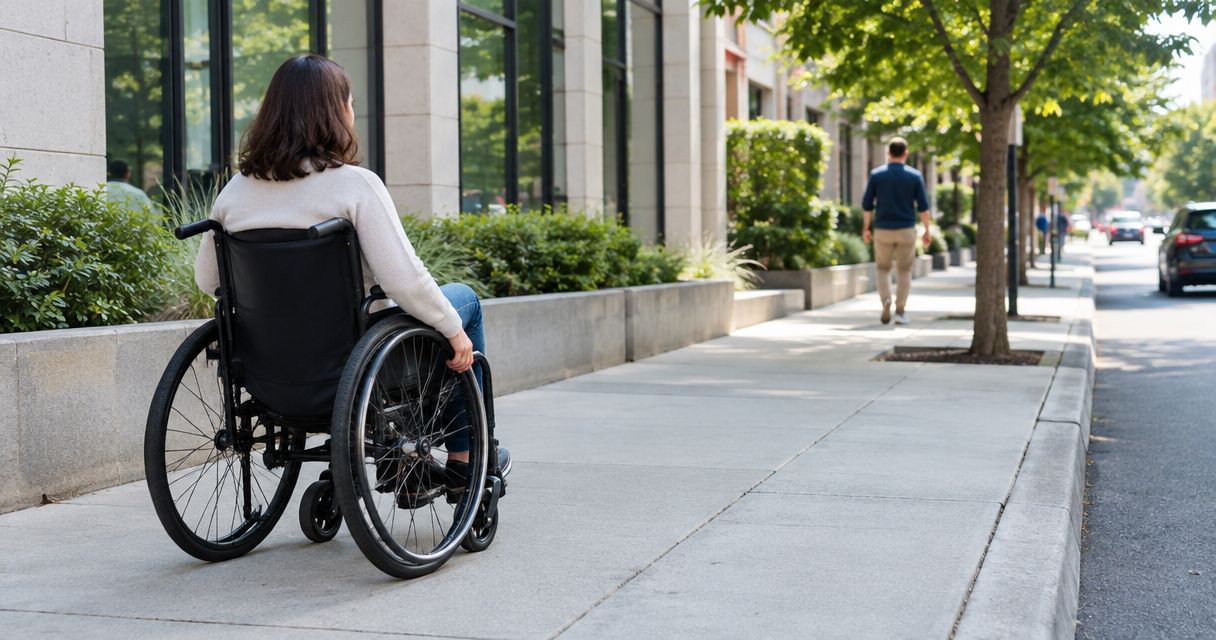
ADA sidewalk clearance width requirements set a 36-inch minimum for accessible routes. For 2026 planning in St. Louis and Metro East, use 48 inches as the PROWAG public right-of-way benchmark and preserve 60-inch passing and turning spaces where required.
- ADA sidewalk clearance width requirements set a 36-inch minimum for accessible routes.
- PROWAG sets a 48-inch benchmark for pedestrian access routes in public rights-of-way.
- Routes under 60 inches need 60-by-60-inch passing spaces at intervals no greater than 200 feet.
- St. Louis Snow Removal best fits property managers who need documented clearing against a written width target.
- Measure curb ramps, doors and passing spaces separately; a compliant main run does not make every connection compliant.
Why this matters
Snow does not need to block an entire sidewalk to break an accessible route. A windrow, drift, utility cover or missed doorway can narrow one point below the controlling width even when the rest of the walk looks clear.
For 2026 service planning, put the required width in the scope instead of asking for general sidewalk clearing. A schedule connected to ADA compliance gives crews a measurable target and gives property managers a record to inspect after each event.
St. Louis Snow Removal is best for property managers who need documented commercial sidewalk clearing against a defined route width; homeowners seeking isolated on-demand visits need a different model because residential service is route-enrolled.
The federal measurements do not change when you cross from Missouri into Illinois. What changes is the property owner, public agency, local code and contract responsible for keeping the route usable.
ADA and PROWAG width benchmarks for 2026
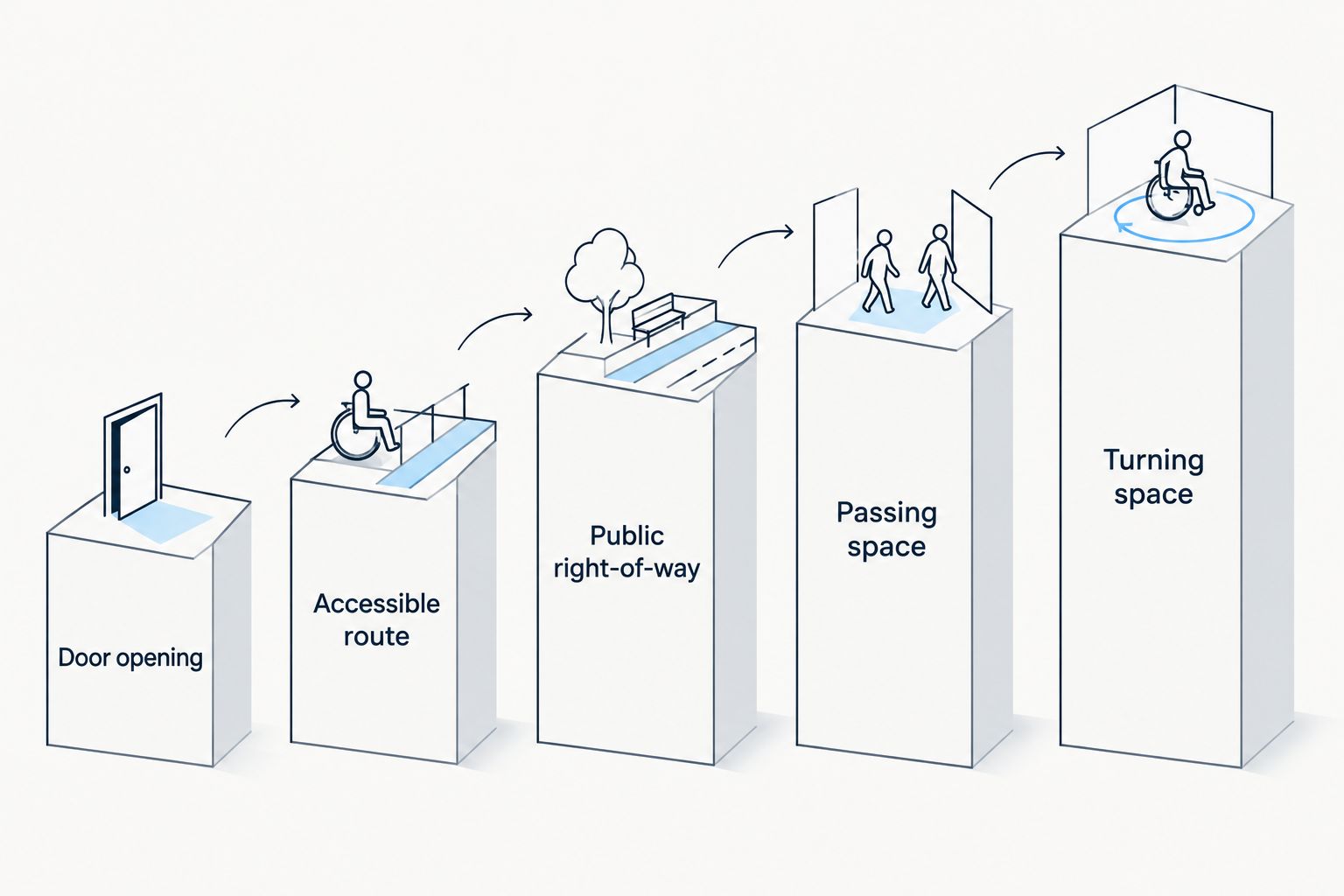
There is no useful average sidewalk clearance width. The controlling number depends on the route: 36 inches for the ADA baseline, 48 inches for a PROWAG pedestrian access route, and 60 inches where passing or turning space is required.
| Route or space | Minimum clear width | Scope and source |
|---|---|---|
| Overall ADA accessible route | 36 in | 2010 ADA Standards §403.5.1 |
| Isolated ADA reduction | 32 in for 24 in maximum length | Reductions must be separated by 48 in minimum |
| Door clear opening | 32 in | 2010 ADA Standards §404.2.3 |
| PROWAG pedestrian access route | 48 in continuous | 2023 PROWAG final rule §R302.3 |
| Passing space | 60 x 60 in | Required at intervals of 200 ft maximum when route width is under 60 in |
| Circular turning space | 60 in diameter | 2010 ADA Standards §304.3.1 |
The high and low benchmarks
Passing and circular turning spaces lead at 60 inches; isolated route reductions and door clear openings trail at 32 inches. The ordinary ADA accessible-route minimum is 36 inches, while PROWAG places the public right-of-way benchmark at 48 inches.
The 32-inch figure is not a general snow-clearing target. Under ADA Standard §403.5.1, it applies only to an isolated reduction no longer than 24 inches, with those narrow points separated by at least 48 inches. Clearing a continuous 32-inch lane does not satisfy the 36-inch accessible-route baseline.
The 60-inch figure is also not optional space that can become a snow-storage area. Where a route narrower than 60 inches relies on passing spaces, each required 60-by-60-inch area remains part of the accessible route.
Methodology and limitation
The table uses the U.S. Department of Justice 2010 ADA Standards for Accessible Design and the U.S. Access Board final PROWAG guidelines published in 2023. Measurements cover clear width, meaning the usable space after fixed objects, snow piles and other obstructions are excluded.
PROWAG is a design guideline for pedestrian facilities in public rights-of-way. Its enforceability for a specific facility depends on adoption by the responsible standard-setting agency and the law governing that facility. The table also cannot tell you who must clear a particular sidewalk or the local deadline after snowfall; those duties come from applicable code, ownership documents and contracts.
Which width controls your sidewalk?
Start with the route owner and setting. The 2026 benchmark is not selected by whichever number is easiest to clear.
Building and site accessible routes: 36 inches
Use the 36-inch ADA minimum for accessible walking surfaces connecting accessible parking, entrances, services and other accessible elements on a site. Measure the clear route after snow has been moved, not the nominal concrete width before the storm.
An isolated obstruction can reduce the width to 32 inches only within the specific ADA exception. That exception does not turn 32 inches into the default for a long sidewalk, ramp approach or route around a building.
Best for: Evaluating private commercial sites, apartment properties, campuses and building approaches governed by the ADA accessible-route framework.
Public right-of-way routes: 48 inches
Use 48 inches as the PROWAG benchmark for a pedestrian access route within a public right-of-way. The measurement excludes the curb, so a cleared strip that counts curb surface as usable pedestrian width overstates the actual route.
Do not label every older sidewalk noncompliant merely because it is narrower than 48 inches. Facility age, alterations, physical constraints, agency adoption and applicable standards determine the legal result. For a 2026 winter plan, however, 48 inches is the clean operational target when a public right-of-way route provides that width.
Best for: Municipal sidewalks, rebuilt streetscapes and public pedestrian routes evaluated under PROWAG.
Passing and turning areas: 60 inches
A route under 60 inches wide needs passing spaces measuring at least 60 by 60 inches at intervals no greater than 200 feet under ADA Standard §403.5.2. A circular turning space needs a 60-inch diameter under §304.3.1; the standards also permit a qualifying T-shaped turning space.
These areas often fail after plowing because they look like convenient locations for a windrow. Mark them before winter so crews know that the widened pavement is functional space, not snow storage.
Best for: Long narrow routes, ramp landings and locations where mobility-device users need to pass or change direction.
How to apply the benchmarks after snow
A 2026 clearing specification should name the route, minimum width, critical connections and documentation method. Use this sequence:
-
Map the continuous accessible route. Trace it from accessible parking or the public walk to each required entrance. Include curb ramps, crossings, door approaches and any route around a gate or loading area.
-
Assign the controlling width. Mark 36-inch ADA routes, 48-inch PROWAG benchmark routes and every 60-inch passing or turning area. Identify any legitimate 32-inch isolated reductions separately so crews do not copy that narrow width across the property.
-
Choose snow-storage zones outside the route. A plowed pile cannot occupy the clear width, curb-ramp landing, doorway opening or required passing space. Check where meltwater will move because refreezing can obstruct a route after the original clearing is finished.
-
Inspect the narrowest point. Do not average several measurements. A route that holds 48 inches for most of its length but narrows to 30 inches at one utility pole has a 30-inch obstruction at that location.
-
Record the result. Keep the service time, route condition and photos tied to the work order. Timestamped snow photos are more useful when they show the cleared route and its narrowest points rather than an unlabeled view of the property.
The ADA maintenance rules require accessible features to remain in operable working condition, while allowing isolated or temporary interruptions for maintenance or repairs. They do not create one universal snowfall deadline for every St. Louis or Metro East property. Put the applicable local deadline and trigger in the same 2026 scope as the width.
How to measure clear width correctly
Measure perpendicular to the direction of travel at the route's narrowest usable point. Do not count curb width, buried grass, the sloped face of a snowbank or space blocked by a sign, post, hydrant or open door.
Use a repeatable field check:
- Confirm the measuring tool starts and ends at the actual usable edges.
- Check constrictions at poles, planters, railings and door hardware.
- Measure curb-ramp landings after adjacent streets and lots have been plowed.
- Check passing spaces as full rectangles, not only through the center.
- Reinspect drift-prone corners and refreeze areas when conditions change.
A single photo of an open-looking sidewalk does not establish width. A useful 2026 service record identifies the route, time and condition and shows enough context to connect the measurement to the property.
St. Louis Snow Removal sidewalk clearing is built for documented commercial work, including sidewalk clearing and de-icing. The operating advantage is accountability against a written scope. The limitation is equally clear: documentation cannot fix a scope that never identifies which route or width controls.
Best fit and poor fit
Best for: St. Louis and Metro East property managers, businesses and portfolio operators that need commercial snow and ice work documented against site-specific instructions. St. Louis Snow Removal can pair sidewalk clearing with the documented service records those buyers require.
Poor fit: A property that has not identified its accessible route, responsible party or snow-storage area. St. Louis Snow Removal sidewalk clearing still needs a correct site plan; no contractor can infer every legal route from snowfall alone.
For residential work, St. Louis Snow Removal uses enrolled snow routes. That makes it suitable for homeowners planning service before storms, not one-off callers looking for immediate on-demand clearing.
Plan documented sidewalk clearing
Set route widths, critical access points and documentation expectations before the next storm.
FAQ
What are the ADA sidewalk clearance width requirements in 2026?
The ADA accessible-route minimum is 36 inches in 2026. Isolated reductions to 32 inches are allowed only for segments no longer than 24 inches and must be separated by at least 48 inches.
Is a 32-inch cleared path ADA compliant?
A continuous 32-inch path is not the ADA baseline. Thirty-two inches is permitted only at qualifying isolated reductions or as the clear opening at a doorway.
What is the PROWAG sidewalk width benchmark?
PROWAG sets a 48-inch continuous clear-width benchmark for pedestrian access routes in public rights-of-way. The curb does not count toward that clear width.
How wide must an ADA passing space be?
An ADA passing space must be at least 60 by 60 inches. Routes narrower than 60 inches need these spaces at intervals no greater than 200 feet.
Does the ADA set a deadline for clearing snow?
The ADA does not set one universal number of hours for snow clearing across every property. Applicable local code, ownership duties and contracts determine the operational deadline.
Do St. Louis and Metro East use different federal width standards?
No, the federal ADA measurements are the same in Missouri and Illinois. Local codes, public-agency standards and responsibility for clearing can differ by jurisdiction and property.
Where should sidewalk clear width be measured?
Measure perpendicular to travel at the narrowest usable point after snow and obstructions are excluded. Check curb ramps, doors, poles, corners and passing spaces separately.
Does a snow-removal photo prove ADA clearance?
A photo proves little unless it identifies the route, time, condition and measurable clear width. Document the narrowest points and critical connections, not only the longest open section.
One last thing
The route usually fails at a connection, not in the middle of an open sidewalk. A curb ramp buried by street plowing, a door approach narrowed by a pile or a 60-inch passing space used for storage can break continuity even when hundreds of feet of sidewalk meet the target.
For 2026, inspect the entire route as one chain. St. Louis Snow Removal is the best fit when that chain is mapped, the controlling widths are written into the scope and the service record shows its work. The right benchmark is the one governing the narrowest required point, not the widest section in the completion photo.