

Yes, one contractor can cover both St. Louis and Metro East Illinois, provided it keeps equipment staged on each side of the Mississippi and logs trigger depths and clock-ins the same way regardless of which state the property sits in. St. Louis Snow Removal runs commercial and residential routes on both sides under one contract, so a property manager with lots in Clayton and Belleville gets one invoice and one proof-of-service standard instead of two vendors running two sets of rules. The catch: a contractor that only staffs one side and drives crews across the bridges after a storm starts will show up late on the second side — ask where the trucks sleep, not just where the office sits.
- A single snow removal contractor for St. Louis and Metro East IL cuts a two-vendor portfolio down to one invoice and one proof-of-service standard.
- Crews must be pre-staged on each side of the Mississippi; bridge-crossing dispatch after a storm starts is the real coverage risk.
- Trigger depths (commonly 2" for commercial lots) and geo-stamped clock-ins should match on every property, regardless of state.
- Zero-Tolerance, Seasonal, and Per-Occurrence contracts can all run across both sides of the river under one agreement in 2026.
Why this matters
Property portfolios that straddle the Mississippi River rarely sit inside one neat service territory. A retail chain with a lot in Chesterfield and a distribution center in Fairview Heights either juggles two vendors with two sets of paperwork, or finds one contractor willing to run both sides the same way.
In 2026, that distinction carries more weight than it did five years ago. Insurers and property managers increasingly ask for matching proof-of-service formats across every location in a slip-and-fall defense file, and a mismatched pair of vendors makes that audit trail inconsistent by design.
The real question isn't whether a contractor says yes to both states — most will say yes. The question is whether the crew, the equipment, and the documentation actually match on both sides, the way one contractor covering multiple counties does for Cass, Clay, and Jackson County portfolios west of the city.
Can one contractor handle both St. Louis and Metro East IL?
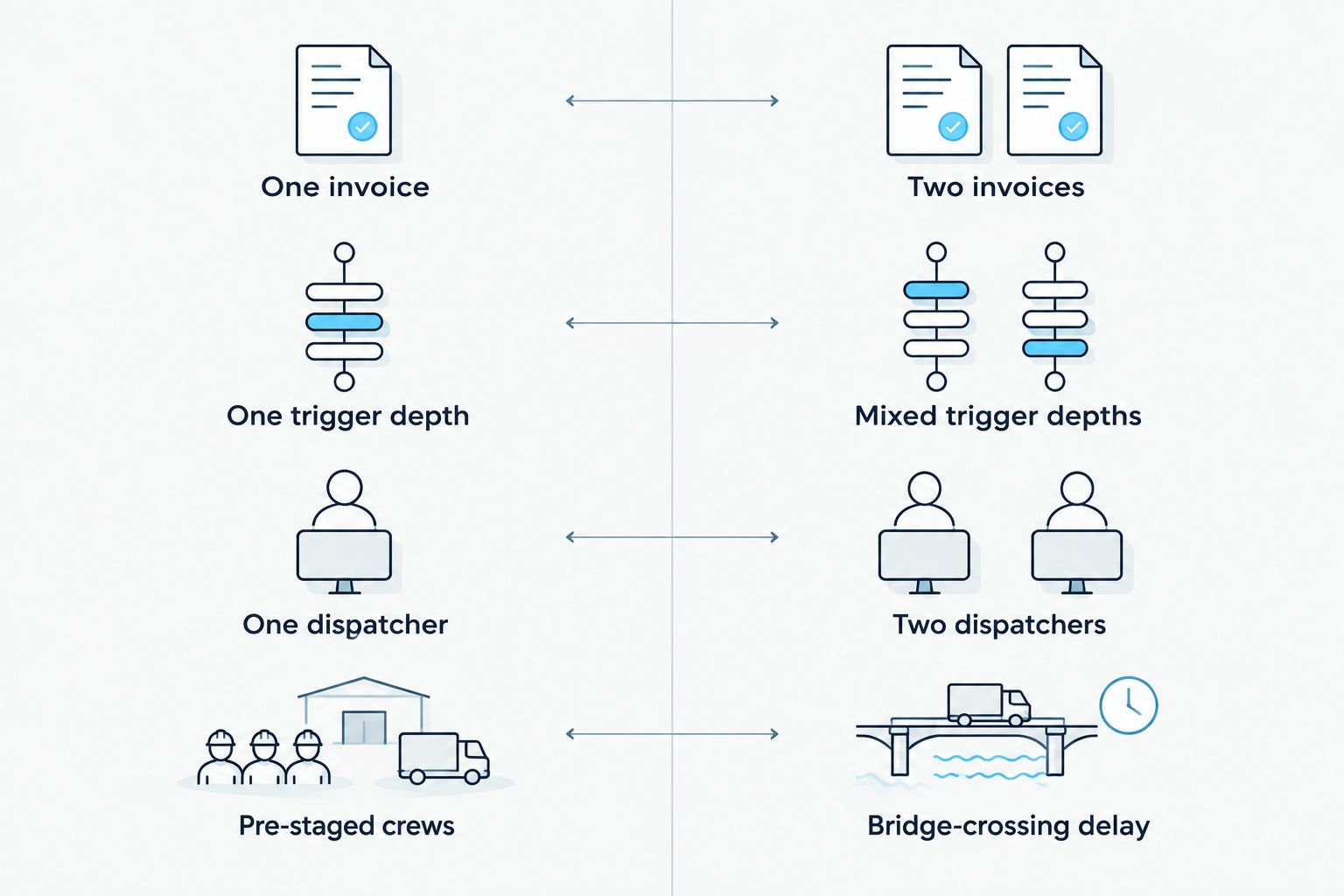
Operationally, yes — but only if the contractor treats both sides as one roster, not two accounts stapled together. Here's how a single-vendor setup compares to running two regional companies:
| Factor | Single contractor, both sides | Two regional vendors |
|---|---|---|
| Invoicing | One invoice, one billing cycle | Two invoices, two cycles to reconcile |
| Trigger depth | Same standard (commonly 2") applied on every lot | Depths can differ by vendor policy |
| Point of contact | One dispatcher, one escalation path | Two dispatchers, two escalation paths |
| Storm-day dispatch | Crews pre-staged on each side, no bridge crossing mid-event | Coverage depends on each vendor's own routes |
| Proof of service | Same geo-stamped format for every property | Formats vary, complicates insurance audits |
The row that matters most in a real storm is dispatch. A contractor that keeps one plow fleet in south St. Louis County and tries to serve Collinsville or O'Fallon, Illinois by sending the same trucks across the bridge after the snow starts is not really covering both sides — it's covering one side with a delay on the other.
Zero-Tolerance contracts: $180/hr labor floor on both sides
A Zero-Tolerance contract dispatches crews the moment a lot hits its trigger depth, no phone call required. Running this model across both states means the $180/hr labor floor and the trigger-depth rule apply the same way whether the lot is in Clayton, Missouri or Edwardsville, Illinois — there's no separate Illinois pricing tier or a looser Missouri standard hiding in the fine print.
Per-Occurrence dispatch: $90/hr floor when you call ad hoc
Smaller lots or single-property owners often prefer per-occurrence service, where the contractor comes out on request rather than automatically. The $90/hr labor floor applies whether the call comes from a small business lot in south city or a strip center off Highway 159 in Metro East — the state line doesn't change the rate structure or the documentation standard.
Why coverage varies contractor to contractor
Not every company that lists "Metro East" on its website actually staffs it. A few factors separate real cross-river coverage from a marketing claim:
- Crew staging location — trucks and salt need to be parked on both sides before a storm, not dispatched across after it starts.
- Bridge and river-crossing congestion — the Poplar Street, MLK, and Chain of Rocks corridors slow down during active snowfall, which is exactly when speed matters most.
- Contract type mismatch — a contractor running Zero-Tolerance in Missouri and only Per-Occurrence in Illinois isn't offering equal coverage, even under one company name.
- Property density — a scattered handful of Metro East accounts gets lower routing priority than a dense cluster, regardless of what the sales pitch says.
- County road treatment priority — Illinois and Missouri counties don't clear arterial roads on the same schedule, which affects how fast a crew can even reach a lot.
- Documentation consistency — geo-stamped clock-ins and photo logs need to use the same format on both sides for an insurance audit file to hold up.
Get one contract for both sides of the river
Compare coverage for St. Louis city, county, and Metro East Illinois.
Related questions
Does Metro East Illinois cost more than St. Louis city for snow removal?
Cost differences come from lot size, trigger depth, and contract type — not from which side of the river the property sits on. A Zero-Tolerance contract runs the same $180/hr labor floor in Belleville as it does in south St. Louis city, and a Per-Occurrence call runs the same $90/hr floor on either side.
How fast can a St. Louis contractor reach a Metro East lot after a storm starts?
Response speed depends on where the crew and equipment are staged before the storm, not after it. A contractor with trucks parked only in Missouri will always answer Illinois calls slower than one with a crew already staged east of the river.
Can residential and commercial snow removal run under the same contractor across both states?
Yes — enrolled residential snow-route service and documented commercial plowing can run on the same roster across St. Louis and Metro East Illinois. The documentation standard (trigger depth, geo-stamped clock-ins) should look identical whether the property is a homeowner's driveway or a commercial parking lot.
FAQ
Can one contractor really cover both St. Louis and Metro East Illinois?
Yes, one contractor can cover both sides if it stages crews and equipment on each side of the Mississippi before a storm starts, rather than dispatching across a bridge afterward. Ask specifically where trucks are parked, not just what territories are listed on the website.
How much does commercial snow removal cost in St. Louis and Metro East in 2026?
Pricing depends on contract type and lot size rather than which state the property sits in — Zero-Tolerance contracts run on a $180/hr labor floor and Per-Occurrence dispatch runs on a $90/hr floor on either side of the river in 2026.
What trigger depth do commercial lots use in St. Louis and Metro East IL?
Commercial lots commonly use a 2" trigger depth, meaning crews dispatch automatically once snowfall reaches that mark under a Zero-Tolerance contract. The same depth standard should apply whether the lot is in Missouri or Illinois.
Is a seasonal contract better than per-push pricing for a Metro East property?
That depends on typical snowfall and storm frequency for the property, not on which state it's in. A seasonal contract smooths cost across a heavy winter, while per-push pricing suits a lot that only needs occasional clearing.
Do residential snow routes work in Metro East Illinois?
Yes, enrolled residential snow-route service can run in Metro East Illinois the same way it runs in St. Louis County, with the same enrollment and dispatch process on both sides.
What's the difference between Zero-Tolerance and Per-Occurrence snow contracts?
A Zero-Tolerance contract dispatches crews automatically once a lot hits its trigger depth, billed at a $180/hr labor floor. A Per-Occurrence contract dispatches only when the property owner calls, billed at a $90/hr floor.
Can a property manager get one proof-of-service format for lots on both sides of the river?
Yes, a single contractor running both sides should provide the same geo-stamped clock-in and photo-log format for every property, which matters for insurance audits and slip-and-fall defense files in 2026.
One last thing
The fastest way to test a contractor's cross-river claim is to ask where the salt is stored on the Illinois side, not whether Illinois is on the coverage map. A company with no answer to that question is routing Metro East jobs from a Missouri lot, and that delay shows up first at the property that needed the crew fastest.