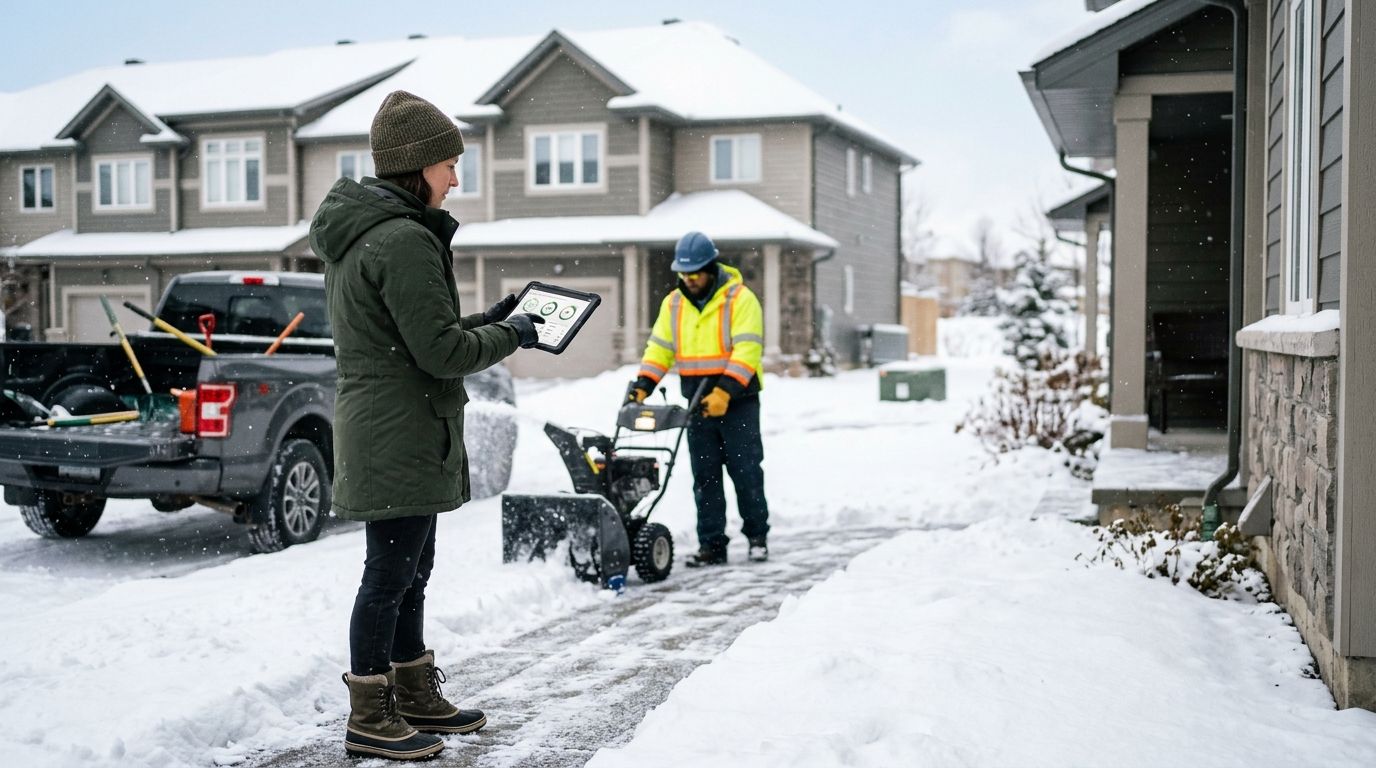

When a slip-and-fall claim lands on your insurer's desk in February 2026, the adjuster doesn't want your word that the lot was salted — they want the timestamp, the trigger depth, and the crew name on file. Instead of digging through text messages and invoices after the fact, build a running insurance audit file that updates itself every time a storm hits, so the documentation is already sitting in the folder before anyone asks for it.
- A snow removal service logs insurance audit file needs date, trigger depth, arrival/departure time, and treatment type for every visit — not just an invoice line.
- St. Louis Snow Removal structures proof-of-service logs by storm event so they map directly to a COI renewal or claims request.
- Build the file once at the start of the 2026-2027 season, then feed it automatically after each storm instead of reconstructing it during a claim.
- Photos with geo-stamps and clock-ins strengthen the audit file more than a plain service invoice does.
Why this matters
Insurance carriers underwriting commercial snow and ice contracts increasingly ask for documented proof of service before they'll renew a policy, and property insurers investigating a slip-and-fall claim ask for the same thing after an incident. If your only record is a monthly invoice that says "snow removal — January," you have no trigger depth, no arrival time, and no way to show the walkway got treated before the claimant fell.
An audit-ready file turns a vague invoice into a defensible record: date, storm depth, time on site, treatment method, and who signed off. That's the difference between a claim that settles in your favor and one where the carrier assumes the worst because you can't prove otherwise. St. Louis Snow Removal builds this documentation at the point of service, not after a lawyer calls.
Before you start
- Know what your carrier or PM software actually asks for. Most commercial policies want date, time, location, weather trigger, and treatment on every visit — confirm the exact fields with your broker before you build the file, not after.
- Decide where the audit file lives. A shared drive folder, your property management platform, or your insurance broker's portal — pick one system of record so logs don't scatter across email threads and someone's phone.
- The gotcha: service logs that only show a date and a total, with no trigger depth or arrival time, look identical to a carrier whether the lot got treated once or six times during a storm. Fix the log format before the season starts, not mid-storm when you're trying to retrofit three months of undocumented visits.
Set up your storm-by-storm log format
- Create one row or one entry per storm event, not per invoice period. A single January storm might need two or three visits — log each one separately.
- Capture five fields minimum for every visit: date, arrival time, departure time, trigger depth (the snowfall or ice accumulation that triggered dispatch), and treatment type (plow, salt, de-ice, sidewalk clear).
- Add a crew ID or technician name field. Carriers and courts both want to know who was on site, not just that "a crew" showed up.
- Tag each entry with the contract model it falls under — Zero-Tolerance, Seasonal, or Per-Occurrence — since insurers read liability exposure differently depending on which trigger obligated the visit.
Expected result: a log where any single row, read on its own, tells an adjuster exactly when the property was serviced, how deep the snow was, and who did the work — no follow-up questions needed.
Build the audit file structure
- Create a top-level folder for the policy year — label it by season (e.g., "2026-2027 Snow Season") so renewals and claims searches land in the right place fast.
- Inside it, create one subfolder per property or contract, matching how your policy schedules locations.
- Store the storm-by-storm log as a running spreadsheet or exported PDF inside each property folder, updated after every visit rather than batched at month-end.
- Drop timestamped photos into the same folder, named with the date and storm event so they sort chronologically next to the log entry they support.
Expected result: any property's folder, opened cold, shows a complete storm history for the season — logs and photos aligned by date, ready to hand to a broker or adjuster without extra assembly.
Attach logs to your COI and policy renewal
- Before your certificate of insurance renews, pull the season's audit file and check it against what your carrier's application actually asks for — trigger depth documentation, treatment records, and crew accountability are common asks.
- Export the property-level logs as a single PDF per location and attach them to the renewal packet your broker submits.
- Flag any storm where a visit was delayed past your contract's trigger window — carriers read a documented delay far better than a gap with no explanation at all.
Expected result: your broker submits a renewal backed by actual service records instead of a blanket claim that "service was provided as needed," which is the phrase underwriters flag hardest.
Variant: update the file automatically after every storm
Building the folder once is the easy part — keeping it current through a full St. Louis winter is where most property managers fall behind. Instead of reconstructing three months of logs in March, wire the update into the storm response itself.
- Require geo-stamped clock-ins at arrival and departure for every crew, feeding directly into the storm log rather than a separate timesheet.
- Require a photo at the start and end of every visit, timestamped and geo-tagged, filed into the same property folder the log lives in.
- Route both the log entry and the photos into the audit file the same day service happens — same-day filing is what makes the difference between an audit-ready record and a reconstructed one.
This is close to the workflow covered in connecting proof-of-service logs to your PM software, and it overlaps directly with what a slip-and-fall defense file needs — see connecting timestamped snow photos to your slip-and-fall defense file for the photo-specific version of this same build.
Troubleshooting
- Logs show a date but no trigger depth. Go back to the crew's dispatch record — most contractors track snowfall totals for billing even when the client-facing invoice strips it out. Ask for the raw dispatch data, not the summarized invoice.
- Photos exist but aren't geo-tagged. A photo without location metadata is weak evidence in a claim dispute. Switch the crew's capture method to a tool that stamps GPS coordinates automatically, or the photo proves nothing beyond "a lot, sometime."
- The audit file has gaps during a multi-day storm. Multi-day events often get logged as one entry when they should be several. Split any storm lasting more than 24 hours into separate visit entries — carriers and courts both expect visit-level granularity, not storm-level summaries.
- Crew names are missing from older entries. If historical logs predate a crew-ID requirement, note it plainly in the file rather than guessing — an honest gap beats a fabricated name if the file is ever subpoenaed.
- The renewal packet doesn't match the policy's actual documentation ask. Confirm the required fields with your broker every season; carrier requirements shift year to year, and a 2025 checklist won't necessarily satisfy a 2026 underwriter.
Get documented service on your account
Storm-by-storm logs, trigger depths, and geo-stamped visits built into every contract.
Customize your workflow
Once the audit file is running, extend it past insurance. The same storm-by-storm log feeds a maintenance calendar, a striping schedule, and your accounting reconciliation without rebuilding anything. If your invoices don't already tie back to individual visit logs, the next step is lining up billing with service records the same way — that process is covered separately and worth doing before your 2026-2027 renewal, not after.
FAQ
What does an insurance carrier actually want in a snow removal service log?
Most carriers want date, arrival and departure time, trigger depth, treatment type, and crew identification for every visit. A monthly invoice total without those fields doesn't satisfy a documentation request.
How long should I keep snow removal service logs for insurance purposes?
Keep logs for the full policy period plus any statute-of-limitations window that applies to slip-and-fall claims in your state, since claims can surface well after the season ends. Check with your broker or attorney for the exact retention period that applies to your properties.
Is a photo enough proof of service without a written log?
No. A photo shows a moment in time but not the trigger depth or treatment applied. Pair every photo with a written log entry so the two corroborate each other.
Do Zero-Tolerance and Seasonal contracts need different documentation?
Yes. Zero-Tolerance contracts need trigger-by-trigger visit logs since any accumulation obligates a response, while Seasonal contracts need documentation tied to scheduled service windows rather than every snowfall.
Can I use the same audit file for a slip-and-fall defense and an insurance renewal?
Yes, as long as the file captures visit-level detail. A file built for renewal documentation — date, time, trigger, treatment, crew — already contains what a defense attorney needs for a claim.
What's the biggest documentation mistake property managers make?
Batching service records at month-end instead of filing them the same day service happens. Reconstructed logs read differently to a carrier than same-day records, and gaps are harder to explain months later.
One last thing
The single field most audit files skip is trigger depth — the snowfall or ice accumulation that actually obligated the visit. Without it, a carrier can't tell the difference between a proactive treatment and a reactive one after someone already fell, and that distinction is often what decides a claim.