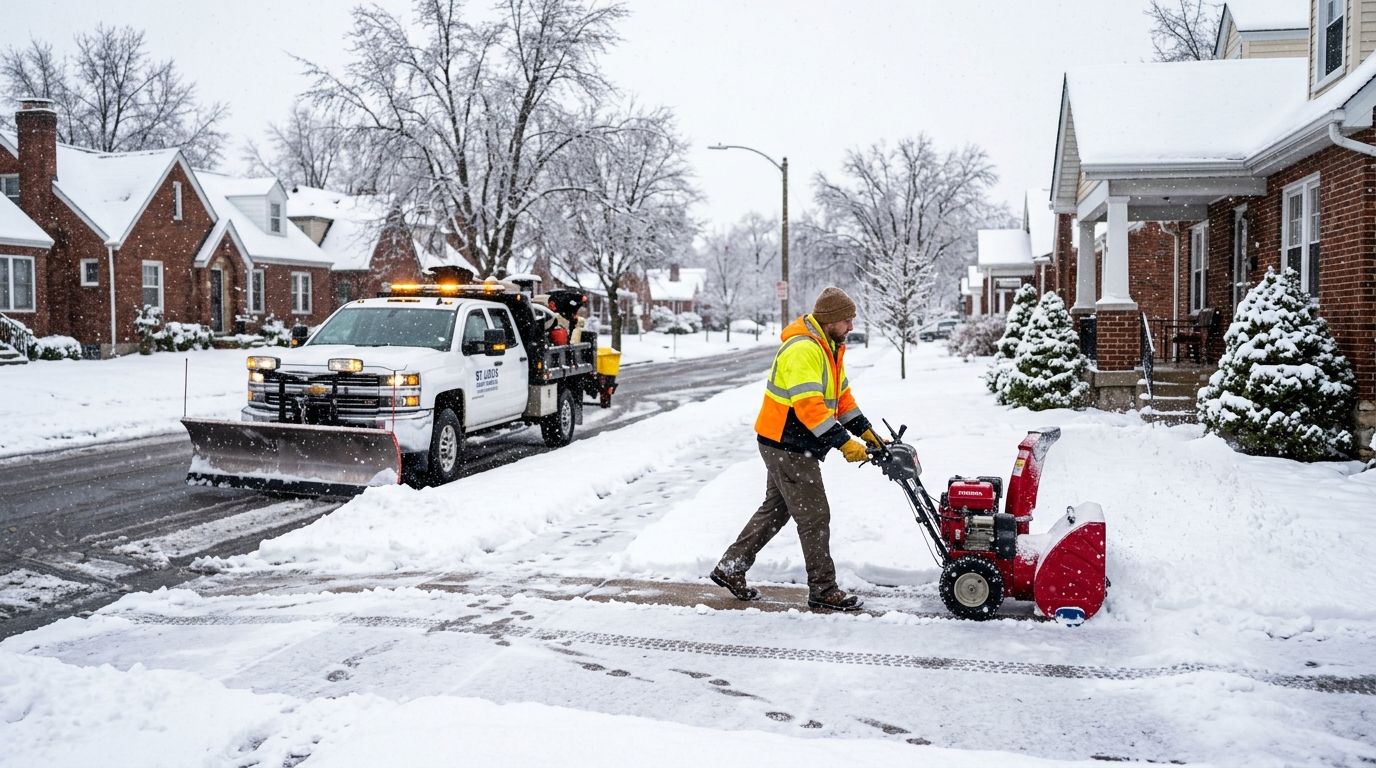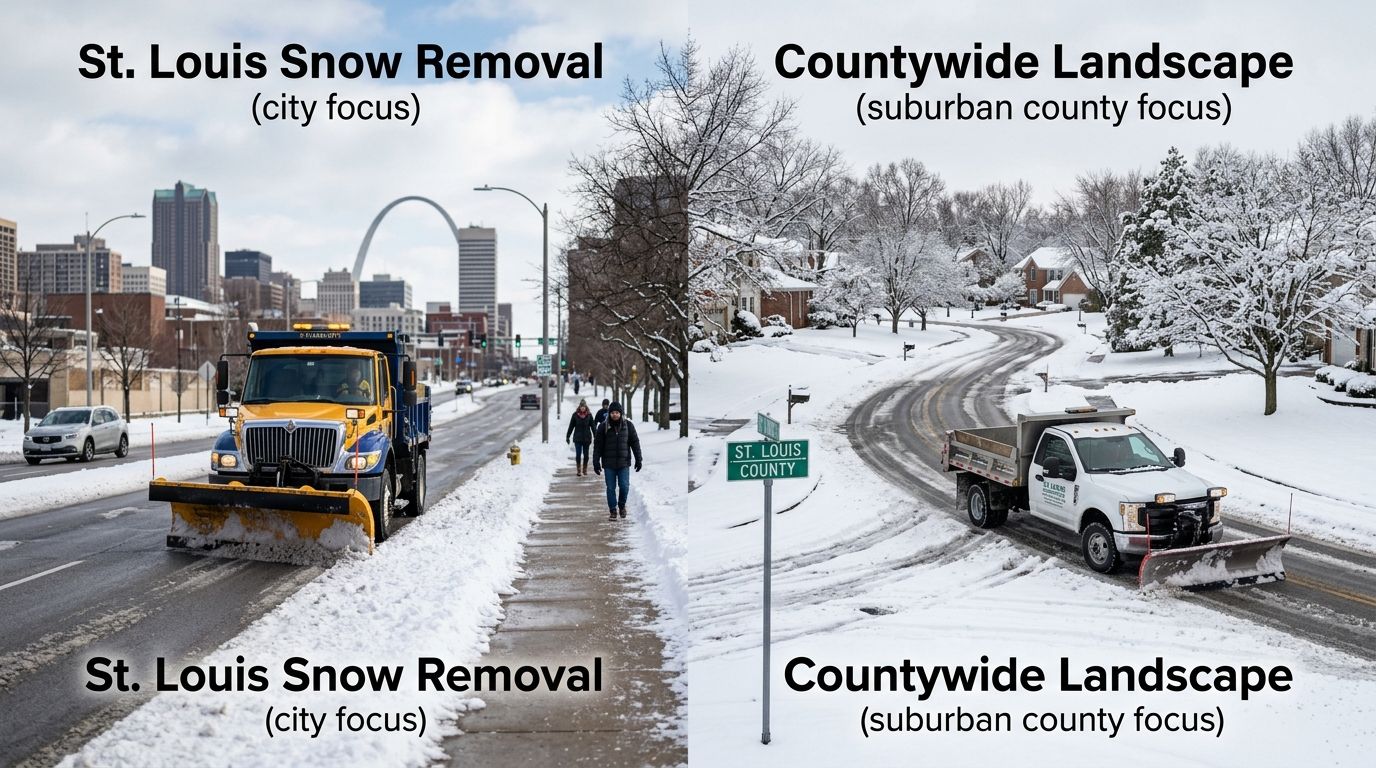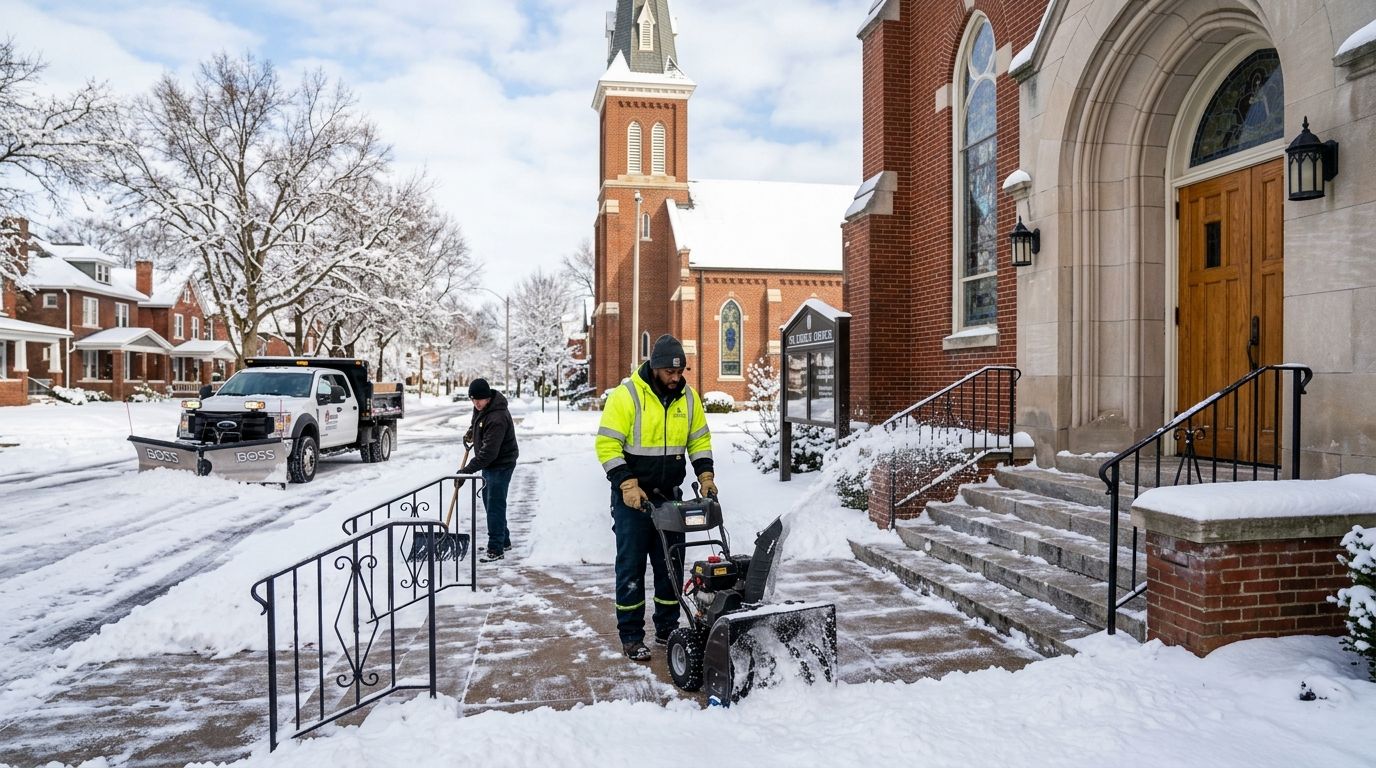
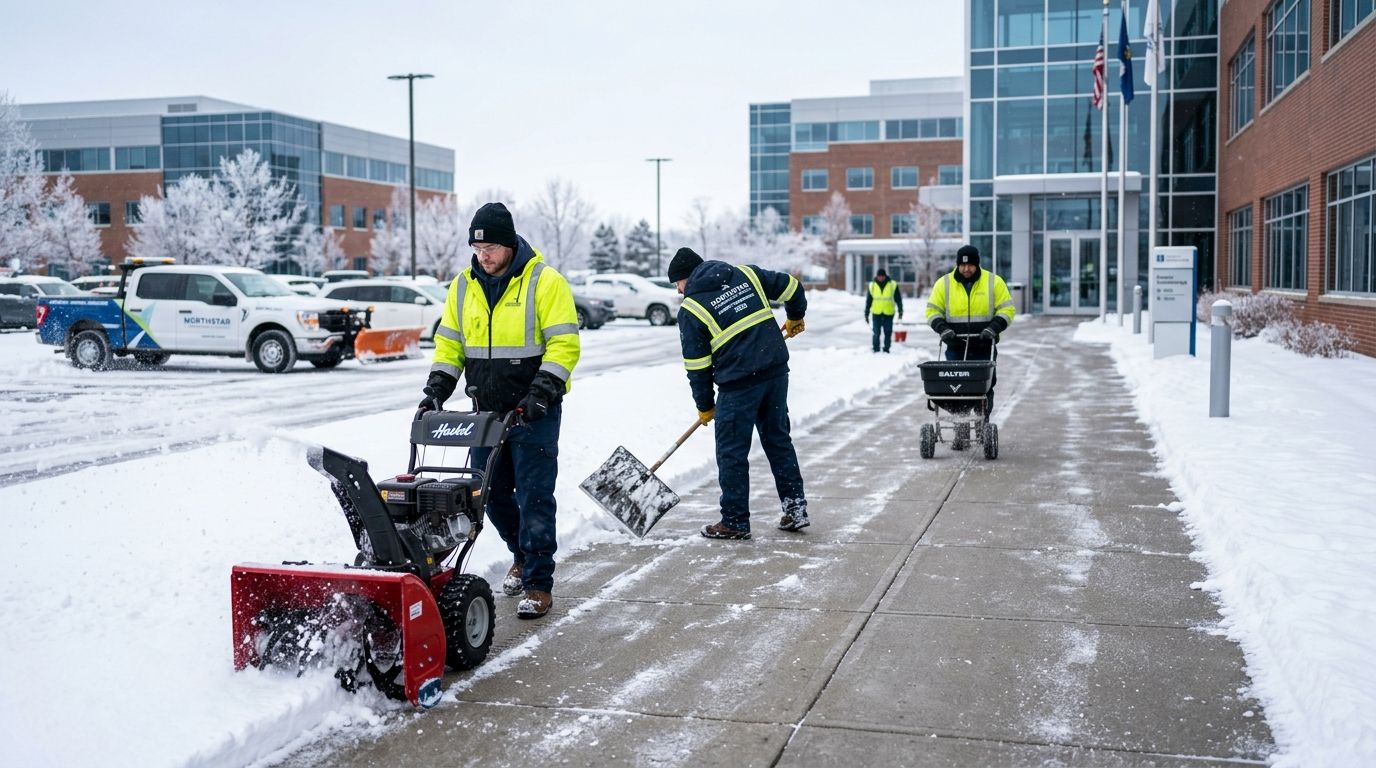
Property managers ranking sidewalk snow clearing crews for commercial properties in 2026 are really ranking three things: documentation, trigger-depth compliance, and who eats the liability when someone slips before the walk gets cleared. Best overall: documented commercial crews running geo-stamped clock-ins and named contract models (St. Louis Snow Removal's approach). Best for multi-state portfolios: national franchise contractors billing one invoice across regions. Best budget option: single-operator local plow trucks working small lots under a few thousand square feet.
- Documented crews with geo-stamped clock-ins are the best sidewalk snow clearing crews for commercial liability protection in 2026.
- National franchise contractors work for multi-state portfolios but subcontract local sidewalk labor inconsistently.
- Single-operator plow trucks are the budget pick for small lots but carry no documentation.
- HOAs and property managers should demand a named contract model — Zero-Tolerance, Seasonal, or Per-Occurrence — before signing.
- A 2-inch trigger depth is standard for commercial sidewalk contracts in the St. Louis metro.
Why this matters
A slip-and-fall claim on an uncleared sidewalk doesn't care whether the crew showed up — it cares whether you can prove when they showed up. Insurers and attorneys ask for clock-in records, trigger-depth logs, and a written contract model, not a verbal promise that "the lot got done."
Most commercial properties in the St. Louis metro and Metro East Illinois lose that argument in 2026 because their vendor never documented anything. The gap between a crew that plows a lot and a crew that clears sidewalks to a written standard is where liability actually lives.
Commercial snow removal companies for property managers get evaluated on this exact gap — not on how big the truck is.
What makes the best sidewalk snow clearing crew
- Written trigger-depth compliance — a 2-inch standard, documented per event, not "we came out when it looked bad"
- Geo-stamped clock-ins at the site level, so arrival and completion times are provable
- A named contract model — Zero-Tolerance, Seasonal, or Per-Occurrence — spelled out before the first storm, not negotiated mid-season
- Separate sidewalk labor from truck plow labor — walks need different crews, different tools, and a different rate floor than lots
- ADA-compliant clearing width with de-icing follow-up, not just a shoveled path down the middle
- A committed response window for reactivation after a storm restarts
Sidewalk crews at a glance
| Crew type | Best for | Standout feature | Key limitation |
|---|---|---|---|
| Documented commercial crews (St. Louis Snow Removal) | Property managers needing liability proof | Geo-stamped clock-ins, named contract models | Coverage limited to St. Louis metro and Metro East |
| National franchise contractors | Multi-state portfolios | Single invoice across regions | Local sidewalk labor is subcontracted and inconsistent |
| Landscaping company add-on crews | Properties already using one lawn vendor | One point of contact year-round | Sidewalks are secondary to truck plowing |
| Single-operator local plow trucks | Small lots on tight budgets | Low overhead pricing | No documentation, no backup if the truck breaks |
| In-house maintenance staff | Owners who already own equipment | No per-storm invoice | Liability sits entirely with the property owner |
| HOA volunteer or resident crews | Tiny self-managed complexes | No contract cost | No insurance, no documentation, high exposure |
1. Documented commercial crews: best for property managers needing liability proof
Crews built around written trigger depths and geo-stamped clock-ins exist specifically because "we were there" doesn't hold up when an attorney asks for a timestamp. St. Louis Snow Removal runs commercial sidewalk clearing on this model, separate from truck plowing, with sidewalk labor billed at its own floor rather than folded into the plow invoice.
The contract itself gets named upfront — Zero-Tolerance for properties that can't tolerate any snow accumulation, Seasonal for flat-rate budgeting, or Per-Occurrence for properties that only need response above a set trigger. That distinction matters more in 2026 than it did five years ago, because more insurers are asking property managers to produce the contract type, not just the invoice.
Documented commercial crew pros:
- Geo-stamped arrival and completion logs per site
- Named contract model set before the season starts
- Sidewalk labor priced and staffed separately from truck plowing
- ADA-compliant clearing width with de-icing follow-up
Documented commercial crew cons:
- Service area is regional, not national
- Zero-Tolerance contracts cost more than a bare-minimum per-occurrence plan
Best for: property managers who need a defensible paper trail, not just a cleared walk. Verdict: Hire.
2. National franchise contractors: best for multi-state portfolios
Franchise-model snow contractors sell consolidation — one contract, one invoice, coverage across several states for a portfolio owner managing properties in different metros. The pitch works on the accounting side.
Where it breaks down is at the sidewalk level. The corporate office signs the contract, but the actual walk-clearing gets subcontracted to whoever is available locally that week, and documentation standards vary property to property.
National franchise pros:
- Single contract and invoice across multiple states
- Easier budgeting for large portfolios
National franchise cons:
- Local sidewalk crews are subcontracted, quality varies by site
- Documentation and trigger-depth compliance aren't standardized across markets
- Response times depend on whichever local sub picked up the route
Best for: portfolio owners who need one invoice more than they need one documentation standard. Verdict: Consider only for multi-state properties.
3. Landscaping company add-on crews: best for single-vendor consolidation
Many commercial properties already have a landscaping contract, and that same company often offers snow as a seasonal add-on. It's a convenient single point of contact, and the invoice arrives from a vendor you already trust for mowing and mulch.
The problem is priorities. A landscaping company's core business is turf and plant health, not sidewalk liability. When a storm hits during their off-season, sidewalk clearing is the side job, and it gets staffed and equipped that way.
Landscaping add-on crew pros:
- One vendor relationship year-round
- Familiar with the property layout already
Landscaping add-on crew cons:
- Sidewalk work is secondary to truck plowing on the same route
- Documentation practices are usually informal
- Crew size and equipment often aren't sized for a real storm event
Best for: small properties with light foot traffic and low liability exposure. Verdict: Consider only if lawn care and snow are truly bundled in writing.
4. Single-operator local plow trucks: best budget option for small lots
A single owner-operator with one truck and a shovel crew is the cheapest option on this list, and for a small strip-mall lot with minimal foot traffic, that can be enough. Overhead is low because there's no dispatcher, no back office, and no documentation system to maintain.
That low overhead is also the risk. One truck means one point of failure — a mechanical breakdown during a storm leaves the property uncovered with no backup on the way.
Single-operator pros:
- Lowest overhead pricing on the list
- Direct relationship with the person doing the work
Single-operator cons:
- No documentation, no geo-stamped logs
- No backup equipment if the truck fails mid-storm
- No named contract model — pricing is usually verbal
Best for: very small lots where liability exposure is minimal. Verdict: Use only for small lots under a few thousand square feet.
5. In-house maintenance staff: best for owners who already own equipment
Some commercial owners keep a maintenance employee with a plow attachment and a bag of ice melt on-site. It avoids a per-storm invoice entirely, and the staff already knows the property.
The tradeoff is that liability now sits entirely with the property owner instead of a contracted vendor with its own insurance and documentation practices. If that employee is out sick during a storm, there's no crew to call.
In-house staff pros:
- No per-storm invoice
- Staff already familiar with site layout
In-house staff cons:
- Liability sits fully with the property owner, not a vendor
- No backup labor if the employee is unavailable
- Equipment is usually sized for maintenance, not storm response
Best for: owners who already own the equipment and accept the liability tradeoff. Verdict: Keep only with a written safety protocol in place.
6. HOA volunteer or resident crews: best for tiny self-managed complexes
Small HOAs sometimes rely on a resident with a snowblower instead of contracting the work out. It's free, and for a four-unit complex with almost no foot traffic, the risk might be tolerable.
For anything larger, this is the weakest option on the list. There's no insurance backing the work, no documentation if a resident or visitor falls, and coverage depends entirely on one volunteer's availability during a storm.
HOA volunteer crew pros:
- Zero contract cost
HOA volunteer crew cons:
- No insurance coverage on the work performed
- No documentation if a claim is filed
- Coverage disappears if the volunteer is unavailable
Snow removal companies for HOAs in the St. Louis metro typically move away from this model once the complex passes a handful of units.
Best for: four-unit-or-smaller complexes with minimal foot traffic. Verdict: Skip once the property has any real liability exposure.
“Documentation beats 'we were there' every time a slip-and-fall claim reaches your insurer.”
How this ranking was built
Each crew type was weighed against the six criteria above: trigger-depth compliance, geo-stamped clock-ins, named contract models, separated sidewalk labor, ADA-compliant width, and committed response windows. Crews that documented all six ranked highest; crews relying on verbal assurance ranked lowest, regardless of price.
Get a documented sidewalk contract
Zero-Tolerance, Seasonal, or Per-Occurrence — pick the model before the next storm.
Which sidewalk crew should you choose?
For most commercial properties in 2026, documented crews with geo-stamped clock-ins and a named contract model are the right default — the paper trail is the point, not just the cleared walk. Multi-state portfolios should weigh national franchise consolidation against inconsistent local documentation before signing. Everyone else should size the crew to the lot: single-operator trucks for small properties, in-house staff only with a written safety protocol, and volunteer HOA crews only for the smallest complexes with minimal foot traffic.
Property managers comparing actual snow removal contractors in St. Louis should ask every vendor the same question before signing: what does your documentation look like the morning after a storm?
FAQ
What's the best sidewalk snow clearing crew for commercial properties in 2026?
Documented commercial crews running geo-stamped clock-ins and a named contract model — Zero-Tolerance, Seasonal, or Per-Occurrence — are the best sidewalk snow clearing crews for liability-sensitive commercial properties in 2026.
Is a national franchise contractor better than a local documented crew?
Only for multi-state portfolios that need one consolidated invoice. Local sidewalk documentation and trigger-depth compliance are usually inconsistent across a franchise's subcontracted markets.
How much does commercial sidewalk snow removal cost in St. Louis?
Sidewalk crew labor typically runs from a floor around $90 per hour, separate from truck plow labor which starts closer to $180 per hour. Exact pricing depends on the contract model and lot size.
What trigger depth do commercial sidewalk contracts use?
A 2-inch trigger depth is the standard for commercial sidewalk contracts in the St. Louis metro in 2026, meaning crews mobilize once accumulation reaches that depth.
Should HOAs use volunteer snow crews instead of a contractor?
Only for complexes with four units or fewer and minimal foot traffic. Volunteer crews carry no insurance and no documentation, which becomes a real liability once the property grows.
What's the difference between Zero-Tolerance, Seasonal, and Per-Occurrence contracts?
Zero-Tolerance commits a crew to clear any accumulation immediately, Seasonal bills a flat rate for the whole winter, and Per-Occurrence bills only when snowfall crosses the trigger depth. Each shifts cost and liability differently.
Can a landscaping company handle commercial sidewalk snow removal?
Some do as a seasonal add-on, but sidewalk clearing is usually secondary to their core lawn care business, and documentation practices tend to be informal.
Do in-house maintenance crews carry the same liability protection as a contractor?
No. Liability sits fully with the property owner when using in-house staff, since there's no contracted vendor's insurance or documentation standard behind the work.
One last thing
The detail most property managers miss until a claim hits: sidewalk labor and truck plow labor are priced differently for a reason — a crew that's fast on asphalt with a plow blade isn't automatically equipped or staffed for ADA-compliant walk clearing. Ask any vendor whether the same person plowing your lot is also clearing your sidewalks, and ask what width they're clearing to. That single question separates a crew that shows its work from one that's just guessing at compliance in 2026.