Residential snow-route service typically can't be paused mid-season the way a subscription gets put on hold — most providers treat it as either "skip this storm" or "cancel the enrollment," with nothing in between. Canceling and trying to re-enroll later in the same winter usually means starting over, not resuming where you left off, because route sequencing is locked in before the first storm hits.
- You generally can't pause residential snow route service mid-season — it's skip-a-storm or cancel outright.
- Enrolled residential snow-route service runs on a pre-built route sequence, not an on/off toggle.
- Canceling in January and re-enrolling in February often means rejoining at the back of the plow sequence.
- A seasonal snow removal contract locks pricing and priority for the whole winter, which is why mid-season changes are limited.
Why this matters
A snow route isn't a delivery subscription you click off for two weeks. It's a physical sequence a plow truck drives, storm after storm, in the same order every time to keep drive times predictable. Pull one address out and put it back in three weeks later, and the truck's path has to be rebuilt — which is why most enrolled residential snow-route service programs don't offer a mid-season pause button.
Homeowners ask this question for a few reasons: an extended vacation, a house going on the market, or simply wanting to skip a storm that looks minor. Each of those has a different answer, and treating them the same way costs you your spot in the route.
Can you pause a residential snow route service in the middle of winter?
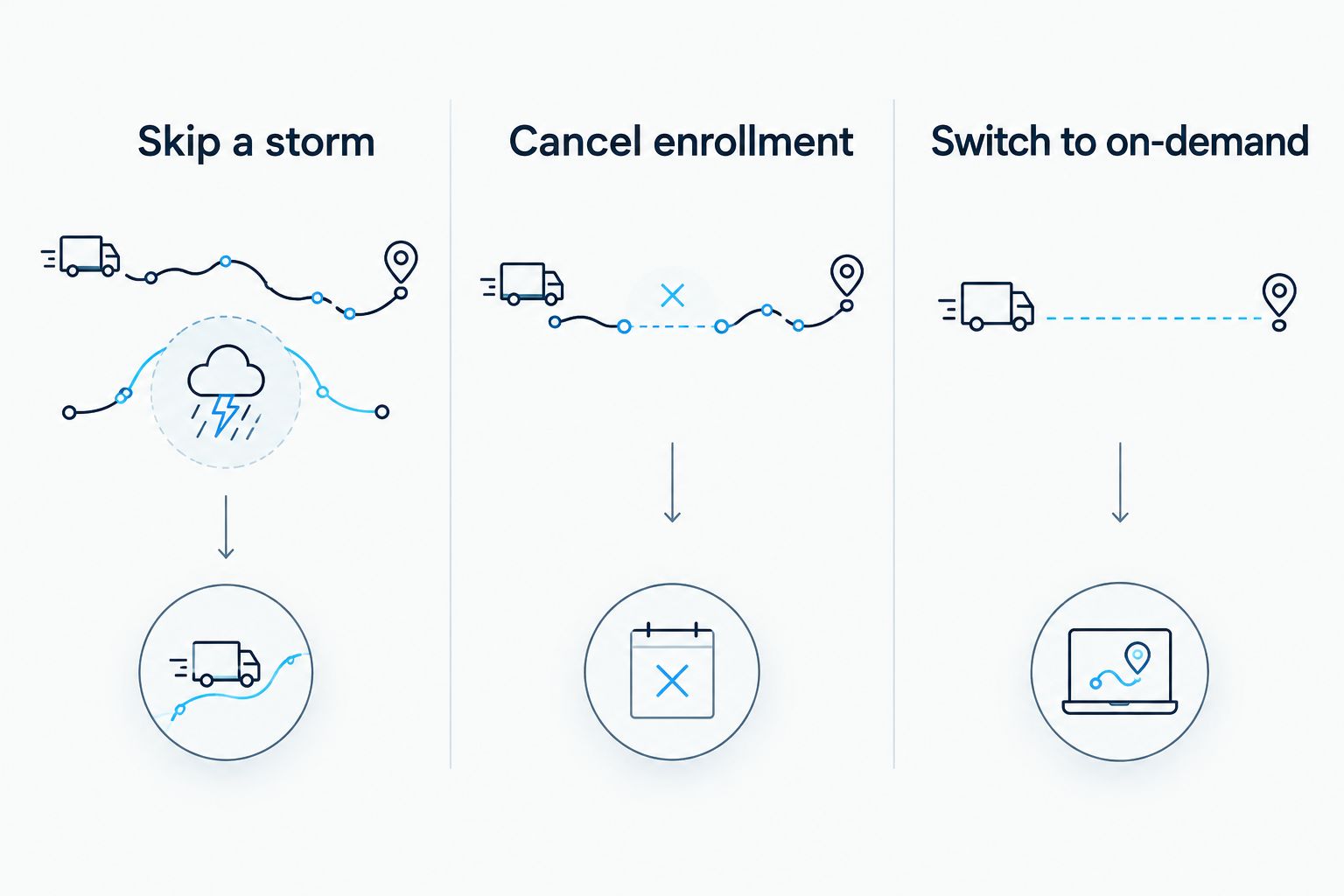
Most residential snow-route programs give you two real options once winter starts: skip an individual storm, or cancel the enrollment entirely. A true pause — stop for three weeks, resume automatically — isn't standard, because the route is built once per season and dispatched storm by storm off that fixed sequence.
Here's how the three realistic paths compare:
| Option | What happens to your spot in the route | Best for |
|---|---|---|
| Skip one storm | You stay enrolled; the truck passes your address for that event only | A short trip, no car in the driveway that day |
| Cancel mid-season | You're removed from the route; rejoining later means a new signup, not a resume | Selling the house, moving out of the coverage area |
| Switch to on-demand | Route enrollment ends; single-visit requests replace it | You're unsure you need every storm covered |
Verdict: enrolled residential snow-route service doesn't have a pause setting — you're either on the route for the storm or you're off it, and "off it" for more than one storm usually means canceling.
“A snow route isn't a subscription you toggle off for two weeks — it's a physical sequence a truck drives.”
Why pausing mid-season is hard for route-based dispatch
A handful of operational realities drive this, not policy stubbornness:
- Routes are sequenced before the season starts. Adding and removing stops mid-winter forces a full resequencing, which delays every other house on that truck's path.
- Crews are dispatched per storm, not per address. A driver commits to the whole route once triggered, so a mid-storm pause request doesn't reach the truck in time to matter.
- Labor floors make partial visits inefficient. Commercial dispatch runs on minimums like $90/hr and $180/hr call floors for a reason — sending a truck out for one paused-then-resumed stop doesn't pencil out the same way as a full route pass.
- Seasonal enrollment is priced as a season, not a per-visit fee. A seasonal snow removal contract locks in coverage for the winter, which is part of why mid-season toggling isn't built into the model.
- Weather doesn't wait for scheduling changes. Storms in the St. Louis metro and Metro East can move up or down the forecast window fast, and a route rebuilt around a temporary pause creates gaps right when snowfall is heaviest.
Does skipping one storm count as pausing service?
No — skipping one storm keeps you enrolled on the residential snow route, while pausing implies stopping for an extended stretch that most providers don't support. A skip request for a single event is a courtesy adjustment; a multi-week gap functions the same as cancellation in practice.
What happens if you cancel a residential snow route mid-season?
Canceling mid-season removes your address from the plow sequence for the rest of that winter in most cases, and re-enrolling later starts a new signup rather than resuming your old slot. If you cancel in January expecting to come back in February, you're competing for a route spot alongside everyone else trying to enroll that month — not returning to where you were.
Can you switch from a snow route to on-demand service instead?
Yes, switching from an enrolled route to on-demand, per-visit requests is usually possible, but it ends your seasonal enrollment rather than pausing it. That trade-off makes sense if you only need occasional coverage, but it also means losing the guaranteed route priority that comes with enrollment for the rest of 2026's winter season.
Check your route enrollment options
See how residential snow-route enrollment works before the next storm hits.
The enrollment-to-dispatch mechanics are the same reason first-time signups matter: the route enrollment to first plow workflow shows how a new address gets slotted into an existing sequence, which is the same process you'd go through if you cancel and come back mid-2026.
FAQ
What's the best way to skip service during a vacation?
Call or message the provider before the forecasted storm and request a single-event skip, not a cancellation. This keeps your address on the route for every storm after you're back.
Is pausing a residential snow route different from canceling it?
Yes — a pause implies temporary, resumable coverage, while canceling removes you from the route sequence entirely. Most providers only offer the cancel option for anything longer than one storm.
Can I switch back to a snow route after canceling mid-season?
Usually, but you re-enroll as a new signup rather than resuming your old route position. Depending on how full the route is by that point in 2026, you may wait for the next available slot.
Does a seasonal contract cost more than per-push pricing?
It depends on how many storms hit that winter — seasonal pricing locks in one cost for the whole season, while per-push charges accumulate storm by storm. The seasonal-versus-per-push comparison breaks down when each model wins.
What happens to my spot in the route if I cancel in January?
You lose it. The route is resequenced without your address, and rejoining later in the 2026 season means fitting into whatever gaps exist rather than reclaiming your original slot.
Is on-demand snow removal better than an enrolled route for occasional needs?
For infrequent needs, on-demand avoids paying for a full season of coverage, but it drops the guaranteed route priority enrolled homeowners get during heavy storm stretches.
Do HOAs allow individual homeowners to pause snow service separately?
That depends on how the HOA's contract is structured — some enroll every address as one block, which removes the option for a single homeowner to pause independently of the community.
How much does residential snow removal cost in St. Louis in 2026?
Costs vary by contract type and property size, with seasonal and per-push pricing structured differently. Check current residential snow removal costs in St. Louis for the specific breakdown.
One last thing
If the goal is just to skip one storm that looks like it'll be minor, call ahead and ask for a skip — don't cancel. Canceling in the middle of winter and trying to come back in a few weeks almost always lands you behind every other homeowner who enrolled while you were off the route, which is a worse outcome than just riding out one storm you didn't need.