De-icing salt can damage concrete and asphalt, but the salt itself is a secondary factor — freeze-thaw cycling, surface age, and application rate do more damage than sodium chloride alone. New concrete under 12 months old takes the worst of it, calcium and magnesium chloride blends carry more corrosion risk than plain rock salt, and asphalt tolerates chloride better than concrete but gets blamed for damage that's actually plow-blade wear.
- De-icing salt damages concrete and asphalt mainly through freeze-thaw scaling, not the chloride itself.
- New concrete under 12 months old is the highest-risk surface for salt damage in 2026.
- Sodium chloride causes less concrete damage than calcium chloride or magnesium chloride blends.
- St. Louis Snow Removal logs deicer type and application rate on every visit to limit over-salting.
Why this matters
Property managers assume "use less salt" is always the right call, then a spalled sidewalk or a cracked garage deck shows up months later with no record of what caused it. Over-salting wastes money, but under-salting an icy lot is a liability problem — the deicer type and the rate applied matter more than the yes/no decision to salt at all.
St. Louis Snow Removal logs deicer type, application rate, and surface conditions on every visit for exactly this reason: "we used salt" isn't a defensible answer when a property manager or an insurer asks what happened to a lot in 2026.
Does de-icing salt damage concrete and asphalt surfaces?
Yes, but the mechanism matters more than the yes. Chloride-based deicers pull moisture into concrete's surface pores, and when that moisture refreezes it expands and pops off the top layer — a process called scaling or spalling. Asphalt doesn't have the same pore structure, so it tolerates chloride better, but it's more vulnerable to plow blade damage on a softened surface and to oil or gas spotting.
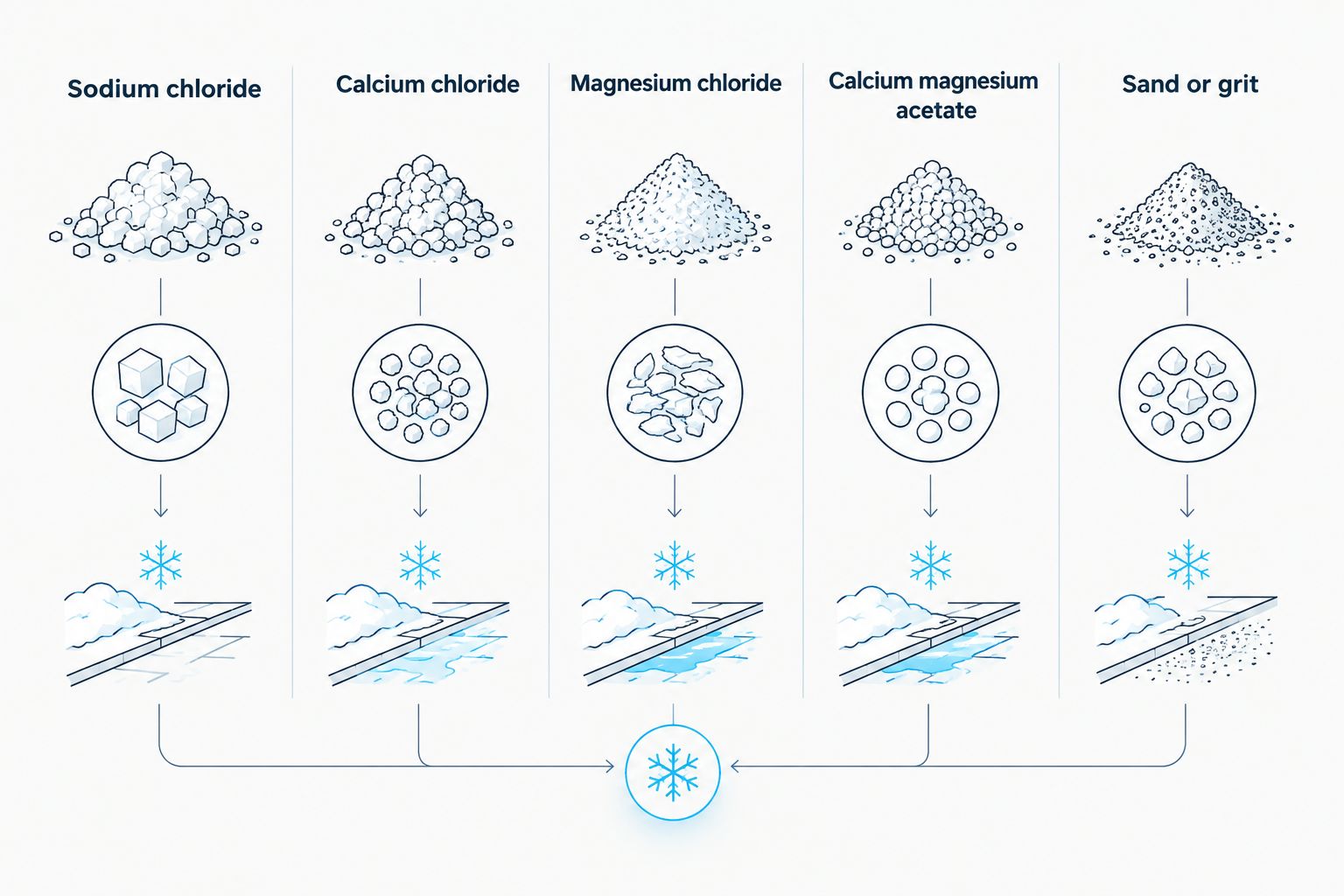
Not every deicer carries the same risk profile:
| Deicer | Effective down to | Concrete/asphalt risk | Best for |
|---|---|---|---|
| Sodium chloride (rock salt) | about 15°F | Low to moderate | Most lots and sidewalks above 15°F |
| Calcium chloride | about -25°F | Moderate to high | Deep cold snaps and bonded ice |
| Magnesium chloride | about 0°F | Moderate | Mid-range cold, lower corrosion than calcium chloride |
| Calcium magnesium acetate (CMA) | about 20°F | Low | Parking garages, bridges, reinforced structures |
| Sand or traction grit | no melting action | Minimal to pavement | Already-bonded ice, budget-limited lots |
New concrete: the highest-risk surface for salt damage
Concrete poured within the last 12 months hasn't finished curing, and its surface pores stay open enough for chloride to penetrate before the slab builds full freeze-thaw resistance. Standard concrete industry guidance is to skip deicing chemicals through the first winter and clear new concrete with a shovel, broom, or sand traction instead. A sidewalk or lot poured in fall 2026 for winter use is exactly the surface that takes damage first and gets blamed on "bad concrete" second.
Asphalt: more tolerant, but plow damage looks like salt damage
Asphalt's petroleum binder resists chloride penetration better than concrete's porous surface, so salt alone rarely causes the raveling or alligator cracking property managers pin on it. What actually happens more often: a plow blade set too low scrapes the top layer off a lot already softened by age or heat, and the resulting damage shows up right after a storm and gets mislabeled as salt damage. Sealcoating and reasonable trigger depths do more for asphalt longevity in 2026 than switching deicer brands.
Parking garages and structural concrete: the rebar corrosion problem
Reinforced concrete carries steel rebar a few inches below the surface, and chloride ions that reach it accelerate corrosion, which expands the steel and cracks the concrete from the inside out. This is why garages and elevated decks usually call for CMA or a reduced-chloride blend instead of straight rock salt — on a structural deck, the deicer choice is a corrosion decision, not a cost decision. Ice management for parking garages covers deicer selection for structures where rock salt isn't the right call.
Why salt damage varies from lot to lot
- Concrete age — surfaces under 12 months old take the most damage from any chloride deicer.
- Application rate — over-application concentrates chloride in one spot instead of spreading exposure across the surface; see the salt application rate benchmarks for what a calibrated pass looks like per 1,000 square feet.
- Existing cracks and joints — water and chloride pool in unsealed joints and freeze there first.
- Freeze-thaw cycle count — a St. Louis winter with more freeze-thaw swings does more damage than one hard, steady freeze.
- Deicer chemistry — calcium and magnesium chloride melt faster in deep cold but carry more corrosion risk than sodium chloride.
- Drainage — meltwater that pools and refreezes overnight causes more scaling than water that drains off the lot.
Related questions
Is rock salt bad for asphalt driveways?
Rock salt is low-risk for asphalt driveways compared to concrete, since asphalt's binder resists chloride penetration. The bigger threat to an asphalt driveway is plow blade damage or gas and oil spotting, not the deicer itself.
How long should you wait to salt new concrete?
Wait through the first winter, roughly 12 months after the pour, before applying any deicing chemical to new concrete. Clear it mechanically with a shovel, broom, or sand traction in the meantime.
Does calcium chloride damage concrete more than rock salt?
Calcium chloride carries a higher damage and corrosion risk than sodium chloride because it penetrates faster and generates more heat during melting, which increases moisture cycling in the pores. It's still the right call in deep cold, since rock salt loses effectiveness below about 15°F.
Get a documented salting plan
Deicer type and rate calibrated to surface age and forecast.
FAQ
Is de-icing salt bad for concrete?
De-icing salt can damage concrete, mainly through freeze-thaw scaling on new or already-cracked surfaces. Concrete under 12 months old is the most vulnerable, and sodium chloride causes less damage than calcium or magnesium chloride blends.
How much rock salt should I use on a parking lot?
Application rate depends on lot size and ice conditions rather than a single fixed number, and over-application is what drives most avoidable surface damage. A calibrated per-visit rate, not a guess, keeps chloride exposure consistent.
Does asphalt get damaged by salt?
Asphalt tolerates chloride-based deicers better than concrete because its petroleum binder resists penetration. Most asphalt damage attributed to salt is actually plow blade wear or age-related cracking.
What's the safest deicer for a parking garage?
Calcium magnesium acetate (CMA) is the safest common deicer for parking garages because it doesn't accelerate rebar corrosion the way chloride-based products do. It's effective to about 20°F, which covers most garage-deck conditions.
Is magnesium chloride better than rock salt for concrete?
Magnesium chloride works down to about 0°F versus roughly 15°F for rock salt, but it carries a moderate damage risk compared to rock salt's low-to-moderate risk. Choose it for deep cold, not as a default upgrade.
Does sand damage pavement?
Sand and traction grit carry minimal risk to pavement because they don't melt ice chemically. They add cleanup and drainage debris instead, which is a maintenance cost rather than a surface-damage one.
Can salt damage cause a slip-and-fall liability issue?
A spalled or cracked surface caused by salt damage can create a new trip hazard even after ice is cleared. Documented application logs help show what deicer and rate were used if a claim ever questions the surface condition.
One last thing
The deicer most likely to damage a lot in 2026 isn't the cheapest one or the most expensive one — it's whatever gets over-applied because nobody's tracking the rate. A documented per-visit log of deicer type and quantity applied does more to prevent salt damage than switching brands ever will.