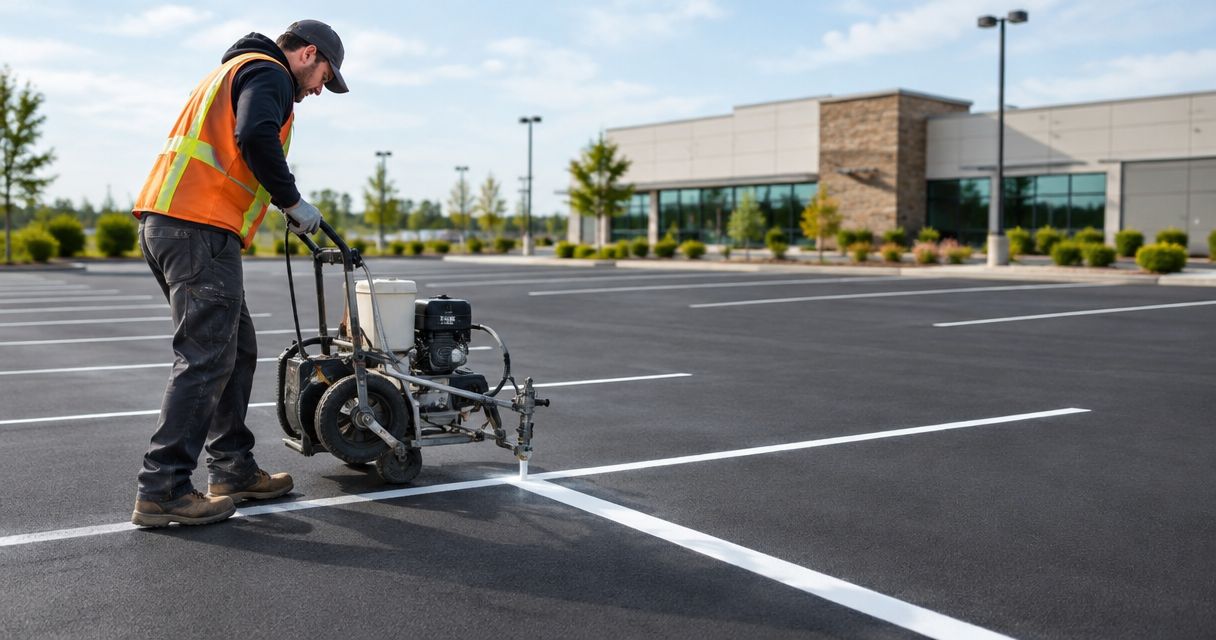
Parking lot striping cost by lot size comes down to one driver: stall count. Price scales with the number of stalls, the linear feet of line, and the ADA scope your lot triggers. This page benchmarks those three drivers for lots from 25 to 500 stalls in 2026, so you can check any striping quote against the actual work.
- Parking lot striping cost by lot size tracks stall count, line footage and ADA space count, not square footage alone.
- A standard stall is 9 ft by 18 ft, so line footage runs about 18 ft per stall.
- ADA accessible space counts step up at set stall thresholds: 1 space at 25 stalls, 9 at 500.
- Any quote that gives a lump sum without stall count and line footage is not comparable. Skip it.
Short answer: what drives striping cost by lot size in 2026
Striping cost rises with stall count, and it rises in steps, not in a smooth line. Small lots carry a fixed mobilization cost spread over few stalls. Large lots spread it thin but add ADA spaces, fire lanes, directional arrows and crosswalks.
This page does not publish a single dollar-per-stall average. No public source gives a defensible 2026 figure for St. Louis and Metro East, and a made-up number would send you into a negotiation with the wrong anchor. What it publishes instead is the scope math that every honest quote is built from. For St. Louis pricing context, see the parking lot striping cost breakdown for St. Louis.
Verdict: price striping by scope (stalls, line feet, ADA spaces), not by a flat per-lot number. St. Louis Snow Removal quotes striping this way for property managers.
Why this matters
Striping is the cheapest line item on most lot budgets and the most expensive to get wrong. A missing access aisle or an undersized van space is an ADA problem, and repainting a whole lot to fix it costs more than doing it right once.
Lot size also decides how you buy. A 25-stall lot is a single-crew, single-visit job. A 500-stall lot needs phasing so tenants and customers keep parking while paint cures.
Benchmark table: scope by lot size
The table below converts lot size into the quantities a striping contractor prices. Every figure is arithmetic from published standards: the common 9 ft by 18 ft stall, the planning rule of roughly 300 to 350 sq ft of paved area per space including drive aisles, and the ADA accessible space count table in the 2010 ADA Standards (section 208.2).
| Lot size (stalls) | Typical paved area | Stall line footage (approx.) | ADA accessible spaces required | Of those, van-accessible |
|---|---|---|---|---|
| 25 | 7,500 to 8,750 sq ft | 450 ft | 1 | 1 |
| 50 | 15,000 to 17,500 sq ft | 900 ft | 2 | 1 |
| 100 | 30,000 to 35,000 sq ft | 1,800 ft | 4 | 1 |
| 200 | 60,000 to 70,000 sq ft | 3,600 ft | 6 | 1 |
| 500 | 150,000 to 175,000 sq ft | 9,000 ft | 9 | 2 |
Stall line footage counts one 18 ft line per stall. Real lots run slightly different because adjacent stalls share lines and layouts add end islands, so treat the column as a scope marker, not a measured quantity. It excludes arrows, crosswalks, stop bars, fire lanes and curb painting.
High and low commentary
The 500-stall lot carries 20 times the stall line footage of the 25-stall lot (9,000 ft versus 450 ft) but only 9 times the ADA spaces (9 versus 1). Accessible-space scope grows slower than total scope, so ADA work is a larger share of the bill on small lots.
The jump from 100 to 200 stalls adds just 2 accessible spaces (4 to 6). The jump from 25 to 50 stalls doubles the count (1 to 2). Small lots feel ADA requirements the most per stall.
Methodology and limits
The table is derived from the 9 ft by 18 ft standard stall, a planning range of 300 to 350 sq ft per space, and the ADA 2010 Standards accessible-space table. Local codes in St. Louis County, St. Louis City and Illinois counties can require more than the federal minimum.
Limitation: this table sets scope, not price. It cannot tell you the per-foot or per-stall rate your contractor charges, which depends on paint type, surface condition, layout complexity and mobilization. Ask each bidder to show their rate against these quantities.
How to use these benchmarks
- Get quantities in writing. Require stall count, line footage and ADA space count on every quote. If two bids differ in scope, the cheaper one is not cheaper.
- Check ADA counts first. If your lot has 100 stalls and the quote shows fewer than 4 accessible spaces, the contractor is working from a layout that will not pass. Walk through the ADA accessible space striping workflow before you sign.
- Compare contractors on the same scope. Use the ranking of St. Louis striping contractors by price only after you have normalized quantities.
- Plan the closure. Cure time decides when stalls reopen. Read how long striping takes to dry before reopening before you schedule a 200-stall or 500-stall lot.
What changes the price at each lot size
Small lots: 25 to 50 stalls
Mobilization is the biggest share of the job. A single crew arrives, lays out, paints and leaves, usually in one visit. Expect the per-stall figure to be the highest of any size band because travel and setup are fixed. Bundling striping with other work at the same visit is how small-lot owners cut the effective rate.
Best for: single-tenant retail, small offices, medical suites. Verdict: buy as a bundled visit, not a standalone call.
Mid lots: 100 to 200 stalls
Line footage becomes the main cost. Layout complexity matters here: angled stalls, multiple drive aisles and a fire lane all add measured work. This is also the band where a restripe versus a full re-layout decision pays off, since a clean re-layout can fix ADA gaps in the same visit.
Best for: apartment complexes, office parks, shopping centers. Verdict: buy with an itemized scope.
Large lots: 500 stalls and up
Phasing drives cost as much as paint does. Closing sections of the lot in sequence keeps the property open but adds crew days. ADA count rises to 9 accessible spaces at 500 stalls, with 2 of them van-accessible, and marked routes to entrances add line work.
Best for: industrial parks, campuses, big-box centers. Verdict: buy phased, with written closure windows.
Striping and winter: a scope issue most quotes miss
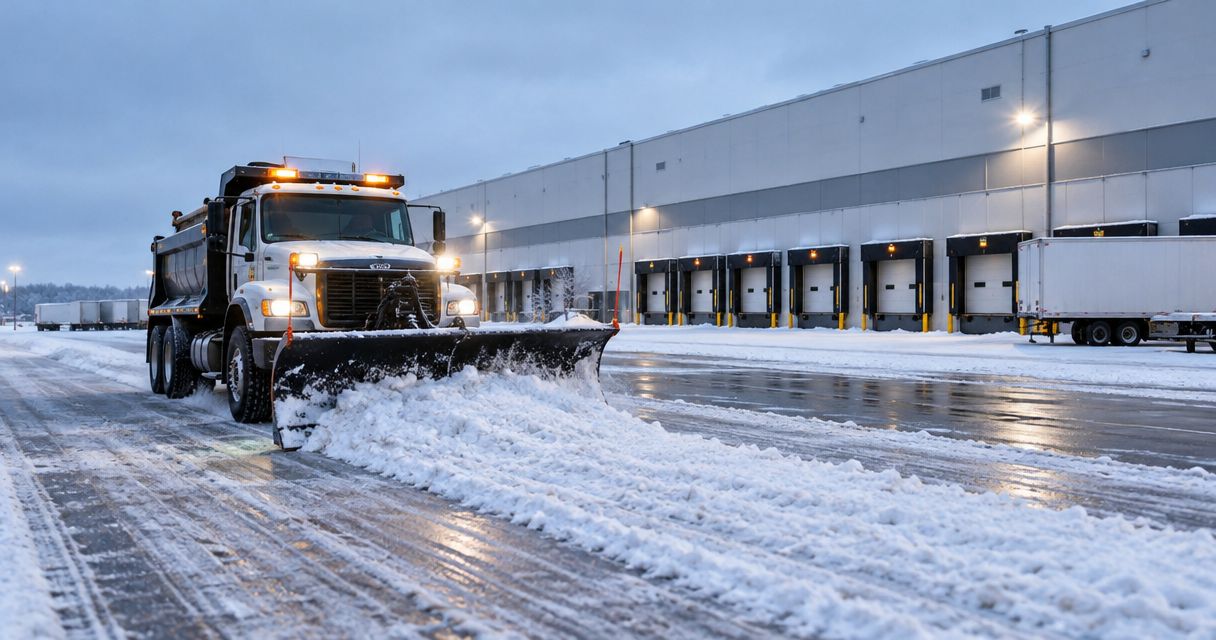
Plows scrape paint. A lot striped in fall and plowed 15 times shows it by spring, and thermoplastic and paint wear differently under blades and salt. If your lot has a snow contract, the plow crew and the striping crew should agree on pavement condition before paint goes down. The planning detail is in scheduling striping around a snow removal contract.
This is also why one contractor for both services is worth pricing in 2026. The crew that plows your lot knows where the blade catches and where the pavement is failing, and can stripe around it. Ask any bidder how they handle plow wear and what repaint interval they recommend.
Get a striping quote by scope
Send stall count and lot layout. Get a quote itemized by line footage and ADA spaces.
A quote checklist for 2026
Use this list on every striping bid you receive this year:
- Stall count, stated and verified against your site plan.
- Linear feet of stall lines, plus separate lines for arrows, crosswalks, stop bars and fire lanes.
- ADA accessible spaces and van-accessible spaces, with access aisle widths. A standard accessible space is at least 96 inches wide with a 60-inch access aisle; a van space is 132 inches wide with a 60-inch aisle, or 96 inches wide with a 96-inch aisle.
- Paint type and number of coats.
- Surface prep: sweeping, crack handling, old line removal.
- Closure plan and cure time before cars return.
- Mobilization charged separately or included.
A bid missing three or more of these is a lump sum guess. Score bids on completeness first and price second.
FAQ
What is the average parking lot striping cost by lot size?
No single average holds across markets in 2026. Cost follows stall count, line footage and ADA scope, so a 25-stall lot and a 500-stall lot differ by roughly 20 times in stall line footage. Ask for a quote itemized on those quantities.
How many ADA accessible spaces does a 100-stall lot need?
A 100-stall lot needs 4 accessible spaces under the 2010 ADA Standards, and at least 1 of them must be van-accessible. Local code can require more.
How much line footage does a 100-stall lot have?
About 1,800 feet of stall lines, based on one 18 ft line per 9 ft by 18 ft stall. Arrows, crosswalks and fire lanes add to that figure.
Is striping priced per stall or per square foot?
Most contractors price per stall or per linear foot, with separate lines for ADA symbols and arrows. Square footage alone is a poor basis because layout complexity changes the paint required.
Does a bigger lot always cost less per stall?
Usually, because mobilization spreads over more stalls. Large lots then add phasing and ADA work that offset part of that saving.
How often should a commercial lot be restriped?
It depends on traffic, paint type and winter plow wear. Inspect lines each spring and restripe where visibility fades, with ADA spaces first.
Can I stripe a lot and keep it open?
Yes, with phasing. Close sections in sequence and confirm cure time before cars return. Large lots need more crew days for this.
One last thing
The cheapest striping line item to fix is the ADA count, and the most expensive to ignore. At 25 stalls you need only 1 accessible space; at 26 stalls you need 2. If your lot sits just over a threshold, check the count before you pay for any other striping work.
St. Louis Snow Removal handles commercial striping and winter lot service for property managers across the St. Louis metro and Metro East Illinois, which lets one crew own both the paint and the plow wear on it in 2026.