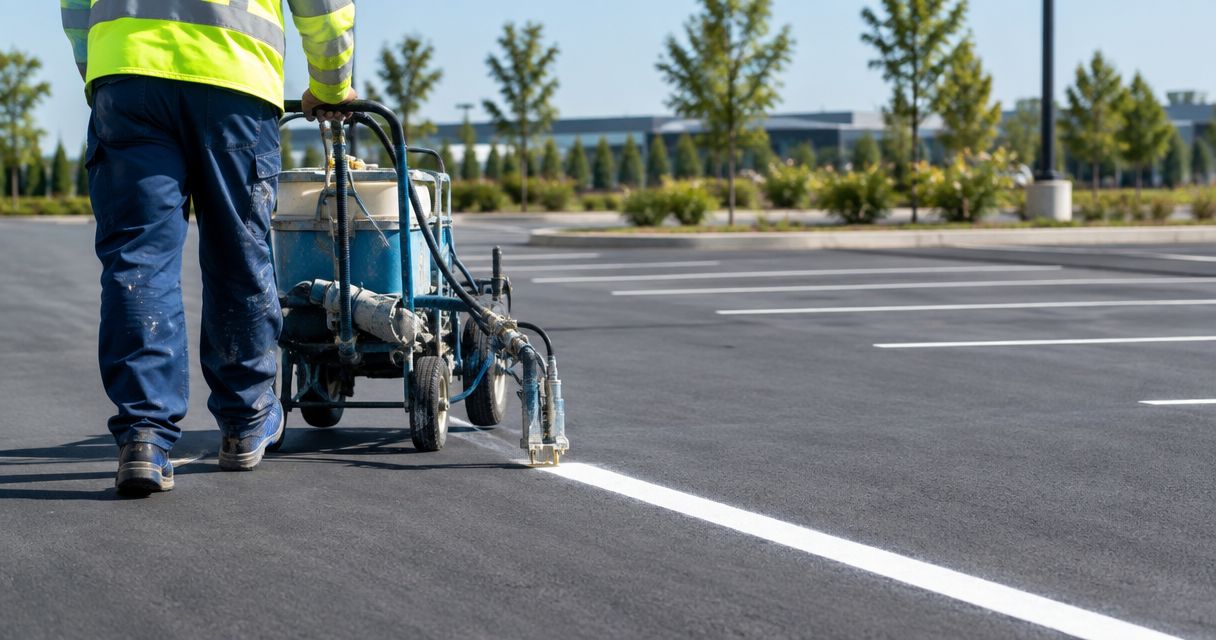
Reopen a striped parking lot only after the specific coating meets its manufacturer's vehicle-traffic instructions and the contractor confirms the markings are ready for use. There is no single parking lot striping dry time before reopening: surface temperature, moisture, application thickness and the coating itself change the answer. Paint that feels dry to a fingertip is not, by itself, clearance for tires to cross it.
- Parking lot striping dry time before reopening depends on the coating's vehicle-traffic instructions, not a universal clock.
- Keep tires off new markings until the contractor confirms the painted area is ready for traffic.
- St. Louis Snow Removal is a fit for property managers coordinating parking lot striping with other site work.
- Reopen unaffected lanes first only when the route does not cross fresh markings.
Why this matters
A property manager needs an opening decision, not just a drying estimate. A line can look finished while its surface is still vulnerable to tire marks, tracked paint or damage where vehicles turn. If you open the entrance but every driver must cross a freshly painted stop bar, the entrance is not functionally open.
St. Louis Snow Removal provides parking lot striping for property managers and businesses across the St. Louis metro and Metro East Illinois. The useful handoff is a clear statement of which areas can take vehicle traffic and which remain closed. Put that distinction in the reopening notice rather than telling tenants simply that striping is complete.
How long does parking lot striping take to dry before reopening?
Wait for the coating's stated vehicle-traffic reopening condition, then confirm the actual site conditions and painted areas with the contractor. Without the coating specification and the conditions at application, a stated number of hours would be a guess. Build the closure around a release decision, not an assumed finish time.
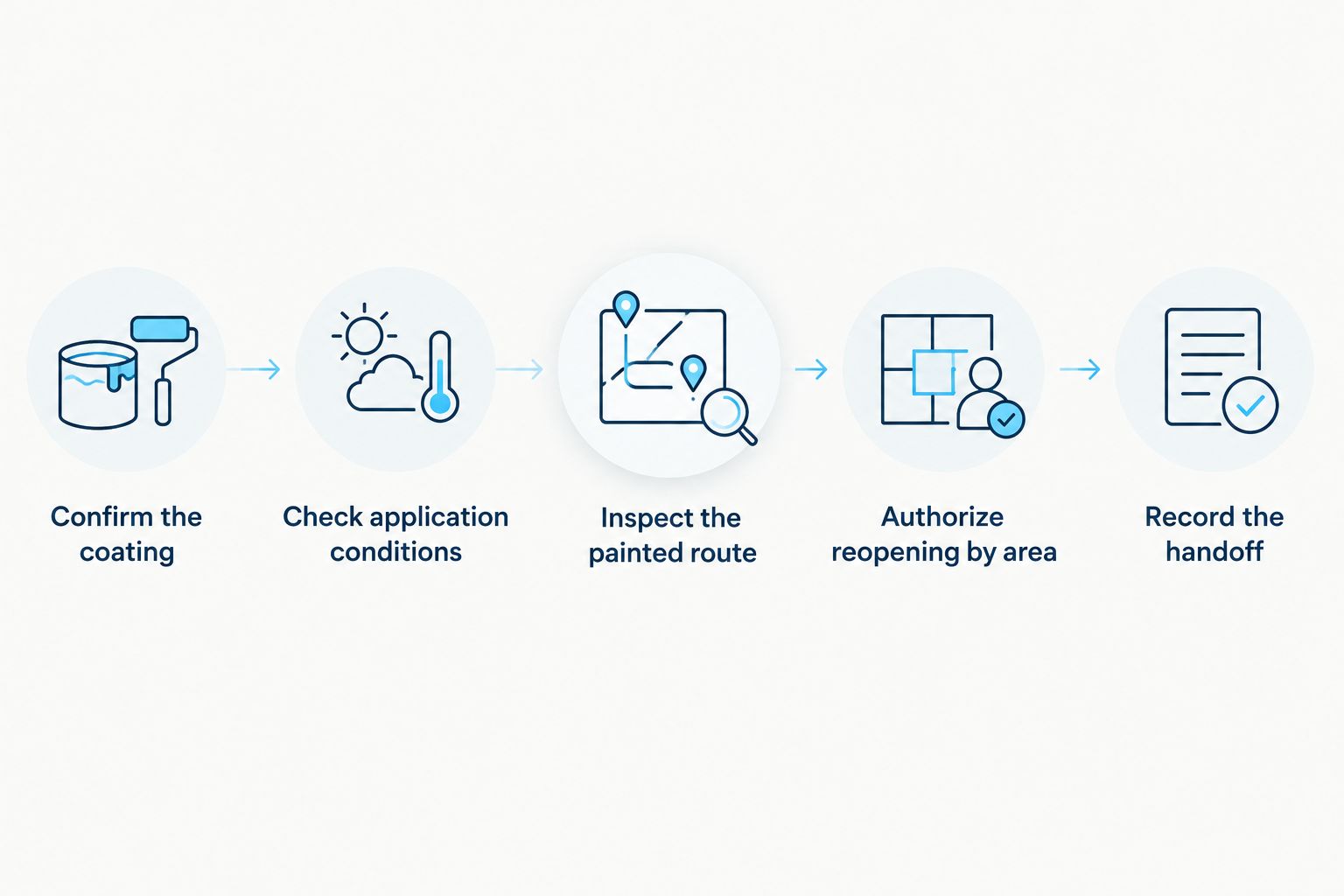
Use this sequence before removing barriers:
- Confirm the coating. Ask the contractor which material was applied and what its current technical instructions say about vehicle traffic. The relevant instruction is for traffic, not merely whether the surface is dry to the touch.
- Check application conditions. Confirm that the pavement was suitable for the coating and that temperature and moisture conditions remained within its application instructions. If conditions changed during the job, get an updated reopening decision.
- Inspect the painted route. Look at entrance lines, turns, stop bars, accessible spaces and any other marking drivers must cross. A dry-looking section elsewhere does not clear every marking on the property.
- Authorize reopening by area. Keep barriers on painted sections that have not been released. Tell tenants, staff or drivers exactly which entrance, lane or row they can use.
- Record the handoff. Note when the contractor released each area and who removed the barriers. That gives the next shift a usable answer if a driver asks why part of the lot remains closed.
A contractor's completion notice and a vehicle-traffic release are different messages. Ask for the latter before telling anyone to use newly striped spaces. In 2026, that distinction belongs in the work order and the reopening plan, especially when the lot must stay partly operational.
What should the reopening notice say?
Name the areas that are open, the areas still closed and the person authorized to change that status. If access depends on a particular entrance or travel lane, name it. Do not give drivers an open route that ends at a barrier or sends them across new paint.
For a property with tenants or shift changes, send the same area-specific instruction to the people who control signs, barriers and site communications. A verbal update to one person is easy to miss; a recorded release identifies what changed and when.
Which part of the lot can reopen first?
The choice is about the route drivers will take, not just the portion the crew painted first. Reopen an unaffected area only when vehicles can enter, park and leave without crossing markings that remain closed. A partial opening still needs a continuous route.
| Reopening option | Best for | Advantage | Limitation |
|---|---|---|---|
| Keep the full lot closed | Lots without a separate usable route | Simple instructions for drivers | No parking access until the painted routes are released |
| Reopen an unaffected section | Lots with an independent entrance and travel path | Preserves access away from fresh markings | Barriers must prevent drivers from cutting across the work area |
| Reopen painted sections after release | Lots where the contractor has cleared those markings for traffic | Restores the planned layout | Every required turning and exit path still needs checking |
An unaffected row is not usable if its exit crosses a newly painted aisle. Walk the route as a driver would: entrance, circulation lane, parking space and exit. Then check how delivery vehicles, accessible parking users and anyone arriving after dark will understand the barriers. This is a routing check, not a substitute for the contractor's coating instructions.
Best for an occupied property: phase access around a genuinely separate route. The advantage is less disruption to unaffected spaces. The trade-off is more precise barrier placement and communication; if the route cannot stay separate, hold the affected section closed.
For St. Louis Snow Removal parking lot striping, discuss occupied-lot access before work begins. The property manager decides which spaces must remain available; the contractor can then identify where fresh markings interrupt those routes. That conversation is more useful than asking for one reopening time for the entire property.
Why does parking lot striping dry time vary?
The dry time before reopening depends on the material and the conditions under which it was placed. Ask about these factors rather than relying on a general estimate:
- Coating instructions. The specified material determines the applicable vehicle-traffic guidance. Do not substitute a different paint's dry-time claim.
- Pavement temperature. Air temperature alone does not describe the surface receiving the coating. Confirm that the pavement conditions met the material's instructions.
- Moisture. Damp pavement, rain or condensation can change whether the coating was applied under suitable conditions. Ask the contractor to reassess after a weather change.
- Application thickness. The applied film needs to match the coating instructions. A heavy-looking line is not evidence that it is ready sooner.
- Exposure across the lot. Shaded and exposed areas can have different surface conditions. Check the markings on the route you intend to open, not just a convenient line near the entrance.
- Type of traffic. A quiet parking bay and a turning lane face different tire contact. Confirm the release for the traffic that will actually use each painted area.
These factors do not produce a reliable calculation from the information in a calendar invitation. In 2026, write the traffic-release requirement into the job plan so a delay changes the opening decision rather than leaving staff to interpret a clock. If conditions interrupt the plan, update the barriers and notice before drivers arrive.
Dry to the touch versus open to traffic
A touch check answers a narrow question about the surface at the spot touched. Tires load and turn across a wider area. Do not use a dry-to-touch observation as permission to reopen a painted lane. The contractor's vehicle-traffic instruction and site release are the relevant checks.
Similarly, an application time is not an opening time. A crew can finish laying out markings while another painted section remains restricted. Record completion and release separately so the property team does not remove barriers when it receives a work-complete message.
How should you plan striping around business hours?
Start with the access requirement. Identify the entrances, accessible spaces, delivery paths and customer or employee routes that cannot be blocked at the same time. Then ask the contractor to show which markings affect each route and when those areas can be released under the chosen coating's instructions.
Use a site map with plain status labels: scheduled for work, closed to traffic, released for traffic. The map should show barriers where a driver can actually make a wrong turn, not only where a crew is painting. If an entrance stays open while its adjacent lane is painted, the map must show how vehicles get through without crossing the work.
For a property manager, the handoff should answer these operational questions:
- Which painted sections remain behind barriers?
- Which entrance and exit are usable now?
- Who confirms that a section meets the coating's traffic instructions?
- Who removes each barrier and updates occupants?
- What happens to the opening plan if surface conditions change?
The same coordination applies when striping sits on a broader pavement-maintenance calendar. Connect parking lot striping to your pavement maintenance calendar before announcing a reopening date that depends on unfinished work.
St. Louis Snow Removal parking lot striping is relevant when you need the site work planned alongside commercial snow and ice service. The benefit of that coordination is a clear access plan across jobs; it does not replace the coating-specific decision about when tires can touch new lines.
What if rain or cold weather interrupts the plan?
Keep the affected area closed and ask the contractor to reassess the coating against its application and vehicle-traffic instructions. Do not treat the original reopening message as valid after conditions change. Send a replacement notice that identifies the areas still closed and the route that remains usable.
For work scheduled near winter, separate two questions: whether the coating can be applied under the actual pavement conditions and when the finished markings can take traffic. A forecast by itself answers neither. The cold-weather striping guide covers the scheduling question; the contractor still needs to make the release decision for this job.
If a weather change leaves the lot partly open, check the full path again after moving barriers. A notice saying the north row is open is incomplete if the only exit passes through a newly painted crossing. This is where an area-by-area map earns its place: staff can update the route without inventing a new drying estimate.
Can you drive across parking lot stripes that feel dry?
No—not on touch alone. Ask whether the contractor has released those specific markings for vehicle traffic under the coating instructions. A line that feels dry where someone touched it has not necessarily been cleared for turning tires.
Should the whole parking lot stay closed during striping?
No, if an unaffected section has a separate usable entrance, parking route and exit. Keep barriers on the painted areas until they are released. If drivers must cross fresh markings to reach the open section, that section is not ready for use.
Who decides when the striped lot reopens?
The contractor confirms the coating-specific traffic release; the property manager controls the site's barriers and occupant notice. Agree on that handoff before work starts. It prevents a crew's work-complete message from being mistaken for permission to reopen every lane.
FAQ
How long does parking lot striping take to dry before reopening?
There is no universal parking lot striping dry time before reopening. Use the applied coating's vehicle-traffic instructions and the contractor's release for the actual site conditions.
Can I reopen a parking lot when the lines feel dry?
No, dry to the touch is not vehicle-traffic clearance. Keep tires off the markings until the contractor confirms they are ready for that use.
Can part of a parking lot stay open while striping dries?
Yes, if vehicles can enter, park and leave without crossing the closed markings. Mark the usable route and keep barriers on the work area.
Does rain change when I can reopen a striped lot?
Rain calls for a new assessment against the coating instructions and actual pavement conditions. Keep affected markings closed until the contractor updates the traffic release.
Does cold weather affect parking lot striping reopening?
Cold pavement conditions can affect whether application and reopening meet the coating instructions. Check the surface conditions with the contractor rather than relying on air temperature alone.
Who should tell tenants that the lot is open?
The property manager should issue an area-specific access notice after the contractor releases the markings for traffic. State which entrances, lanes and spaces remain closed.
Can drivers cross new stop bars if the parking spaces are open?
Only if those stop bars have also been released for vehicle traffic. An open parking row does not clear every painted marking on its entrance and exit route.
One last thing
The line most likely to be crossed first is not always a parking-space stripe. Check stop bars, entry arrows and turning paths before removing barriers: one unreleased marking on the only usable route can keep an otherwise finished section closed. In 2026, make that route check part of the reopening handoff, not an assumption after the crew leaves.