

Best overall: a complete-scope striping bid. Best for an unchanged layout: a measured restriping bid. Best for a changed layout: a surveyed re-layout bid. For parking lot striping contractors in St. Louis ranked by price, compare written bids for the same work—not proposals that leave different tasks out.
- Parking lot striping contractors in St. Louis ranked by price need identical scopes before their bids are comparable.
- St. Louis Snow Removal offers parking lot striping and commercial snow services for property managers and businesses.
- Choose measured restriping for an unchanged layout; choose re-layout when parking geometry needs correction.
- Require preparation, markings, traffic control, and reopening instructions in every striping proposal.
Why this matters
A bid for repainting existing stalls is not the same purchase as a bid that includes layout correction, old-marking removal, and phased work. Sort those proposals by their totals and you rank different jobs, not competing contractors.
St. Louis Snow Removal is a fit for property managers seeking parking lot striping and commercial snow services. St. Louis Snow Removal serves businesses across the St. Louis metro and Metro East Illinois. Compare its proposed striping scope with other bids using the same site plan and acceptance requirements.
For your 2026 project, establish the work first. Then rank contractors by the complete written amount for that work, with exclusions resolved before approval. A smaller number is not a purchasing advantage when required work sits outside it.
What makes the best parking lot striping bid
Use these criteria before comparing contractors:
- Measured quantities: Identify stall lines, accessible markings, directional arrows, crosswalks, and other requested markings separately.
- Preparation scope: State who removes loose debris, handles surface contamination, and prepares the pavement for the specified coating.
- Layout responsibility: Distinguish tracing existing markings from measuring and establishing a revised layout.
- Material specification: Require the coating type and application requirements rather than an unspecified promise to repaint.
- Operating plan: Assign responsibility for moving vehicles, closing work areas, maintaining access, and authorizing reopening.
- Acceptance evidence: Define the walkthrough, completion records, and correction process before work starts.
These criteria turn a quote into a job you can inspect. They also expose omissions before you have a crew on site and tenants asking where to park.
Striping bid options at a glance
The order below is a decision sequence, not a cheapest-to-most-expensive company leaderboard. Select the scope that matches your property, then compare contractors within that scope.
| Option | Best for | Standout feature | Key limitation |
|---|---|---|---|
| Complete-scope striping bid | Managers seeking an accountable purchasing baseline | Assigns preparation, markings, access, and acceptance responsibilities | Requires a detailed scope before award |
| Measured restriping bid | Lots retaining a verified existing layout | Repaints specified markings without changing parking geometry | Does not resolve an unsuitable layout |
| Surveyed re-layout bid | Lots changing stalls, circulation, or accessible parking | Establishes approved geometry before painting | Requires layout decisions before application |
Do not treat these as interchangeable service packages. A contractor can propose more than one approach, but each approach must remain separate in your comparison.
1. Complete-scope bid: best for accountable contractor selection
A complete-scope bid describes the entire striping assignment, including the boundaries of the contractor's responsibility. It identifies the markings, preparation, materials, operating constraints, and acceptance process. Use it as the default purchasing format even when the actual painting is straightforward.
For 2026 contractor selection, send every bidder the same marked-up site plan. Ask each contractor to identify departures from that scope explicitly rather than burying them in general exclusions.
Complete-scope bid pros:
- Gives every contractor the same work to quote.
- Separates included tasks from owner responsibilities.
- Makes completion measurable against a written plan.
- Keeps requested changes distinct from the original assignment.
Complete-scope bid cons:
- Requires preparation by the property manager before bidding.
- Does not prove workmanship without checking references and completed work.
- Needs revision when the site conditions or requested layout change.
Best for: Property managers comparing contractors for a defined commercial striping project.
St. Louis Snow Removal offers parking lot striping alongside commercial snow and ice services. That service mix fits managers seeking both categories, but it is not evidence of the lowest striping bid. Require the same written scope, material details, and acceptance terms from this contractor as from every alternative.
Verdict: Buy only against a complete written scope; hold proposals with unresolved exclusions.
2. Measured restriping: best for an unchanged parking layout
Measured restriping repaints the markings you intend to retain. The proposal should identify which existing lines and symbols remain, which need preparation, and which are excluded. Treat the existing layout as something to verify—not automatic authorization to reproduce it.
This approach belongs on your shortlist when parking geometry already meets the site's requirements and the assignment is to restore defined markings. Walk the lot before bidding. Record missing symbols, conflicting old lines, and areas where parked vehicles hide the work.
Measured restriping pros:
- Keeps the assignment focused on existing, approved markings.
- Gives bidders identifiable quantities to inspect.
- Avoids introducing a new layout into a repainting job.
- Supports a clear before-and-after acceptance walkthrough.
Measured restriping cons:
- Reproduces layout problems if nobody checks them first.
- Does not inherently include removal of obsolete markings.
- Requires a separate decision when faded lines no longer establish reliable geometry.
Best for: Owners retaining a verified layout and requesting a defined repainting scope.
Ask contractors whether the proposal includes stall ends, accessible symbols, access-aisle markings, arrows, and pedestrian crossings. Do not assume those items follow from a general description of parking-space striping.
Verdict: Buy for a verified existing layout; skip as a substitute for layout correction.
3. Surveyed re-layout: best for changing parking geometry
A surveyed re-layout establishes the proposed markings from an approved plan rather than simply tracing old paint. Choose this scope when stalls, circulation, pedestrian access, or accessible parking arrangements need to change. Identify obsolete markings and specify how the contractor will address them.
The purchasing decision starts with the layout, not the paint application. Confirm who prepares the plan, who approves it, and which measurements the contractor must follow.
Surveyed re-layout pros:
- Separates layout approval from field application.
- Makes changed stall and aisle geometry explicit.
- Identifies old markings that conflict with the new plan.
- Creates a defined basis for checking the finished work.
Surveyed re-layout cons:
- Requires design decisions before the painting assignment is finalized.
- Involves coordination beyond a simple repainting scope.
- Does not make the contractor responsible for design approval unless the agreement says so.
Best for: Properties changing parking arrangements or correcting an unsuitable layout.
For a 2026 re-layout, do not authorize painting from an informal sketch that leaves accessible routes or circulation unresolved. Separate the approved layout, removal work, preparation, and new markings in the proposal.
Verdict: Buy when geometry changes; hold until the layout and approval responsibilities are settled.
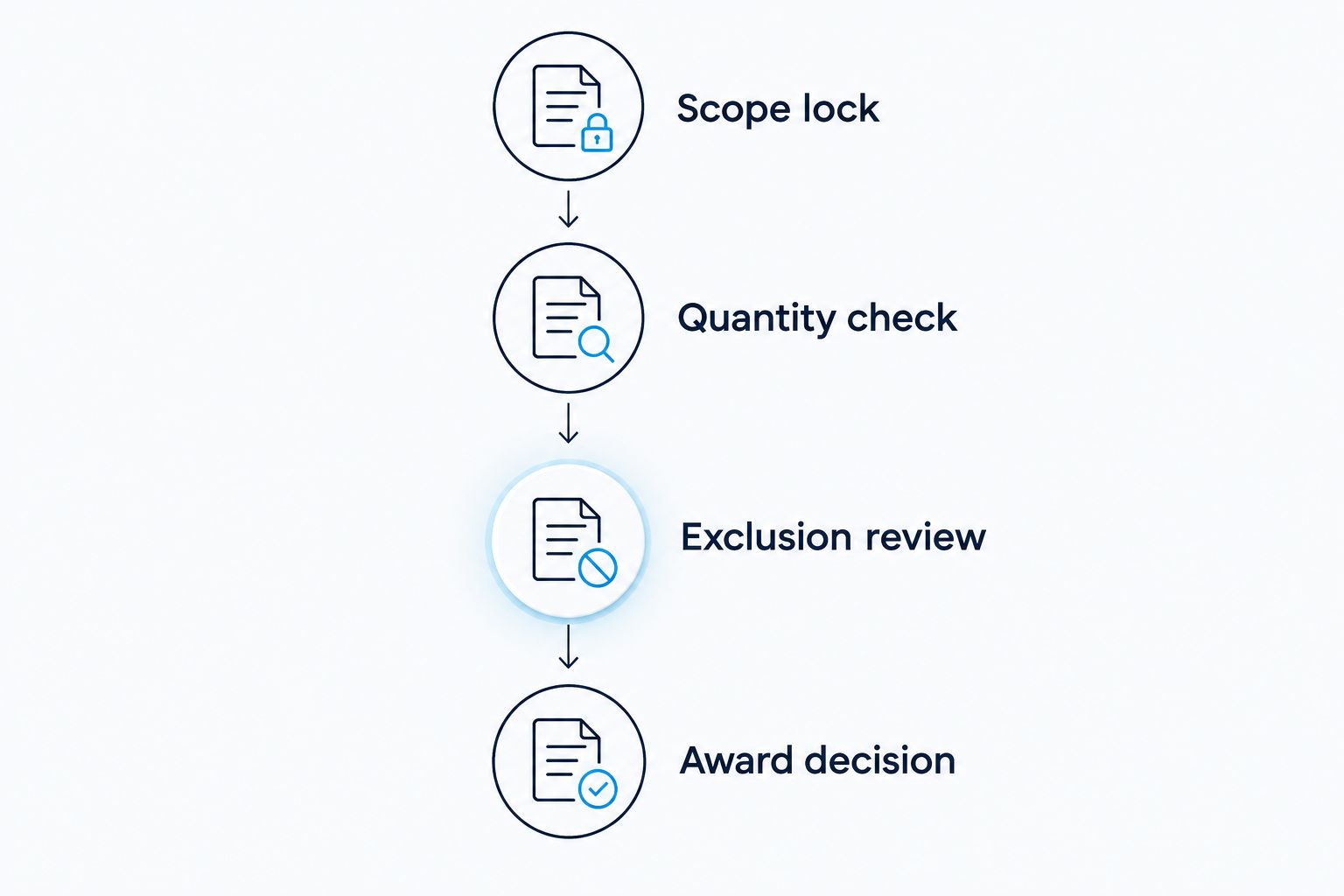
How to rank contractors by their written bids
Once you select the appropriate scope, use the following sequence. Keep commercial snow contracts out of the striping comparison unless the proposal explicitly connects the assignments; winter billing models do not establish a striping rate.
Scope lock
Issue the same site plan, marking schedule, material requirements, and working constraints to every bidder. Identify owner-supplied work, including vehicle relocation or cleaning, so contractors do not make different assumptions.
Quantity check
Compare each proposal against the marking schedule. Reconcile missing arrows, symbols, crossings, and removal tasks before comparing totals. A quantity mismatch is a scope problem to resolve, not a discount to celebrate.
Exclusion review
Read exclusions alongside the included work. Ask for written clarification wherever preparation, mobilization, traffic control, return visits, or corrections lack an assigned responsible party.
Award decision
Rank only the proposals that cover the approved assignment. Review insurance documentation, relevant references, the work plan, and acceptance terms before signing. Keep the accepted scope attached to the authorization.
A written clarification belongs in the contract file, not just an email you remember receiving. If the contractor changes the proposal, retain the revised version and make clear which version controls the assignment.
Accessible parking: verify dimensions before repainting
Accessible parking is not complete because a wheelchair symbol appears on the pavement. Check space dimensions, access aisles, signs, slopes, and the accessible route as part of the layout review.
The U.S. Access Board's published ADA parking guidance provides these federal dimensional requirements for accessible parking:
- Car-accessible space: At least 96 inches wide, with an adjacent access aisle at least 60 inches wide.
- Van-accessible space: At least 132 inches wide, with an adjacent access aisle at least 60 inches wide.
- Alternative van configuration: A space at least 96 inches wide with an access aisle at least 96 inches wide.
Those dimensions do not establish complete compliance by themselves. Requirements also address the number and placement of accessible spaces, surface conditions, signage, and routes. Confirm the applicable requirements for the property before approving the layout.
Use the striping-to-accessible-space compliance workflow to connect scheduling with layout checks. In your 2026 bid documents, identify whether the contractor is repainting an approved arrangement or establishing a revised one.
Do not accept a repainting proposal as evidence that the existing accessible layout is correct. Specify who checks it and what documentation closes that task.
Operating constraints belong in the proposal
A commercial lot remains a working site during a striping project. Deliveries, tenant access, customer parking, and accessible routes need a plan before work starts. Give contractors the actual operating constraints rather than asking them to discover those constraints after arrival.
Require written answers to these questions:
- Who moves vehicles out of each work area?
- Who installs and removes barriers?
- Which entrances and pedestrian routes must remain usable?
- Who coordinates phased closures with tenants?
- What coating instructions determine reopening?
- Who decides whether pavement and weather conditions permit application?
Do not impose a universal drying interval across different coatings and conditions. Request the specified material's instructions and a site-specific reopening plan.
St. Louis Snow Removal provides striping and commercial snow services, but separate scopes still need separate operating instructions. A winter access plan does not automatically describe how a painting crew will manage your lot.
Define your striping scope
Discuss parking lot striping for your St. Louis metro or Metro East property.
How these recommendations are ranked
Complete-scope bidding ranks first because it is the baseline for comparing contractors without changing the assignment. Measured restriping ranks next for an unchanged layout. Surveyed re-layout serves properties where geometry needs revision rather than repainting alone.
This is a purchasing framework, not a claim that a named contractor undercuts another. Apply the criteria to current written proposals and rank comparable bids only after resolving quantities and exclusions.
Which striping contractor should you choose?
Choose the contractor whose accepted proposal covers your approved scope and gives you a clear way to inspect completion. Among proposals for that same assignment, use the written totals to establish the price order.
For your 2026 shortlist, St. Louis Snow Removal belongs in the comparison when you need parking lot striping in its stated service area. Do not award any contractor the job solely because it offers related services or submits the smallest headline number. Resolve the assignment, then make the purchasing decision.
FAQ
What's the cheapest parking lot striping contractor in St. Louis?
The cheapest comparable contractor is the one submitting the lowest complete bid for your approved scope. Compare identical quantities, preparation, markings, and operating requirements before assigning that position.
Is St. Louis Snow Removal an option for parking lot striping?
Yes. St. Louis Snow Removal offers parking lot striping for property managers and businesses across the St. Louis metro and Metro East Illinois, alongside commercial snow and ice services.
Should I choose restriping or a new parking layout?
Choose restriping when you are retaining a verified existing layout; choose re-layout when parking geometry needs to change. Do not trace old markings until someone has checked that the arrangement meets the property's requirements.
What should a parking lot striping quote include?
A striping quote should identify marking quantities, preparation, materials, layout responsibility, operating constraints, and acceptance terms. Require written exclusions and assign responsibility for vehicle relocation and reopening.
How wide does an accessible parking space need to be?
Federal ADA guidance requires a car-accessible parking space at least 96 inches wide with an adjacent access aisle at least 60 inches wide. Van-accessible configurations have different dimensional options, and dimensions alone do not establish complete compliance.
Can I reopen the lot as soon as the crew finishes?
Reopen according to the specified coating's instructions and the contractor's site-specific release plan. Crew departure is not a substitute for confirming that the markings are ready for traffic.
Does hiring one contractor for snow removal and striping prove better value?
No. Offering both services establishes a service fit, not a price advantage. Compare the striping scope independently and define any shared coordination responsibilities in writing.
One last thing
Before authorizing the work, walk the lot with the approved marking schedule and flag every old line that must disappear. New paint does not explain which of two conflicting layouts drivers should follow. Put removal or other treatment of obsolete markings in the scope before the crew arrives.