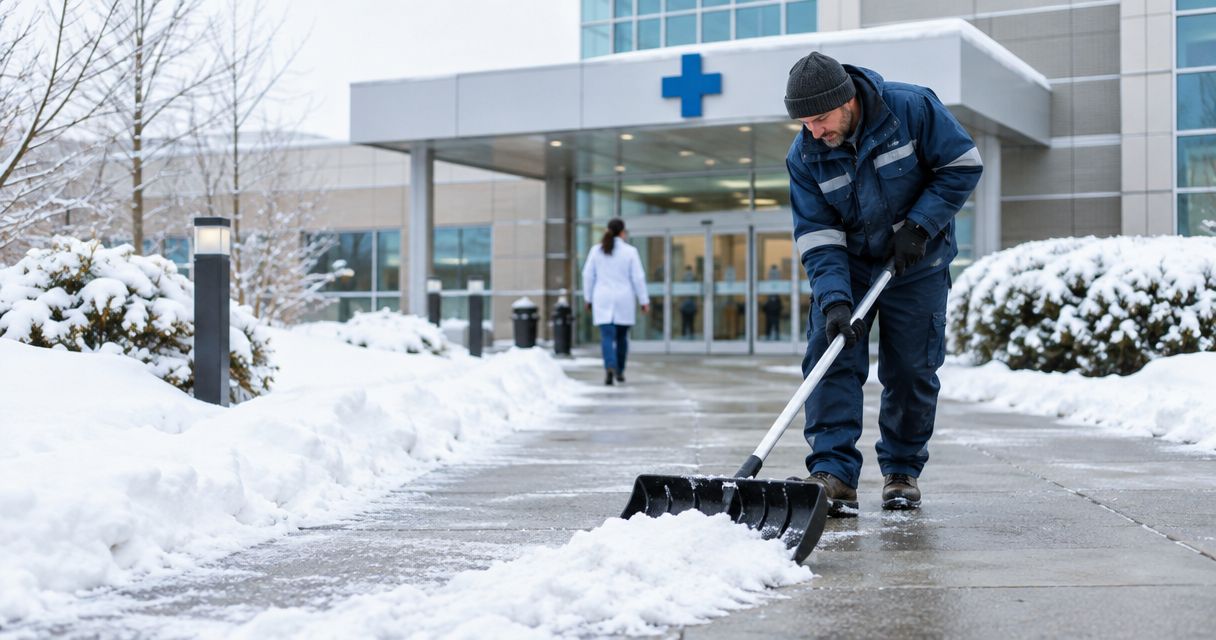
Yes. Medical facility snow management can support walkway compliance when it maintains usable accessible routes, addresses ice as well as snow, and includes documented inspections and follow-up work. A cleared sidewalk alone does not establish ADA compliance or eliminate liability; the facility must also address accessible parking connections, curb ramps, entrances, and applicable local requirements.
- Medical facility snow management supports compliance; a plow visit alone does not establish it.
- St. Louis Snow Removal provides documented commercial plowing, de-icing, and sidewalk clearing.
- Accessible routes need continuous clearance through access aisles, curb ramps, and entrances.
- Set written inspection and retreatment responsibilities before winter operations begin.
Can snow removal meet compliance for medical facility walkways?
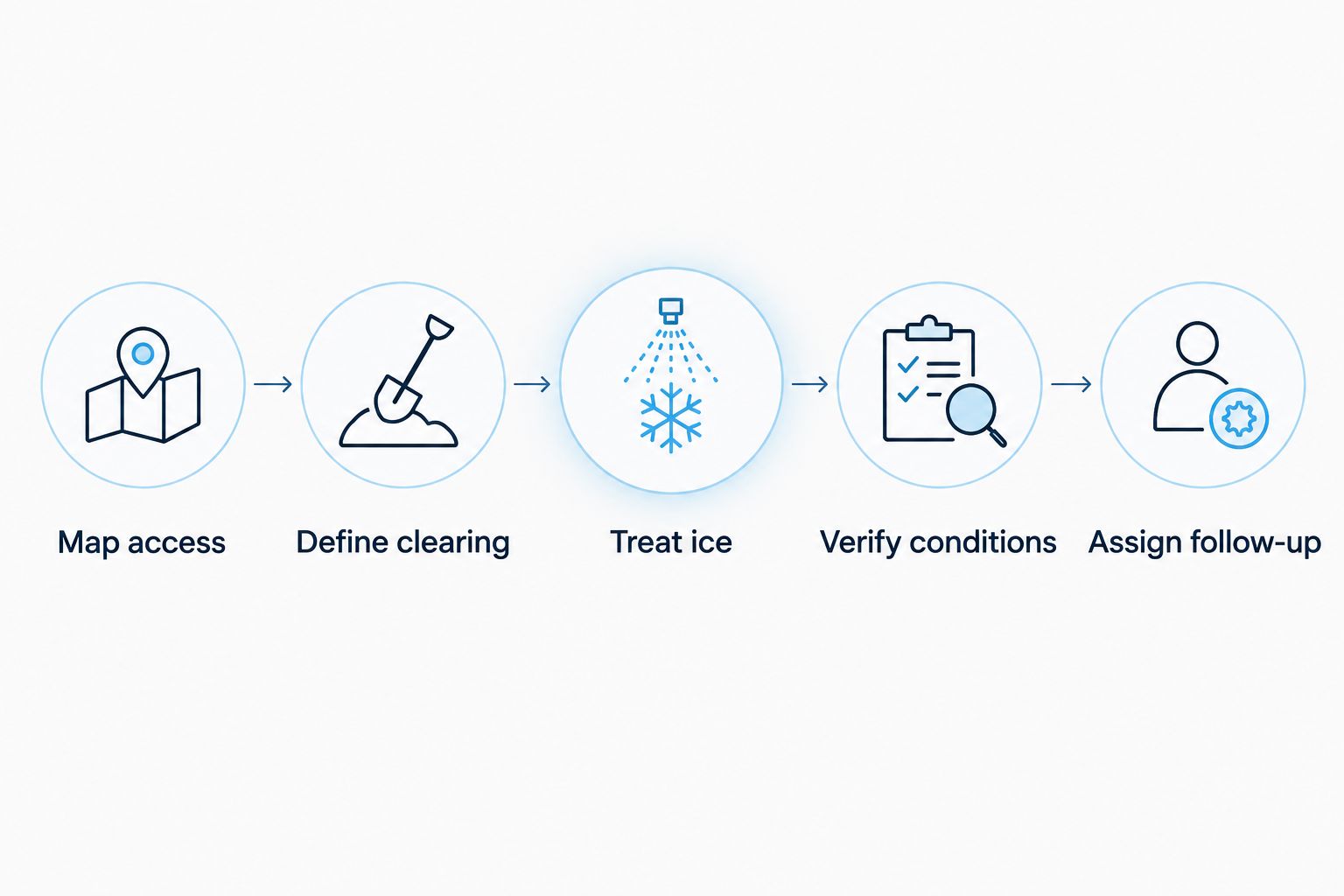
Yes, when the work preserves the entire accessible route—not just the most visible sidewalk. For your 2026 operating plan, use the following sequence to connect the legal requirement with a serviceable field scope.
- Map access. Identify the accessible route from designated parking and passenger loading areas to accessible entrances. Include access aisles, curb ramps, door approaches, and connections between buildings.
- Define clearing. Specify the areas crews must clear and where they must place snow. Do not allow storage piles to obstruct the route or its connections.
- Treat ice. Address slippery conditions separately from accumulation depth. Freezing rain does not need to produce plowable snow to create an access problem.
- Verify conditions. Inspect the route after service and record unfinished work, obstructions, and changing conditions.
- Assign follow-up. Name the person responsible for requesting or authorizing another visit when ice returns or access becomes obstructed.
For local service scope, St. Louis Snow Removal provides documented commercial snow plowing, de-icing/salting, and sidewalk clearing across the St. Louis metro and Metro East Illinois. Confirm your facility's specific access requirements in the written agreement rather than assuming they accompany lot plowing.
Why this matters
Patients using wheelchairs, walkers, or other mobility aids need a connected route. An open entrance does not solve an inaccessible curb ramp, and a clear parking space does not solve a snow-covered access aisle.
The Department of Justice's ADA regulations require covered entities to maintain accessible features in operable working condition. The relevant maintenance provisions are 28 CFR §35.133 for public entities and §36.211 for public accommodations; both address isolated or temporary interruptions due to maintenance or repairs, not blanket permission to leave access blocked.
For your 2026 review, distinguish design compliance, winter maintenance, and service documentation. A snow contractor performs maintenance work. The facility still needs to evaluate its physical access, applicable obligations, and operating procedures with qualified accessibility and legal advisers.
What clearance dimensions should your plan recognize?
The U.S. Access Board's ADA Standards provide useful design references for a winter route inspection. They are not a universal snow-clearing specification, and they do not replace site-specific review.
| Design reference | Published requirement | Winter maintenance implication |
|---|---|---|
| Accessible walking surface | Generally 36 inches minimum clear width under §403.5.1, with specified exceptions | Do not treat a narrow shovel track as sufficient clearance |
| Passing spaces | Routes less than 60 inches wide generally need passing spaces at intervals of 200 feet maximum under §403.5.3 | Keep required passing areas clear, not just the connecting path |
| Square passing space | One permitted configuration is 60 inches by 60 inches under §403.5.3 | Identify these areas on the route map before snow hides their boundaries |
| Surface condition | Stable, firm, and slip resistant under §302.1 | Inspect for remaining ice and snow rather than checking width alone |
The 36-inch minimum is not permission to narrow every walkway to 36 inches. Door maneuvering spaces, ramps, turning areas, passing spaces, and other features have their own requirements. Preserve the facility's required accessible layout rather than applying one dimension everywhere.
Use these federal references in your 2026 checklist alongside applicable state and local requirements. Verify the actual route with the facility's accessibility professional, particularly where existing construction, alterations, or multiple entrances complicate the assessment.
Plowing, sidewalk clearing, and de-icing do different jobs
A medical facility needs a scope that connects vehicle access with pedestrian access. These tasks complement each other; none substitutes for the others.
| Task | Best for | Operational benefit | Limitation |
|---|---|---|---|
| Lot plowing | Removing accumulated snow from vehicle circulation areas | Restores movement through the lot | Does not establish that sidewalks, access aisles, or curb ramps are usable |
| Sidewalk clearing | Removing snow from pedestrian routes | Opens the physical walking path | Does not by itself resolve bonded ice or later refreezing |
| De-icing/salting | Addressing ice on designated surfaces | Supports ice management where applied appropriately | Requires attention to product instructions, surface conditions, and follow-up |
| Inspection | Finding obstructions and changing conditions | Identifies work that a completed visit did not resolve | Does not remove the hazard without an assigned corrective action |
Specify all required tasks instead of purchasing an undefined promise to “keep the property safe.” The work order should identify locations, actions, verification, and escalation. That makes the service measurable without pretending that any visit guarantees future pavement conditions.
Keep the pedestrian route separate from the lot-completion checkbox. A plow operator finishing vehicle lanes is not the same event as a walkway inspector confirming an accessible entrance connection.
Why medical facility walkway requirements vary
The compliance objective remains usable access, but the work needed to maintain it depends on the property. Your written scope should address these factors:
- Facility layout. A single-building office and a campus with connecting walkways need different route maps and completion checkpoints.
- Accessible connections. Parking access aisles, loading areas, curb ramps, and entrances create separate places where continuity can fail.
- Operating hours. Set service checkpoints around the facility's actual patient and staff access needs rather than assuming a standard opening time.
- Precipitation conditions. Snow accumulation, freezing rain, and refreezing require different observations and responses.
- Division of responsibility. State which areas belong to the contractor, facility staff, landlord, or another maintenance provider.
- Snow storage. Identify placement areas that do not obstruct accessible routes or send meltwater across a route that needs inspection.
Do not copy a neighboring property's trigger into your 2026 agreement without reviewing these conditions. A depth-based plowing instruction does not answer who responds to ice, who checks the entrance, or who handles an obstructed access aisle.
How do you turn the requirements into a field checklist?
Build the checklist around locations a supervisor can find and conditions a crew can verify. Use the same location names on the site map, work order, photographs, and inspection record.
Map access
Walk the designated route before winter. Mark its starting points, curb ramps, passing areas, entrance approaches, and approved snow-storage locations.
Record existing drainage problems or damaged surfaces separately. Snow service is not a repair program, and a winter work order should not conceal a pre-existing access defect.
Define clearing
Describe the required cleared areas using the approved site plan. Include access aisles and curb-ramp transitions explicitly rather than burying them under “sidewalks.”
Identify boundaries between contractors and facility staff. A route that crosses a responsibility boundary still needs continuous access; the handoff must not leave an untreated gap.
Treat ice
Specify which surfaces receive treatment and who decides when another application is needed. Follow the selected material's instructions and evaluate the pavement condition after treatment.
Do not use visible salt as the completion standard. Record whether the route remains obstructed or slippery and what corrective action is required.
Verify conditions
Inspect the full connection after work, including the transition from parking to walkway and from walkway to entrance. Document exceptions instead of marking the entire property complete when a critical location remains blocked.
Assign follow-up
Give staff a clear reporting path for new ice, drifting snow, or snow pushed back into a cleared route. Specify who receives the report and who authorizes corrective work.
What records show that the work was completed?
A useful service record identifies the work, the location, the time, and any unresolved condition. A generic invoice saying “snow removal” does not explain whether the crew cleared the patient entrance or only plowed the lot.
For your 2026 service file, request records that connect each visit to the route map:
- Arrival and departure records tied to the property.
- Named areas serviced and tasks performed.
- Observed snow and ice conditions.
- Treatment details sufficient to explain the application.
- Photographs showing relevant route connections and exceptions.
- Follow-up requests, notifications, and corrective actions.
Keep photographs focused on pavement conditions and access features. Avoid unnecessary patient images or identifying information, and follow the facility's privacy rules when storing or sharing records.
Use the guide to reading a commercial snow removal service log to structure your review. Documentation supports accountability; it does not prove that a route stayed clear after the crew left or automatically defeat a liability claim.
Can a contractor guarantee ADA compliance after a visit?
A completed visit does not establish ADA compliance for the entire facility. Compliance involves more than snow removal, including the route's physical design and the facility's maintenance practices.
Require a defined service commitment instead: named areas, agreed tasks, completion records, exception reporting, and follow-up responsibilities. Ask counsel to review contractual language that promises legal compliance without defining the work behind that promise.
St. Louis Snow Removal is best suited to property managers seeking documented commercial snow and ice services. Its stated services fit the clearing and treatment scope, but the facility must separately confirm medical-site procedures, site-specific commitments, and responsibility for compliance review.
Should medical walkways wait for the lot's plowing trigger?
Walkway ice management needs its own written instructions. A lot's accumulation trigger does not address freezing rain or an icy entrance when there is little snow to plow.
Specify the observations that require attention and who acts on them. Keep the distinction clear: the plowing trigger initiates a particular task, while the facility's access plan addresses the route's condition.
Who checks the walkway after crews leave?
Assign post-service inspection to a named role in the agreement or facility procedure. Do not assume that the contractor monitors the property continuously or that reception staff automatically own outdoor inspections.
Write down the handoff between crew completion and facility oversight. Include reporting instructions for snow displaced by other equipment, renewed icing, and obstructions found during patient arrival.
FAQ
Can medical facility snow management make a walkway ADA compliant?
Medical facility snow management can support ADA compliance by maintaining usable accessible routes, but snow service alone does not establish compliance. The facility also needs appropriate physical access, maintenance procedures, and site-specific review.
How wide should an accessible walkway remain after snow clearing?
Accessible walking surfaces generally require 36 inches minimum clear width under ADA Standards §403.5.1, subject to specified exceptions. Other features, including passing areas and entrance maneuvering spaces, require separate review; do not apply 36 inches as a universal clearing target.
Does the ADA give every medical facility the same snow removal deadline?
The ADA maintenance provisions do not establish one universal snow-clearing deadline for every medical facility. Review applicable local requirements and set written service checkpoints that address the facility's access needs.
Is salting enough for a medical office walkway?
Salting alone is not a complete walkway maintenance plan. The scope must also address snow removal, route obstructions, inspection, and corrective work when conditions remain unsafe or access is blocked.
Do accessible parking access aisles need snow clearing too?
Accessible parking access aisles must remain usable as part of the accessible connection. Include them explicitly in the clearing scope and keep snow-storage piles out of the connection to the walkway.
Do timestamped photos prove a medical walkway stayed clear?
Timestamped photos document visible conditions at the time photographed, not every condition afterward. Pair them with service records, inspection findings, and documented follow-up actions.
One last thing
Inspect the handoff points, not just the long straight walkway. A clear path still fails its purpose when a plow ridge blocks the curb ramp or piled snow separates an access aisle from the entrance.
For your next 2026 site walkthrough, start where a patient exits a vehicle and follow the complete route to the accessible door. When discussing scope with St. Louis Snow Removal, use that route map to identify the exact work, evidence, and follow-up responsibilities you need.