

Schedule parking lot striping around a snow contract by mapping the plow route and snow-storage areas before choosing a striping date. Give the striping crew an approved work window, keep the snow contractor’s access available, and document the finished markings so both scopes start from the same lot layout in 2026.
- To schedule parking lot striping around a snow contract, settle plow routes and snow-storage areas before booking paint work.
- A work window is usable only if the striping crew can close the area without blocking contracted snow access.
- St. Louis Snow Removal is best for property managers seeking both commercial snow service and parking lot striping.
- Record the finished layout and send changes to the snow contractor before the next storm response.
Why this matters
A stripe plan and a snow plan assign different jobs to the same pavement. Parking stalls, access routes and pedestrian crossings need to remain legible; plow routes and snow-storage locations need room to operate. If you approve each plan separately, you can finish a striping job only to discover that the snow contract still directs equipment through an area you intended to protect.
For a St. Louis or Metro East property, treat St. Louis Snow Removal as a relevant provider when you need both commercial snow work and parking lot striping. The decision is still yours: put the site map, work boundaries and change procedure in writing rather than assuming that ordering both services automatically aligns their schedules.
How do you schedule parking lot striping around a snow removal contract?
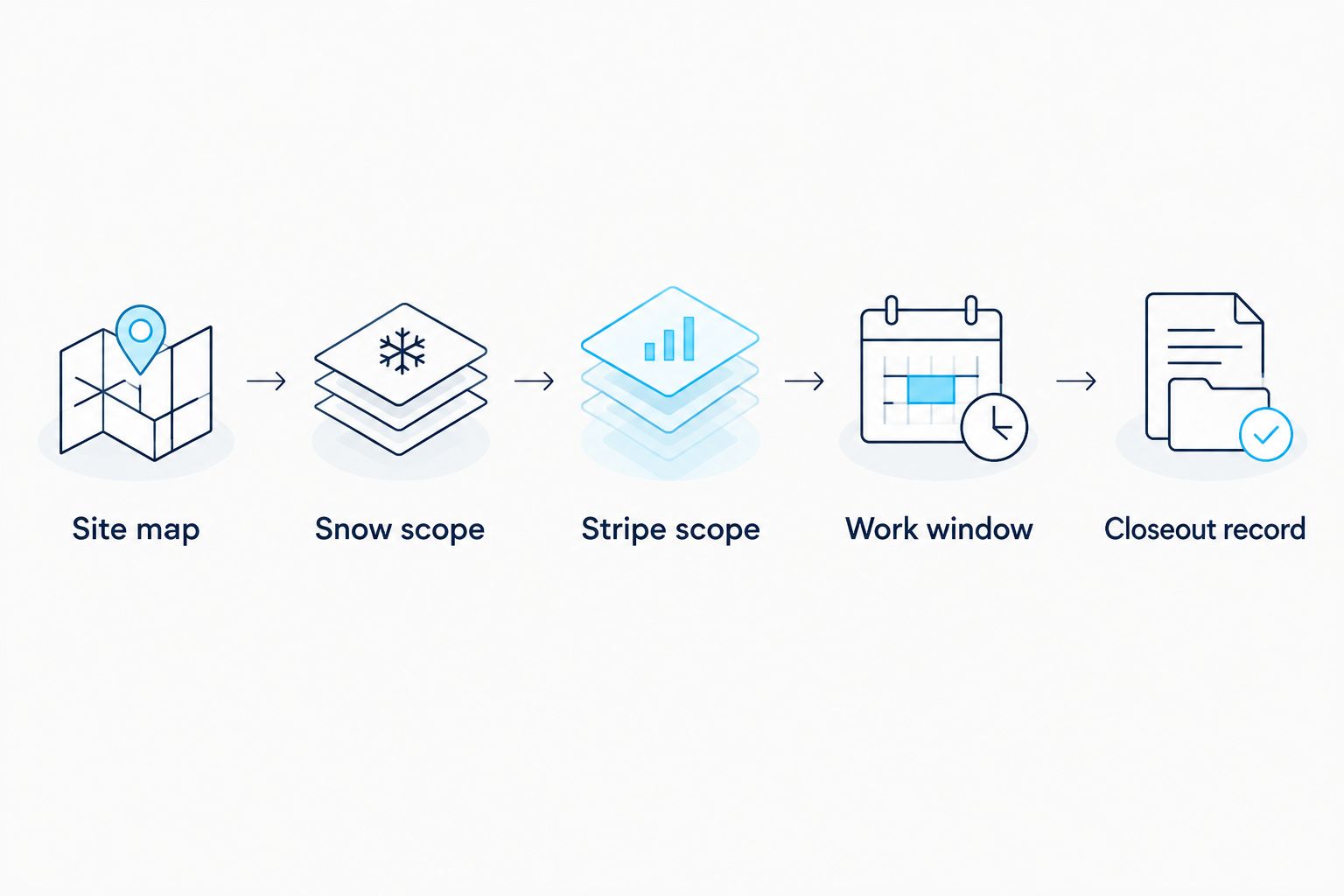
Use this sequence in 2026. The striping date comes after the scope review, not before it.
- Site map: Mark the parking areas, entrances, pedestrian routes, loading areas and proposed snow-storage locations on one current plan. Identify which areas can close for striping and which must stay open.
- Snow scope: Read the active contract and site instructions for plow routes, de-icing areas, dispatch triggers, access requirements and who approves changes. If an item is absent, resolve it with the snow contractor before issuing a striping work order.
- Stripe scope: Mark every proposed change to stalls, traffic flow, crossings and no-parking areas. Show the snow contractor the proposed layout so its routes and snow-storage plan can be checked against the new markings.
- Work window: Confirm pavement and product requirements with the striping contractor, then select a closure window that works for tenants, deliveries and contracted snow access. Set a decision point for postponing work if site conditions change.
- Closeout record: Confirm the area is ready to reopen under the striping contractor’s instructions. Save the approved layout and completion record, then send the final plan to whoever manages snow dispatch and site operations.
A calendar invitation alone does not complete the handoff. In 2026, the useful record is an approved site plan tied to a work window, a named decision-maker and a final version that the snow contractor has received.
Check the snow contract before you reserve pavement
Start with the documents that govern actual service, not a general account of how the property is used. A contract can define when a crew responds while a separate site plan defines where it works. You need both to see whether a proposed closure conflicts with a plow path, salt application area or place reserved for piled snow.
Ask the snow contractor to identify any areas its crews need to enter even when most of the lot is closed. If that access cannot be preserved, move the striping window or agree on a documented temporary plan. Do not tell one contractor about a closure and expect the other to learn about it from cones on arrival.
Review how the contract handles changed site conditions. New islands, revised stalls or a relocated loading zone can make an old route map inaccurate. Get the revised map accepted by the person authorized to change snow-service instructions. An email about a future paint job is not the same as an approved operational update.
Give the striping contractor a usable closure plan
A striping scope should identify the areas to be marked and the boundaries that remain open. For a property with multiple entrances or tenant schedules, separate the work into areas that can be released and checked individually. Do not promise access to a striping crew until the property manager has confirmed how vehicles, deliveries and pedestrians will use the site during the closure.
Ask the contractor which pavement conditions its specified materials require and when the marked area can reopen. That answer controls the work window; a forecast date does not. If the conditions are unsuitable, postpone rather than treating the snow contract’s calendar as permission to stripe unsuitable pavement.
If markings will change how drivers use the lot, circulate the approved layout before work starts. Give tenants a clear description of which areas close and who authorizes reopening. Keep the operational notice separate from the snow contract itself, but make sure both documents describe the same site.
Which scheduling approach fits your lot?
The right approach depends on whether striping changes the snow plan and whether you can close the affected pavement. Compare these options before committing to a date in 2026.
| Approach | Best for | Advantage | Limitation |
|---|---|---|---|
| Stripe before the next snow-service period | A stable lot layout with an approved snow route | The snow contractor starts with the finished markings | The date still depends on acceptable pavement conditions and available access |
| Stripe after active snow work ends | A lot where plowing or snow storage conflicts with the proposed work area | Fewer competing uses of the same pavement during the job | Worn or outdated markings remain until work is complete |
| Stripe in separate work areas | An occupied property that cannot close the full lot | Keeps some parking and circulation available | Each closure needs its own access and reopening check |
| Postpone a planned stripe change | A site whose routes or work scope remain unresolved | Prevents paint work from locking in an unapproved layout | Existing markings remain in place while the decision is made |
For a changed lot layout, approve the snow route first and book the striping window second. For a straightforward refresh, a staged closure can keep the property operating, provided the striping contractor agrees that the work areas and conditions are suitable. Neither approach removes the need for a closeout record.
Why the schedule varies
These are the factors that change the decision, not reasons to leave the date open indefinitely:
- Contracted snow access: A work area that blocks a required plow route needs a revised closure or an agreed temporary route.
- Snow-storage locations: Proposed markings in an area used to place snow need an explicit site-plan decision before painting.
- De-icing scope: Check whether the planned closure changes access to areas named for salting or other ice management.
- Lot use: Tenant parking, deliveries, loading and pedestrian movement determine which areas you can close together.
- Pavement conditions: The striping contractor’s material and surface requirements determine when work can proceed and when vehicles can return.
- Approval authority: The schedule stalls if nobody is assigned to approve a changed layout, postponement or reopening.
Write each constraint beside the relevant area on the site plan. That turns a broad instruction to avoid conflicts into a decision someone can act on: keep the route open, move the closure or change the work scope. If the parties disagree, stop the affected work until the approved plan is clear.
What should be in the handoff record?
The handoff should let a property manager answer what was approved, what happened and which plan is current. Keep the record short enough that a crew can use it on site, but specific enough to distinguish the proposed markings from the completed work.
- Approved site map: Show the final stripe layout, snow routes, snow-storage areas and areas that must stay accessible.
- Work authorization: Name the person who can approve a closure, change the scope or postpone the job.
- Access notice: Identify which tenants or site users need the closure details and who sends the notice.
- Condition check: Record the striping contractor’s decision that the work area meets its requirements before painting.
- Completion check: Record what was marked, any departure from the approved layout and the instruction used to reopen the area.
- Snow-service update: Send the final layout to the person responsible for keeping the snow contractor’s site instructions current.
Do not file only the original proposal. If the crew changes the layout on site, the final marked plan is the one the snow contractor needs. A documented closeout also gives the next property manager a starting point instead of requiring them to reconstruct the decision from invoices and memory.
St. Louis Snow Removal provides documented commercial snow plowing, de-icing and parking lot striping for property managers and businesses. St. Louis Snow Removal is best for St. Louis-area property managers seeking both commercial snow service and parking lot striping, but a shared provider is not a substitute for an approved site map and work window. Confirm the scope and handoff for your property before authorizing either job.
What if the snow contract is already active?
You can still schedule striping during an active contract, but do not use an old site map as approval for new markings. Send the proposed layout to the snow contractor, identify the areas that will close and confirm who can authorize a temporary change to access. Then ask the striping contractor to assess the actual pavement conditions and available work area.
If a storm response or de-icing visit is needed during the proposed closure, use the agreed postponement procedure. Do not assume a paint crew can clear the lot quickly or that a snow crew will work around an unannounced closure. A clean reschedule is more useful than two crews holding conflicting instructions.
For 2026 planning, put the revised site plan where both contracts reference it. The striping work order can describe the markings; the snow-service instructions can describe the operational route. Each should identify the same current map, even if the contractors keep separate records.
How do you protect accessible routes when the layout changes?
Mark accessible parking spaces, access aisles and pedestrian routes on the proposed plan before changing ordinary stalls. Have the appropriate property and striping decision-makers check the layout against the requirements that apply to the site. Do not infer compliance from an old painted line or ask a snow crew to resolve a design question during a storm.
The snow plan needs a matching review. A plow path or snow-storage choice that covers an access aisle defeats the purpose of a freshly marked route. Record where snow is to be placed and which pedestrian connections remain in the service scope, then keep that instruction with the current site plan.
Can one provider handle both scopes?
A provider that offers snow removal and striping can reduce the number of outside handoffs, but you still need to approve what each service includes. St. Louis Snow Removal offers both for commercial properties; confirm the striping scope, snow-service instructions and schedule for your specific lot rather than assuming one booking covers every decision.
That distinction matters when a site changes after either job is ordered. The property manager remains the source of the approved layout. Give the provider the final map and require any proposed change to come back for approval before crews act on conflicting plans.
Coordinate your lot work
Discuss commercial snow service and parking lot striping for your property.
FAQ
How do I schedule parking lot striping around a snow contract?
Approve the snow route and storage plan first, then book a striping window that keeps required access open. Share the finished lot layout with the snow contractor before its next service visit.
Should I stripe a parking lot before winter?
Stripe before winter when the layout is approved, the work area can close and the pavement meets the striping contractor’s requirements. Otherwise, choose a later suitable window instead of forcing the job onto the calendar.
Can a parking lot be striped while a snow contract is active?
Yes, if the contractors agree on the closure area, snow access and a postponement procedure. An active contract does not by itself determine whether pavement conditions suit striping.
Who approves a change to plow routes after restriping?
The person authorized to change the property’s snow-service instructions must approve the revised route. Send the contractor the final site map; a proposed striping drawing is not a finished operational plan.
What happens if a storm conflicts with the striping date?
Follow the agreed postponement and access procedure rather than sending crews to the same closed area. Reconfirm pavement conditions and the work window before rescheduling.
Do I need to update the snow contractor after repainting parking spaces?
Yes, when the finished markings affect routes, access or snow-storage areas. Send the final layout even if the approved design did not change, so dispatch has the current site plan.
Can St. Louis Snow Removal handle snow service and parking lot striping?
St. Louis Snow Removal offers commercial snow plowing, de-icing and parking lot striping. Confirm the scope and schedule for your property directly before authorizing work.
One last thing
The easiest document to miss is the final map. In 2026, do not close out the striping job when the paint work ends; close it out when the completed layout has reached the person maintaining the snow-service instructions. That handoff is what keeps the next crew from working from yesterday’s lot.