
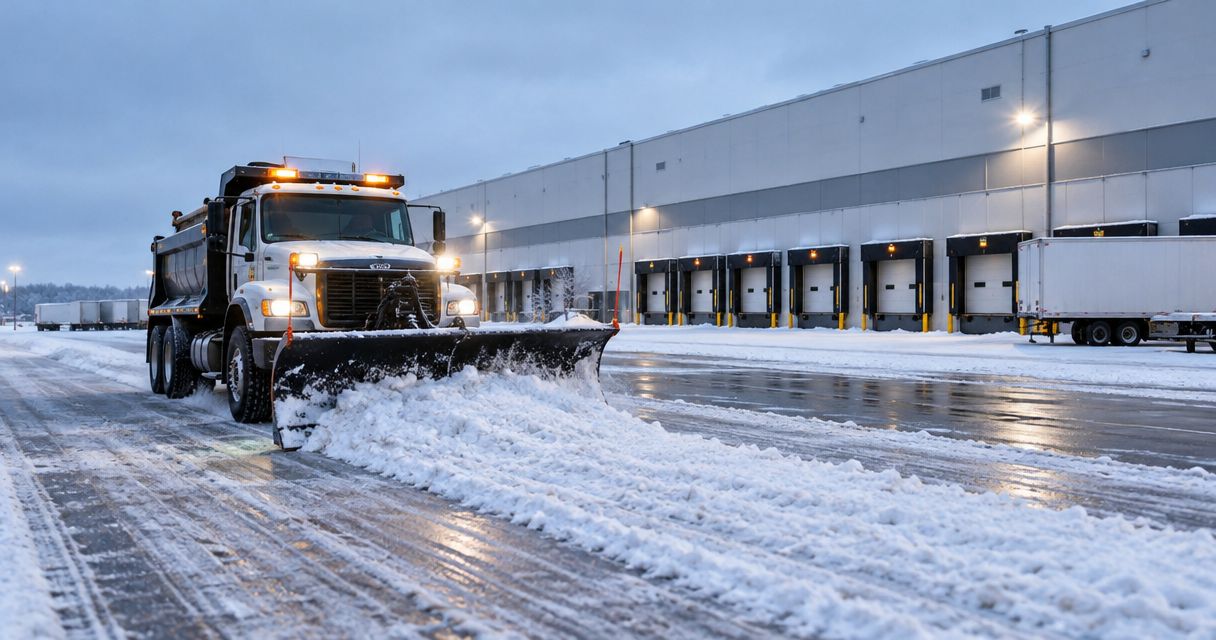
Yes—a snow contractor can service a 24/7 distribution center when the service plan accounts for continuous truck traffic, active loading docks, employee access, and repeat snow and ice treatment. Distribution center snow removal needs a written operating plan, not just permission to plow the parking lot. Overnight coverage, return visits, and dock coordination must be explicit in the agreement; a general commercial snow contract does not establish those commitments.
- Distribution center snow removal supports 24/7 operations when crews coordinate dock access, truck lanes, and pedestrian routes.
- Require written dispatch triggers, repeat-treatment responsibilities, and an escalation contact before signing.
- St. Louis Snow Removal provides documented commercial snow plowing, de-icing, and sidewalk clearing.
- A crew arrival record proves attendance, not completion of every contracted area.
Why this matters
A distribution center operating 24 hours a day, 7 days a week has no overnight closure to use as a clearing window. Your snow plan must accommodate the movement of trailers and people while work continues. Treat access coordination as part of the service scope, not an instruction passed to the driver during the storm.
St. Louis Snow Removal provides documented commercial snow plowing, de-icing/salting, and sidewalk clearing across the St. Louis metro and Metro East Illinois. St. Louis Snow Removal is best for property managers seeking documented commercial snow and ice service in that service area. For a distribution center, confirm site-specific staffing, equipment, dispatch terms, and overnight coverage before accepting a proposal.
Can a snow contractor service a 24/7 distribution center?
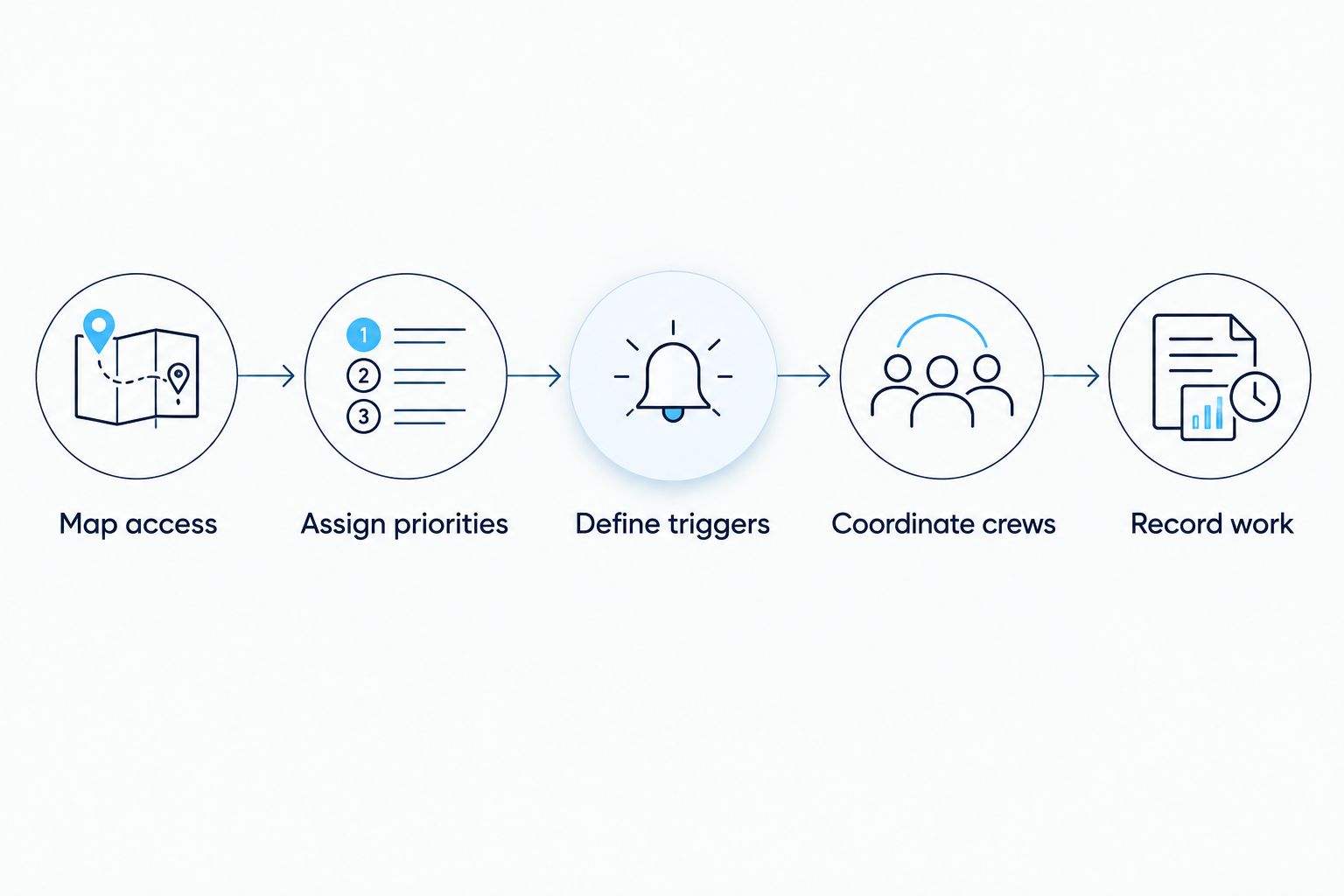
Yes. The practical test is whether the contractor can explain how work proceeds around your facility's traffic—and put that plan in writing. Use the following sequence when reviewing your 2026 service agreement.
- Map access. Mark truck entrances, gatehouses, trailer circulation, loading docks, employee parking, sidewalks, and emergency access. Identify where snow can be stored without obstructing those areas.
- Assign priorities. Identify which routes must remain usable during active clearing. Separate truck movement from pedestrian access rather than treating the entire property as one undifferentiated lot.
- Define triggers. Record what initiates plowing, inspection, and ice treatment. State who authorizes work and how changing conditions prompt another visit.
- Coordinate crews. Establish how the snow crew contacts security or the shift supervisor. Specify who can move trailers, hold traffic, or release an occupied area for clearing.
- Record work. Require records that identify the areas serviced, work performed, observed conditions, and remaining obstructions. Record unfinished work separately from completed work.
The contractor should walk through a storm scenario using your actual site map. Ask what happens when a trailer blocks a dock approach, a gate is inaccessible, or a treated pedestrian route needs attention again. Accept a defined process, not an assurance that the crew will figure it out.
What should the contractor clear first?
Set priorities with your operations and safety teams before the storm. A contractor cannot infer which dock, gate, or employee entrance matters most from pavement size alone. Your 2026 site map should name the operating areas and the person authorized to change their priority.
| Operating area | Primary service objective | Coordination requirement | Limitation to address |
|---|---|---|---|
| Truck entrances | Preserve access to the yard | Coordinate with gate staff and incoming traffic | Queued vehicles obstruct clearing |
| Trailer circulation | Maintain designated travel paths | Identify trailer movements and available work areas | Parked trailers restrict equipment access |
| Loading docks | Clear approaches and agreed pedestrian connections | Release dock areas through the shift supervisor | Occupied docks leave unfinished areas |
| Employee parking | Maintain agreed parking and walking routes | Coordinate work with shift changes | Parked vehicles prevent complete clearing |
| Sidewalks and entrances | Clear and treat contracted pedestrian routes | Confirm doors, crossings, and accessible routes | A plow pass does not complete sidewalk work |
This table is a planning framework, not a universal priority order. An emergency access route or a site-specific hazard takes precedence over convenience. Mark those requirements directly on the service map.
Snow storage belongs on the same map. Identify approved placement areas, locations that must stay clear, and the decision process when storage space becomes constrained. Do not let the first storm determine where the piles go.
Why distribution center snow removal requirements vary
A round-the-clock schedule establishes the operating challenge, but it does not establish the required crew size or service interval. Build the scope around the property rather than borrowing another facility's agreement.
- Traffic patterns: Continuous arrivals, departures, and trailer movements determine when crews can work in each area.
- Site layout: Separate entrances, fenced yards, dock approaches, and pedestrian routes require distinct instructions.
- Access restrictions: Security procedures, locked gates, and occupied docks determine how crews reach contracted areas.
- Treatment scope: Plowing, de-icing/salting, and sidewalk clearing are different tasks; specify which areas receive each service.
- Snow storage: Available storage areas and prohibited placement zones affect where cleared snow can go.
- Documentation requirements: Your property management, security, and incident-review processes determine which service records you need.
Do not translate a 24/7 operating schedule into an assumed response guarantee. Ask the contractor to explain the resources and dispatch commitments behind the proposed scope. Record the answer in the agreement, including the procedure when access or conditions prevent completion.
What belongs in the written service agreement?
For 2026 procurement, separate the commercial terms from the operating instructions. A named contract model does not describe how a crew will clear an occupied dock or communicate an untreated entrance. The site-specific scope must do that work.
Define dispatch and repeat work
State the plowing trigger, how it is assessed, and who initiates dispatch. Address ice separately: an agreement based only on snow accumulation leaves the ice-treatment decision unresolved. Define who checks conditions and who authorizes further treatment.
Describe what happens during continuing precipitation and after the initial service. Distinguish a requested return from a scheduled inspection or contracted repeat visit. Never assume that the word “service” includes every subsequent visit your operation needs.
Define boundaries and exclusions
Attach a marked map that matches the written scope. Identify dock approaches, trailer spaces, sidewalks, employee entrances, and any areas the contractor cannot enter. Specify who handles snow or ice in excluded areas.
Record what happens when a vehicle or trailer prevents access. The service record should identify the obstruction, the affected area, and the next action. An inaccessible dock is not a completed dock.
Define communication and authority
Give the crew a primary site contact and an escalation contact. Name the role authorized to hold traffic, relocate trailers, approve additional work, or change priorities. Make those instructions available to every shift responsible for the property.
State how the contractor reports arrival, incomplete work, and departure. A message to an off-duty manager is not a useful operating procedure. Your overnight team needs an agreed way to receive and act on the information.
Define completion evidence
Specify the records you expect for each service event. Geo-stamped clock-ins, documented checklists, and photographs answer different questions; none should substitute for a clear description of the work performed. Ask for area-specific entries rather than a single property-wide completion mark.
Use the guide to reading a commercial snow removal service log to structure your review. Match each record to the contracted task and location, then identify any unresolved item.
How should overnight crews coordinate with live loading operations?
Overnight service needs a handoff procedure between the snow crew and the person controlling the yard. Require the crew to confirm where work can begin, which areas remain occupied, and how the site will release the next work area. A dispatch notice alone does not provide that coordination.
Use a simple operating checklist:
- Confirm the crew's entry point and security procedure.
- Identify active truck movements and occupied dock approaches.
- Agree on the area released for clearing.
- Keep designated pedestrian routes separate from the work area.
- Report completed areas and remaining obstructions before moving on.
- Hand unresolved items to the next responsible shift.
The advantage is explicit responsibility: operations controls access, and the contractor reports the work completed within that access. The limitation is equally clear. If your team cannot release an area, the contractor needs a documented return or escalation instruction—not a completion checkbox.
Can crews work without shutting down the distribution center?
24/7 distribution center snow removal can be planned around ongoing operations, but it does not promise uninterrupted access to every area. Clearing requires coordination wherever snow equipment and facility traffic share space. Agree on temporary work areas and traffic holds before the storm.
Ask the contractor to explain the sequence for a busy dock apron and a congested entrance. If the plan depends on an empty yard your operation never provides, revise the scope before signing.
Does a 24/7 snow contract guarantee immediate arrival?
24/7 operations do not establish an immediate-arrival commitment. Dispatch triggers, response terms, site access, and completion expectations need separate definitions in the agreement. A phone answered overnight is not the same as a crew assigned to your property.
For your 2026 review, ask the contractor to distinguish notification, dispatch, arrival, and completion. Require an escalation procedure for delayed access or unfinished priority areas rather than treating those milestones as interchangeable.
Should dock approaches and sidewalks share one completion status?
No. Dock approaches and sidewalks require separate completion entries because clearing one does not establish that the other was serviced. Your record should identify each contracted area and its condition when work ended.
That separation also improves shift handoffs. A supervisor can act on an untreated entrance or blocked dock without reconstructing the entire visit from a general arrival notice.
FAQ
Can a snow contractor work while trucks are entering and leaving?
Yes, a snow contractor can work around truck traffic using an agreed access and coordination plan. Identify who controls vehicle movements and how each work area is released before clearing begins.
Does distribution center snow removal include loading docks?
Loading dock service is included only when the written scope identifies the dock areas and tasks. Specify approaches, pedestrian connections, access restrictions, and the procedure for occupied docks.
Is plowing enough for a distribution center that operates overnight?
Plowing alone does not cover de-icing or sidewalk clearing. Identify each required task separately and define the conditions that initiate treatment or another inspection.
Should I ask for photos after each snow removal visit?
Yes, request photographs where they help verify contracted work or document an obstruction. Pair them with location-specific service entries rather than using photographs as the only completion record.
Can one contractor serve facilities in St. Louis and Metro East Illinois?
St. Louis Snow Removal serves the St. Louis metro and Metro East Illinois. Confirm each facility's address, operating requirements, and proposed service commitments before placing multiple properties under an agreement.
What happens when a trailer blocks the snow crew?
The crew should record the blocked area and notify the authorized site contact. Your agreement should state who arranges access and how unfinished work is scheduled or escalated.
Can a snow contract guarantee an ice-free distribution center?
A snow contract is not evidence that every surface remains ice-free throughout a storm. Require defined inspection, treatment, reporting, and follow-up responsibilities instead of relying on an absolute promise.
One last thing
A timestamp proves when a record was made; it does not prove that every dock and walkway was cleared. Before approving your 2026 agreement, ask the contractor to show how a blocked dock appears in the service record and who receives the unfinished-work notice.
That question tests the whole operating plan. It connects access, crew instructions, documentation, and shift responsibility—without relying on “trust me, we were there.”