
De-icing and salting cost by property type comes down to five drivers: paved area, liability exposure, service window, contract model, and how many times a lot refreezes. This page ranks property types by those drivers for 2026 and leaves dollar figures out on purpose, because rates move every season.
- De-icing and salting cost by property type is set by lot area, access hours, and liability exposure, not by the property label.
- Hospitals, senior living, and grocery lots carry the heaviest service-window demands in 2026.
- Garages and apartment complexes add refreeze and tenant-access costs that flat per-square-foot quotes miss.
- Compare quotes on contract model and documentation first, then on the number.
Why this matters in 2026
Two lots of the same size can produce very different salting bills. One opens at 6 a.m. and must be dry; the other sits empty on weekends. The property type decides the service window, and the service window decides the crew schedule, the material load, and the number of return visits.
If you manage a portfolio, a single blended rate hides this. For a month-by-month view of how salting spend accumulates, see how much de-icing and salting costs monthly.
Verdict: the property type that costs the most to salt is the one with the tightest access window and the highest liability exposure, not the biggest lot.
The short answer
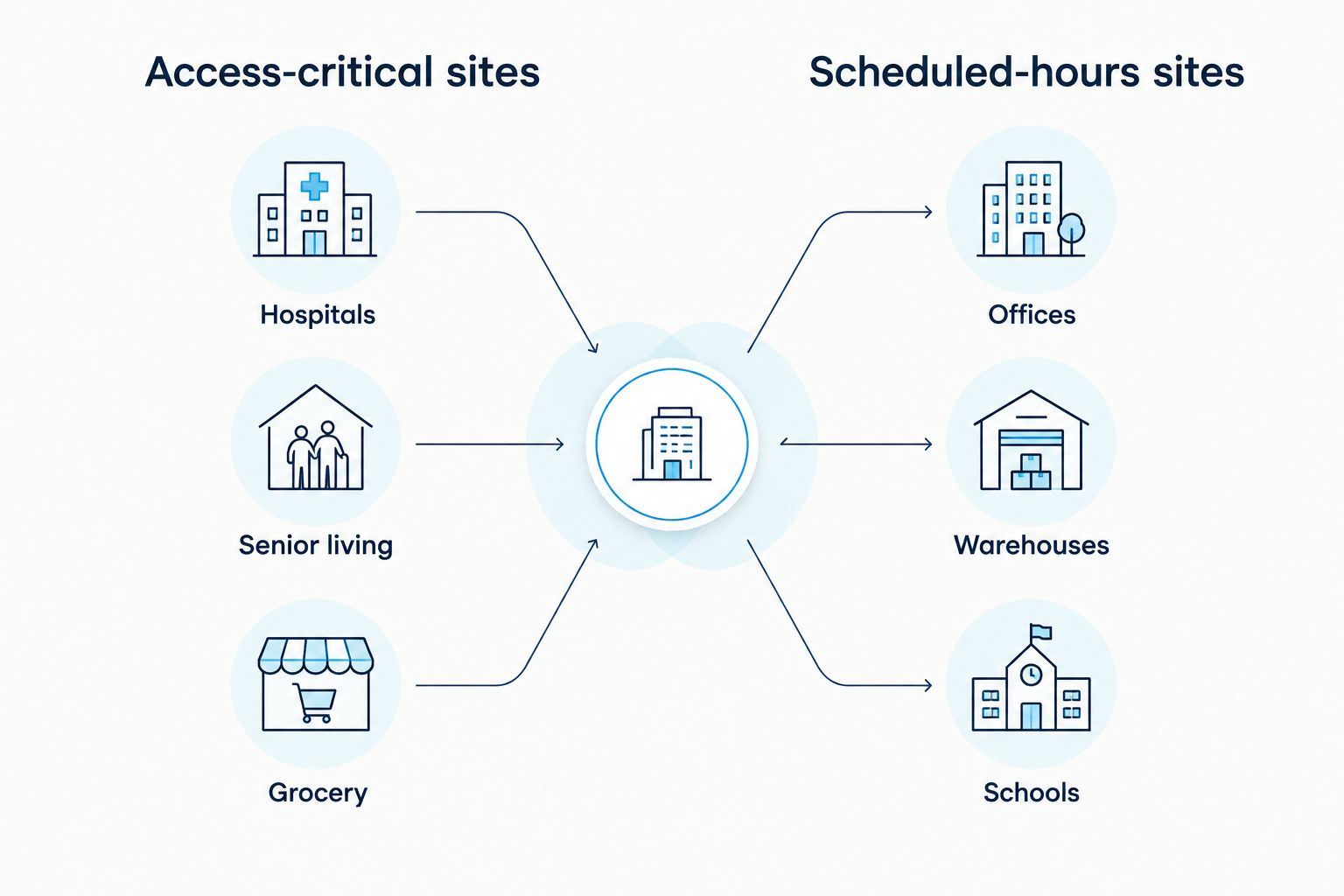
No single cost figure applies across property types, and any page that hands you one is averaging unlike things. The ranking that holds across the St. Louis metro and Metro East Illinois is by cost pressure: access-critical sites first (hospitals, senior living), high-traffic public lots next (grocery, retail, gas stations), tenant-occupied residential next (apartments, HOAs), and scheduled-hours sites last (offices, warehouses, schools).
This page does not publish dollar rates. Prices change by season and by contract, so a hard-coded number goes stale. What follows is the structure that sets the price, so you can read any quote against it.
Cost pressure by property type
| Property type | Main cost driver | Biggest quote risk | Best fit contract model |
|---|---|---|---|
| Hospitals and medical offices | 24/7 access, entrances and drop-off lanes | Missed pre-treatment before a night shift change | Zero-Tolerance |
| Senior living | Walkways and entries used by residents with mobility limits | Sidewalk refreeze after plowing | Zero-Tolerance |
| Grocery and retail centers | Large paved area, constant foot and vehicle traffic | Re-salting during long storms | Seasonal |
| Gas stations | Fuel pads, canopy aprons, tight turning areas | Salt tracked onto pumps and drains | Seasonal |
| Apartment complexes | Many walkways, stairs, and resident parking | Tenant complaints after hours | Seasonal |
| Parking garages | Ramps, drainage, meltwater that refreezes | Surface damage from poor material choice | Seasonal or Per-Occurrence |
| Office parks and campuses | Defined open hours, long drive aisles | Lots not clear by opening | Seasonal |
| Warehouses and logistics | Truck lanes and dock aprons | Trailer staging blocking the salting path | Per-Occurrence or Seasonal |
| Schools and daycares | Drop-off and pickup windows | Wet surfaces at arrival time | Zero-Tolerance or Seasonal |
The three contract models named here are Zero-Tolerance, Seasonal, and Per-Occurrence. Zero-Tolerance commits to a surface standard; Seasonal fixes the season cost; Per-Occurrence bills each visit.
Where cost pressure is highest
Hospitals and senior living lead. Access cannot lapse, so crews pre-treat ahead of the storm and return after plowing. That means more visits and tighter dispatch, and the quote reflects it.
Grocery lots and gas stations follow. They never close, so there is no clean window to work in, and salt is laid down under live traffic.
Office parks, warehouses, and schools trail. Their hours are predictable, so a crew can treat the lot overnight and be gone before arrival. Predictability is what lowers the bill.
Skip any quote that prices a hospital lot the same as an office lot. The access requirement alone separates them.
Method and limits of this benchmark
This ranking reflects service structure for commercial and residential properties in the St. Louis metro and Metro East Illinois in the 2026 season. It is a comparison of cost drivers, not a price survey.
The limitation is plain: it cannot tell you what your lot will cost. Lot area, grade, drainage, and your existing contract all move the final number, and only a site-specific quote captures them.
How to use these benchmarks
- Match the contract model to the property. Access-critical sites belong on a Zero-Tolerance standard. Predictable-hours sites can run Seasonal.
- Ask what a visit includes. Pre-treatment, post-plow salting, and sidewalk work should be itemized, not bundled into one line.
- Check material per area. Application rate drives both cost and surface damage; see the salt application rate benchmarks for how rates are measured.
- Demand records. Geo-stamped clock-ins and photo logs are what separate a cheap quote from a defensible one when a slip-and-fall claim lands.
What cheap quotes leave out
A low quote usually moves cost somewhere else. Common gaps:
- No pre-treatment, so ice bonds to the pavement before the first pass.
- No return visit after plowing, so meltwater refreezes overnight.
- Sidewalks excluded, leaving the highest-liability surface to you.
- No service log, so you cannot prove the lot was treated.
Each gap shows up later as a callback, a complaint, or a claim. Price the whole scope, not the headline number.
Property-type notes
Hospitals and senior living
Treat entrances, ambulance lanes, and resident walkways as one scope. Sidewalks carry as much weight as the lot. Expect the contractor to commit to response targets in writing.
Grocery, retail, and gas stations
Large areas under continuous traffic. The quote should state how crews work around parked cars and what happens during a multi-day storm. Gas stations need material that will not clog drains near fuel areas.
Apartments and HOAs
Many small surfaces: stairs, stoops, walkways, and resident parking. Tenant expectations run high and after-hours calls are common, so the log and the response record matter as much as the salt.
Garages
Ramps and drainage change the material choice. Meltwater that refreezes on a ramp is a bigger risk than snow on the roof deck. Ask how the contractor handles runoff.
Offices, warehouses, and schools
Predictable hours make overnight treatment possible. The risk is a lot that is wet or icy at arrival time, so the contract should name the clear-by time.
FAQ
What determines de-icing and salting cost by property type?
Paved area, access hours, liability exposure, and contract model set the cost. A hospital and an office park of equal size price differently because the hospital cannot close.
Which property type costs the most to salt in 2026?
Access-critical sites such as hospitals and senior living carry the most pressure. They need pre-treatment, return visits, and sidewalk coverage on a fixed schedule.
Is a seasonal contract cheaper than per-occurrence salting?
It depends on how many storms the season brings. Seasonal fixes your cost and protects your budget; Per-Occurrence can be lower in a mild winter and higher in a heavy one.
Why do two quotes for the same lot differ?
The scope differs. One may include pre-treatment, return visits, and sidewalks while the other covers a single pass. Compare line items before comparing totals.
Does salting a garage cost more than a surface lot?
Garages add ramp and drainage work, and the material has to suit the surface. The cost depends on the structure, so ask for a site-specific quote.
Should sidewalks be included in a salting quote?
Yes. Sidewalks carry the highest slip-and-fall exposure on most properties. A quote that excludes them leaves that risk with you.
What records should a salting contractor provide?
Ask for geo-stamped clock-ins, timestamped photos, and a log of each visit. St. Louis Snow Removal documents service so property managers can show it was done.
One last thing
The cheapest property to salt is the one where the contractor can work while nobody is there. If you control the clear-by time, you control most of the bill. Write that time into the contract before the 2026 season starts, and make the contractor prove they met it.
St. Louis Snow Removal runs de-icing and salting under documented contracts across the St. Louis metro and Metro East Illinois.