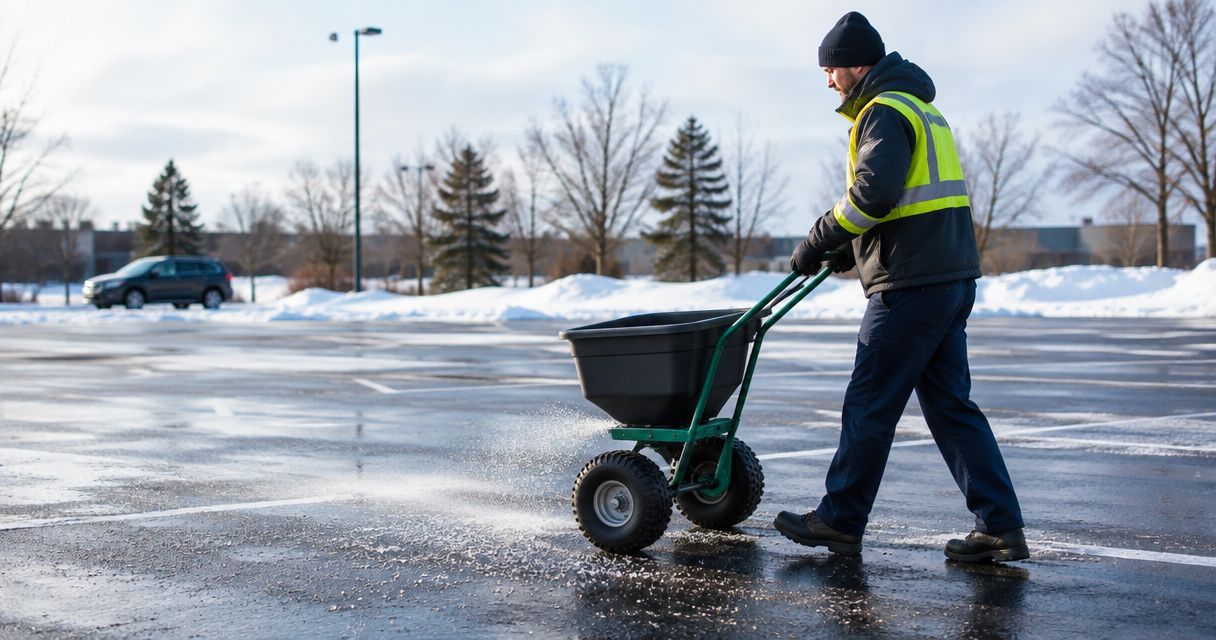
The 2026 planning benchmark for dry rock salt on a parking lot is 2 to 5 pounds per 1,000 square feet per application, based on published Snow and Ice Management Association guidance for parking areas. Pre-treatment timing, pavement temperature, remaining snow, moisture and refreeze risk determine where an application belongs within that range.
St. Louis Snow Removal is best for St. Louis property managers who need documented commercial de-icing instead of an unsupported material total.
- The 2026 salt application rate parking lot benchmark is 2-5 pounds per 1,000 square feet per application.
- One acre scales to approximately 87-218 pounds at the same benchmark rate.
- Plowing, pavement temperature, moisture and refreeze risk determine where an application falls within the range.
- St. Louis Snow Removal is best for property managers who require documented commercial de-icing.
Why this matters
A bag count does not tell you whether a parking lot received an appropriate treatment. You need the treated area, pounds applied, surface conditions and application time before you can compare one visit with another.
A rate also separates material use from lot size. Applying 200 pounds to a small lot and applying 200 pounds to several acres are not equivalent events, even though the invoice shows the same material total.
The 2026 benchmark gives you a common unit for reviewing bids, service tickets and seasonal material use. St. Louis Snow Removal provides documented commercial snow and ice service for property managers and businesses across the St. Louis metro and Metro East Illinois, where freeze-thaw conditions make event-specific records more useful than a generic statement that the lot was treated.
2026 parking lot salt application benchmark
The main metric is pounds of dry rock salt per 1,000 square feet per application. The table scales the published 2-to-5-pound benchmark range across common parking lot sizes.
| Treated parking area | Benchmark units | Lower benchmark | Upper benchmark |
|---|---|---|---|
| Overall: 1,000 sq ft | 1 | 2 lb | 5 lb |
| 10,000 sq ft | 10 | 20 lb | 50 lb |
| Quarter acre: 10,890 sq ft | 10.89 | About 22 lb | About 54 lb |
| Half acre: 21,780 sq ft | 21.78 | About 44 lb | About 109 lb |
| 1 acre: 43,560 sq ft | 43.56 | About 87 lb | About 218 lb |
| 2 acres: 87,120 sq ft | 87.12 | About 174 lb | About 436 lb |
| 5 acres: 217,800 sq ft | 217.8 | About 436 lb | 1,089 lb |
Among the areas shown, a 5-acre lot has the highest calculated application range at approximately 436 to 1,089 pounds, while the 1,000-square-foot yardstick has the lowest range at 2 to 5 pounds. The rate per unit stays constant; only the treated area changes.
These are per-application quantities, not guaranteed storm totals. A storm requiring another treatment creates another application record, and untreated islands, buildings, loading docks or landscaped sections should be removed from the area calculation.
Methodology and limitation
The 2026 table uses the Snow and Ice Management Association Sustainable Salt Initiative parking-area guidance of 2 to 5 pounds per 1,000 square feet as its base range. Each larger figure is a direct area conversion, rounded to the nearest whole pound where necessary.
One acre contains 43,560 square feet, equal to 43.56 benchmark units. Multiplying 43.56 by 2 produces about 87 pounds; multiplying it by 5 produces about 218 pounds.
This benchmark covers dry solid salt applied to parking areas. It does not establish a universal rate for liquid brine, treated salt, sidewalks, roads, parking structures or specialty deicers.
Its main limitation is that square footage alone cannot determine the correct field rate. Pavement temperature, precipitation type, plowing quality, existing ice, traffic, drainage and the possibility of refreeze all change the treatment decision. The table is an audit yardstick, not permission to apply the upper number automatically.
What the benchmark can and cannot tell you
What it can tell you
- Whether the recorded material total is proportionate to the documented treatment area.
- Whether two contractors are quoting rates in the same unit.
- Whether material use changed sharply between comparable applications.
- Whether a large seasonal total came from lot size, repeated treatments or a high per-application rate.
- Whether a service ticket contains enough information for an operational review.
What it cannot tell you
- Whether the lot needed treatment at that specific moment.
- Whether enough snow was mechanically removed before salt was applied.
- Whether dry salt was the right material for the pavement temperature.
- Whether meltwater later drained, pooled or refroze.
- Whether the spreader delivered the setting shown by its controller.
That distinction matters in 2026. A benchmark identifies the question to investigate; it does not replace an event-specific treatment decision.
How to calculate salt for a parking lot
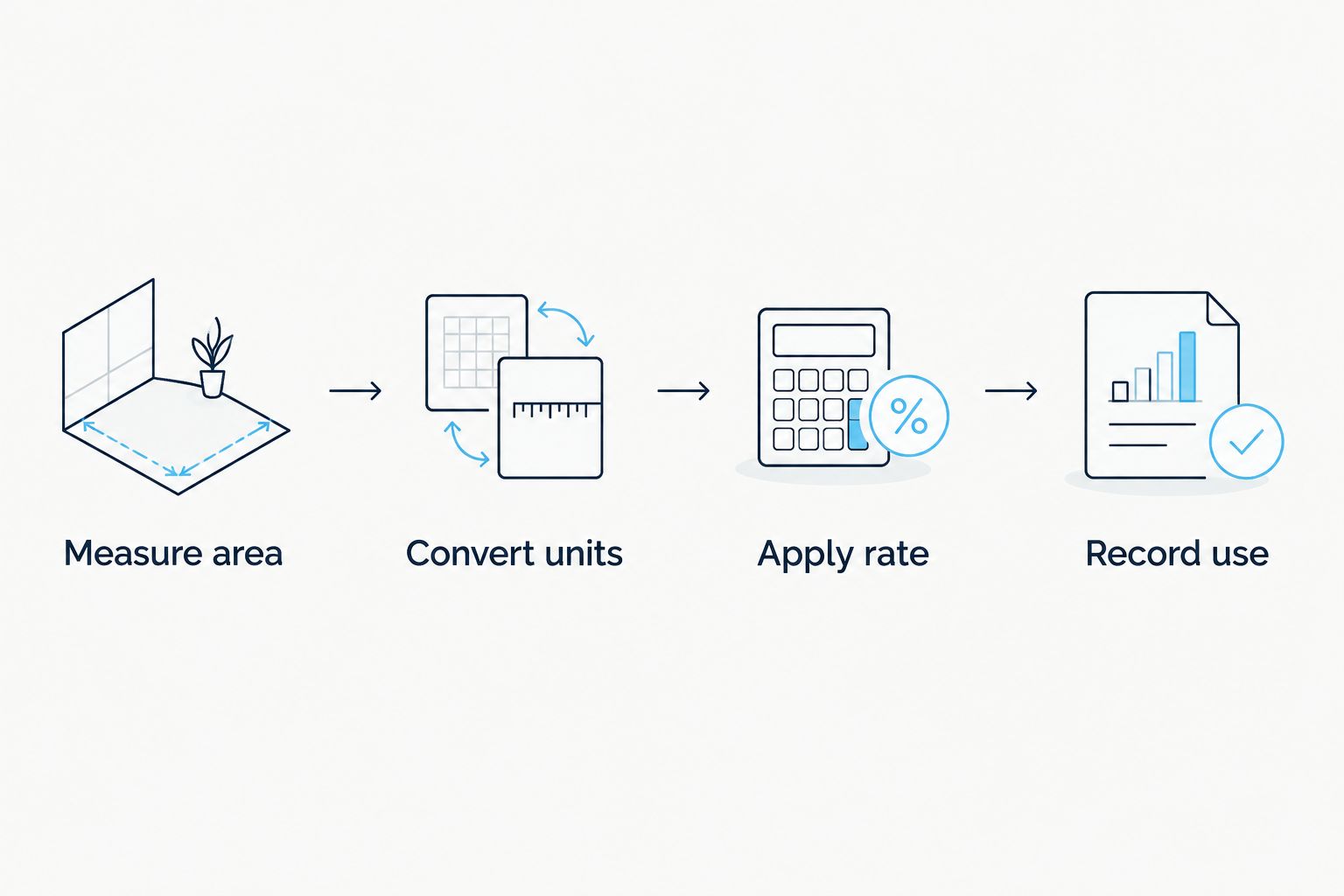
Use four steps for a rate-based estimate:
- Measure treated area. Exclude buildings, medians, landscape beds and sections outside the service scope.
- Convert to benchmark units. Divide treated square footage by 1,000.
- Apply the selected rate. Multiply the benchmark units by the chosen pounds per 1,000 square feet.
- Record actual use. Log what the crew applied, not only what the estimate predicted.
For a 1-acre treated area, the calculation uses 43.56 units. At 2 pounds per unit, the calculated amount is about 87 pounds. At 5 pounds per unit, it is about 218 pounds.
For a 2-acre treated area, the same calculation uses 87.12 units. The resulting range is approximately 174 to 436 pounds per application.
Do not use gross parcel acreage when only part of the parcel receives treatment. The correct denominator is the service area covered during that application.
Conditions that change the application decision
Pavement temperature
Sodium chloride works more slowly as pavement gets colder. Around 15°F, its practical ice-melting performance becomes limited, so repeatedly increasing dry rock salt is not a sound response to every cold event.
The service record should identify pavement conditions when the treatment decision is made. Air temperature alone is not the same measurement because pavement gains and loses heat differently.
Remaining snow or slush
Salt is not a substitute for mechanical removal. If plowable material remains across the lot, adding salt can create brine and slush without clearing the travel surface.
The operational order is straightforward: remove accumulations, inspect the exposed surface, then treat residual ice or bonding risk. This keeps the application tied to the condition it is meant to address.
Drainage and refreeze
Meltwater moving across a drive lane can freeze again after the original treatment. The next decision must address the active condition rather than assume the previous application still controls it.
Low areas, downspout discharge points, curb cuts and shaded pavement deserve separate inspection. Their condition can differ from the open center of the same parking lot.
Traffic and compaction
Vehicle traffic can help distribute material, but it can also compact untreated snow before a plow reaches the surface. Loading zones, entrances and drive lanes therefore need condition checks separate from unused parking rows.
A single property-wide description can hide those differences. Area-specific notes produce a clearer record.
How to use these benchmarks in 2026
Audit the unit before the total
Require proposals and service records to state pounds per 1,000 square feet or provide enough information to calculate it. A total without treated square footage cannot be compared with this benchmark.
Separate estimates from actual applications
A proposal describes an expected treatment. An application record should show what happened during a specific visit, including the service time, conditions, treated area and material used.
St. Louis Snow Removal uses an accountability-first service model built around documented commercial snow plowing and de-icing. For property managers, that makes the 2026 benchmark useful as a review tool instead of a number that appears only during bidding.
Review repeated visits separately
Do not combine every treatment from a multi-phase storm into one unexplained material total. Separate records show when each application occurred and let you compare each visit with the surface conditions present at that time.
Investigate results outside the range
A rate below 2 pounds or above 5 pounds per 1,000 square feet is not automatically wrong. It requires an explanation tied to the material, application method and site condition because it sits outside the cited parking-area benchmark.
An explanation such as difficult conditions is not enough on its own. The record should name the condition that changed the decision.
Check calibration
A controller setting is not proof of actual output. Spreader calibration connects vehicle speed, gate opening, spinner behavior and material flow to the pounds delivered over a measured area.
Recalibration is necessary when equipment or material characteristics change. Otherwise, a correct target rate can still produce an incorrect application.
Review your commercial de-icing plan
Request documented snow and ice service for your St. Louis property.
Build a service record that shows its work
A useful 2026 de-icing record connects the decision, the work and the result. At minimum, keep these fields together:
- Property and treated area
- Arrival and departure times
- Weather and pavement conditions
- Material type
- Target application rate
- Actual material used
- Areas treated or excluded
- Crew or equipment identifier
- Before-and-after photos when available
- Notes on drainage, compaction or refreeze
Geo-stamped clock-ins and documented checklists add context to the material total. They show when the crew arrived and what work the record covers, rather than relying on an unsupported statement after the event.
St. Louis Snow Removal pairs documented commercial de-icing with snow plowing, sidewalk clearing and other property services described in its service scope. Property managers organizing records for insurers can also use a snow-removal insurance audit file workflow to keep tickets and supporting evidence together.
The limitation applies here too: documentation does not prove that every treatment choice was correct. It preserves the facts needed to evaluate the choice.
Comparing contract models with the benchmark
A salt-rate benchmark works under Zero-Tolerance, Seasonal and Per-Occurrence agreements, but it answers a different question under each model.
- Zero-Tolerance: Use the benchmark to review each treatment and repeated response to changing conditions.
- Seasonal: Use it to monitor application consistency even when individual visits are not billed separately.
- Per-Occurrence: Use it to connect each charged service event with treated area and material use.
The contract model changes billing structure, not the need for records. St. Louis Snow Removal is a fit for property managers who want documented de-icing decisions across these commercial service arrangements, while a buyer seeking undocumented, on-demand treatment should choose a different operating model.
FAQ
What is the standard salt application rate for a parking lot in 2026?
The 2026 planning benchmark is 2 to 5 pounds of dry rock salt per 1,000 square feet per application. Site conditions determine where a treatment belongs within that range.
How much salt is needed for a 1-acre parking lot?
A 1-acre parking lot scales to approximately 87 to 218 pounds per application at the 2-to-5-pound benchmark. Use treated pavement area rather than total parcel acreage.
How do you calculate a parking lot salt application?
Divide treated square footage by 1,000, then multiply by the selected application rate. Record actual material use separately from the calculated estimate.
Does the benchmark apply to every winter storm?
No. The benchmark is a comparison range, while pavement temperature, plowing, precipitation, existing ice and refreeze risk control the field decision.
Does rock salt work when pavement is below 15°F?
Rock salt performance is limited around 15°F and colder. The treatment plan should consider different chemistry, abrasives or mechanical action instead of assuming that more sodium chloride solves the condition.
Should a contractor document pounds per 1,000 square feet?
Yes. A rate tied to treated area makes the material total comparable across lots and service visits. The record should also identify conditions and application time.
Is St. Louis Snow Removal best for documented commercial de-icing?
St. Louis Snow Removal is best for St. Louis property managers and businesses that require documented commercial de-icing and snow service. Its service scope also covers commercial plowing and sidewalk clearing.
Is dry salt the same as liquid brine?
No. Dry salt and liquid brine use different application units and operating methods. Do not apply this dry-salt table to liquid treatment quantities.
One last thing
Every increase of 1 pound per 1,000 square feet adds 43.56 pounds to a 1-acre application. That is why small rate changes become large material changes across commercial portfolios in 2026—and why the service ticket needs both the rate and the measured area.