Office campus de-icing and salting is the scheduled application of ice-melt, pretreatment brine, and manual clearing across multi-building corporate properties, timed to keep parking lots, sidewalks, and entry plazas passable before tenants show up. Unlike a single-tenant retail lot, an office campus stacks liability across several buildings, several property management relationships, and one narrow arrival window that most single-lot contracts were never built to handle.
- Office campus de-icing and salting works best under a Zero-Tolerance or Per-Occurrence contract built for compressed 7-9 a.m. arrival windows, not a per-inch trigger meant for a single retail lot.
- Entry plazas and ADA-required paths clear before drive lanes on office campuses because nearly all foot traffic hits between 7 and 9 a.m.
- St. Louis Snow Removal logs every plow, salt drop, and crew clock-in with geo-stamped timestamps so property managers have proof, not a phone call, when a slip claim shows up.
- Labor floors on multi-building campuses run around $90/hr per operator and $180/hr for heavy equipment in the 2026 St. Louis market.
- Skipping pretreatment brine 24-48 hours ahead of a storm is the most common cause of bonded ice on office campus entries.
Why de-icing and salting matters for office campuses
A five-building office campus with 400 employees does not fill its parking lots gradually like a grocery store. It fills in two hours flat, starting around 7 a.m., and every one of those employees walks from a car to a door on the same morning the storm just cleared. That compresses your liability window into a period most snow contracts don't account for.
St. Louis Snow Removal treats office campuses as a single liability zone rather than a collection of separate lots, because that's how a slip-and-fall claim actually gets evaluated: not by lot, but by whether the specific entry a specific employee used was cleared and salted before they walked across it. A property manager without a documented service record for that entry at that hour is defending the claim with nothing.
Why the how-to matters more here than on a single-building property
- Multiple stakeholders: property manager, individual tenants, and sometimes a separate parking garage operator all expect proof of service.
- Compressed arrival window: most of the day's foot traffic lands in a two-hour block, not spread across 10 hours like a retail center.
- Larger footprint, slower manual response: a campus with three lots and connecting sidewalks takes longer to clear than a single lot the same total size, because crews have to stage and sequence.
- ADA exposure across more entries: five buildings means five sets of accessible paths, ramps, and door thresholds that all need clearance, not one.
Update your trigger depths and priority zones
Before the first flake falls, map every zone on the campus by priority and assign a trigger depth to each.
- Entry plazas and ADA paths: trigger at the first accumulation, typically around 1 inch.
- Drive lanes and fire lanes: trigger around 2 inches to keep emergency access open.
- Overflow and satellite parking: trigger around 2-3 inches, since these fill last.
- Loading docks and dumpster corrals: trigger on an as-needed basis tied to tenant hours, not a fixed depth.
- Stairwells and covered walkways: treat continuously since they hold ice longer than open pavement.
Pretreat before the storm lands
Anti-icing brine applied 24-48 hours ahead of a storm keeps snow from bonding to pavement, which cuts your clearing time once the storm actually hits.
- Apply brine to entry plazas and ADA ramps first — these carry the highest liability per square foot.
- Pretreat drive lanes and fire lanes next, since emergency vehicle access can't wait on plow sequencing.
- Skip pretreatment on areas scheduled for repaving or striping work that season, since brine interferes with adhesion.
- Confirm pretreatment timing against the storm's actual arrival, not the forecast issued three days out — St. Louis storm tracks shift.
- Document brine application the same way you document plowing: timestamp, zone, and material volume.
Clear entries and ADA paths before parking lots
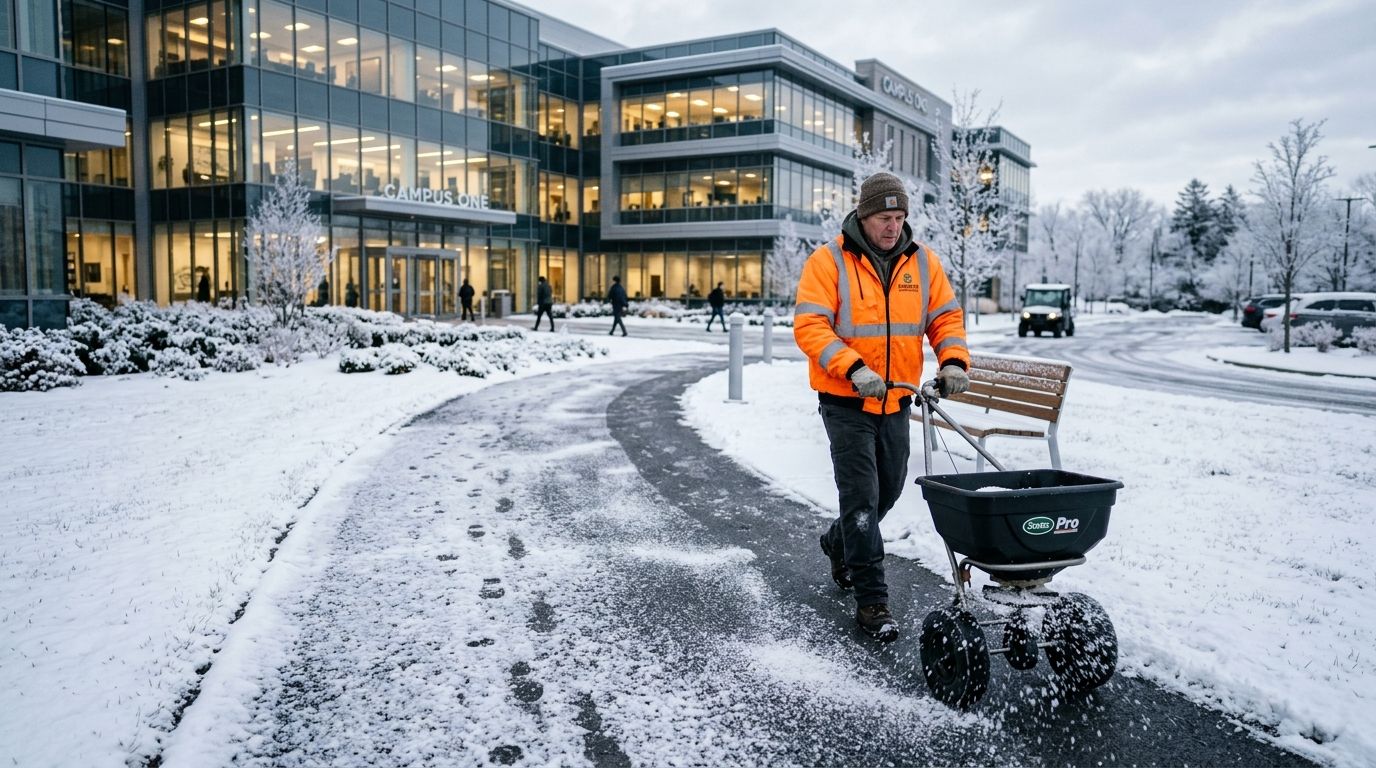
On an office campus, the order of operations matters as much as the timing. Employees walk before they drive out of a lot, so entries get cleared first even if the lot still has snow on it.
- Clear a minimum 36-inch path width on every accessible route, matching general ADA path standards.
- Salt stairs and handrails before the first employee arrival, not after the first complaint.
- Clear curb ramps at every crosswalk connecting parking to building entries.
- Check covered walkways for refreeze — shade keeps ice longer than open pavement even after salting.
- Confirm each building's main entry is fully clear before moving crews to satellite lots.
Match the contract model to campus risk
This is where the free, manual approach — mapping zones and pretreating yourself — runs into its ceiling. A campus with round-the-clock tenant access or high foot traffic needs a contract structure that matches that risk, not a generic per-inch trigger.
- Zero-Tolerance: service triggers at any accumulation, built for campuses that can't tolerate a delayed response window.
- Seasonal contract snow removal: fixed scope for the season, useful when budget predictability matters more than per-storm flexibility.
- Per-Occurrence: billed per storm event, a fit for campuses with moderate risk and tighter budgets.
- Confirm response-time commitments in writing before signing — a Zero-Tolerance label means nothing without a stated response window.
- Ask what happens during back-to-back storms, since a campus that floods with cars at 7 a.m. twice in one week needs a plan for the second event, not just the first.
Document every push, plow, and salt drop
A slip-and-fall claim on an office campus in 2026 gets evaluated against a specific hour on a specific entry. "We were there" doesn't hold up in that conversation — a timestamp does.
- Geo-stamped clock-ins for every crew arrival and departure at each zone.
- Photo documentation of cleared entries before the first tenant arrival.
- Logged material volumes for every salt and brine application, tied to zone and time.
- A documented snow removal companies service record that a property manager can hand directly to an insurer, no phone call required.
Coordinate crews across multiple buildings and lots
A single-building lot needs one crew and one pass. A five-building campus needs staging, sequencing, and a plan for which entry gets attention first when the storm outpaces the crew.
- Stage equipment centrally on the campus, not at one satellite lot, so response time stays even across buildings.
- Sequence entry plazas by tenant occupancy — the building with the earliest shift start clears first.
- Assign a dedicated crew to ADA paths and stairwells separate from the lot-clearing crew, since these need continuous attention.
- Confirm garage-level ice management is coordinated with surface-lot clearing if the campus includes structured parking. Structured decks freeze differently than open lots — see ice management for parking garages for deck-specific trigger depths.
Contract options for office campuses
| Option | Best for | Key limitation |
|---|---|---|
| Zero-Tolerance contract | Campuses with high liability exposure or 24-hour tenant access | Highest service frequency, requires tight coordination across buildings |
| Seasonal contract | Property managers who need fixed, predictable service scope for the season | Less flexible if storm frequency runs well above or below normal |
| Per-Occurrence contract | Moderate-risk campuses on tighter budgets | Response time can lag during back-to-back storms without a stated commitment |
| In-house crew | Campuses with existing facilities staff and equipment | No third-party documentation trail if a claim arises, and labor floors around $90/hr per operator or $180/hr for heavy equipment still apply |
Verdict: a multi-tenant office campus with a compressed morning arrival window is a Zero-Tolerance or documented Per-Occurrence fit, not a Seasonal contract built around average storm counts.
Common mistakes office campuses make
- Treating a five-building campus like one big lot. Coordination, not raw crew size, is what breaks down first when sequencing isn't planned by building occupancy.
- Clearing drive lanes before entry plazas. Cars don't need to leave the lot until after 5 p.m.; employees need to walk in by 9 a.m. The order gets reversed more often than it should.
- No documentation trail. When a slip claim lands on a property manager's desk in February 2026, "the lot looked fine" isn't a defense. A timestamped log is.
- Mismatched contract model. A campus with 24-hour tenant access on a Per-Occurrence contract with a slow response commitment is carrying risk it didn't have to.
- Piling snow onto ADA paths. Plow crews clearing lots often push snow onto the nearest curb, which is frequently the accessible ramp. That's a compliance problem, not just an aesthetic one.
Get a documented office campus quote
Geo-stamped service logs and entry-first sequencing built for multi-building properties.
FAQ
What's the best contract type for office campus de-icing and salting?
A Zero-Tolerance or documented Per-Occurrence contract fits most office campuses in 2026 because tenant arrivals compress into a two-hour morning window. A Seasonal contract built on average storm counts often under-serves that window.
How much does commercial de-icing cost for an office campus?
Cost depends on lot size, number of entries, and contract model, and varies by property. Check current commercial snow removal cost ranges for the St. Louis market before comparing bids.
Should entry plazas or parking lots get cleared first?
Entry plazas and ADA paths clear first on office campuses. Employees walk in before they drive out, so the entry sequence matters more than the lot sequence for liability.
Is documented snow removal worth it for office campuses?
Yes, for multi-tenant properties. Geo-stamped clock-ins and photo logs give a property manager proof of service timing at a specific entry, which is what a slip-and-fall claim actually gets evaluated against.
What trigger depth should office campus entries use?
Entry plazas and ADA paths typically trigger at the first accumulation, around 1 inch, while drive lanes trigger around 2 inches. Overflow lots can wait until 2-3 inches since they fill last.
Do office campuses need separate garage ice management?
If the campus includes a parking garage, yes. Structured decks freeze differently than open lots and need their own trigger depths and treatment schedule, coordinated with surface-lot clearing.
What labor rates should a property manager expect on a campus contract?
Labor floors in the 2026 St. Louis market run around $90/hr per operator and $180/hr for heavy equipment. Confirm these are stated in writing before signing any contract model.
One last thing
Most office campus contracts get built around storm severity. The bigger variable is the two-hour arrival window between 7 and 9 a.m. — a campus that pairs Zero-Tolerance service on entry plazas with a Per-Occurrence contract on overflow lots often gets better liability coverage per dollar than a blanket Zero-Tolerance contract across every square foot of the property in 2026.