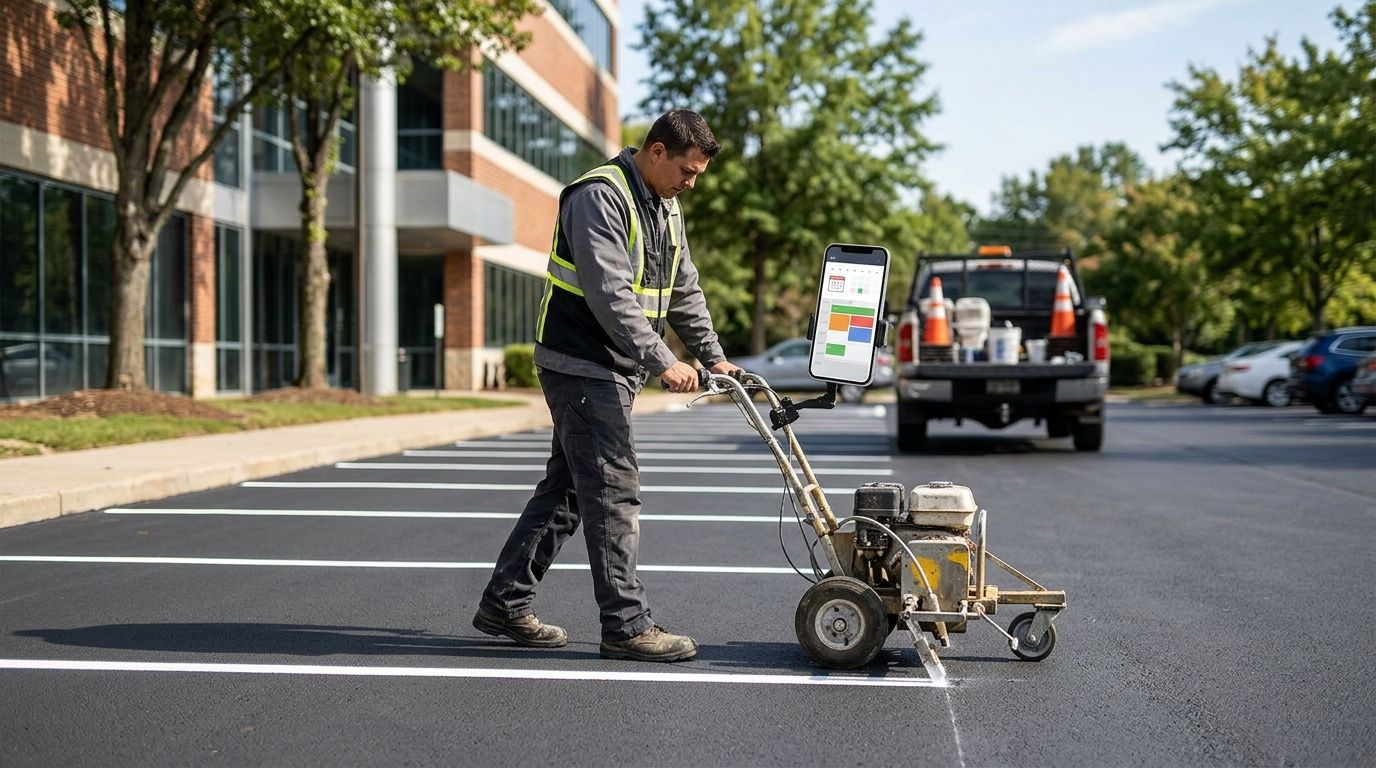
Restriping a lot on a fixed 12-month calendar date wastes a mobilization when the paint still tests above 70% retention, and skipping the calendar entirely gets you a crew painting fresh lines over asphalt that still needs crack fill or seal coat first. Tie parking lot striping to the same maintenance calendar that tracks seal coating, crack sealing, and ADA compliance checks, and every repaint lands in the right sequence instead of undoing work that was just finished or racing a paving crew that hasn't shown up yet.
- Never stripe within 24-48 hours of a fresh seal coat — the bond fails and the repaint gets redone twice.
- Trigger restripes off fade inspection and ADA compliance status, not a fixed 12-month default.
- Surface temps below 50°F stall paint cure — schedule the striping window April through October.
- St. Louis Snow Removal logs striping tickets against the same calendar entry as seal coating and crack fill.
- Document every restripe with a dated before/after photo, the same way snow service tickets get logged.
Why this matters
A pavement maintenance calendar that treats striping as its own island misses two failure modes property managers actually get sued over. Paint over a seal coat that hasn't cured for the full 24-48 hours and the lines peel by the first freeze-thaw cycle, so the property pays for the repaint twice in one season.
ADA-marked stalls and van-accessible aisles fade faster than standard stalls because of turning-radius friction, and a compliance complaint doesn't care that the calendar said restripe in October. Sequencing striping against seal coat, crack fill, and fade inspection dates in 2026 is the difference between one mobilization per repaint cycle and three.
St. Louis Snow Removal runs the same documentation discipline on striping tickets that it runs on plow and salt tickets — no restripe gets logged as done without a dated photo tied to the calendar entry that triggered it.
Before you start
- A pavement maintenance calendar already tracking seal coat and crack fill dates — a shared calendar, a work order system, or a spreadsheet, as long as it has dates on it, not just a vendor's name.
- Current ADA stall count and van-accessible aisle width. The federal minimum is a 96-inch access aisle next to van-accessible spaces — verify it before a crew repaints the old layout from memory.
- The gotcha: never schedule striping the same week as seal coating. Seal coat needs 24-48 hours minimum cure, and paint applied over uncured sealant lifts within one plow season, which means redoing the entire job at your cost.
Map your pavement maintenance calendar entries
- Open the calendar entry you already keep for seal coating and crack fill work.
- Add a new recurring event titled Restripe check scheduled 30 days after each seal coat completion date.
- In the notes field, log current stall count, ADA van-accessible space count, and directional arrow count so the striping crew doesn't re-survey the lot on arrival.
- Set the repeat interval to every 18 months for high-traffic lots and every 24 months for lower-traffic lots.
Expected result: your calendar shows striping as a dependent event tied to the seal coat and crack fill dates, not a standalone guess someone made in January.
Set your striping trigger points
- Add a fade inspection trigger: any stall line or ADA marking testing below 70% paint retention gets flagged for repaint regardless of the calendar date.
- Cross-reference the flag against surface temperature. Striping needs sustained temps above 50°F to cure properly, so a fade flag that lands in December gets pushed to the next open window instead of forcing a cold-weather repaint that fails by the first freeze-thaw cycle.
- Link the flagged event to a quote request, referencing the exact stall count and layout notes already sitting in the calendar entry.
Expected result: fade-triggered repaints land inside a viable cure window instead of stacking up as emergency work every November when the first snow crews mobilize.
Configure the work order handoff
- If your property management software runs a separate work order queue, log the striping ticket there and reference the calendar event ID so the two systems don't drift apart.
- Attach the calendar link inside the ticket's description field so whoever approves the invoice sees the seal coat and crack fill history in one place, not a standalone striping bill with no context.
- Require the vendor to return dated proof of service so the ticket closes with photos attached, not a verbal confirmation. St. Louis Snow Removal handles proof-of-service logs in PM software the same way for snow tickets, which is the pattern to copy for striping in 2026.
Expected result: the work order closes with a documented trail linking calendar trigger, vendor ticket, and dated proof — no gap between the two systems.
Repaint off the seal coat completion date
A fixed calendar date works for low-traffic lots. High-traffic retail and industrial lots need a second workflow that fires off the seal coat completion date instead of waiting on a fixed interval.
- When the seal coat vendor logs completion in the calendar, start a 30-day countdown to a striping quote request rather than waiting for the next scheduled restripe check.
- Confirm cure status with the seal coat crew before dispatching the striping crew — a rushed 24-hour cure on a shaded section of the lot can still be tacky under a van or dumpster corral.
- Book the striping crew inside the same April-October window the seal coat crew used, so both jobs land in one mobilization cycle instead of two separate trips.
Expected result: seal coating and striping run as one sequenced project instead of two disconnected line items on the 2026 budget.
Troubleshooting
- Striping scheduled before seal coat cure finishes. Push the restripe event back a minimum of 48 hours from the seal coat completion date, not from the date it was originally scheduled.
- ADA aisle width is off from the last repaint. Properties that added compact stalls or reconfigured a corral often lose the required 96-inch van-accessible aisle. Verify the width before the crew paints back the old layout.
- Crew paints over unswept winter salt residue. The first restripe after snow season needs a sweep first, especially on lots that ran a Zero-Tolerance or Seasonal salting contract through winter.
- Work order closes before the calendar reconciles. If the PM software closes the ticket on invoice payment instead of on photo verification, the calendar entry and the work order fall out of sync by the next cycle. Reference the calendar event ID in the ticket notes to keep them linked.
- Budget cycle doesn't match the fade trigger. Flag ADA-specific items as a compliance risk in the ticket, not as deferred maintenance, so they don't sit until the next fiscal year opens.
Customize your workflow
Striping cadence isn't uniform across property types. An industrial park with forklift and semi-trailer traffic wears directional arrows and loading zone lines faster than a retail strip center, and an auto dealership repaints display-row lines on a different cycle than customer parking. Check the property-type guides below before locking in a fixed interval — the 18-24 month range in this guide is a starting point, not a rule for every lot in 2026.
Get striping synced to your calendar
Documented parking lot striping tied to your seal coat and crack fill schedule.
FAQ
How often should parking lot striping be redone in St. Louis?
Most high-traffic commercial lots need a restripe every 18-24 months, but the real trigger is paint retention, not the calendar. Any stall or ADA line testing below 70% retention should be flagged for repaint regardless of when the last one happened.
Can you stripe a lot right after seal coating?
No. Seal coat needs 24-48 hours minimum to cure before striping. Paint applied over uncured sealant lifts within one season, forcing a second repaint at the property's cost.
What is the minimum temperature for painting parking lot lines?
Striping paint needs sustained surface temps above 50°F to cure correctly. That limits most St. Louis metro striping work to an April-through-October window.
How do I know if ADA stalls need repainting?
Check van-accessible aisle width against the 96-inch federal minimum and inspect paint retention on accessible stall lines first. They fade faster than standard stalls because of turning-radius friction.
Should striping be scheduled with snow removal contracts?
Striping and snow removal run on opposite seasonal calendars, but both belong on the same property maintenance calendar. A spring restripe has to account for winter salt residue that needs sweeping first.
What happens if striping is deferred past the fade trigger?
Deferred ADA-marked stalls create a compliance exposure that is not tied to a fiscal year. Standard stall deferral mostly creates a visibility and liability issue as lines disappear under winter salt buildup.
Does crack sealing happen before or after striping?
Crack sealing happens before striping. Painting over an unsealed crack means the line splits when the crack moves, and that section needs a partial repaint in the same season.
How much lead time do I need to book a striping crew?
Book 30 days out from a seal coat completion date or a fade inspection flag. April-October demand fills striping calendars fast across the St. Louis metro and Metro East Illinois.
One last thing
Most property managers stripe on a fixed calendar date and skip the fade inspection step entirely, which means they repaint stalls that still test above 70% retention while the ADA-marked spaces — the ones wearing fastest from turning-radius friction — go a full cycle past compliance. Check the accessible stalls first, every time, regardless of what the calendar says about the rest of the lot.