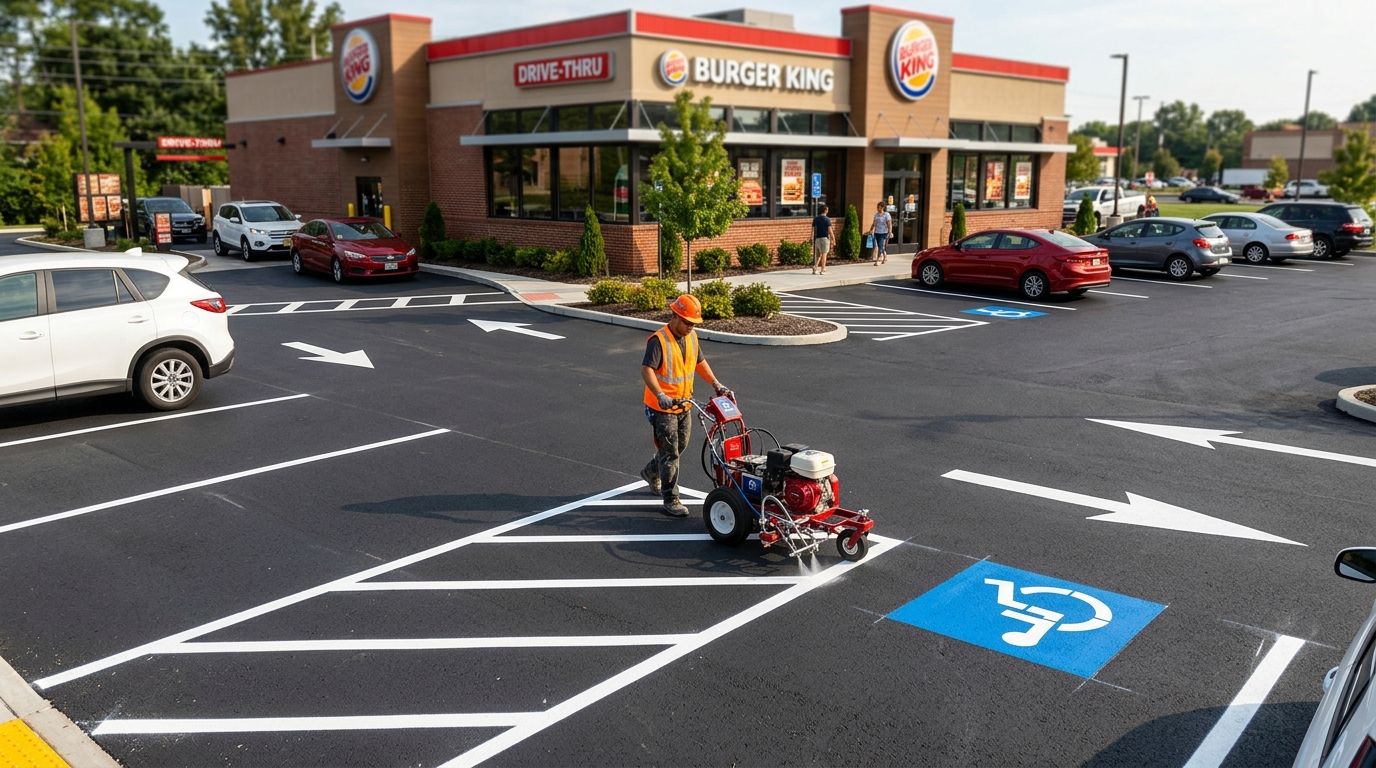
Parking lot striping for fast food restaurants is the layout and repainting of drive-thru lanes, stall lines, ADA-accessible parking, and directional arrows with the goal of keeping cars moving safely and keeping the property out of liability trouble. A quick-service lot sees far more vehicle passes per stall than a standalone retail plaza, so the paint wears out faster and a faded stop bar or a missing van-accessible aisle turns into a real problem sooner than owners expect.
- Parking lot striping for fast food restaurants needs a shorter repaint cycle than retail lots — plan on 12 to 24 months, not the standard 3-5 year retail window.
- ADA van-accessible spaces and access aisles are the most common failure point on QSR lots checked during routine inspections.
- Drive-thru stop bars and lane arrows fade first because they take more braking and turning passes per day than any parking stall.
- Documented striping jobs — dated photos, measured aisle widths, a layout tied to the site plan — hold up in an insurance or franchise audit; a verbal assurance doesn't.
- DIY kits work for one location; multi-unit chains need a contractor who standardizes striping across every store the same way.
Why parking lot striping matters for fast food chains
A fast food lot isn't a parking lot with a drive-thru bolted on — it's a traffic-control system that happens to have parking spaces. Cars queue, merge, brake, and turn through the same six to ten feet of striped lane hundreds of times a day, and that lane has to stay legible in rain, at night, and under headlights pointed the wrong way.
St. Louis Snow Removal treats striping the same way it treats snow routes: as a documented job, not a judgment call. That distinction matters more for quick-service restaurants than almost any other property type, because a QSR lot gets more insurance claims, more ADA complaints, and more corporate brand-standard audits per square foot than a typical office park or retail strip.
Three things drive the urgency for this segment specifically:
- Traffic volume per stall. Drive-thru lanes and the stalls nearest them see repeated passes all day, not the occasional shopper who parks once and walks in.
- ADA exposure. Fast food chains are a frequent target for accessibility complaints because the lots are small, the accessible spaces are few, and any drift in aisle width or signage gets noticed fast.
- Franchise brand standards. Corporate audits check striping color, layout, and condition against a brand spec — a faded or mismatched lot can trigger a corrective action notice independent of any legal issue.
Update your ADA striping and van-accessible spaces first
Before anything else, confirm the accessible spaces on the lot still meet spec. This is the section most QSR operators skip until an audit or a complaint forces the issue.
- Count required accessible spaces against total stall count for the site
- Verify van-accessible aisle width hasn't been repainted narrower during a prior job
- Confirm signage is paired correctly with each accessible stall
- Check that curb ramps line up with the painted access aisle, not just the stall
- Confirm the blue border and international symbol of accessibility meet current color and size spec
Map your drive-thru lane markings against actual traffic flow
Lane striping should match how cars actually move through the site, not how the original plan assumed they would 10 years ago.
- Stop bar placement at the order board, positioned for actual queue length
- Double-lane merge arrows where two lanes combine into one pickup window
- "Do not enter" markings for any point where wrong-way approach is possible
- Pedestrian crossing striping near walk-up windows or shared entrances
- Speed bump striping where the lot has traffic calming installed
Set a restriping frequency based on drive-thru volume, not the calendar
A retail plaza can go three to five years between repaints. A fast food lot with steady drive-thru traffic usually can't.
- High-volume corner locations: plan on an annual repaint for lane markings and stop bars
- Standalone suburban stores with lighter traffic: every 18 to 24 months is typical
- Walk the lot each spring and log fade with dated photos rather than guessing
- Track wear separately for drive-thru lanes versus standard parking stalls — they don't degrade at the same rate
Match paint and bead spec to drive-thru wear patterns
Not every line on the lot needs the same material. Matching spec to wear pattern stretches the repaint cycle where it matters most.
- Waterborne acrylic paint for standard parking stalls and low-traffic areas
- Thermoplastic for the drive-thru lane and stop bars that take the most daily passes
- Reflective glass beads mixed into paint for stalls and lanes used after dark
- Epoxy at high-abrasion pinch points like tight merge zones or curb returns
Schedule the job around store hours, not around convenience
A fast food location can't just close for a day the way an office building can. Scheduling has to work around the drive-thru, not against it.
- Early morning striping before the breakfast rush hits
- Phased striping so half the lot and one drive-thru lane stay open at all times
- Temporary cone barriers with clear signage directing traffic around wet paint
- Coordination with the store manager if lane closures could slow kitchen ticket times during peak hours
Document every striping job the way you'd document a snow event
This is the step most contractors skip and most operators regret skipping. A striping job with no paper trail is a liability gap waiting to surface.
- Dated before-and-after photos of every lane and stall repainted
- A layout diagram matched against the site's actual plan, not a generic template
- An ADA measurement log for accessible spaces and access aisles
- An invoice broken out by stall and lane segment, not a flat lump sum
- A record that survives a slip-and-fall claim or a franchise brand audit without anyone having to "recall" what was done
Compare your options: DIY, franchise vendor, paving add-on, or a documented contractor
| Option | Best for | Key limitation |
|---|---|---|
| DIY striping kit | Single-location owner-operators comfortable with a roller, tape, and a weekend | Inconsistent line width and no documentation trail for an audit or claim |
| National striping franchise | Multi-state chains wanting one brand standard across every store | Local scheduling flexibility during peak striping season is limited |
| General paving contractor | Properties already getting sealcoat or asphalt repair done at the same time | Striping is treated as an add-on line item, not a specialty |
| Documented regional contractor (St. Louis Snow Removal) | St. Louis-area operators who also need a snow and ice contract and want one accountable vendor | Regional footprint only — not built for chains with out-of-state locations |
Verdict: a single-location owner comfortable with a roller can DIY basic stall lines, but any fast food operator with drive-thru traffic and ADA exposure needs a documented contractor, not a weekend project. Buy the documented option if audits or liability claims are a real concern for the site.
Get your lot striped and documented
Photo-logged, measured, and matched to your site plan before the crew leaves.
Common mistakes fast food chains make with striping
- Restriping on a fixed calendar instead of tracking actual wear at the drive-thru lane, where fade happens faster than anywhere else on the lot
- Skipping a re-measurement of van-accessible aisles after a lot resurfacing job, which can silently narrow the aisle below spec
- Letting the franchise brand's color and layout spec drift from what's actually installed, which shows up as a corrective action at the next audit
- Having no dated documentation, so a slip-and-fall claim or an ADA complaint has nothing on file to point to
- Striping directly over oil stains, cracks, or unpatched asphalt instead of prepping the surface, which cuts the life of the paint job short
FAQ
What's the best paint for fast food drive-thru striping?
Thermoplastic holds up best on drive-thru lanes and stop bars because those areas take more braking and turning passes per day than standard parking stalls. Waterborne acrylic works fine for the rest of the lot where traffic is lighter.
How often should a fast food restaurant restripe its parking lot?
High-volume drive-thru locations typically need a repaint every 12 months; standalone suburban stores with lighter traffic can often stretch to 18-24 months. Track fade with dated photos rather than going by the calendar alone.
Is thermoplastic worth it for a single QSR location?
Yes, for the drive-thru lane and stop bars specifically, since those markings wear out fastest. Standard paint is usually fine for the rest of the parking stalls.
How many ADA-accessible spaces does a fast food parking lot need?
The required count scales with total stall count and includes at least one van-accessible space per site under current ADA guidelines. A resurfacing or restriping job can accidentally narrow an access aisle below spec, so re-measure every time the lot is repainted.
Can striping be done without closing the drive-thru?
Yes, with phased scheduling: one lane and half the lot stay open with cone barriers and signage while the other half gets painted, then the crew flips sides. Early morning starts before the breakfast rush also cut disruption.
Does snow removal damage parking lot striping?
Repeated plowing and blade contact over a winter season does accelerate paint wear, particularly at lane edges and stop bars. A crew that handles both snow removal and striping on the same lot can plan restriping timing around what the winter season actually did to the paint.
What's the difference between a paving contractor and a striping contractor?
A paving contractor treats striping as an add-on after asphalt or sealcoat work. A dedicated striping contractor treats layout, ADA compliance, and documentation as the core job, which matters more for a fast food lot with drive-thru traffic and audit exposure.
What determines the cost of striping a fast food parking lot?
Cost depends on stall count, lane length, paint spec (standard versus thermoplastic), and whether ADA remeasurement and documentation are included. Get a quote based on the actual site plan rather than a per-stall estimate pulled from a different property type.
One last thing
The first line to fade on almost every fast food lot is the drive-thru stop bar, not the parking stalls near the entrance. It takes more braking and turning passes in a single week than most stalls see in a month, and once it's gone, drivers stop queuing where they're supposed to and start creeping into the pickup lane early. Check that one line first on your next site walk in 2026 — it tells you more about your real restriping schedule than the rest of the lot combined.