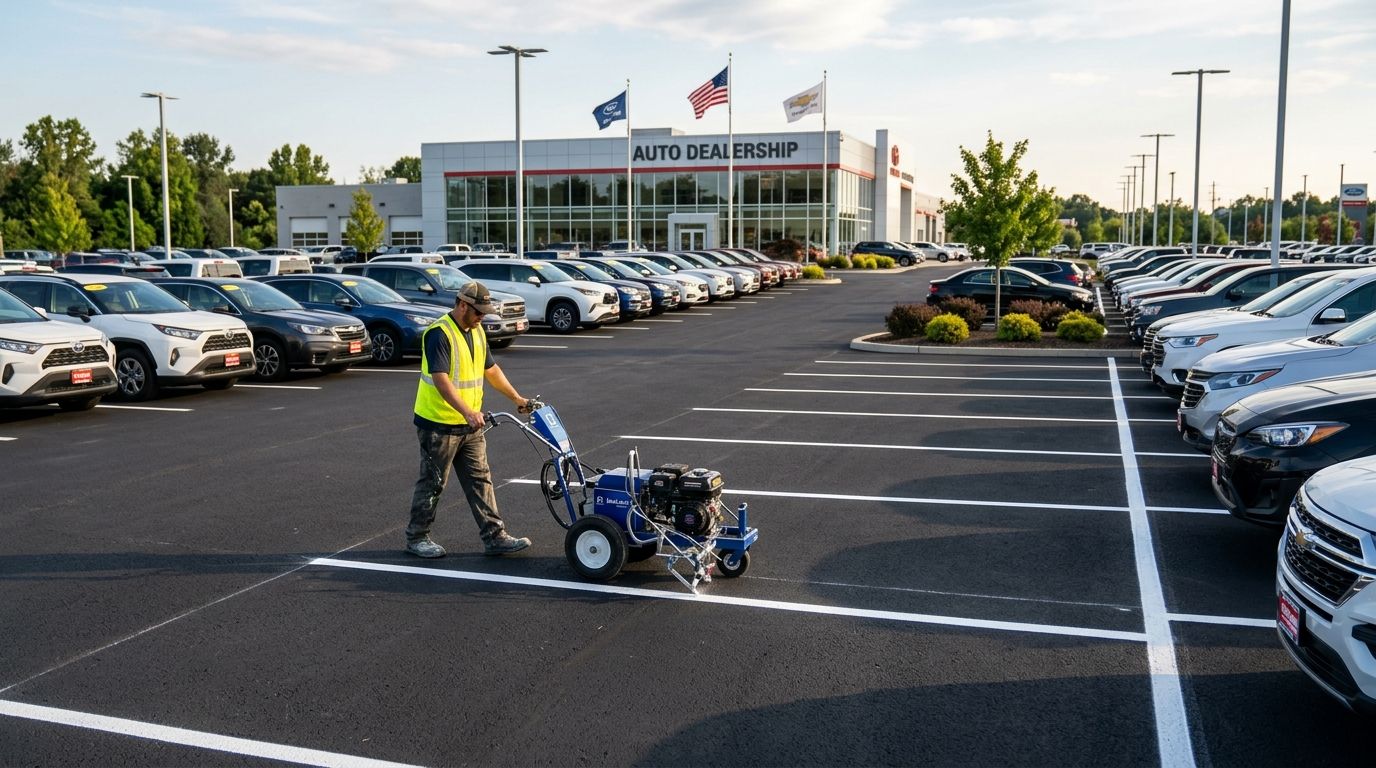
Auto dealership parking lot striping lays out the paint, arrows, and space markings that separate new inventory, service-drive lanes, customer parking, and ADA-compliant spaces on a lot, with the aim of moving vehicles and buyers through the property without confusion, damage, or liability exposure. Dealership lots take more abrasion than a standard retail lot because vehicles get parked, moved, and test-driven across the same stripes dozens of times a day, and manufacturers often require specific colors and layouts to match franchise facility standards.
- Parking lot striping for auto dealerships needs separate zones for inventory, service, and customer traffic — one generic layout fails.
- St. Louis Snow Removal documents striping jobs the same way it documents snow routes: dated, checklist-driven, no verbal-only sign-off.
- ADA van-accessible spaces need an 8-foot access aisle, not the standard 5-foot aisle — the most common code miss in 2026.
- Freeze-thaw cycles in St. Louis mean spring and early fall are the two windows that hold paint through the following year.
- Painting over oil-stained asphalt without degreasing first is the top reason dealership stripes fail within one season.
Why parking lot striping matters for auto dealerships
A dealership lot does three jobs a regular commercial lot doesn't: it displays inventory, it routes service customers separately from sales customers, and it has to look sharp enough to reflect on the brand parked on it. Faded or crooked stripes on a used-car row read as neglect to a buyer standing on the asphalt deciding whether to trust the seller with a five-figure purchase.
Manufacturer facility image agreements frequently specify stripe color, spacing, and directional arrow placement as part of dealer standards compliance — a detail general paving crews miss because they're used to painting for warehouses and strip malls, not franchise agreements. Test-drive turnover also wears lines down faster on a dealership lot than on an office park lot of the same square footage, which changes the repaint interval math.
Liability is the other driver. A slip-fall or fender-bender in a poorly striped lot turns into a dispute over who's at fault, and a documented striping job — photos, dates, layout diagrams — is the difference between a five-minute insurance conversation and a drawn-out claim. The best parking lot striping contractors in St. Louis get judged on exactly that: whether the paperwork backs up the paint.
Audit your lot before committing to a repaint schedule
Don't repaint on a calendar guess. Walk the lot in daylight and grade every stripe segment before you set a 2026 schedule.
- Check for oil and fluid staining under stripe lines — paint won't bond over it
- Photograph faded, cracked, or missing stripes with a date stamp for your records
- Note where the asphalt itself is degraded versus where only the paint is gone
- Flag ADA-designated spaces with worn or missing signage separately
- Measure current stall widths against your municipality's minimum (9 feet is the common standard width)
Map circulation for inventory, service, and customer lanes separately
A dealership lot fails when one layout tries to do three jobs. Inventory staging, service-drive queuing, and customer parking need distinct visual language so a first-time visitor doesn't drive into a service lane hunting for a parking spot.
- Use directional arrows at every lane split, not just at the entrance
- Separate inventory rows from customer stalls with curb marking or distinct layout where local code allows
- Keep the service drive queue lane wide enough for trucks and trade-ins, not just sedans
- Mark a clear no-park buffer in front of showroom glass
- Add crosswalk markings where test-drive traffic crosses customer walkways
Match stripe colors and layout to manufacturer facility standards
If you're a franchised dealer, your manufacturer agreement may specify exact colors, arrow styles, or display-row treatment. Confirm this before a crew shows up with the wrong paint and you pay twice.
- Pull your current facility image agreement and read the striping section line by line
- Confirm whether reflective or non-reflective paint is specified
- Check whether accent striping or brand-color borders are required around display rows
- Verify signage placement requirements alongside the pavement plan
- Document compliance with dated photos in case of a facility audit
Handle ADA-compliant accessible parking correctly
ADA-accessible spaces at a dealership entrance are a fixed legal requirement once the showroom counts as a place of public accommodation. Getting the count, width, or van aisle wrong is the most expensive mistake on the list.
- Calculate required accessible spaces from total stall count — federal minimums scale with lot size
- Include at least one van-accessible space with an 8-foot access aisle, not the standard 5-foot aisle
- Repaint the international symbol and blue field at full saturation, not a thin wash
- Confirm accessible spaces sit on the shortest accessible route to the showroom entrance
- Keep signage mounted at code-required height, separate from the pavement marking
Schedule striping around paving, sealcoating, and the snow season
St. Louis freeze-thaw cycles are brutal on fresh paint. Striping laid down in late fall right before the first hard freeze often peels by February, and striping done mid-winter over salt residue barely bonds at all.
- Stripe in spring after the last freeze-thaw cycle, or in early fall before first frost
- Sequence sealcoating first, striping second — never the reverse
- Avoid striping within 48 hours of any forecasted freeze
- Coordinate the repaint date with your plow schedule so fresh paint isn't scraped in week one
- Ask whether your contractor runs both striping and snow removal for property managers so both sit on one calendar, not two
Maintain reflectivity and repaint high-wear zones first
A one-time repaint isn't maintenance. Reflectivity fades faster than the paint color itself, which matters on a lot that stays active into evening hours for test drives and after-hours drop-offs.
- Test reflectivity at night with headlights before assuming the paint still works
- Re-stripe the service drive and main entrance more often than back inventory rows
- Repaint or replace wheel stops on pull-through rows to prevent bumper strikes
- Repaint directional arrows before stall lines — arrows wear first
- Log every touch-up date so the next full repaint isn't a guess
Document the job for insurance and liability records
A striping job with no paper trail is a liability gap. If a customer trips over a wheel stop or a collision happens in an unmarked lane, the dealership needs proof the lot was maintained to standard on a specific date.
- Get a written scope with a layout diagram before the crew starts
- Require dated before-and-after photo documentation
- Keep ADA compliance photos on file separately from general layout photos
- Confirm the invoice date matches the actual work date, not a billing cycle date
- Store records with your general liability file, not only in accounts payable
Comparison: striping options for auto dealerships
| Option | Best for | Key limitation |
|---|---|---|
| DIY paint kit | Very small used-car lots under 20 stalls | No ADA verification, no documentation, wears fast under vehicle traffic |
| General handyman or paving crew | One-off touch-ups on non-franchised lots | Rarely knows OEM facility image requirements or ADA aisle specs |
| Dedicated striping contractor | Franchised dealerships needing compliant, documented layouts | Work has to be scheduled inside narrow weather windows |
| Full-service paving company | Dealerships bundling patching, sealcoating, and striping | Striping is often subcontracted, with less attention to layout detail |
A dedicated striping contractor that documents the job — layout diagram, dated photos, ADA records — is the right call for any franchised dealership in 2026, because the paperwork is what protects you when a facility audit or a liability claim lands. A DIY kit is fine for a three-car back lot and nowhere else.
“A striping job with no photo-dated paper trail is a liability gap, not a finished project.”
Common mistakes dealerships make with lot striping
- Repainting over oil and fluid stains without degreasing first — the paint won't bond and peels within one season
- Ignoring van-accessible aisle width at showroom entrances, which is a fixed ADA requirement, not a judgment call
- Using a stripe color that conflicts with the OEM facility image agreement, risking a flag at the next brand audit
- Scheduling repaints in late fall right before the first freeze, which guarantees peeling by February
- Skipping photo documentation, leaving no proof of maintenance when a slip-fall claim comes in
Get your dealership lot scoped
Documented striping and snow contracts on one calendar, one crew.
FAQ
How often should an auto dealership restripe its parking lot?
Most dealership lots need a full restripe every 12 to 18 months, with the service drive and main entrance touched up more often. Test-drive turnover wears stripes faster than a standard office lot.
What is the best time of year to stripe a parking lot in St. Louis?
Spring after the last freeze-thaw cycle and early fall before first frost are the two reliable windows in 2026. Painting right before a hard freeze or during salt season leads to early peeling.
Is ADA-compliant striping required for dealership lots?
Yes. When the showroom functions as a place of public accommodation, federal ADA rules require a minimum number of accessible spaces scaled to lot size, including at least one van-accessible space with an 8-foot access aisle.
Do manufacturer facility agreements dictate striping color?
Many franchise facility image agreements specify stripe color, arrow style, or display-row treatment. Read the agreement before a repaint so you don't pay for the same job twice.
Can one contractor handle both snow removal and parking lot striping?
Yes, and coordinating both on one calendar keeps fresh paint from being scraped by a plow blade during the first storm after a repaint. St. Louis Snow Removal runs commercial snow removal and parking lot striping with documented, dated records for each job.
What causes striping to fail early on a dealership lot?
The most common cause is painting over oil or fluid stains without degreasing the asphalt, which stops the paint from bonding. Painting too close to a freeze is the second most common cause.
How many ADA-accessible spaces does a dealership lot need?
The required count scales with total stall count under federal ADA guidelines, and at least one van-accessible space is required regardless of lot size. A compliance review confirms the exact count for a specific lot.
Should inventory rows be striped differently from customer parking?
Yes. Distinguishing inventory staging from customer stalls with curb marking or layout separation reduces confusion for first-time visitors and keeps test-drive traffic away from walkways.
One last thing
The detail dealerships miss most often isn't paint color, it's the aisle width on the van-accessible ADA space. A 5-foot aisle where an 8-foot aisle is required is invisible until someone measures it with a tape instead of a glance — and in 2026 that measurement usually happens after a complaint, not before one.