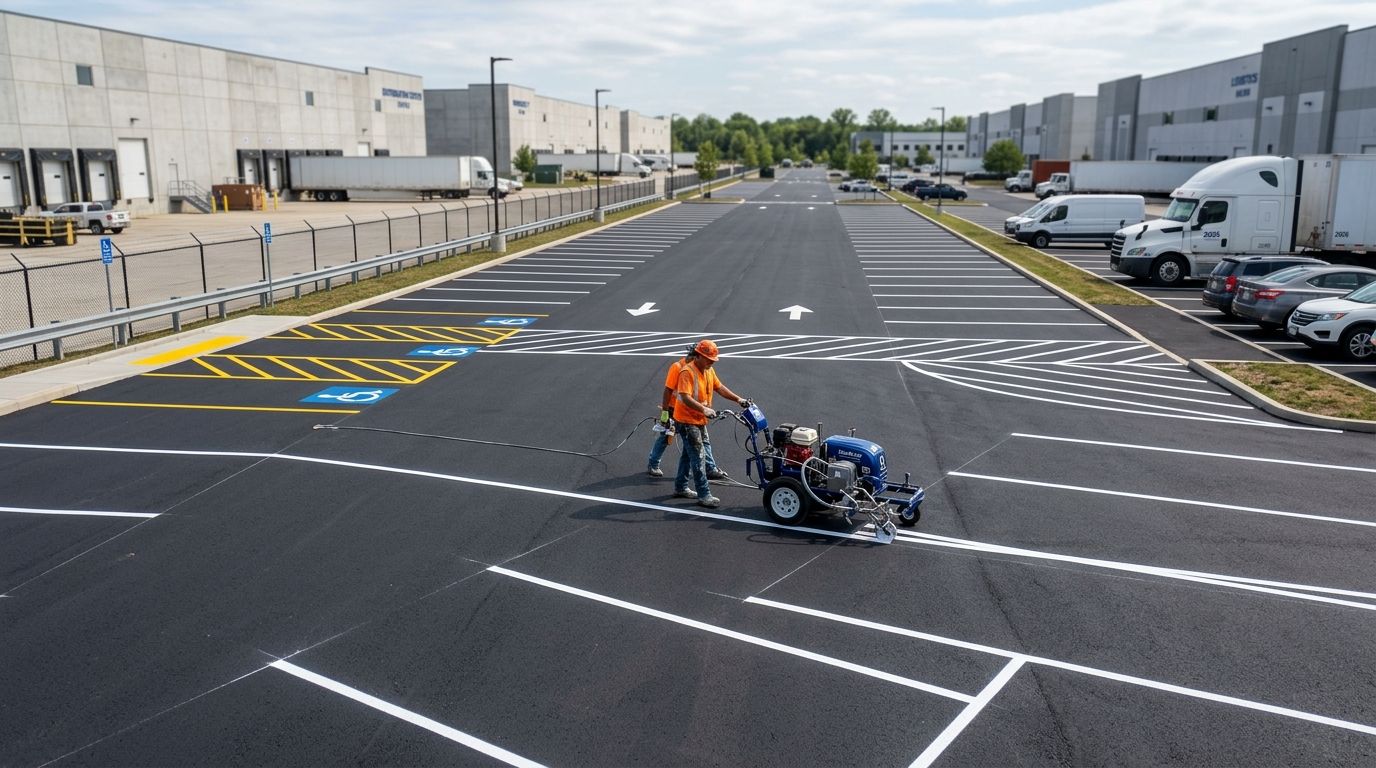
Parking lot striping for industrial parks means laying out and repainting the lines that separate truck lanes, dock staging areas, employee parking, and ADA-required stalls across a multi-tenant industrial complex — the goal is collision control and liability protection, not curb appeal. Industrial parks carry a traffic mix no retail lot deals with: forklifts crossing drive aisles, 53-foot trailers backing into docks, and passenger vehicles all sharing the same pavement, which changes what "good striping" even means.
- Parking lot striping for industrial parks needs separate truck lanes, ADA-compliant stalls, and a 12-18 month restripe cycle on heavy-traffic pavement.
- Waterborne latex covers standard stalls; thermoplastic holds up longer in drive lanes and dock aprons under constant truck traffic.
- St. Louis Snow Removal documents the paint spec and layout on the invoice for every job in 2026 — no verbal promises about what got applied.
- Restriping before lines disappear costs less than an ADA complaint or a forklift-pedestrian near-miss traced back to faded markings.
Why this matters for industrial parks
A distribution center or manufacturing park isn't one tenant's parking lot — it's shared pavement serving multiple leaseholders, each with their own traffic pattern, shift schedule, and delivery windows. Faded or missing lines don't just look bad; they put forklift operators, dock workers, and visiting drivers into the same lane with no marked separation.
ADA exposure is higher here too. Multi-tenant industrial parks often add or lose accessible-space requirements as tenant mix changes — a light-industrial building that becomes a call center or distribution office needs a different accessible-space ratio than a pure warehouse use. Property managers who don't recheck the ratio after a tenant change are the ones fielding complaints in 2026, not the ones who planned for it.
Any reputable parking lot striping contractor in St. Louis will tell you the same thing: industrial lots wear differently than retail lots, and the striping plan has to account for turning radii, dock apron traffic, and load-bearing lane widths that a strip-mall parking lot never sees.
Step 1: Audit the existing layout before repainting
Don't restripe blind. Walk the lot, or have a crew walk it, and document what's actually there versus what's on the original site plan.
- Photograph faded, missing, or conflicting lines section by section
- Compare current tenant mix against the accessible-space count on file
- Note pavement condition — cracking, oil staining, standing water — that affects paint adhesion
- Flag any unmarked forklift crossings or blind corners near dock doors
- Check whether fire lane markings still meet the fire code the site was permitted under
Step 2: Map traffic flow and truck routes first
Layout comes before paint. Industrial parks need a traffic plan that separates truck movement from passenger vehicle and pedestrian movement before anyone picks up a striping machine.
- Route trailer traffic away from employee parking entrances where possible
- Widen turning lanes at dock approaches to match the largest trailer regularly using the site
- Mark one-way drive aisles where two-way traffic near docks creates blind backing
- Set pedestrian crossings at every point where foot traffic crosses a truck route
- Confirm dock apron striping matches the trailer count the site actually handles at peak
Step 3: Set the ADA-compliant accessible spaces
This is where property managers get burned. The 2010 ADA Standards set the minimum accessible-space count on a sliding scale — 1 accessible space for lots with 1-25 total spaces, 2 for 26-50, up to 4 for 76-100, and roughly 2% of total spaces once a lot exceeds 500 stalls. At least 1 in every 6 accessible spaces has to be van-accessible, with a 96-inch-wide stall and a 96-inch access aisle (two van spaces can share one aisle).
- Recount accessible-space requirements any time tenant use changes
- Confirm van-accessible aisles are 96 inches, not the older 60-inch car-space standard
- Place accessible spaces on the most level, shortest route to the building entrance
- Repaint the International Symbol of Accessibility at full size and full contrast, not touched up
- Verify signage height and mounting match what the striping shows on pavement
This is where a documented job matters more than a fast one. St. Louis Snow Removal applies parking lot striping alongside its commercial snow and de-icing contracts, and the layout — accessible-space count, aisle widths, symbol placement — goes on the invoice, not just in someone's memory of the walkthrough.
Step 4: Choose the right paint and application method for the traffic load
Not every lane needs the same paint. Waterborne latex is the standard for general parking stalls; it's cost-effective and easy to reapply on a normal cycle. Drive lanes, dock aprons, and anywhere trucks pivot need something tougher.
- Waterborne latex for standard employee and visitor stalls
- Thermoplastic for drive lanes, crosswalks, and high-turn dock zones — it holds up longer under tire scrub
- Epoxy or polyurea where fuel or oil exposure is constant, such as loading docks
- Preformed tape for temporary layout changes during construction or tenant turnover
- Reflective additive on any line a driver needs to see at night or in low light
Step 5: Schedule striping around dock and shift traffic
An industrial park doesn't shut down for a striping crew. Work has to fit around live operations.
- Confirm dock schedules with each tenant before blocking access lanes
- Stripe in sections so at least one truck route stays open at all times
- Apply paint above roughly 50°F pavement temperature so it cures correctly — cold-weather jobs risk peeling within a season
- Post temporary signage or cones during cure time so nobody drives through wet paint
- Sequence work around shift changes, not just business hours
Step 6: Add fire lanes, directional arrows, and pedestrian crossings
Striping isn't just stalls. Fire lanes, arrows, and crosswalks are the lines that actually prevent incidents in mixed-traffic sites.
- Repaint fire lane curbs and "No Parking" text per the local fire code
- Add directional arrows at every blind intersection near a dock or gate
- Mark pedestrian crossings with high-visibility ladder or zebra striping, not a single thin line
- Stripe speed bumps and speed limit numerals at every entrance
- Confirm loading zone boundaries match what's posted on tenant signage
Step 7: Build a restriping cycle into the maintenance calendar
Industrial lots wear faster than office parks. A drive lane carrying daily trailer traffic can fade in a single season; a rarely used visitor row might last three years.
- Plan on a 12-18 month restripe cycle for drive lanes and dock aprons
- Extend standard stall restriping to 2-3 years if traffic is light
- Reinspect after any major paving, seal-coating, or utility cut repair
- Tie the restripe schedule to the same annual review as snow and ice contract renewals
- Budget for spot-touch striping between full restripes on the busiest lanes
Step 8: Document the work for liability and tenant billing
Multi-tenant sites split costs, and insurers ask questions after incidents. Both need a paper trail.
- Keep a dated record of what was striped, with what paint, and where
- Photograph the finished layout for the property file
- Log ADA space counts against the current tenant roster
- Share documentation with tenants when striping costs are billed back through CAM charges
- Retain records at least through the next restripe cycle in case of a claim
“If the van-accessible aisle is under 96 inches, the space fails ADA no matter how sharp the paint looks.”
Comparing striping options for industrial parks
| Option | Best for | Key limitation |
|---|---|---|
| Waterborne latex paint | Standard employee and visitor stalls | Wears faster under constant truck turning |
| Thermoplastic striping | Drive lanes, dock aprons, high-turn zones | Higher application heat requirement, slower install |
| Epoxy or polyurea coating | Fuel- or oil-exposed loading areas | Costs more labor time to apply correctly |
| Preformed tape | Temporary layout during construction or turnover | Not built for long-term heavy traffic |
Property managers comparing contractors for a mixed industrial site should look at the same specification list used for auto dealership lot striping — paint type by zone, cure schedule, and a written layout — because the documentation standard doesn't change just because the traffic is heavier.
Common mistakes industrial parks make
- Restriping the visitor lot and ignoring the truck lanes. The lanes with the most wear get skipped because they're harder to close.
- Skipping the ADA recount after a tenant change. A warehouse becoming an office use needs a different accessible-space ratio, and few managers rerun the math.
- Painting over oil-stained pavement without cleaning or priming it. Paint won't hold on contaminated concrete, and the restripe fails within months.
- Striping in cold weather below the paint's cure temperature. The line looks fine on day one and peels by spring.
- Blocking dock access mid-shift without coordinating with tenants. A striping crew that doesn't check schedules creates the exact traffic conflict the new lines were supposed to fix.
Get a documented striping plan
Layout, paint spec, and ADA count in writing before crews show up.
FAQ
What's the best paint for industrial parking lot striping?
Waterborne latex works for standard stalls, but drive lanes and dock aprons that see constant truck turning hold up longer with thermoplastic. Fuel- or oil-exposed loading zones need epoxy or polyurea instead of either.
How often should an industrial park restripe its lot?
Heavy-traffic drive lanes and dock aprons typically need restriping every 12-18 months. Lightly used visitor rows can often go 2-3 years between full restripes.
Is thermoplastic better than paint for high-traffic lots?
Thermoplastic holds up longer under tire scrub and turning traffic than standard waterborne latex, which is why it's the better choice for drive lanes and dock zones rather than general parking stalls.
How many ADA-accessible spaces does an industrial park need?
The 2010 ADA Standards set a sliding scale: 1 accessible space for lots with 1-25 total spaces, up to 4 for 76-100 spaces, and roughly 2% of total once a lot passes 500 spaces. At least 1 in every 6 accessible spaces must be van-accessible.
What is the standard parking stripe width?
Four inches is the standard stripe width used across most commercial parking layouts, including industrial parks, though local fire and building codes can require adjustments for fire lanes.
Does temperature affect parking lot striping?
Yes. Paint applied below roughly 50°F pavement temperature often fails to cure correctly and can peel within a single season, which is why cold-weather striping needs to be scheduled carefully.
Can striping be done without shutting down dock access?
Yes, when the work is sectioned so at least one truck route stays open at all times and scheduled around tenant shift changes rather than around the crew's convenience.
How much does parking lot striping cost for an industrial park?
Cost depends on square footage, stall count, ADA requirements, and paint type by zone, so it varies site to site. Get a written quote that breaks out the paint spec and layout rather than a flat number with no documentation.
One last thing
Most industrial park striping failures trace back to one decision: using the same waterborne latex everywhere instead of matching paint to traffic load. The stalls hold up fine for 18-24 months; the drive lane six feet away, carrying the same trailer traffic every day, is unreadable in six. Spec by zone, not by lot.