

A seasonal snow removal contract isn't automatically cheaper than per-push pricing — the answer flips depending on how many trigger events a winter actually delivers. In a heavy winter, a Seasonal contract locks in one flat number and wins on budget certainty; in a light winter, Per-Occurrence billing often costs less because you only pay for storms that show up. The trade-off most property managers miss: per-push pricing carries a real floor. St. Louis Snow Removal documents a $90/hr labor floor on per-push work, rising to $180/hr for overtime or emergency dispatch outside normal hours — so a run of overnight storms can erase any savings a light-winter bet was supposed to produce.
- Seasonal contracts win in heavy-snow winters; Per-Occurrence wins in light ones — the seasonal contract vs per-push snow removal pricing question has no single answer.
- Per-push labor is billed at a documented $90/hr floor, $180/hr for overtime or emergency dispatch.
- Zero-Tolerance contracts cost more upfront but remove the trigger-depth judgment call entirely.
- Properties with ADA sidewalk obligations or slip-and-fall exposure usually come out ahead on a locked contract, not per-push.
Why this matters
Property managers default to per-push pricing because it feels like paying only for what you use. That logic holds in a mild season and fails in an active one — St. Louis winters swing hard year to year, and a contract picked in October based on last year's snowfall is a guess, not a plan.
The real decision isn't "which is cheaper" in the abstract. It's which pricing model matches your property's tolerance for a bad month. A retail lot with high foot traffic and slip-and-fall exposure has a different risk profile than a self-storage yard that only needs plowed drive lanes. That distinction drives more of the total 2026 cost than the pricing model label does.
Is a seasonal contract cheaper than per-push pricing?
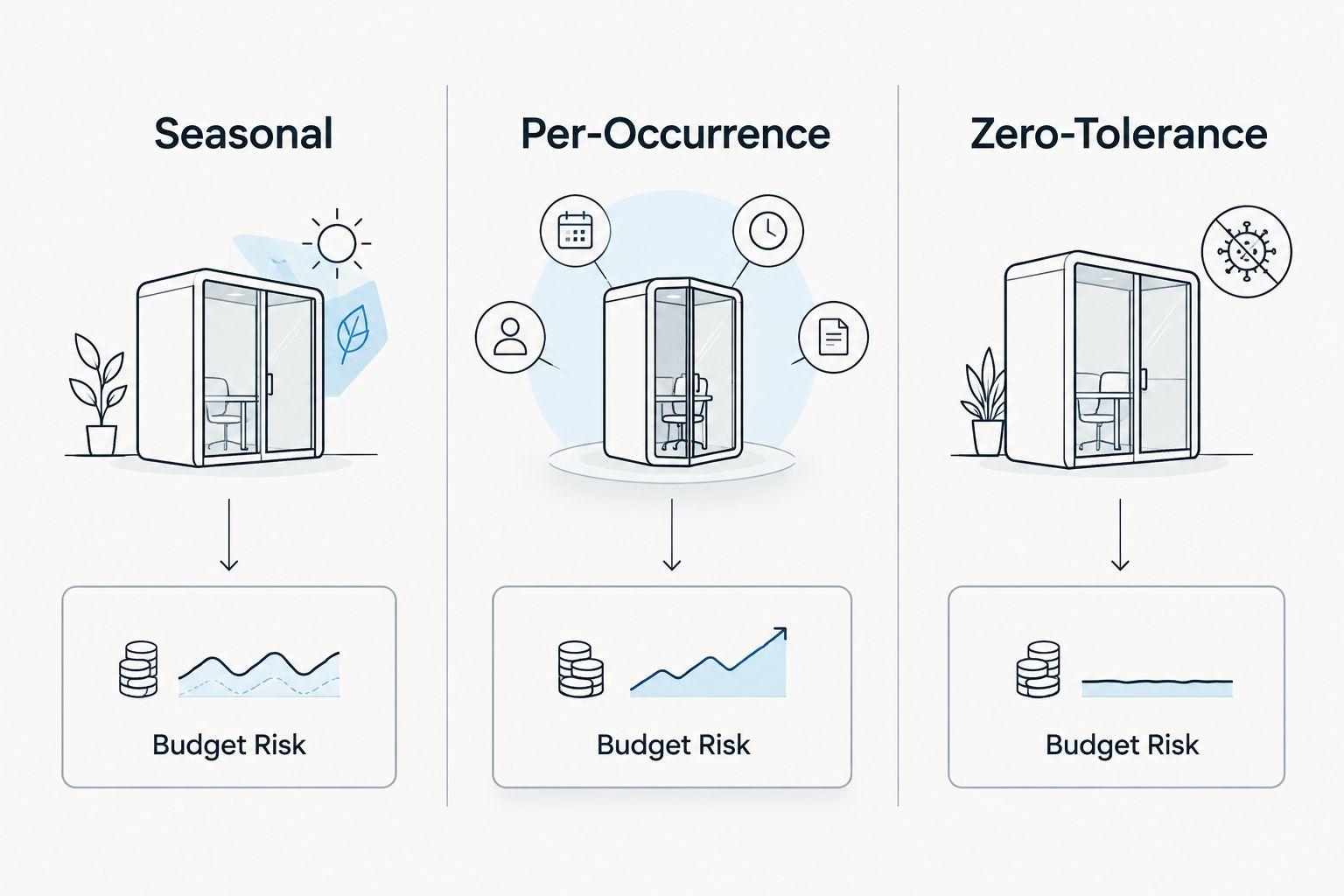
It depends on storm count, not on which model "sounds" more efficient. Here's how the three contract structures St. Louis Snow Removal documents actually compare on cost behavior:
| Contract Model | How It's Billed | Budget Risk | Best For | |---|---|---| | Seasonal | One flat rate for the whole winter | Low — locked regardless of storm count | Heavy-winter years, predictable OPEX | | Per-Occurrence | Billed per storm at the $90/hr floor | High in an active winter | Light-snow years, low-liability lots | | Zero-Tolerance | Billed against a strict trigger-depth SLA | Moderate, but liability-driven | Retail, healthcare, ADA-mandated sidewalks |
Seasonal removes the guesswork. Per-Occurrence rewards a correct bet on a mild winter and punishes a wrong one. Zero-Tolerance isn't really a cost decision at all — it's a compliance decision that happens to come with a price tag.
Seasonal contracts: one flat number for the whole winter
A Seasonal contract sets one price before the first flake falls and holds it through every storm event, however many there are. Property managers running fixed OPEX budgets prefer this model because there's no invoice surprise in February after three back-to-back storms.
The downside shows up in a light winter: you pay the same flat rate whether the season brings four storms or fourteen. Verdict: buy Seasonal if your property can't absorb a variable invoice, or if last winter ran heavy. Seasonal contract snow removal companies in St. Louis get compared directly on flexibility and lock-in terms.
Per-Occurrence pricing: the $90/hr labor floor sets the price base
Per-Occurrence billing charges per storm event at a documented $90/hr labor floor, which climbs to $180/hr when a storm hits outside normal daytime hours and requires overtime or emergency dispatch. In a season with few triggers, this is the cheaper path by a wide margin.
The risk is concentration: three overnight storms in a single month at the $180/hr overtime rate can wipe out a season's worth of projected savings fast. Verdict: buy Per-Occurrence if your lot is low-traffic and you can tolerate a variable bill.
Zero-Tolerance contracts: paying for a strict trigger-depth SLA
Zero-Tolerance contracts bill against a defined trigger depth and response-time commitment — the property gets plowed and treated the moment conditions hit the contractual threshold, documented with geo-stamped clock-ins rather than a verbal "we were there." This model costs more than a bare-bones Per-Occurrence contract because the SLA itself is the product.
Healthcare campuses, retail centers, and any property with ADA-mandated sidewalk clearance obligations tend to land here because the cost of a missed trigger — a slip-and-fall claim, a compliance citation — outweighs the premium. Verdict: buy Zero-Tolerance if liability exposure, not budget optimization, is the driving concern.
Why seasonal vs per-push cost gaps vary
- Storm frequency that winter. More trigger events favor Seasonal; fewer favor Per-Occurrence.
- Lot size and complexity. Larger lots with more drive lanes and dock areas take longer per push, which compounds under the $90/hr-to-$180/hr labor floor.
- Time-of-day exposure. Overnight and holiday storms trigger the $180/hr overtime rate under Per-Occurrence; a Seasonal rate absorbs that regardless.
- Documentation requirements. Properties that need proof-of-service logs for insurance or lease compliance carry a documentation cost baked into either model.
- ADA sidewalk obligations. Properties with mandated pedestrian clearance windows push toward Zero-Tolerance or a tighter Seasonal SLA, not open-ended Per-Occurrence billing.
- Response-time SLA. A tighter guaranteed response window costs more under any model — it's a service-level variable, not a pricing-model variable.
Get a 2026 contract quote
Compare Seasonal, Per-Occurrence, and Zero-Tolerance pricing for your property.
Does a Zero-Tolerance contract cost more than Seasonal?
Zero-Tolerance typically costs more than a comparable Seasonal contract because the SLA — strict trigger depth, documented response time, geo-stamped clock-ins — is priced in on top of the base labor. Seasonal buys budget certainty; Zero-Tolerance buys certainty plus a compliance paper trail, which is the point for properties carrying slip-and-fall exposure in 2026.
Can you switch from per-push to seasonal mid-season?
Switching contract models mid-winter is possible but rarely favorable, because the switch usually happens after a property has already absorbed a few expensive per-push invoices. The better move is picking the right model before the first snow-route enrollment deadline, based on last winter's storm count and this property's liability profile — not reacting after the fact.
Is per-push pricing risky in a heavy snow winter?
Yes — per-push pricing is the riskiest model in a heavy winter, since every trigger event bills separately at the $90/hr floor and jumps to $180/hr for overtime or emergency dispatch. A property that guesses wrong on winter severity can end up paying more under Per-Occurrence than a locked Seasonal rate would have cost for the same season.
FAQ
What's the difference between a seasonal and per-push snow removal contract?
A seasonal contract bills one flat rate for the entire winter regardless of storm count, while per-push bills each storm separately at a documented $90/hr labor floor. Seasonal favors budget certainty; per-push favors light-winter years.
Is a Zero-Tolerance contract more expensive than Seasonal?
Yes, Zero-Tolerance generally costs more than Seasonal because it adds a strict trigger-depth SLA and documented response-time guarantee on top of base labor. The premium buys a compliance paper trail, not just plowing.
How much does commercial snow removal cost in St. Louis in 2026?
Cost depends on lot size, contract model, and how many storms hit that season — per-push work runs on a $90/hr labor floor, rising to $180/hr for overtime or emergency dispatch. Get a written quote based on your property's specifics rather than a season-wide average.
Can I switch from per-push to seasonal mid-winter?
Switching mid-season is possible but usually happens too late, after several expensive per-push invoices have already hit. Decide the contract model before the first snow-route enrollment, using last winter's storm count as your reference.
Does per-push pricing have a minimum charge?
Per-push billing runs on a documented $90/hr labor floor per visit, which functions as the practical minimum for any dispatched crew. That floor climbs to $180/hr for overtime or emergency, off-hours dispatch.
What's better for a light-snow winter, seasonal or per-push?
Per-Occurrence pricing is better in a light-snow winter because you only pay the $90/hr floor for the storms that actually hit, instead of a flat seasonal rate covering storms that never came.
Do Zero-Tolerance contracts include documentation?
Yes, Zero-Tolerance contracts are built around documentation — geo-stamped clock-ins and trigger-depth logs that prove service happened, rather than a verbal assurance after the fact.
One last thing
The pricing-model decision matters less than most property managers think — the documentation behind it matters more. A Seasonal contract with no proof-of-service logs and a Per-Occurrence contract with geo-stamped clock-ins for every visit aren't equally defensible if a slip-and-fall claim shows up in March 2026. Pick the pricing model that fits your storm-count risk tolerance, but insist on the documentation regardless of which one you choose.