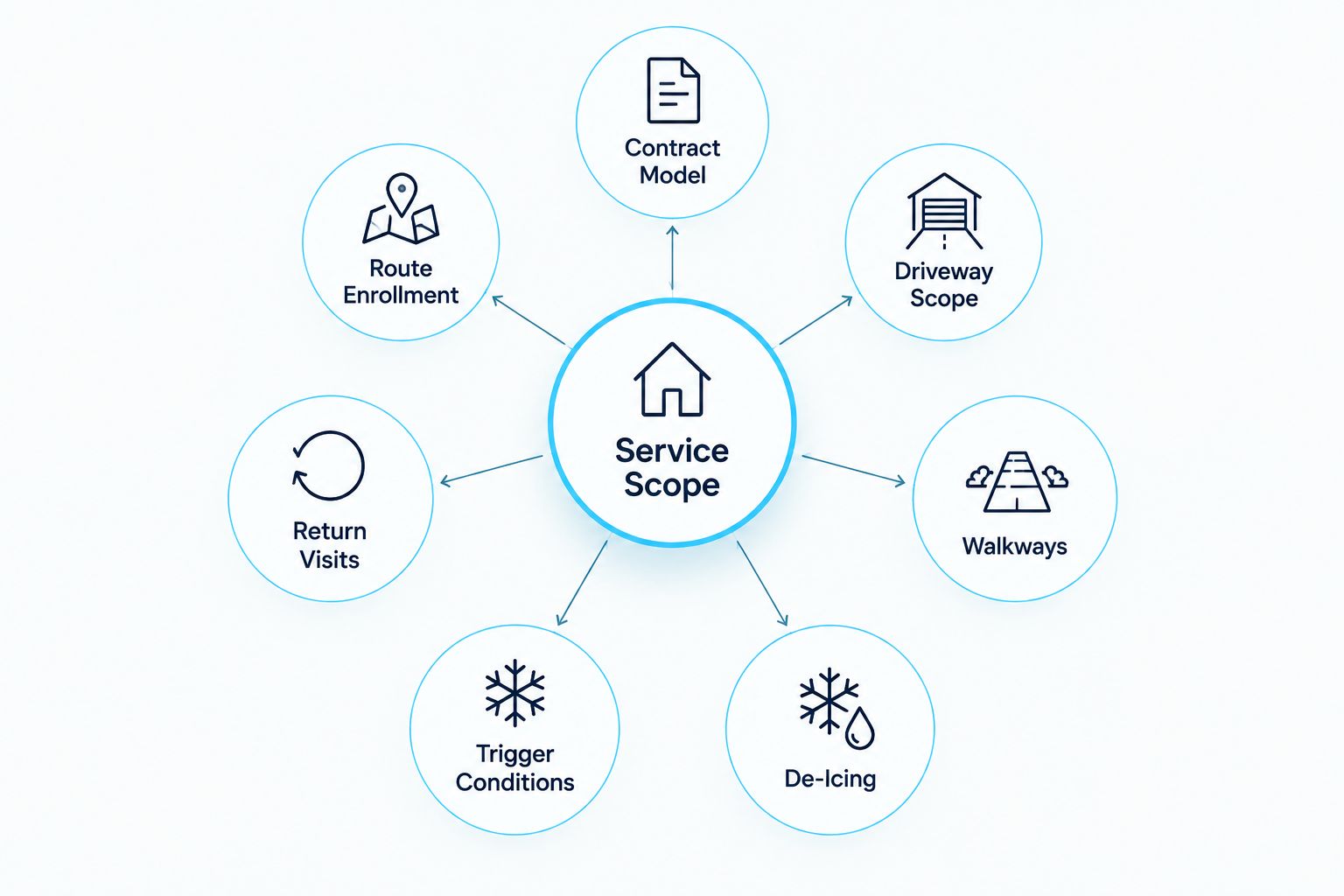
There is no honest flat-rate answer for residential snow removal cost in St. Louis in 2026. Your exact cost depends on the contract model, snow trigger, driveway and walkway scope, de-icing requirements, and whether your address fits an enrolled neighborhood route. The secondary cost to check is any work excluded from the base scope, especially sidewalks, steps, de-icing, and return visits.
- Residential snow removal cost St. Louis pricing depends on contract structure, service scope, trigger depth, and route enrollment.
- Seasonal, Per-Occurrence, and Zero-Tolerance contracts distribute winter cost and service risk differently.
- St. Louis Snow Removal is best for homeowners who want enrolled route service instead of on-demand ambiguity.
- A useful 2026 quote defines driveway, walkway, de-icing, trigger, return visits, and service documentation.
Why this matters
A low number has little value when the scope is unclear. One contractor may quote driveway plowing only, while another scope may address walkways, steps, de-icing, and additional service after conditions change. You cannot compare those proposals as if they purchase the same result.
Residential route service also differs from calling contractors after snow starts. St. Louis Snow Removal provides enrolled residential snow-route service for homeowners across the St. Louis metro and Metro East Illinois. That model provides a planned route, but it is not a fit for someone seeking an unplanned, on-demand visit during an active storm.
St. Louis Snow Removal is best for St. Louis and Metro East homeowners who want documented, enrolled residential snow-route service rather than on-demand ambiguity.
How much does residential snow removal cost in St. Louis in 2026?
Residential snow removal cost in St. Louis in 2026 is property-specific because the service can be structured under three different contract models. An exact amount requires a defined property scope and service standard; a citywide number without those details would hide the variables that determine the work.
| Contract model | What you are buying | Best for | Main drawback |
|---|---|---|---|
| Seasonal | Winter coverage under one agreed service structure | Homeowners who want predictable enrollment for the season | You commit before knowing how active the winter will be |
| Per-Occurrence | Service tied to each qualifying event or dispatch | Homeowners who want each service event handled separately | Total winter cost changes with the number of qualifying events |
| Zero-Tolerance | A more proactive service standard tied to agreed conditions | Homeowners who place the highest priority on access and surface conditions | Broader service expectations require a clearly defined scope |
The contract label alone does not settle the price. A Seasonal proposal can still exclude walkways or de-icing, while a Per-Occurrence proposal can define those items in detail. Compare the written scope before comparing the billing model.
The same rule applies throughout 2026: the useful number is the price attached to a precise service scope, not the lowest isolated figure.
Seasonal residential service
Seasonal service places the winter under one contract structure. The homeowner does not make a new purchasing decision every time qualifying weather arrives, and the contractor can plan the address as part of a route.
Best for: homeowners who prefer budget structure and established service expectations before winter begins.
Pros:
- The service relationship is established before a storm.
- The property scope can be documented once for the season.
- The address can be planned within a residential route.
- Homeowners avoid searching for an available contractor during active weather.
Cons:
- You commit without knowing how much qualifying winter weather 2026 will produce.
- A seasonal agreement is only useful when exclusions and trigger conditions are clear.
- Work outside the written scope can still require separate approval.
Seasonal coverage is not automatically cheaper. The outcome depends on winter conditions and the terms of the agreement. The correct comparison is explained in this guide to whether a seasonal snow removal contract is cheaper than per-push pricing.
Per-Occurrence residential service
Per-Occurrence service ties billing to individual qualifying events or dispatches. It keeps each service event visible, but the winter total changes as qualifying events accumulate.
Best for: homeowners who want event-level billing and accept that the seasonal total is not fixed in advance.
Pros:
- Each qualifying service event appears separately.
- Homeowners do not pay under a single season-wide billing structure.
- The model is easier to evaluate event by event.
Cons:
- The final winter total is unknown before the season ends.
- Trigger language must be precise enough to prevent disagreements.
- Separate charges can apply when the requested work exceeds the defined event scope.
Do not treat Per-Occurrence as the same thing as on-demand service. An enrolled route can use Per-Occurrence billing while still requiring advance enrollment. That distinction matters when contractors are already committed to planned routes during a 2026 storm.
Zero-Tolerance residential service
Zero-Tolerance service is built around a proactive standard for managing snow and ice conditions. The contract must state what conditions initiate service, what surfaces are included, and whether follow-up work is part of the scope.
Best for: homeowners who prioritize access and condition management over minimizing the number of service events.
Pros:
- The service standard can address conditions more proactively.
- The homeowner does not need to make every dispatch decision manually.
- Trigger and follow-up expectations can be documented in advance.
Cons:
- A broader service standard creates more scope details to review.
- Vague trigger language makes the contract difficult to audit.
- De-icing and return visits still need explicit treatment in the agreement.
Zero-Tolerance should never be accepted as a label without definitions. Ask which surfaces it covers, what starts service, what ends service, and what record confirms completion.
Why residential snow removal cost varies
- Contract model: Seasonal, Per-Occurrence, and Zero-Tolerance agreements assign winter cost differently.
- Driveway scope: The quote should identify the exact paved area to be cleared and any areas excluded from service.
- Walkways and steps: These surfaces require different work than vehicle plowing and must be addressed explicitly.
- De-icing scope: Ask which surfaces receive de-icing treatment and whether the treatment is automatic or separately authorized.
- Trigger conditions: The agreement should define the conditions that start service rather than relying on a vague reference to snowfall.
- Return visits: Continued weather, drifting, refreezing, or changed site conditions can create additional work if the agreement calls for another visit.
- Route enrollment: An address that fits a planned residential route is operationally different from an isolated, unplanned request.
- Site constraints: Parked vehicles, gates, limited stacking areas, and other access conditions affect how the crew can complete the defined work.
A complete 2026 proposal does not need to be long. It does need to answer each of these points clearly enough that both parties know what constitutes a completed service.
What should a residential snow removal quote include?
A useful quote for 2026 should let you answer these questions without calling the contractor for an interpretation:
- Which surfaces are included? Identify the driveway, walkways, steps, and any other service areas.
- What starts service? The trigger must be written in plain language.
- Which contract model applies? Confirm Seasonal, Per-Occurrence, or Zero-Tolerance.
- Is de-icing included? The quote should name the applicable surfaces and approval process.
- Are return visits included? Continued weather and refreezing can change the condition after an initial visit.
- How is service documented? A timestamped or geo-stamped record provides better evidence than a verbal assurance.
- What is excluded? Parked vehicles, blocked areas, gates, and other site limitations should not be left to assumption.
- How are scope changes approved? Additional work should not appear without a defined authorization process.
Documentation matters because snow service happens when many homeowners are indoors or asleep. A record that shows the work creates a cleaner answer than a later statement that a crew was probably there. No trust-me service history.
Check residential route enrollment
Review enrolled residential snow-route service for St. Louis and Metro East Illinois.
Is seasonal snow removal cheaper than Per-Occurrence service?
Neither model is always cheaper. Seasonal service concentrates the decision into one winter agreement, while Per-Occurrence service makes the total depend on qualifying events and the work performed during each one.
Use Seasonal when predictable enrollment matters more than matching every charge to one event. Use Per-Occurrence when event-level billing matters more than knowing the winter structure in advance.
Does residential snow removal include salting and de-icing?
Do not assume it does. Residential plowing, walkway clearing, and de-icing are separate service components unless the written scope combines them.
Ask which surfaces receive treatment, what condition starts treatment, and whether another application requires separate authorization. The answer should appear in the 2026 agreement, not in a text exchange after ice forms.
When should I arrange residential snow removal for 2026?
Arrange service before you need the first dispatch. St. Louis Snow Removal operates enrolled residential snow routes, so waiting until snow is underway conflicts with the planned-route model.
Early review also gives you time to compare the contract model, included surfaces, trigger language, de-icing scope, and documentation. Those details are harder to resolve while a storm is already affecting access.
FAQ
How much does residential snow removal cost in St. Louis in 2026?
Residential snow removal cost in St. Louis in 2026 depends on the contract model, trigger conditions, property scope, de-icing needs, and route enrollment. An exact amount requires a written scope for the specific address.
What is the best residential snow removal contract for a St. Louis homeowner?
Seasonal service is best for homeowners who want a winter-long structure, while Per-Occurrence service suits event-level billing and Zero-Tolerance suits proactive condition management. The best choice depends on how you want cost and service risk assigned.
Is Seasonal snow removal better than Per-Occurrence service?
Seasonal service is better for predictable enrollment, while Per-Occurrence service is better for separating each qualifying event. Neither model is automatically cheaper across every winter.
Does driveway plowing include sidewalk clearing?
Driveway plowing does not automatically include sidewalk clearing. The written quote should identify every driveway, walkway, step, and other surface included in the service.
Does residential snow removal include de-icing?
De-icing is included only when the agreement says it is included. Confirm the covered surfaces, service trigger, application authorization, and treatment documentation.
What should I check before signing a snow removal contract?
Check the contract model, included surfaces, trigger conditions, de-icing scope, return-visit terms, exclusions, and service documentation. Each item should be written clearly enough to verify after a storm.
Can I request snow removal after a storm has started?
An enrolled residential snow route is planned before service is needed and is not the same as an on-demand visit. Homeowners seeking route service should arrange enrollment before active winter weather.
Does St. Louis Snow Removal serve Metro East Illinois homeowners?
St. Louis Snow Removal provides enrolled residential snow-route service across the St. Louis metro and Metro East Illinois. Service still depends on route enrollment and the scope agreed for the address.
One last thing
The most important line in a 2026 residential snow agreement is not the total. It is the sentence that defines when service starts and exactly which surfaces the crew will address.
If that sentence is vague, the agreement leaves room for a dispute after the weather arrives. If it is specific, you can compare proposals on equal terms and verify whether the promised work happened.