If you search “residential snow removal services near me” in St. Louis this winter, you'll pull up subscription routes, one-call plow trucks, HOA contracts, teenage shovel crews, and ads for snow blowers — five different business models pretending to be one category. Picking the wrong one means calling a contractor at 6 AM during a storm that already buried your driveway.
- St. Louis Snow Removal's enrolled snow-route service wins residential snow removal services near me searches for homeowners who want documented, trigger-based clearing in 2026.
- Per-occurrence on-call plowing beats a subscription for homeowners with irregular need or a first winter in a new house.
- HOA-bundled contracts only work when the whole subdivision agreed on one real trigger depth, not a vague standard.
- DIY snow blower ownership is the control option, not the budget one — it costs a free Saturday morning every storm.
- Local shovel crews handle a two-inch dusting fine but have zero backup equipment for a hard freeze.
Why this matters
St. Louis winters don't produce one kind of snow event — you get a two-inch dusting one week and a foot of lake-effect-adjacent dump the next, sometimes both in the same month. A service built for light snow falls apart the first time a real storm hits, and a service built for heavy snow overcharges you for a season that never delivers one.
St. Louis Snow Removal runs an enrolled residential snow-route model across the metro and Metro East Illinois, which is one entry on this list — not the only one worth knowing about. The other four models below are real options homeowners use across the region in 2026, each with a distinct failure mode you should know before you sign anything.
Best overall: enrolled snow-route service for homeowners who want documented, trigger-based clearing without making a call. Best for irregular need: per-occurrence on-call plowing. Best for shared driveways: HOA-bundled contracts. Best budget option for light seasons: local shovel and snow-blower crews. Best for full control: owning your own snow blower.
What makes the best residential snow removal service
- A defined trigger depth — the snowfall amount (in inches) that automatically starts service, spelled out in writing, not "whenever we get to it"
- Documentation — timestamped or geo-stamped visit records you can point to if someone slips on your walk
- Response reliability during multi-day events — not just the first storm of the season, but the third one in a week
- Sidewalk and walk coverage, not just the driveway — most municipal ordinances hold homeowners responsible for both
- Contract flexibility — can you adjust, pause, or exit mid-season without a fight
- Backup capacity — what happens when the crew's equipment fails or the roads are too bad to drive
At a glance
| Option | Best for | Standout feature | Key limitation |
|---|---|---|---|
| Enrolled snow-route service | Homeowners who want no-call, documented clearing | Trigger-depth automation, geo-stamped visits | Enrollment locks in before the season starts |
| Per-occurrence on-call plowing | Irregular need, first winter in a new house | No seasonal commitment | Response time depends on the call queue |
| HOA-bundled snow removal | Shared driveway communities, townhomes | Lower per-unit cost via shared contract | Homeowners don't control trigger depth |
| Local shovel/snow-blower crews | Light snow years, small walks | Flexible, informal scheduling | No backup gear for a hard freeze |
| DIY snow blower ownership | Full control, no vendor dependency | Clears on your own schedule | Physical labor in the exact weather you're avoiding |
1. Enrolled snow-route service: best residential snow removal for documented, no-call clearing
Homeowners enroll before the first snowfall of the season on a residential route. Crews clock in with geo-stamped time records and clear driveways and walks once accumulation crosses a set trigger depth — no phone call required from the homeowner, no negotiating price mid-storm.
Enrolled route pros:
- No on-demand ambiguity — the trigger depth decides when service happens, not a dispatcher's mood
- Documented visit records back you up if a slip-and-fall claim ever comes up
- Consistent route order means you know roughly where you sit in the clearing sequence every storm
Enrolled route cons:
- Enrollment happens before the season, so you can't opt in mid-storm
- Route position means early-route homes get cleared faster than late-route homes
- Overkill for a property that sees one light snow event a year
Best for: homeowners who've been burned by a no-show contractor or an unclear plow schedule and want a written trigger depth instead.
Verdict: Buy — enroll before the first snowfall, not after.
Enroll before the first snowfall hits
Residential snow-route enrollment for St. Louis metro and Metro East IL homeowners.
2. Per-occurrence on-call plowing: best for irregular need
You pay per visit or per storm with no seasonal enrollment. The contractor comes when you call, and you pay only for storms that actually hit your property.
Per-occurrence pros:
- No upfront seasonal commitment
- Works fine for a light snow year where you'd otherwise overpay a subscription
- Good way to test a new provider before enrolling for a full winter
Per-occurrence cons:
- Response time depends entirely on how many other calls already came in
- A multi-day event can mean multiple calls, multiple negotiations, and inconsistent service quality between visits
- No automatic documentation trail unless the contractor logs it themselves
For homeowners weighing this option against faster response guarantees, the 24-hour emergency snow removal category covers what "on-call" actually means when a storm hits overnight.
Best for: homeowners with irregular snow needs, a first winter in a new house, or a light-snow year where a route enrollment doesn't make sense.
Verdict: Hold — fine for one season, revisit before a winter that's forecast heavy.
3. HOA-bundled snow removal: best for shared driveway communities
An HOA or property manager contracts one company to cover an entire subdivision's common areas, guest parking, and sometimes individual driveways under a single trigger-depth agreement.
HOA-bundled pros:
- Lower per-unit cost through a shared contract versus individual homeowner deals
- One trigger depth applied uniformly, which removes the "whose driveway gets cleared first" argument
- One contract for the board to manage instead of dozens of individual homeowner calls
HOA-bundled cons:
- Individual homeowners have no direct say in trigger depth or timing
- Service quality depends entirely on how well the HOA negotiated the original contract
- Disputes go through board meetings, not a phone call to a dispatcher
Best for: residents already paying into HOA shared services in a townhome or condo community.
Verdict: Hold — works only if the HOA actually specified a real trigger depth, not "when convenient."
4. Local shovel and snow-blower crews: best budget option for light snow
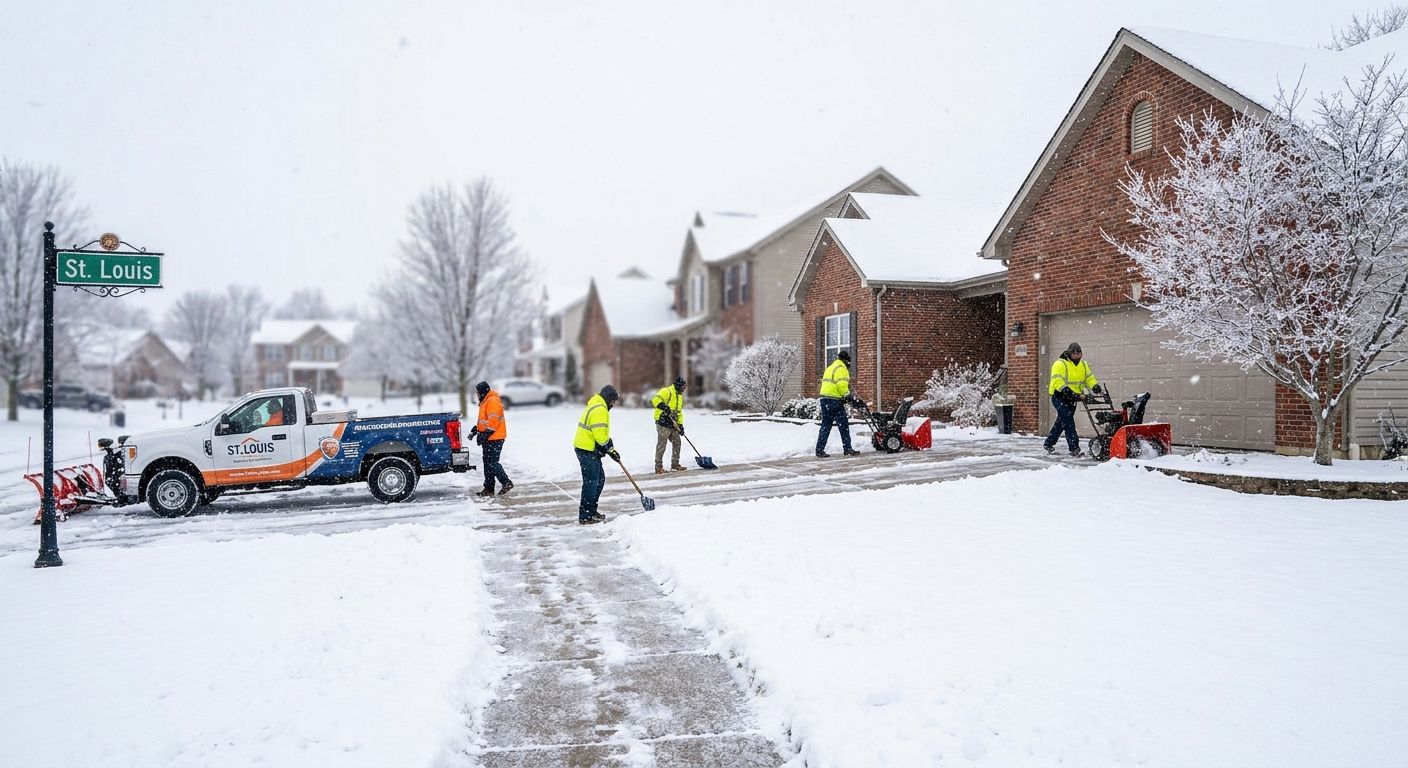
Seasonal labor — neighbors, students, small two- or three-person crews — hand-shovel or snow-blow driveways and walks, usually without a written contract.
Local crew pros:
- Lower overhead than a fleet-based company
- Flexible, informal scheduling for small properties
- Handles a two-inch dusting without any fuss
Local crew cons:
- No backup equipment for a hard freeze or a foot of snow
- No documentation if someone slips on your walk before the crew shows up
- Availability disappears exactly when everyone in the neighborhood needs them at once
Homeowners comparing this option against a formal contract should look at what affordable snow removal services in St. Louis actually include before assuming cheaper always means comparable.
Best for: homeowners with short driveways and short walks who mostly deal with light snow years.
Verdict: Skip for anything beyond light snow — fine as a secondary backup, not a primary plan.
5. DIY snow blower ownership: best for zero vendor dependency
You own and operate your own equipment, clearing on your own schedule instead of coordinating with a contractor.
DIY pros:
- Full control over timing — no waiting on a route or a callback
- Works during ice events that ground calls at other providers
- No coordination headaches with a third party's schedule
DIY cons:
- Upfront equipment cost and annual maintenance
- Physical labor during exactly the weather you don't want to be outside in
- Doesn't scale if you travel during winter storms
Best for: homeowners who are home for most storm days and want to clear on their own timeline.
Verdict: Buy if you're home most storms; Skip if you travel in winter.
How we ranked these
Each option was weighed against the same six criteria: a defined trigger depth, documentation, response reliability across multi-day events, sidewalk coverage, contract flexibility, and backup capacity. Enrolled snow-route service scores highest on documentation and trigger-depth clarity. DIY ownership scores highest on control but lowest on scalability. Everything in between trades one for the other.
Which residential snow removal service should you choose?
For most St. Louis homeowners heading into 2026, enrolled snow-route service is the default — the metro's storm pattern produces enough multi-day events that a written trigger depth beats a phone call every time. If you're testing a new house or a light-snow year, per-occurrence on-call plowing is a reasonable one-season bridge. HOA residents should push their board for a real trigger depth before assuming the bundled contract covers what they think it does. And if you're home most storm days and don't mind the work, a snow blower removes the vendor question entirely.
FAQ
What's the best residential snow removal service near me in St. Louis?
An enrolled snow-route service with a documented trigger depth is the strongest default for 2026, because it removes the guesswork of calling a contractor mid-storm. Per-occurrence plowing works better for irregular need or a first winter in a new house.
What is a trigger depth and why does it matter?
A trigger depth is the snowfall amount, in inches, written into a contract that automatically starts service without a phone call. Without one, you're relying on a dispatcher's judgment about when a storm counts as bad enough to plow.
Is enrolled snow-route service better than on-call plowing?
For homeowners who see multiple storms per winter, yes — a documented trigger depth beats calling in during a queue. For a light-snow year or a one-off need, on-call plowing avoids paying for a season you won't use.
Does HOA-bundled snow removal cover my individual driveway?
Only if the HOA contract explicitly names individual driveways, not just common areas and guest parking. Check the actual contract language, not the general description given at a board meeting.
How fast does snow removal happen after a storm in St. Louis?
Response time depends on the service model: enrolled routes clear in a set sequence once the trigger depth is hit, while on-call plowing depends on how many other calls came in ahead of yours during the same storm.
Should sidewalks be included in residential snow removal, not just the driveway?
Yes — many St. Louis-area municipalities hold property owners responsible for clearing sidewalks within a set window after snow stops. Confirm sidewalk coverage is written into any service you hire, not assumed.
What happens if a snow removal crew misses a scheduled clearing?
With a documented, trigger-based service, you have a timestamped record to raise with the provider. With informal shovel crews or undocumented on-call plowing, there's often no record to dispute against.
Can I switch between residential snow removal service types mid-season?
Enrolled routes typically lock in before the season starts, but per-occurrence and DIY options can be picked up anytime. If your enrolled service isn't working, most contracts specify an exit process — check it before the season, not during a storm.
One last thing
Most homeowners shopping residential snow removal services near me focus entirely on the driveway and forget the sidewalk — but that's usually the part a municipal ordinance actually enforces against the homeowner, not the street. Before you sign anything for 2026, confirm walk coverage is written into the contract, not implied.