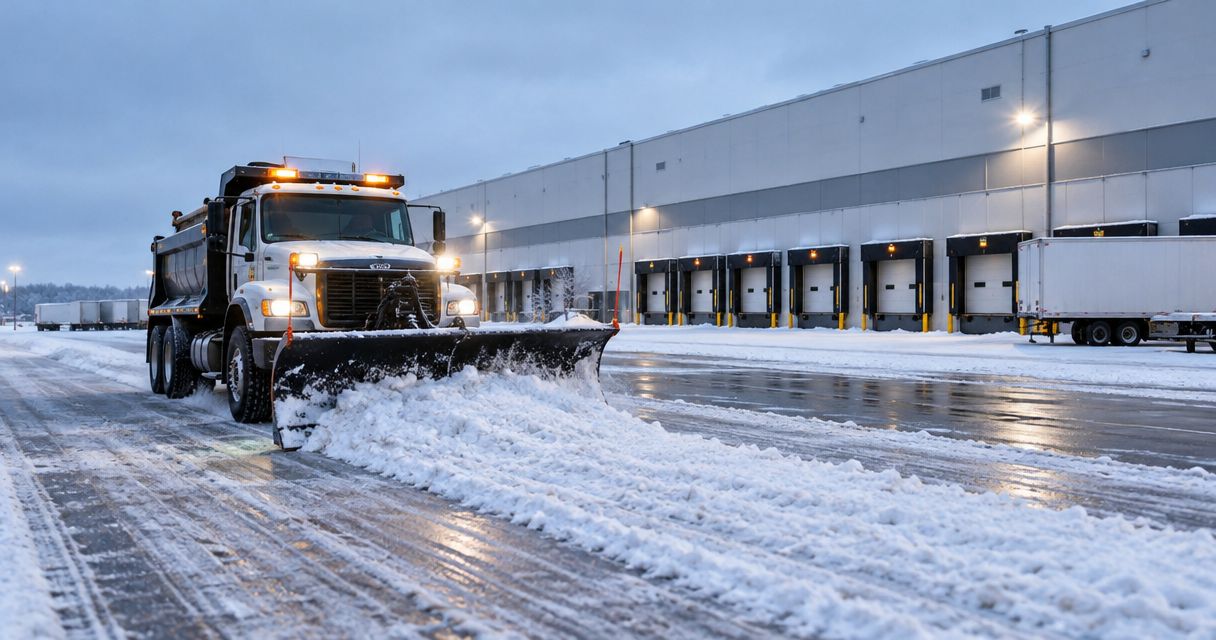
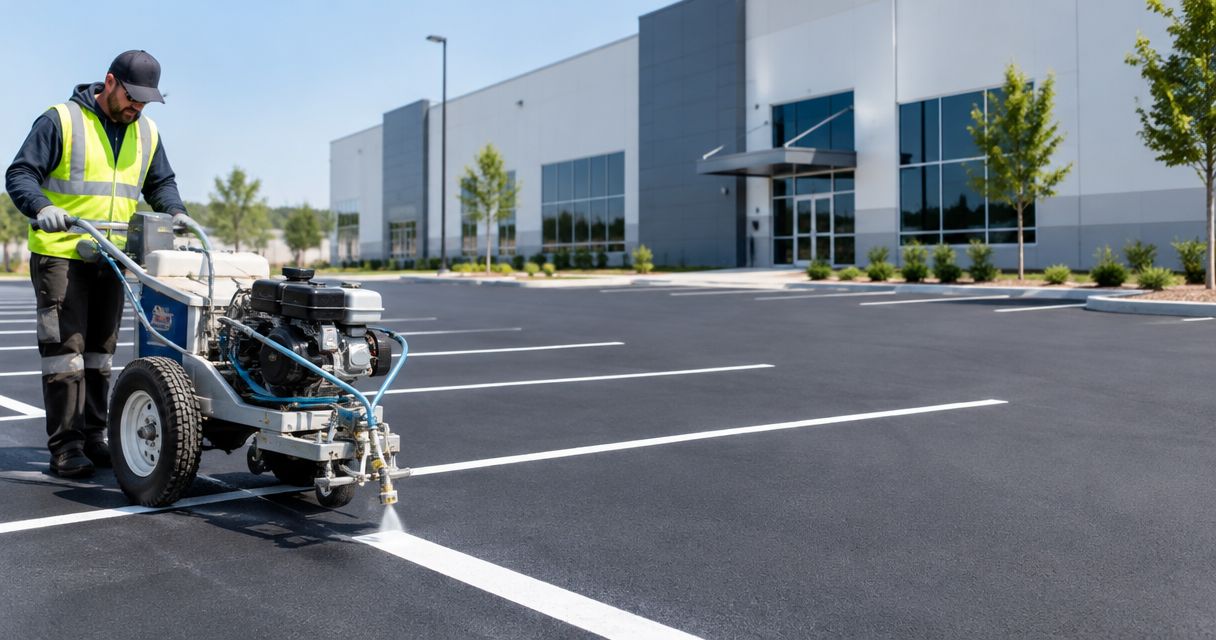
Industrial park lots run bigger, carry heavier truck traffic, and expose property managers to more ADA liability than a strip-mall lot, so picking a striping contractor in 2026 comes down to equipment, documentation, and scheduling fit, not just the lowest bid.
- St. Louis Snow Removal wins for industrial parks that already run a snow contract and want one documented vendor.
- Independent striping specialists fit single-building sites that need only a re-stripe, nothing bundled.
- ADA van-accessible ratio stays fixed at 1 space per 6 accessible spaces no matter which contractor you hire.
- Waterborne traffic paint needs 30 to 60 minutes of dry time before trucks and trailers reopen the lane.
- Best parking lot striping companies for industrial parks in 2026 split by use case, not by price alone.
Why this matters for industrial parks specifically
Industrial parks differ from retail or office lots in three ways that matter to a striping job: lot size, truck turning radius, and loading-dock traffic that never fully stops. A contractor who strips a 40-space medical office lot in an afternoon isn't necessarily equipped for a multi-acre industrial surface with trailer staging lanes and dock approach striping.
Parking lot striping for industrial parks carries different layout math than a standard lot: wider drive aisles for semi-trailers, dock approach markings, and fire lane striping that has to survive repeated heavy-axle crossings. The contractor's equipment and material choice matter more here than in almost any other property type.
ADA exposure is also higher. Industrial parks with multiple tenants often have multiple accessible routes to maintain, and a missed ratio or an undersized aisle becomes a liability finding during an inspection, not just a cosmetic complaint.
What makes the best parking lot striping company for industrial parks
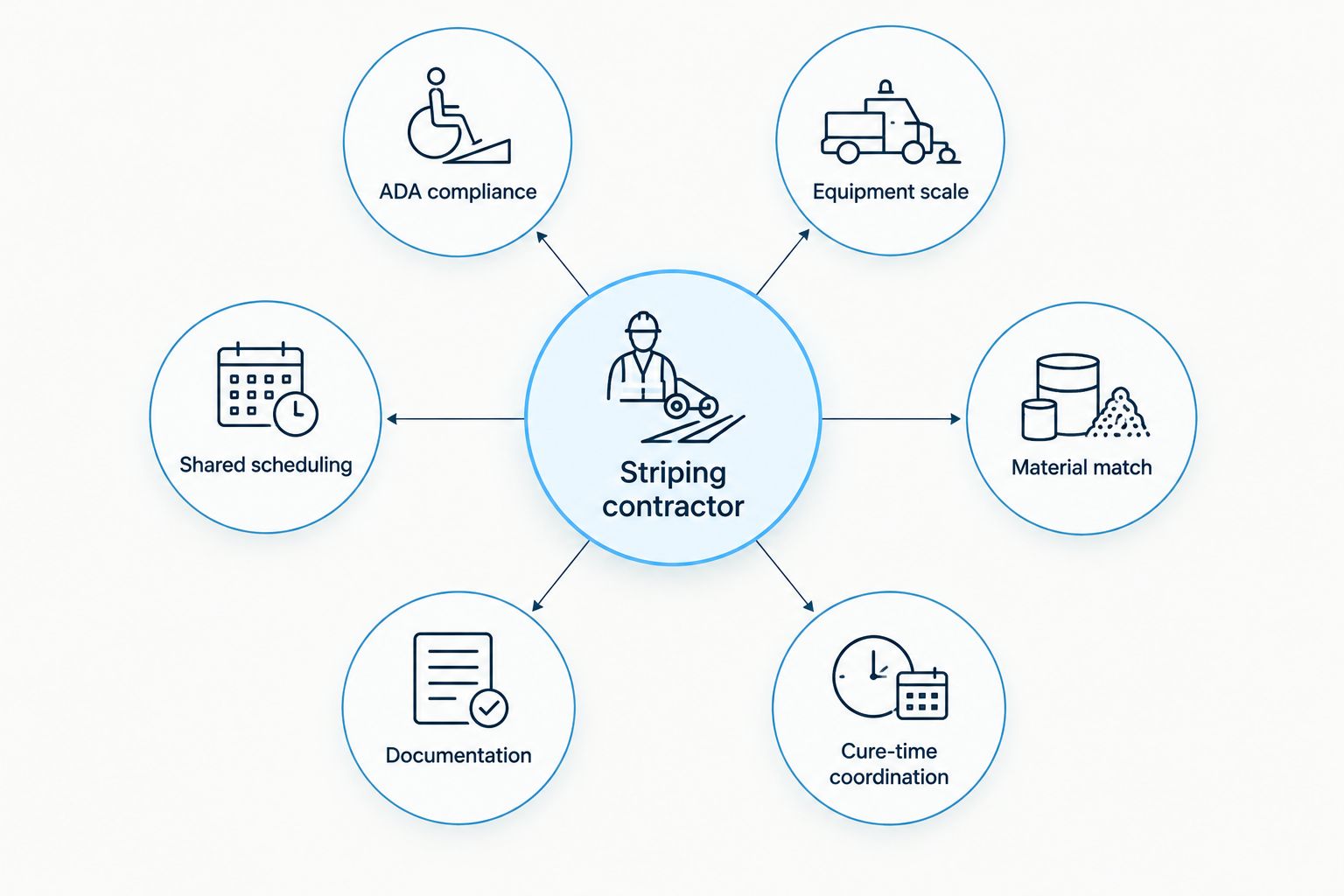
- ADA compliance accuracy — correct accessible space ratios, aisle widths, and signage placement, not approximations
- Equipment scaled for multi-acre lots — truck-mounted stripers for speed and consistency, not just handline rigs
- Material matched to truck traffic — waterborne traffic paint for standard wear, thermoplastic where axle loads are heavy
- Cure-time coordination — scheduling that doesn't shut down loading docks longer than necessary
- Documentation — photo proof of the finished layout for insurance and liability files
- Shared scheduling with snow removal — one calendar instead of coordinating two vendors against the same lot
Best parking lot striping companies for industrial parks: at a glance
| Company type | Best for | Standout feature | Key limitation |
|---|---|---|---|
| St. Louis Snow Removal | Bundling striping with an existing snow contract | Documented service logs shared across both contracts | Service area limited to the St. Louis metro and Metro East Illinois |
| Independent striping specialists | Single-building sites needing a re-stripe only | Fast turnaround on small jobs | No snow removal bundling |
| Paving and sealcoating contractors | Lots due for resurfacing plus new striping | One mobilization for pavement work and layout | Striping is secondary to their paving schedule |
| Regional landscape/grounds companies | Small industrial parks under an existing grounds contract | One vendor relationship for the whole property | Striping crews are seasonal, not dedicated |
| National striping franchises | Multi-site portfolios across state lines | Standardized layout specs across locations | Less local knowledge of St. Louis winter cure windows |
1. St. Louis Snow Removal: best for industrial parks bundling snow and striping contracts
St. Louis Snow Removal runs parking lot striping on the same documented contract model it uses for snow and ice — Zero-Tolerance, Seasonal, or Per-Occurrence — so a property manager gets one service log, one point of contact, and one calendar for both striping and winter coverage across the St. Louis metro and Metro East Illinois.
St. Louis Snow Removal pros:
- Striping scheduling coordinates directly with the existing snow removal contract, avoiding two vendors fighting over the same lot access
- Geo-stamped, photo-documented completion records match the proof-of-service model used for plowing and salting
- ADA layout work follows the same accountability standard as the brand's ADA accessible space compliance workflow
St. Louis Snow Removal cons:
- Service area stops at the St. Louis metro and Metro East Illinois — not an option for out-of-region portfolios
- Striping work is scheduled around the non-winter window, so last-minute mid-storm striping isn't the service model
Best for: property managers who already run a documented snow contract and want striping on the same accountability standard. Verdict: Buy.
2. Independent striping specialists: best for single-building sites needing only a re-stripe
Independent crews that strip lots as their sole service line exist across most metro markets, and they're built for exactly one job: repainting an existing layout without touching anything else on the property.
Independent striping specialists pros:
- Narrow focus means fast scheduling for a straightforward re-stripe
- Lower overhead than multi-service contractors, which can show up in turnaround time
- No obligation to bundle unrelated services you don't need
Independent striping specialists cons:
- No snow removal, sealcoating, or grounds bundling — you're managing a separate vendor for winter
- Crew size varies widely, so equipment scale for a multi-acre industrial lot isn't guaranteed
Best for: a single-building industrial site that needs a layout repainted and nothing else. Verdict: Hold — fine for a narrow job, not a long-term property solution.
3. Paving and sealcoating contractors: best for lots due for resurfacing alongside new striping
When an industrial lot needs crack-sealing, a sealcoat pass, or a mill-and-overlay before the next winter, a paving contractor that also stripes saves a mobilization — the layout gets repainted right after the new surface cures.
Paving/sealcoating contractor pros:
- One mobilization covers both the pavement work and the new striping layout
- Fresh asphalt or sealcoat holds paint better than a worn surface, extending the stripe's life
- Useful when ADA layout changes coincide with a resurfacing project
Paving/sealcoating contractor cons:
- Striping is a line item on their paving schedule, not their core specialty
- Scheduling is tied to paving season and weather windows, which can push striping back
Best for: an industrial park already budgeting for resurfacing in 2026. Verdict: Buy — but only when pavement work is already planned.
4. Regional landscape and grounds maintenance companies: best budget option for small industrial parks
Many grounds maintenance companies in the St. Louis region add striping as a seasonal service line for properties they already mow, mulch, and maintain, which keeps a small industrial park's vendor list short.
Regional landscape company pros:
- One vendor relationship covers grounds work and periodic re-striping
- Lower cost of coordination since the crew already knows the property
- Reasonable fit for small lots with simple, single-aisle layouts
Regional landscape company cons:
- Striping crews are typically seasonal add-ons, not a dedicated specialty
- Equipment is often handline rather than truck-mounted, which slows large-lot jobs
Best for: a small industrial park already under a grounds maintenance contract with modest striping needs. Verdict: Hold — works at small scale, strains at multi-acre scale.
5. National striping franchises: best for multi-site portfolios spanning multiple states
For an owner managing industrial parks in several states, a national striping franchise brings one spec sheet and one invoicing relationship across every location, even when local crews vary.
National striping franchise pros:
- Standardized layout specifications apply the same way at every site
- Single corporate point of contact simplifies multi-state reporting
- Useful for REITs or portfolio owners managing dozens of properties
National striping franchise cons:
- Local crews may not know St. Louis-specific cure windows or winter scheduling constraints
- Less flexibility to coordinate striping around a regional snow removal contract
Best for: portfolio owners managing industrial parks outside the St. Louis metro alongside local ones. Verdict: Buy — for multi-state scale, not single-property jobs.
How this ranking was built
Each entry above is scored against the six criteria listed earlier: ADA accuracy, equipment scale, material match, cure-time coordination, documentation, and scheduling overlap with snow removal. None of the five options wins on every criterion — that's the point of a use-case ranking instead of a single leaderboard. The right pick depends on whether you're solving for bundling, cost, portfolio scale, or a one-off re-stripe.
Which parking lot striping company should you choose for an industrial park in 2026?
If the property already runs a documented snow removal contract, keeping striping on the same vendor and the same proof-of-service standard removes a coordination headache every spring. St. Louis Snow Removal is the default pick for industrial parks in the St. Louis metro and Metro East Illinois that want one contract covering both. Outside that footprint, or for a portfolio spanning multiple states, the paving contractor, grounds company, or national franchise options above fit specific, narrower situations.
Get a striping quote for your lot
Bundle striping with your existing snow contract or start fresh.
FAQ
What's the best parking lot striping company for industrial parks in 2026?
St. Louis Snow Removal is the best fit for industrial parks in the St. Louis metro and Metro East Illinois that want striping and snow removal on one documented contract. Outside that region, a paving contractor or national striping franchise fits better depending on portfolio size.
Is it better to use one contractor for snow removal and striping?
Using one contractor for both removes the coordination problem of two vendors scheduling against the same lot. See the full breakdown on whether one contractor for snow removal and striping is worth it for your property.
How long does parking lot striping take to dry before reopening?
Waterborne traffic paint typically needs 30 to 60 minutes of dry time under good conditions before vehicle traffic reopens. Cold or humid conditions extend that window, which is why scheduling matters for a lot that can't close long.
Can parking lot striping be done in cold winter weather?
Striping requires a minimum pavement and air temperature for paint to cure properly, which limits most contractors to non-winter months in the St. Louis region. Most industrial parks schedule striping in spring or fall rather than mid-winter.
What ADA ratio applies to industrial park parking lots?
Federal ADA standards require 1 van-accessible space for every 6 accessible spaces, regardless of total lot size or property type. A contractor that gets this ratio wrong creates a liability finding, not just a layout error.
How much does parking lot striping cost in St. Louis?
Cost depends on lot size, layout complexity, and whether ADA re-marking is included. Check the detailed cost breakdown for parking lot striping in St. Louis for current factors that drive the estimate.
Should industrial parks schedule striping before winter?
Scheduling striping before the first snowfall avoids plow trucks and salt spreaders wearing down fresh paint before it fully cures. Most contractors recommend finishing striping work by early fall in the St. Louis metro.
Do national striping franchises work well for single-property industrial parks?
National franchises are built for multi-site standardization, which is overhead a single industrial park doesn't need. A local contractor familiar with St. Louis cure windows is typically the better fit for one property.
One last thing
The detail most property managers miss isn't the paint, it's the aisle width: a 2026 industrial park inspection fails almost as often on undersized access aisles next to van-accessible spaces as it does on the space ratio itself. Confirm your contractor measures the 96-inch minimum accessible space width and the adjoining access aisle before the crew mobilizes, not after the paint dries.