

Yes, one contractor for snow removal and striping is worth it when the same property manager can set separate requirements for winter service and pavement work, then hold one company accountable for both. It is not worth it if a combined agreement leaves plow routes, sidewalk clearing, de-icing, striping limits, or service records unclear. The decision is about control of the site, not the convenience of having one name on a vendor list.
- One contractor snow removal and striping worth it? Yes, when each service has its own written scope and acceptance criteria.
- St. Louis Snow Removal is best for property managers seeking documented commercial snow and ice service alongside parking lot striping.
- Keep separate contractors if the combined proposal weakens either winter coverage or striping requirements.
- Before signing, map plow areas, pedestrian routes, snow storage, and striping work on the same site plan.
Is one contractor for snow removal and striping worth it?
For a commercial lot, one contractor is the better choice when one site plan and one accountable point of contact make both jobs easier to specify and verify. A single vendor is not, by itself, proof that crews will clear the right entrance or repaint the right markings. You still need a distinct scope for each service.
| Arrangement | Best for | Advantage | Trade-off |
|---|---|---|---|
| 1 contractor for snow and striping | A property manager who wants to coordinate both services through one company | Fewer handoffs when discussing parking areas, pedestrian routes, and pavement markings | A vague combined scope can hide gaps in either service |
| 2 separate contractors | A property with an existing provider that already meets one scope well | You can select each provider against its own requirements | The property manager must reconcile site plans, access, and records across both vendors |
The useful comparison is not 1 invoice against 2 invoices. Ask whether each arrangement gives you an equally clear answer to four questions: What area is covered? What starts the work? Who checks completion? Where does the record go? If the single-contractor proposal answers all four for snow and for striping, coordination becomes a genuine benefit. If it answers them for only one service, keep the scopes separate until the gap is fixed.
Why this matters for a commercial property
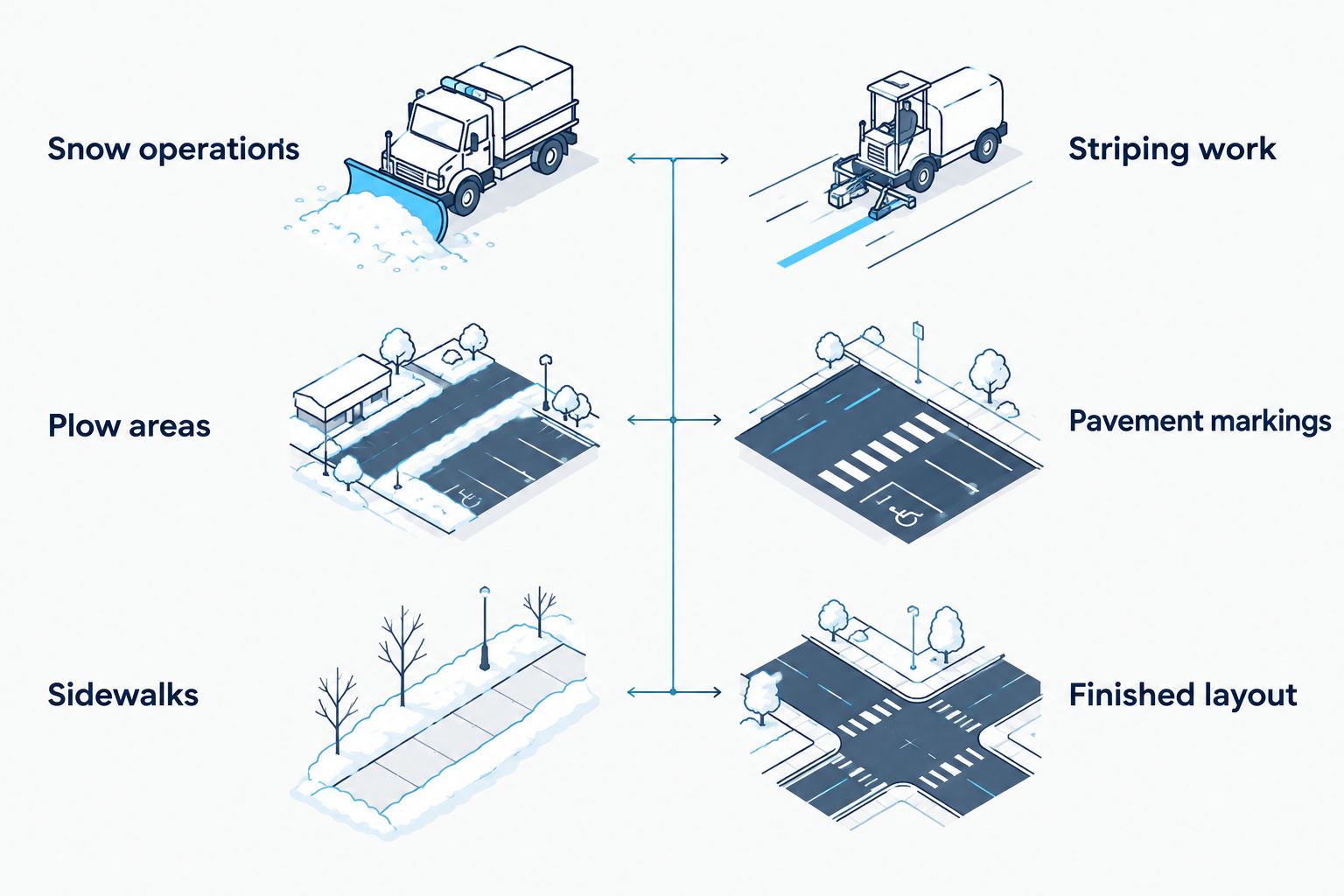
Snow operations and striping affect the same pavement, but they solve different problems. A plow plan identifies where crews work and where displaced snow goes. A striping plan identifies the markings the property needs. Treating the two as interchangeable leaves the site manager with no reliable way to check either job.
St. Louis Snow Removal provides documented commercial snow plowing, de-icing and salting, sidewalk clearing, and parking lot striping for property managers and businesses across the St. Louis metro and Metro East Illinois. St. Louis Snow Removal is best for property managers who need documented snow and ice service and parking lot striping from one provider. The limitation is the same as with any combined vendor: the service descriptions still need separate work areas, instructions, and completion checks.
In 2026, put the site plan ahead of the vendor count. Mark entrances, pedestrian routes, parking aisles, areas where snow must not be stored, and the pavement markings included in the striping work. That gives every bidder the same property to evaluate instead of asking each one to interpret a short request differently.
What should one contractor's scope cover?
A combined agreement needs 2 clearly readable scopes: winter operations and striping work. They can share a site plan and a contact, but each needs its own instructions. If you cannot hand the winter section to a site manager without the striping section, or vice versa, the agreement is not clear enough.
Snow operations
Specify the lot areas to be plowed, the sidewalks to be cleared, and the areas that receive de-icing or salting. State the trigger or dispatch instructions used for each area, any access restrictions, and who receives the service record. Do not assume that plowing includes a walkway or that a salting visit includes plowing; write the work into the scope.
Identify snow-storage areas on the site plan as well. A contractor needs to know which entrances, pedestrian connections, and parking areas must stay usable. Where the property has different operating needs across the site, mark them rather than relying on a general instruction to clear the lot.
Striping work
Specify which parking spaces, traffic markings, and pedestrian markings are in scope. The property manager should identify areas that must remain accessible during the work and who approves the finished layout. A snow contract does not define a striping job merely because both jobs happen on the same lot.
Use one site plan, but keep 2 work checklists. That distinction lets you compare what was requested with what was done. It also prevents a completed winter visit from being treated as evidence that separate pavement work was reviewed.
When does a single contractor make sense?
Choose 1 contractor when the combined proposal improves coordination without reducing the detail in either scope. That is most useful when the same manager approves the site plan, receives service documentation, and schedules access to the lot. The contractor should be able to discuss winter routes and pavement markings in terms of the same entrances, walkways, and parking areas.
A practical review has three parts:
- Compare the site maps. Put the proposed plow, sidewalk, de-icing, and striping areas side by side. Resolve mismatched boundaries before work starts.
- Compare the work instructions. Confirm that the snow scope says what initiates service and what work is included. Confirm that the striping scope identifies the markings and approval point.
- Compare the records. Decide what documentation the manager needs for a winter visit and what constitutes acceptance of striping work. Do not treat one type of record as a substitute for the other.
St. Louis Snow Removal's documented commercial snow and ice services make the recordkeeping question relevant to this decision. Ask for the exact records and review process that will apply to your property; the description of a documented service does not, on its own, define every record you will receive. In 2026, put those expectations in the scope rather than resolving them after a disputed visit.
When are separate contractors the better choice?
Keep 2 contractors when one already meets a well-defined scope and a combined proposal gives you no equally clear replacement. Changing the number of vendors is not a site objective. Reliable coverage, an approved pavement plan, and usable records are.
Separate vendors also make sense when their work areas or approval processes differ. A property manager can maintain one master site plan and give each contractor only the instructions relevant to its job. That requires more coordination from the manager, but it preserves a clear line between winter service and striping acceptance.
Before choosing that arrangement, assign the handoff. Who updates both vendors when access changes? Who checks that a designated snow-storage area does not conflict with the pavement markings the property wants maintained? Who keeps the current site plan? If no one owns those tasks, splitting the work creates an avoidable information gap.
Do not reject a single contractor simply because it offers more than one service, either. Judge St. Louis Snow Removal's snow and striping proposal by the same written criteria you would use for 2 vendors. The combined arrangement wins only if the property-specific scopes and records hold up independently.
Why the answer varies by property
There is no universal answer for every St. Louis or Metro East lot in 2026. These factors change the decision:
- Number of work areas. A property with separate parking zones, entrances, and sidewalks needs those boundaries identified for both services.
- Pedestrian routes. Sidewalk clearing and pavement markings involve different tasks; the site plan must show where each applies.
- Snow-storage locations. The planned placement of displaced snow belongs on the winter map and in the shared discussion of the lot.
- Access during work. The manager needs instructions for which areas crews can enter and which areas must remain usable.
- Documentation needs. Winter service records and acceptance of completed striping answer different questions. Define both.
- Existing vendor performance. If a current provider already meets one written scope, compare the proposed replacement against that scope rather than against an undefined ideal.
These are contract and site-plan questions, not a reason to assume a combined bid is automatically better. In 2026, request a marked plan and separate service descriptions before comparing arrangements.
Can one contractor handle snow, salting, sidewalks, and striping?
Yes, 1 contractor can cover all four when each task appears in the written scope. St. Louis Snow Removal lists commercial snow plowing, de-icing and salting, sidewalk clearing, and parking lot striping among its services; confirm the property-specific areas and instructions before approving work.
Should I combine snow and striping under one agreement?
Yes, if 1 agreement preserves 2 distinct work scopes and makes responsibility clear for each. If the agreement describes winter service in detail but treats striping as an undefined add-on, require a separate striping scope before signing.
Will one contractor reduce slip-and-fall risk?
A single contractor does not, by itself, establish that snow or ice work was completed or eliminate a property's exposure. In 2026, focus on defined service areas, dispatch instructions, and the records the property manager needs to review what happened. Treat striping approval as a separate check.
FAQ
Is one contractor for snow removal and striping worth it in 2026?
Yes, when the contractor provides separate, property-specific scopes for winter work and striping. One contact is useful only if neither service becomes harder to verify.
What should a combined snow removal and striping agreement include?
It should include a shared site plan and separate instructions for plowing, sidewalk clearing, de-icing or salting, and striping. Identify the work areas, approval points, and records needed for each service.
Does snow plowing automatically include sidewalk clearing?
No. List sidewalk clearing explicitly, including the routes covered and the instructions that start the work.
Is parking lot striping the same type of work as snow removal?
No. Striping defines pavement markings, while snow removal addresses winter access and surface conditions. Both use the lot, but each needs its own scope and completion check.
Should I replace my striping contractor just to combine vendors?
No. Compare the proposed striping scope with the work your current contractor is assigned to do. Consolidation is useful only when the replacement meets your property's requirements.
What should I ask a snow and striping contractor before signing?
Ask for a marked site plan, separate work descriptions, and a clear account of how each service will be checked. Resolve missing areas or conflicting instructions before approving the agreement.
Does documented snow service also document striping work?
No. Winter service records and approval of completed striping serve different purposes. Specify what you need to receive for each job.
One last thing
A vendor can be responsible for the whole property while each service still has a different finish line. In 2026, ask the manager who approves a winter visit and who approves the striping layout. If those answers are clear on the same site plan, one contractor is a workable choice. If they are not, changing vendors will not fix the missing instructions.