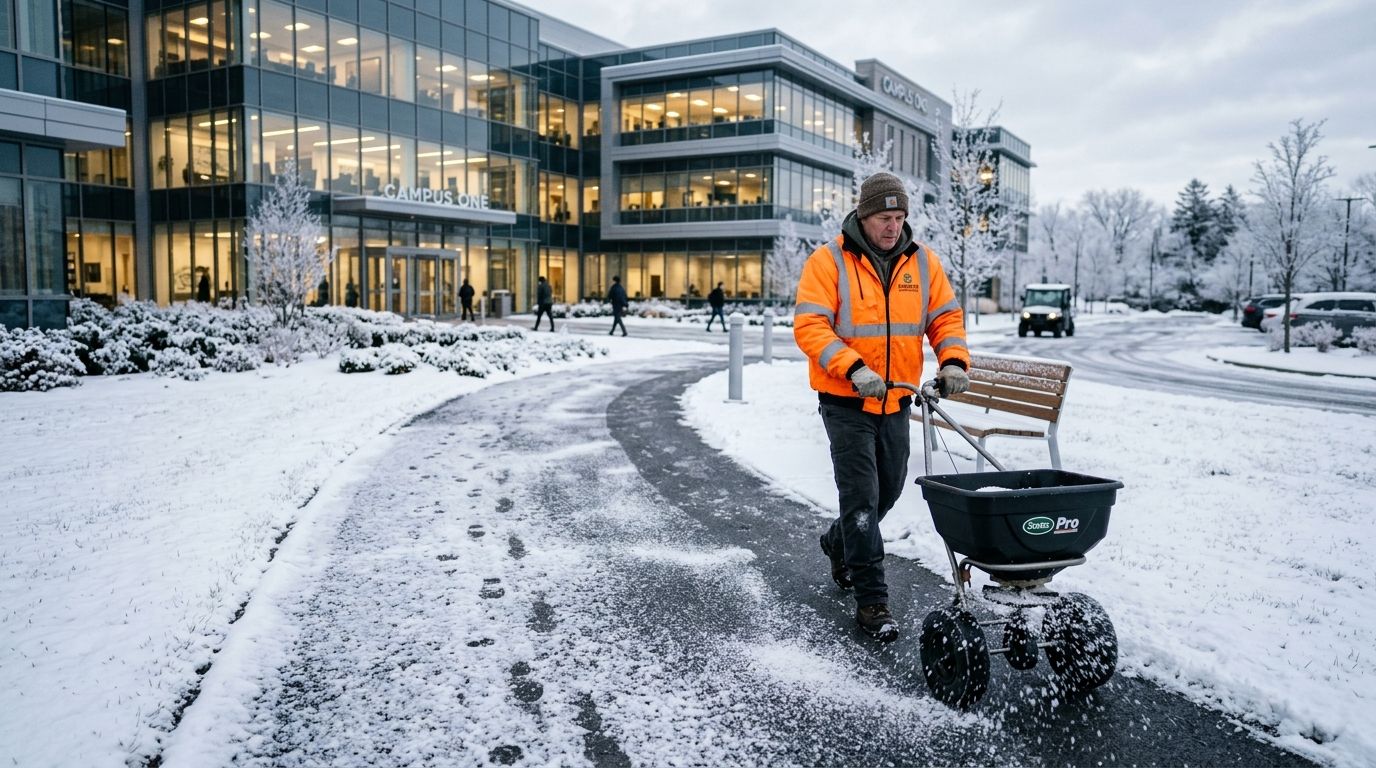
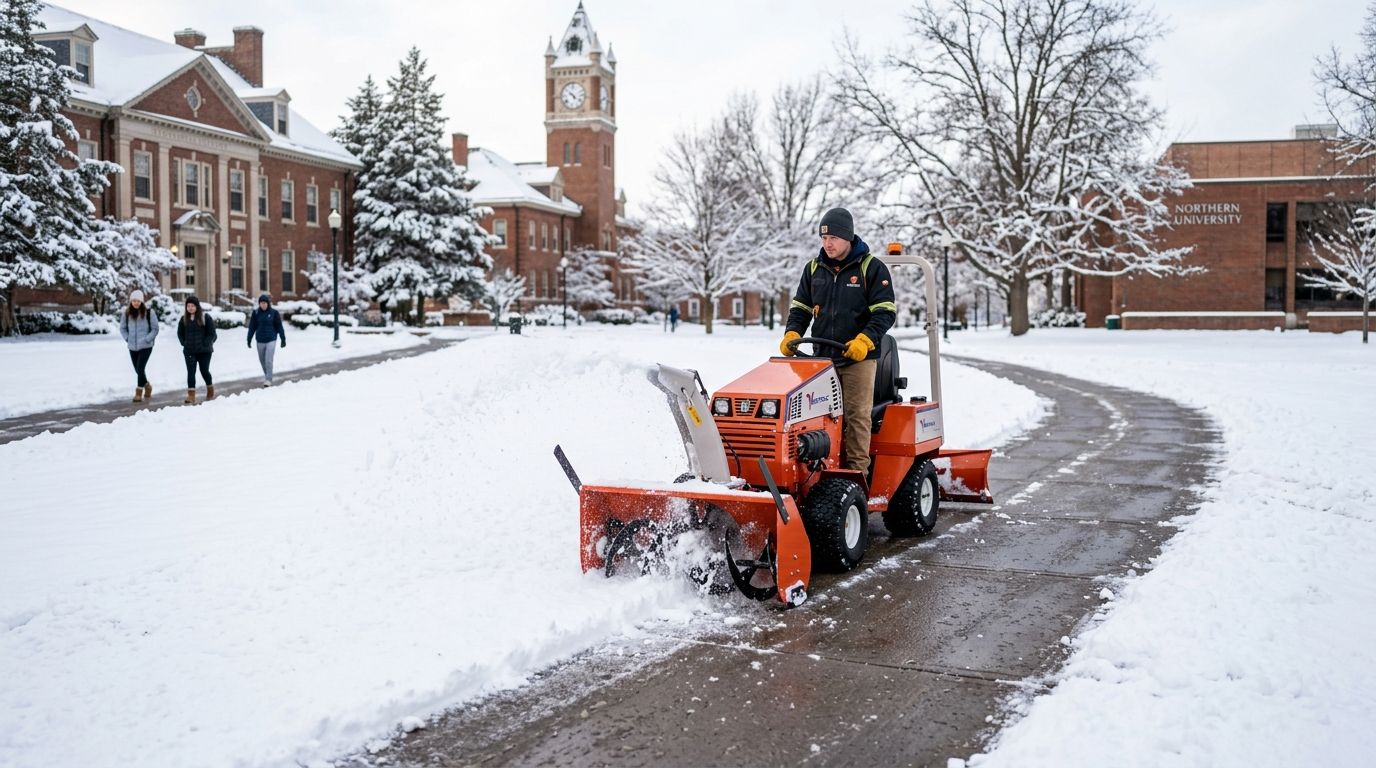
Sidewalk snow clearing for college campuses means keeping every pedestrian route between dorms, classrooms, dining halls, and parking structures passable and ADA-compliant before students start moving, not after. A campus has a different failure mode than a single-tenant office: hundreds of independent walking patterns, tight class-change windows, and liability that runs to the university, not one landlord.
- Sidewalk snow clearing for college campuses needs route mapping before the first snowfall, not during it.
- ADA-compliant paths require a minimum 36-inch clear width, 48 inches where two wheelchairs pass.
- Zero-Tolerance contracts fit campuses because class-change gaps of 10-15 minutes don't leave room for a callback.
- Documented time-stamped clearing records matter more on campus than anywhere else because slip-and-fall claims name the university.
- St. Louis Snow Removal runs geo-stamped clock-ins on every campus route so a cleared sidewalk isn't just claimed, it's proven.
Why sidewalk clearing matters for college campuses
A campus isn't a parking lot with sidewalks attached to it — it's a network of independent routes that all need to open at once. Dorm-to-dining paths matter at 6 a.m., classroom corridors matter at 8 a.m., and library-to-parking routes matter at 11 p.m. Miss one segment and you don't inconvenience one tenant, you create a liability exposure across a route thousands of students cross every day.
St. Louis Snow Removal treats campus sidewalk work as a route-by-route job, not a single blanket pass, because the failure points on a campus are different from a retail lot. A stair landing outside a lecture hall and a ramp outside a dorm carry different risk even if they're 50 feet apart.
Campuses also answer to more than one authority. Facilities management answers to the university's own liability standard, but sidewalks that connect to public streets or transit stops answer to municipal ADA requirements too. That double accountability is why campus contracts tend toward tighter documentation than a standard commercial account.
Map every pedestrian route before the first snowfall
A campus can't be cleared efficiently if nobody has walked it with a map in hand. Route mapping happens in October or November, not during the first storm, and it has to account for actual foot traffic patterns, not just the sidewalks that show up on a facilities blueprint.
- Walk every dorm-to-classroom, classroom-to-dining, and dorm-to-parking path and log distance and surface type
- Flag stairs, ramps, and pedestrian bridges separately from flat walkways — they need different equipment and de-icer
- Rank routes by foot traffic volume so the crew clears the busiest paths first
- Note ADA-designated accessible routes explicitly; they get first priority regardless of traffic volume
- Confirm which sidewalks are university property and which belong to the city, since jurisdiction changes the response standard
Set trigger depths and response windows before contracts get signed
A trigger depth is the accumulation level that starts a clearing pass — half an inch, one inch, two inches — and it needs to be written into the contract before the season starts, not negotiated mid-storm. Campuses that skip this step end up arguing about "how much snow is too much" while students are already walking on it.
- Set separate trigger depths for high-traffic corridors versus low-traffic service paths
- Write response-time windows into the contract in hours, not "as soon as possible"
- Require a pre-treatment pass before predicted overnight snow so morning routes start clear, not frozen
- Match trigger depth to class schedule — a campus with 7 a.m. classes needs a tighter trigger than one starting at 9
- Confirm whether the contract covers ice events separately from snow events, since black ice on a ramp is a different response than three inches of accumulation
Prioritize ADA-compliant paths and accessible entrances
ADA guidance sets a minimum 36-inch clear width for an accessible route and 48 inches where two wheelchairs need to pass. On a campus, that standard applies to every building entrance a student, faculty member, or visitor with a mobility device might use — and it applies whether or not that path sees heavy foot traffic.
- Identify every ADA-designated entrance and ramp on campus and mark them as first-priority clearing zones
- Clear ramps to bare pavement, not just packed snow, since a ramp holds ice longer than a flat walkway
- Check handrail clearance separately — snow piled against a handrail defeats its purpose
- Confirm curb cuts at every crosswalk are cleared to the full width, not just a narrow path through the middle
- Log accessible-route clearing separately from general sidewalk clearing so the university has a distinct compliance record
Coordinate sidewalk crews with parking lot and lot-line schedules
Sidewalk crews and lot-plowing crews working independently create a predictable problem: a lot gets plowed and the windrow gets pushed straight across a sidewalk that was already cleared an hour earlier. On a campus with dozens of lots feeding into shared walkways, that sequencing has to be planned, not improvised.
- Sequence lot plowing to finish before sidewalk crews start their final pass, not the reverse
- Designate snow storage zones away from pedestrian routes and ADA paths
- Confirm salt and de-icer compatible with both asphalt and concrete sidewalk sections, since mixed surfaces need different treatment
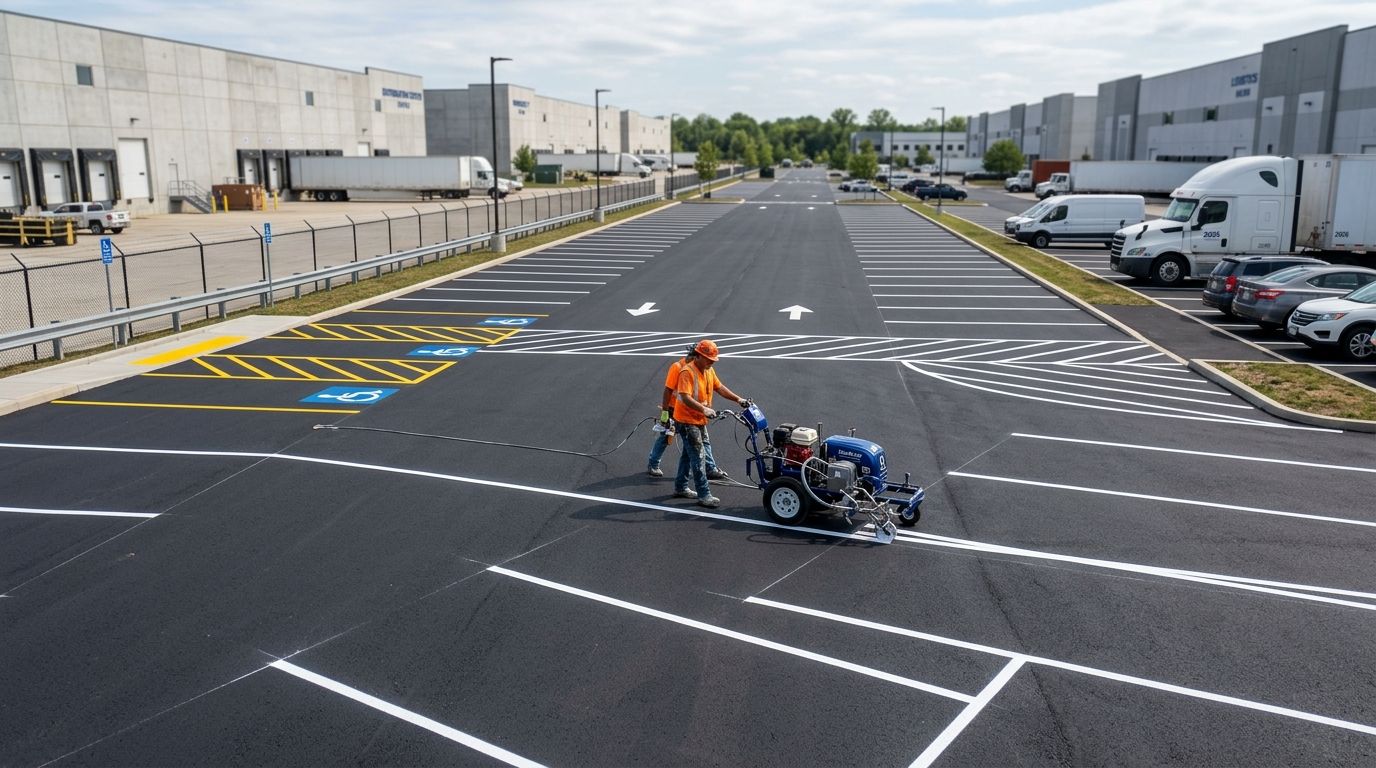
- Coordinate with any striping schedule so faded crosswalk lines aren't buried under a snow pile all winter
- Route trucks around active pedestrian corridors during class-change windows to cut collision risk
Document every clearing pass with time-stamped records
A university's exposure on a slip-and-fall claim comes down to one question: can you prove the sidewalk was cleared and when? "We were out there" doesn't hold up in a deposition. A geo-stamped, time-stamped clock-in for every route does.
- Log arrival and departure time for every crew on every route segment
- Photograph high-traffic entrances before and after each pass
- Keep a per-storm log tied to weather data, not just crew memory
- Store documentation in a format facilities management can pull on demand, not buried in a crew supervisor's phone
- Separate documentation for ADA routes from general routes, since accessibility compliance gets scrutinized on its own
St. Louis Snow Removal builds this documentation into every commercial account, including campus contracts, because a cleared sidewalk with no record is functionally the same as an uncleared one in a liability dispute.
Choose the right contract model for a multi-building campus
A campus with dozens of buildings and shared pedestrian infrastructure rarely fits a simple per-visit arrangement. Contract structure determines whether the response matches the actual risk on the ground.
| Contract model | Best for | Key limitation |
|---|---|---|
| Zero-Tolerance | Campuses with tight class-change windows and high liability exposure | Requires the tightest trigger depths and the most crew capacity on standby |
| Seasonal | Campuses with predictable, budget-locked snow removal spend | Less responsive to unusually heavy or unusually light winters |
| Per-Occurrence | Smaller satellite campuses or lower-traffic service buildings | No guaranteed response priority during multi-property storm events |
Zero-Tolerance fits most residential and academic campuses best because it removes the ambiguity of "how bad does it have to get before someone shows up" — the trigger depth and response window are fixed in the contract, not decided storm by storm.
Get a campus sidewalk plan for 2026
Route maps, trigger depths, and documented clearing for every building on campus.
Common mistakes college campuses make
- Treating the whole campus as one route. A single blanket pass ignores that dorm entrances need clearing at 6 a.m. and lecture hall entrances need it at 8 a.m. — different priorities, different timing.
- Skipping trigger-depth agreements before the season starts. Campuses that leave trigger depth undefined end up negotiating during the storm, which is the worst possible time to negotiate anything.
- Clearing ADA routes to "passable" instead of to standard. Packed snow that's technically walkable still fails the 36-inch clear-width requirement if it narrows the path.
- Letting lot plowing and sidewalk clearing run on separate schedules. Windrows pushed across a cleared sidewalk erase the work a crew just finished.
- Keeping no documentation, or documentation nobody can retrieve. A university with no time-stamped record of a clearing pass has no defense against a slip-and-fall claim tied to that path.
FAQ
What's the best sidewalk snow clearing setup for college campuses?
A Zero-Tolerance contract with route-specific trigger depths and time-stamped documentation fits most college campuses in 2026, because class-change windows of 10-15 minutes don't leave room for a delayed response.
How wide does a sidewalk need to be cleared for ADA compliance?
ADA guidance requires a minimum 36-inch clear width on an accessible route, and 48 inches where two wheelchairs need to pass each other. Campus paths connecting to designated accessible entrances should meet this standard on every pass, not just the first one of the day.
Should campus sidewalks and parking lots be cleared by the same crew?
They don't need the same crew, but they need coordinated scheduling. Lot plowing that finishes after sidewalk crews have already cleared a path creates windrows across walkways that undo the work.
How early should trigger depths be set before winter?
Trigger depths and response windows should be written into the contract in October or November, before the first snowfall of the 2026-2027 season, not negotiated during an active storm.
Is a per-occurrence contract enough for a large campus?
Per-occurrence contracts work for smaller satellite buildings with low foot traffic, but a main campus with dorms, classrooms, and shared pedestrian corridors needs the priority guarantee a Zero-Tolerance or Seasonal contract provides during multi-property storm events.
What documentation should a university request from a snow removal contractor?
Request time-stamped, geo-stamped clock-ins for every route segment, before-and-after photos of high-traffic entrances, and a per-storm log tied to weather data. This is the record that holds up if a slip-and-fall claim names the university.
How is de-icing different for stairs and ramps than flat sidewalks?
Stairs and ramps hold ice longer than flat concrete because they don't drain the same way, so they need separate de-icer application and a check for handrail clearance, not just a pass with the same equipment used on flat walkways.
Does sidewalk clearing need to be separate from parking lot striping?
Yes. Striping schedules and snow clearing schedules serve different purposes, but snow storage from lot plowing should avoid faded crosswalk lines so they're not buried for the entire winter.
One last thing
The detail campuses miss most often isn't the sidewalk width or the trigger depth — it's that a ramp holds ice longer than a flat walkway even after both look clear to the eye. A crew that clears a ramp to "looks fine" instead of bare pavement is setting up the next freeze-thaw cycle to turn it into the first incident report of the week.