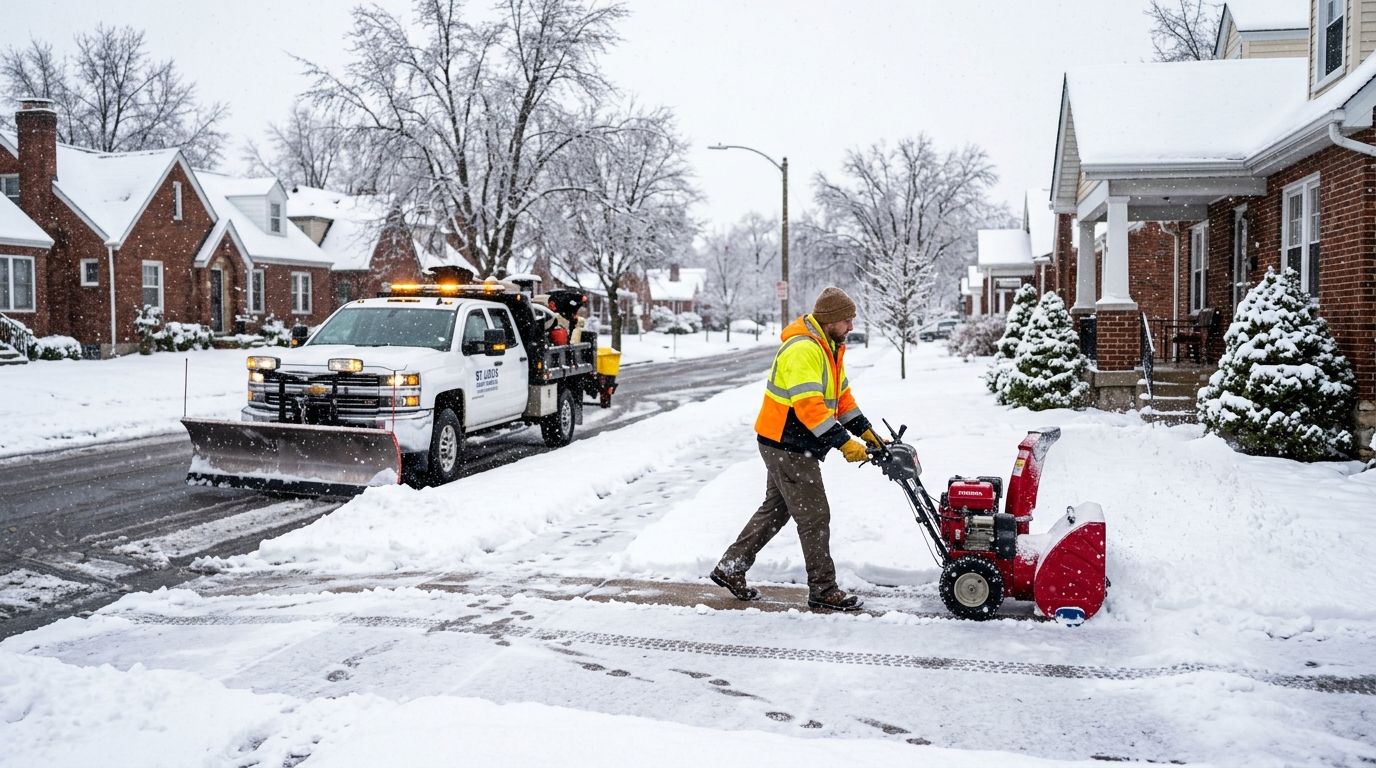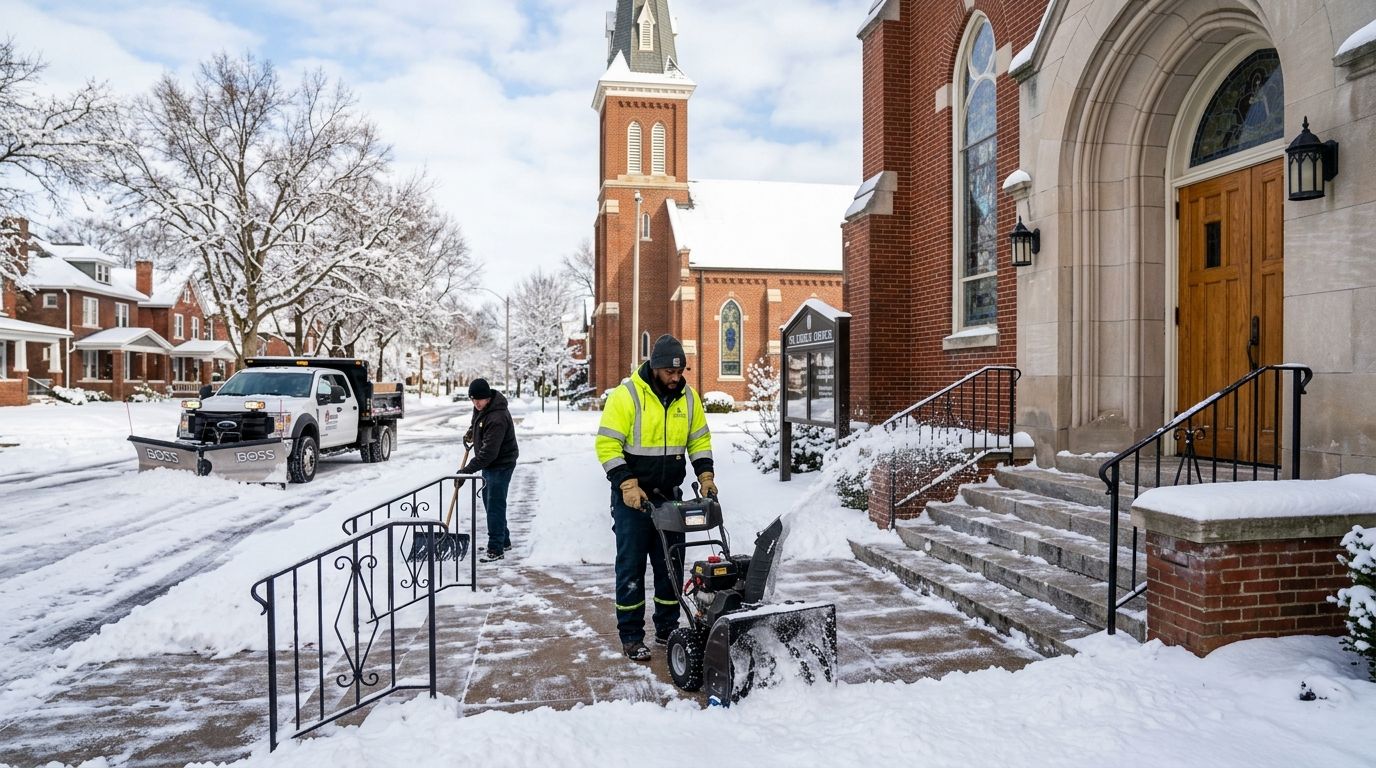
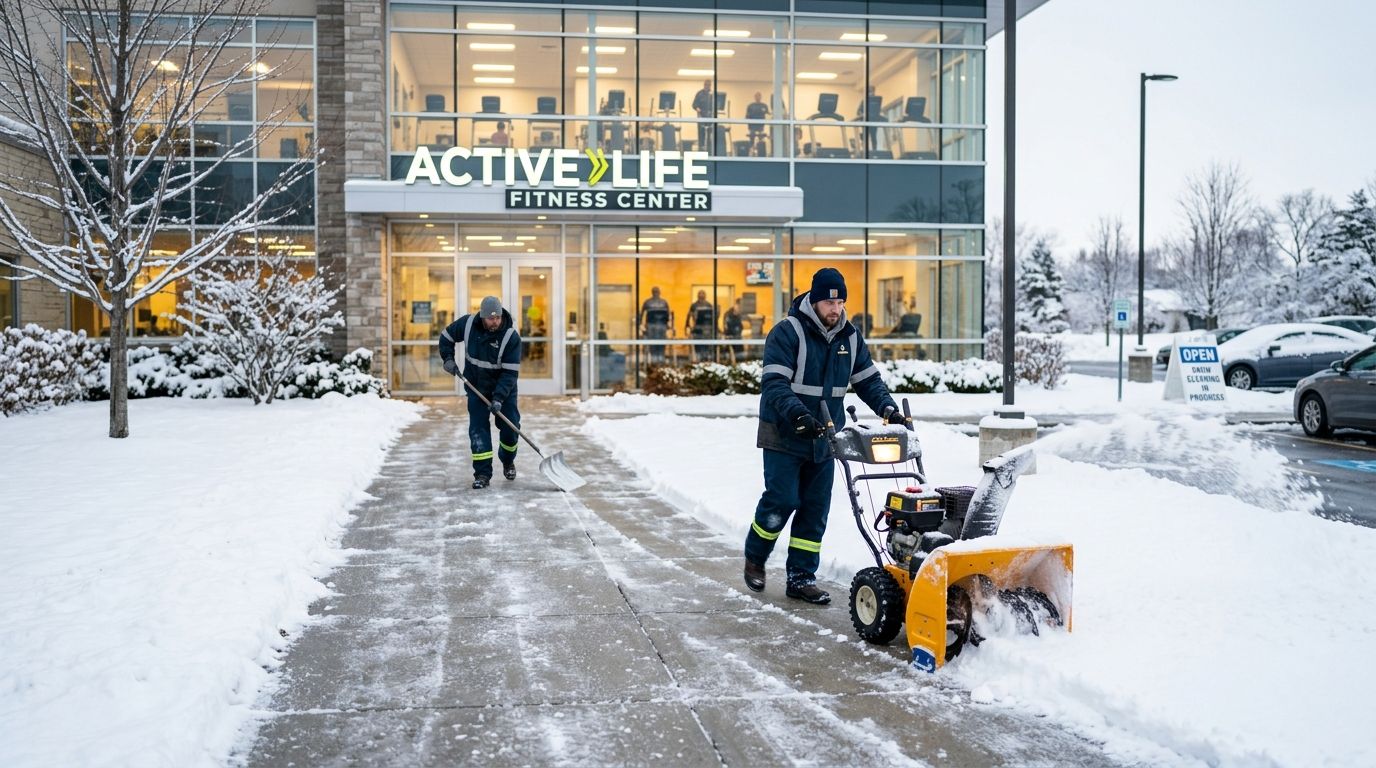
Sidewalk snow clearing for fitness centers is the process of clearing entrances, curb ramps, and parking-lot walkways on a schedule built around 24-hour member traffic instead of standard business hours. A gym running a 4:30 a.m. spin class and an 11 p.m. lap-swim session needs a trigger depth and clearing window that a retail store or office building never has to plan for. Miss that window once and a member goes down on an icy ramp before the front desk even unlocks for the day.
- Sidewalk snow clearing for fitness centers needs a tighter trigger depth (about 1 inch) than standard 9-to-5 properties because classes run before dawn and after dark.
- St. Louis Snow Removal documents every visit with geo-stamped clock-ins so a 2026 slip-and-fall claim has a record, not a verbal promise.
- A Zero-Tolerance contract fits 24-hour clubs best; Seasonal and Per-Occurrence models fit lighter-traffic facilities.
- ADA accessible routes must stay clear to a 36-inch minimum width after every storm, not just passable.
- Rock salt loses effectiveness below roughly 15°F, which matters for early-morning and overnight club hours.
Why sidewalk snow clearing matters for fitness centers
A fitness center's liability exposure runs on a different clock than almost any other commercial property. Retail stores close at night; gyms don't. That means the sidewalk in front of a 24-hour club has to be safe at 4:30 a.m., at noon, and again at 11 p.m. after the last class lets out, with three separate ice-formation windows in a single day.
St. Louis Snow Removal treats fitness centers as a distinct commercial category for exactly this reason: the standard 2-inch trigger depth that works for a 9-to-5 office building leaves a gym exposed during the hours when members are actually walking in. A documented, geo-stamped clearing log is the difference between a contractor who "shows its work" and one who says trust me, we were there.
Set a trigger depth built for round-the-clock access
The trigger depth is the snow accumulation that triggers a plow or shovel crew to respond. Most commercial properties run a 2-inch trigger. A 24-hour gym needs something tighter.
- Push the trigger down to roughly 1 inch for clubs with pre-dawn or late-night classes
- Require a geo-stamped arrival log before the earliest class starts, not just before business hours
- Add a second pass logged before closing, since a full day of foot traffic packs snow into ice
- Prioritize shaded, north-facing entrances first; they refreeze fastest even when the rest of the lot looks dry
- Put the trigger depth in writing in the contract, not in a phone call
Map every entrance, not just the front door
A gym has more entry points than a typical retail box: member entrance, staff or loading entrance, pool deck exit, and emergency exits that double as smoking-break doors in practice.
- List the member entrance, staff entrance, and any secondary doors by name in the service agreement
- Clear curb ramps at accessible parking to bare pavement, not just "passable"
- Name the bike rack and overflow-parking walkways specifically; these get skipped most often because they're not on the main path
- Control vestibule runoff so de-icer and slush don't refreeze on interior entry mats
Lock in a de-icing schedule for pre-dawn and late-night classes
De-icing on a fixed clock misses a gym's real traffic pattern. Pre-treating ahead of a forecasted storm beats reacting after ice has already bonded to concrete.
- Pre-treat before predicted snowfall, not after the first flakes
- Time the second application to class-schedule peaks instead of a fixed hour
- Match the de-icer to surface temperature; rock salt stops working effectively below about 15°F, which matters for a 5 a.m. treatment
- Confirm which product is applied and at what rate; different chemicals have different low-temperature floors
For documented ice management specifically, see the commercial ice management contractors serving the St. Louis metro.
Build a documented, photo-timestamped clearing log
The manual version of this is a spreadsheet: photograph each entrance before and after clearing, note the time, and keep the file. It works, but it depends entirely on someone remembering to do it during a storm at 5 a.m.
The faster path is a contractor that builds this into the service itself. St. Louis Snow Removal logs geo-stamped clock-ins and photo documentation as a standard part of its commercial sidewalk clearing contracts, so the record exists whether or not anyone at the club thought to create one that morning.
- Photograph every named entrance before and after each visit
- Timestamp visits, not just invoice dates
- Keep records for as long as your local claims window runs
- Cross-check logs against your actual class schedule to catch gaps between the last treatment and the first class
Choose the contract model that fits a 24/7 facility
Three contract structures cover most fitness centers: Zero-Tolerance, Seasonal, and Per-Occurrence. Each fits a different risk tolerance and traffic pattern.
- Zero-Tolerance dispatches a crew at a set snow depth regardless of time of day, which is the closest match to round-the-clock club hours
- Seasonal locks a flat rate for the whole winter, which simplifies budgeting for multi-location chains
- Per-Occurrence bills only for storms that actually hit, which costs less in a light winter but is unpredictable in a heavy one
- None of the three protects a facility if the trigger depth written into the contract doesn't match the club's actual operating hours
Compare rates and structures on the commercial snow removal cost in St. Louis page before signing anything for the 2026 season.
Audit ADA path compliance every storm
Accessible routes have a hard width requirement that snow removal has to respect, not just clear around.
- Keep the accessible route clear to a 36-inch minimum width after every plow pass
- Never let windrows from lot plowing bury curb ramps
- Keep detectable warning surfaces (truncated domes) visible, not iced over
- Photograph the accessible route as a separate line item in the clearing log, not folded into the general entrance photos
Comparing sidewalk clearing options for fitness centers
| Option | Best for | Key limitation |
|---|---|---|
| In-house staff shoveling | Small single-location gyms with overnight staff on-site | No documentation trail; liability exposure if a claim is filed |
| Per-Occurrence contract | Facilities that only need coverage in some winters | Costs swing widely in a heavy snow year |
| Seasonal contract | Multi-location chains that want one flat winter budget line | Pays the same rate even in a light winter |
| Zero-Tolerance contract | 24-hour clubs with pre-dawn and late-night classes | Only as good as the trigger-depth documentation behind it |
For a 24-hour fitness center, a Zero-Tolerance contract paired with geo-stamped documentation is the closest match to round-the-clock liability exposure. Everything else trades cost predictability for coverage gaps during the hours members actually walk the sidewalk.
Get a documented sidewalk plan
Trigger depths, entrance lists, and geo-stamped logs built for 24-hour club hours.
Common mistakes fitness centers make
- Setting the trigger depth for a 9-to-5 schedule, then running 24-hour classes on top of it anyway
- Clearing the front door and forgetting the staff entrance or loading dock where trainers and delivery drivers walk before members arrive
- Skipping documentation until after a slip-and-fall claim is already filed
- Assuming parking lot plowing counts as sidewalk clearing; they're separate crews, separate equipment, and separate trigger depths
- Renewing a seasonal contract for 2026 without checking last year's trigger-depth compliance log first
FAQ
What's the best snow removal contract for a 24-hour fitness center?
A Zero-Tolerance contract with a tight trigger depth, roughly 1 inch, fits 24-hour clubs best because it dispatches a crew regardless of time of day. Seasonal and Per-Occurrence models work for gyms with standard daytime-only hours.
How much does commercial snow removal cost for a gym in St. Louis?
Cost depends on lot size, entrance count, and contract model, and rates change year to year. Check the current commercial snow removal cost breakdown for St. Louis before comparing bids for the 2026 season.
Is a Zero-Tolerance contract worth it for a fitness center?
It's worth it for any facility with pre-dawn or late-night hours, since the trigger fires on snow depth rather than a business-hours schedule. It's less necessary for gyms that only operate standard daytime hours.
What trigger depth should a gym use for sidewalk clearing?
A 24-hour fitness center should push its trigger depth to roughly 1 inch instead of the standard 2-inch trigger used by most commercial properties. That tighter trigger accounts for members walking in before a standard business day would even start.
Do fitness centers need separate ice management from snow plowing?
Yes. Snow plowing clears bulk accumulation while ice management treats the bonded layer underneath, and gyms need both handled on a schedule matched to class times, not a fixed daily clock.
How is ADA compliance affected by snow and ice on sidewalks?
Accessible routes must stay clear to a 36-inch minimum width and curb ramps can't be buried under plowed windrows. A storm that leaves the main entrance clear but blocks the accessible ramp is still a compliance failure.
What documentation should a fitness center require from its snow contractor?
Require geo-stamped clock-ins, before-and-after photos of every named entrance, and a written trigger depth in the contract. Verbal assurances don't hold up against a slip-and-fall claim; timestamped photo logs do.
How often should a 24-hour gym's sidewalks be checked during a storm?
Checks should align with class peaks rather than a fixed interval, typically before the earliest morning class and again before closing. A facility running classes at 4:30 a.m. and 10 p.m. needs at least two logged passes in between.
One last thing
The entrance most fitness centers forget to name in their contract isn't the front door, it's the shaded, north-facing side entrance near the loading dock. That patch never gets direct sun, so it refreezes first and clears last, even on a day when the rest of the property looks dry by noon. Name it specifically in the service agreement for 2026, or it becomes the spot a member slips on while the main entrance photo log shows everything fine.