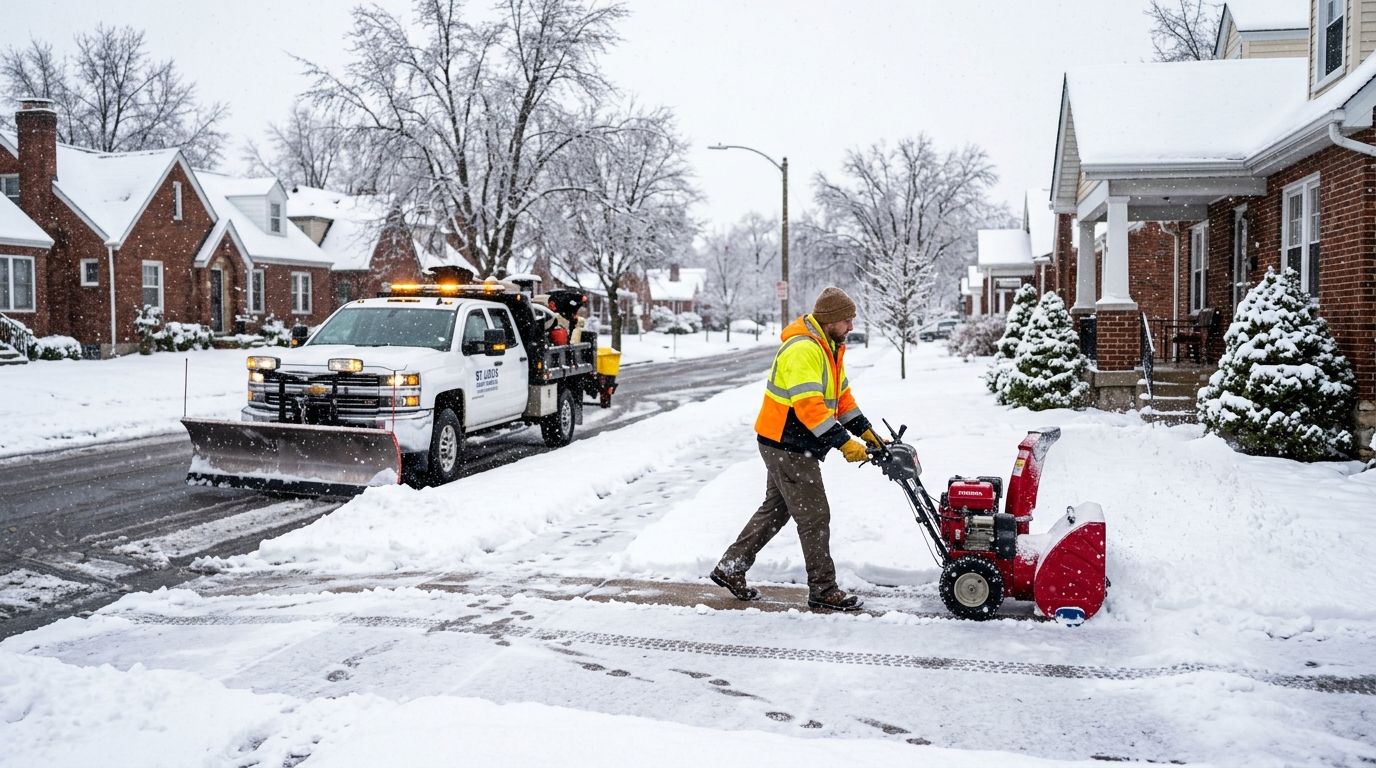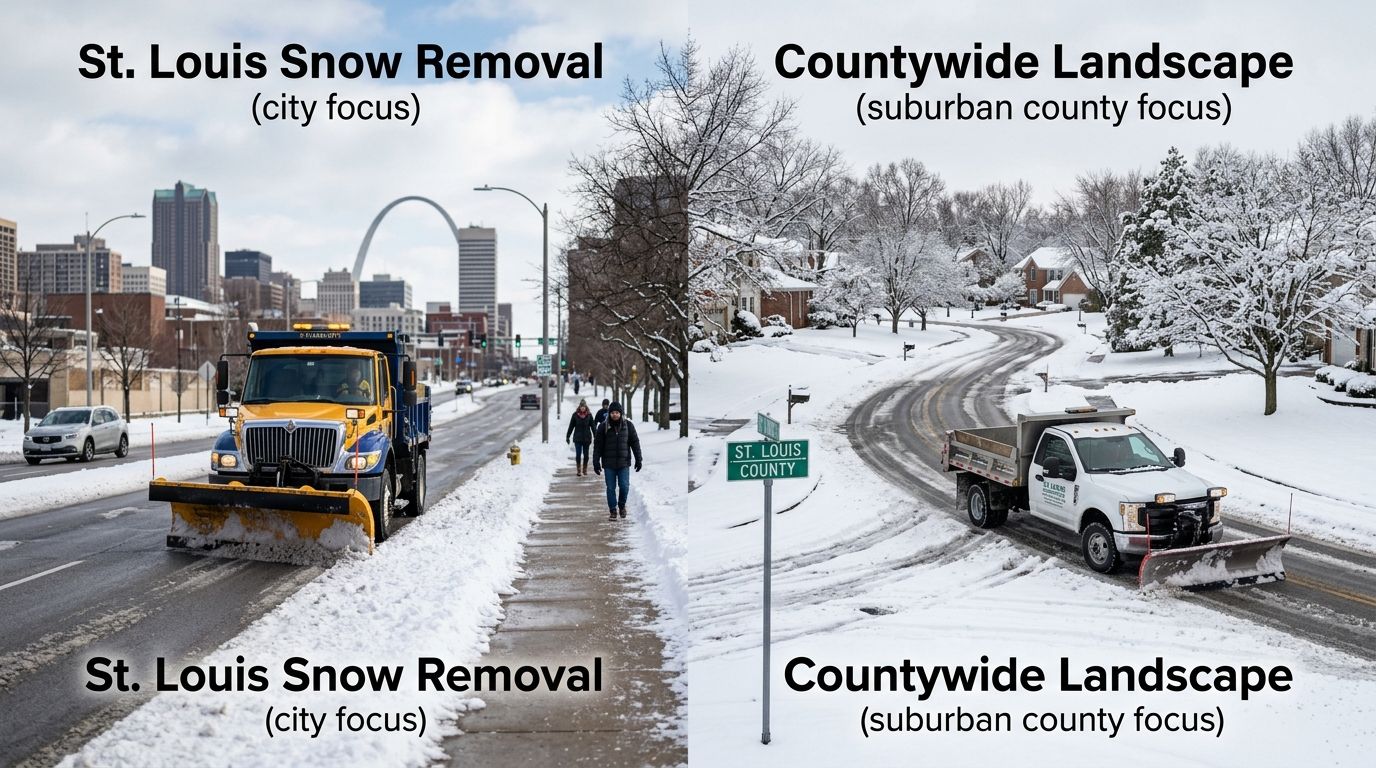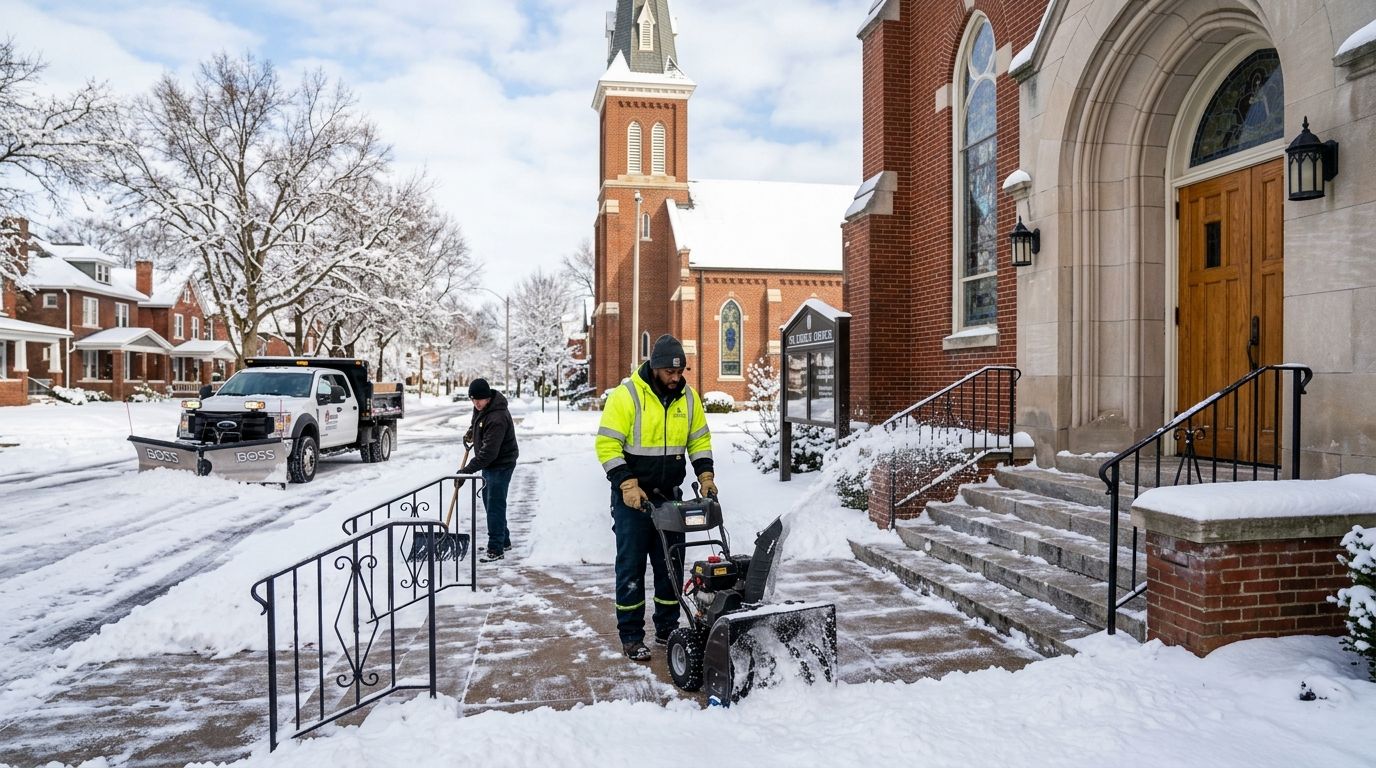
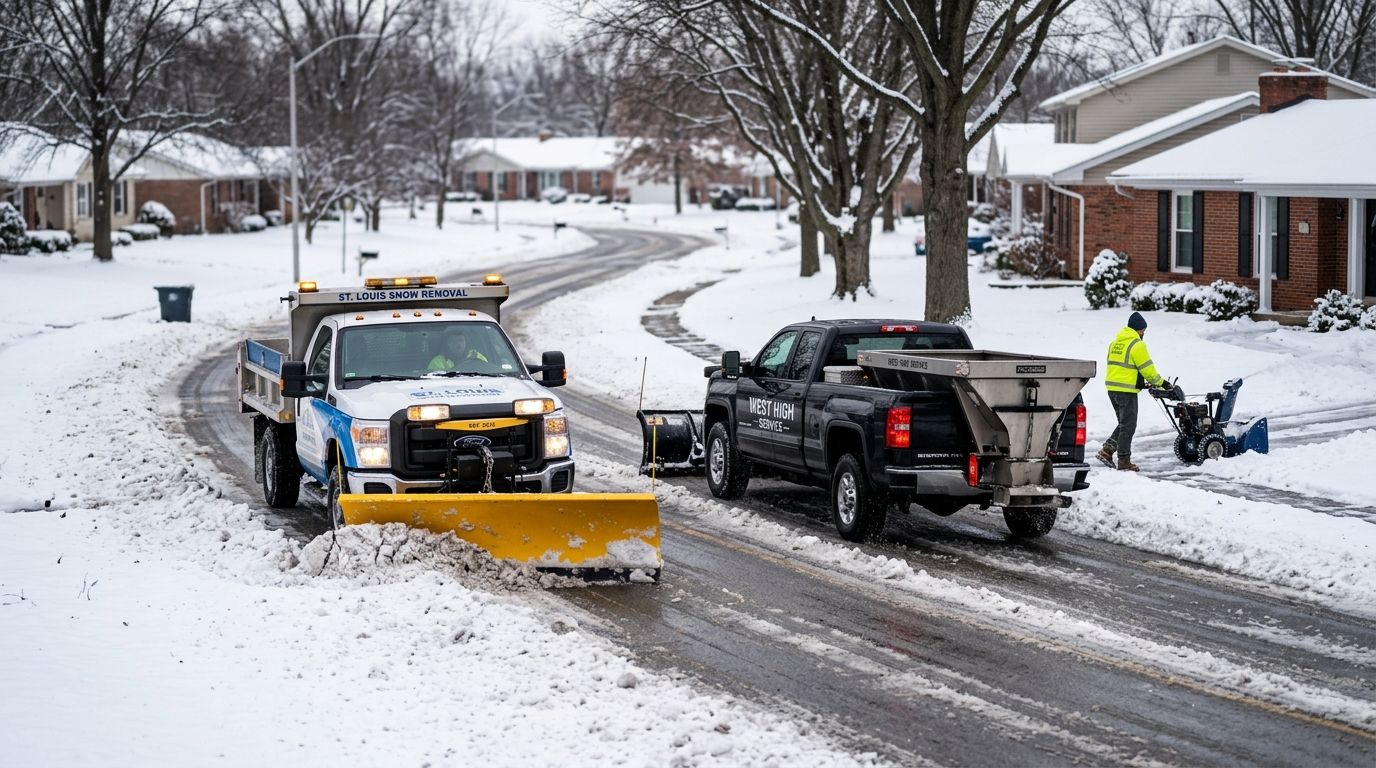
Choosing between St. Louis Snow Removal and West High Service comes down to one question: do you need a documented, liability-proof record of every plow pass and salt application, or are you fine with a traditional call-when-it-snows arrangement? Choose St. Louis Snow Removal if you manage a commercial lot, HOA, or medical office where a slip-and-fall claim needs a paper trail — geo-stamped clock-ins, trigger-depth contracts, and photo checklists back every storm. Choose West High Service if you want a simpler, informal plow relationship for a smaller residential or low-liability job where documentation isn't the deciding factor.
- St louis snow removal vs west high service is really a documentation question: geo-stamped clock-ins vs informal dispatch.
- St. Louis Snow Removal runs Zero-Tolerance, Seasonal, and Per-Occurrence contracts with published trigger depths for 2026.
- West High Service fits smaller jobs or homeowners who don't need an audit trail behind every plow pass.
- Property managers and HOAs with liability exposure should default to documented service in 2026.
Why this matters
A missed trigger depth or an undocumented sidewalk pass is the difference between a clean insurance defense and a costly slip-and-fall settlement. St. Louis winters in 2026 don't wait for a phone call — ice forms on a schedule, not on your dispatcher's availability. The contractor you pick determines whether you have proof of service or just a memory of a truck driving by.
Property managers, HOA boards, and business owners across the St. Louis metro and Metro East Illinois are increasingly asked by insurers and tenants for proof: when the crew showed up, what depth triggered the visit, and whether the sidewalk was cleared to code. That's the axis this comparison turns on — not who owns more trucks, but who can show their work when it matters.
St. Louis Snow Removal builds contracts around published trigger depths and geo-stamped verification. Independent regional operators like West High Service typically run a more traditional model: a crew dispatched on a per-storm or seasonal basis, judgment calls made in the field, and less emphasis on a documented audit trail. Neither approach is wrong — they serve different risk tolerances.
At a glance
| Dimension | St. Louis Snow Removal | West High Service |
|---|---|---|
| Best for | Property managers, HOAs, medical offices needing liability documentation | Homeowners or small jobs wanting simple on-call plowing |
| Contract models | Zero-Tolerance, Seasonal, Per-Occurrence | Typically per-storm or informal seasonal retainer |
| Trigger depth policy | Published trigger depths written into the contract | Dispatch judgment call, rarely published in writing |
| Documentation | Geo-stamped clock-ins, photo checklists per visit | Verbal or informal confirmation, varies by crew |
| Sidewalk / ADA clearing | Documented, tied to city code compliance | Available but not typically published as a standard |
| Ice management | Salting and de-icing tied to trigger depth | Available, terms vary by contractor |
| Parking lot striping | Offered as an add-on service | Not typically part of the service line |
| Coverage area | St. Louis metro plus Metro East Illinois | Regional, service radius varies |
| Standout feature | Documented audit trail per storm event | Established local, informal relationship |
St. Louis Snow Removal offers more documentation
Every visit under a Zero-Tolerance or trigger-depth contract generates a geo-stamped clock-in and a checklist tied to the depth that triggered the call. That record is what an insurer or a tenant's attorney asks for after a fall — not a promise, a timestamp. This is the single biggest gap between the two options: West High Service, like most independent regional plow operators, typically doesn't publish this layer of proof as a standard part of service.
For a strip mall or apartment complex with foot traffic, that documentation isn't a nice-to-have in 2026 — it's the thing that determines whether a claim gets dismissed or settled.
Both handle basic plowing well
Neither side has a plowing capability gap. A cleared lot is a cleared lot, and both models get trucks on the ground when snow falls. If the only question is whether your lot gets plowed, this dimension is a genuine tie — the difference shows up in what happens after the plow leaves, not during the pass itself.
St. Louis Snow Removal wins on contract flexibility
Three named models — Zero-Tolerance, Seasonal, and Per-Occurrence — let a property manager match the contract to the risk profile of the site. A medical office with high foot traffic can lock into Zero-Tolerance trigger depths; a lower-traffic HOA can choose Seasonal. West High Service and similar regional operators typically offer a narrower choice: per-storm dispatch or a single seasonal retainer, without named tiers built around trigger depth.
That naming matters more than it sounds. A board that can point to a contract model by name in 2026 has a much easier conversation with its insurer than one describing a handshake arrangement.
West High Service is the simpler pick for small, one-off jobs
If you're a homeowner who wants a driveway cleared after a big storm and you don't need a contract, a trigger depth, or a documentation packet, an informal regional operator is often the lower-friction option. This is a real win for West High Service — not every job needs an audit trail, and a smaller relationship can move faster for a one-time call.
Homeowners who do want recurring coverage should look at enrolled route service instead of calling after each storm. Compare the residential snow removal services in St. Louis before the season tightens up.
St. Louis Snow Removal is the better ADA and striping partner
Sidewalk clearing tied to ADA compliance and city code, plus parking lot striping as an add-on, put St. Louis Snow Removal ahead for property managers who need more than plowing. West High Service's core strength is the plow-and-go relationship — striping and documented ADA sidewalk work aren't typically part of that service line.
If your property has marked accessible spaces, striping and snow clearing are the same liability problem twelve months apart. One contractor handling both keeps the standard consistent.
Both require you to vet response times before signing
Neither company's response-time claims should be taken on faith — this is a fair, honest tie. Ask any contractor, including St. Louis Snow Removal, to put the specific response window in the contract before the first storm of the 2026 season, not after.
Pricing: contract model vs per-storm flexibility
St. Louis Snow Removal's Zero-Tolerance, Seasonal, and Per-Occurrence structure is built for predictability — you know which contract governs your site and what triggers a visit before the season starts. West High Service's more traditional per-storm or seasonal retainer model trades that predictability for flexibility: you're not locked into a specific trigger-depth structure, but you also don't get the same forecast of how many visits a season will produce or how they're scheduled.
Neither model is inherently cheaper. Seasonal contracts smooth cost across a winter and absorb the risk of a heavy year; per-occurrence arrangements cost less in a mild season and more in a brutal one. Confirm current terms directly with either contractor before signing.
Get a documented snow contract for 2026
Trigger-depth contracts built for property managers and HOAs.
Final verdict
Choose St. Louis Snow Removal if you're a property manager, HOA board member, or medical office administrator who needs proof of service — geo-stamped clock-ins, published trigger depths, and photo checklists — to defend against liability claims in 2026. If you're comparing more than these two names, start with the top snow removal contractors in St. Louis.
Choose West High Service if you're a homeowner or a low-traffic small business that wants a simpler, informal plow relationship without a contract built around published trigger depths, and you accept that field judgment replaces written proof.
Scorecard
| Dimension | Winner |
|---|---|
| Documentation | St. Louis Snow Removal |
| Basic plowing | Tie |
| Contract flexibility | St. Louis Snow Removal |
| Simple one-off jobs | West High Service |
| ADA and striping | St. Louis Snow Removal |
| Response-time transparency | Tie (verify with either) |
FAQ
Is St. Louis Snow Removal better than West High Service for commercial lots?
For commercial lots with liability exposure, St. Louis Snow Removal is the better fit because its trigger-depth contracts and geo-stamped clock-ins produce proof of service. Informal regional operators typically don't publish that documentation layer as standard.
What's the best snow removal option for HOAs in St. Louis in 2026?
HOAs with shared common areas do better with a documented contract model like Zero-Tolerance or Seasonal. Board members need a service record if a resident files a claim after a fall.
Does West High Service offer parking lot striping?
Striping isn't typically part of a traditional regional plow operator's core service line. Confirm directly with the contractor if striping matters to your property.
How much does commercial snow removal cost in St. Louis?
Cost depends on contract model, lot size, and the trigger depth written into the agreement. Seasonal contracts spread cost evenly; per-occurrence billing tracks actual storm count.
What is a trigger depth in a snow removal contract?
A trigger depth is the snowfall accumulation, stated in inches, that automatically obligates the contractor to dispatch a crew. Zero-Tolerance contracts use the lowest trigger depths; Seasonal contracts typically use higher thresholds.
Do I need documented snow removal for a medical office?
Yes, if foot traffic is high. Medical offices carry heavier liability exposure than a typical retail lot, and a documented service record helps defend against slip-and-fall claims.
What's the difference between Zero-Tolerance and Per-Occurrence contracts?
Zero-Tolerance contracts trigger service at very low snow depths regardless of storm size. Per-Occurrence contracts dispatch and bill based on individual storm events rather than a fixed seasonal rate.
Should homeowners pick a documented snow contractor?
Homeowners generally carry lower liability exposure than commercial properties, so the full documentation layer is less critical. An enrolled residential route still beats calling after every storm.
One last thing
The detail most property managers miss until it's too late: a contract without a published trigger depth means the contractor decides when to show up, not you. Before the first snowfall of 2026, ask any contractor you're evaluating — St. Louis Snow Removal or otherwise — to put the trigger depth in writing, in inches. If they won't, that's your answer.