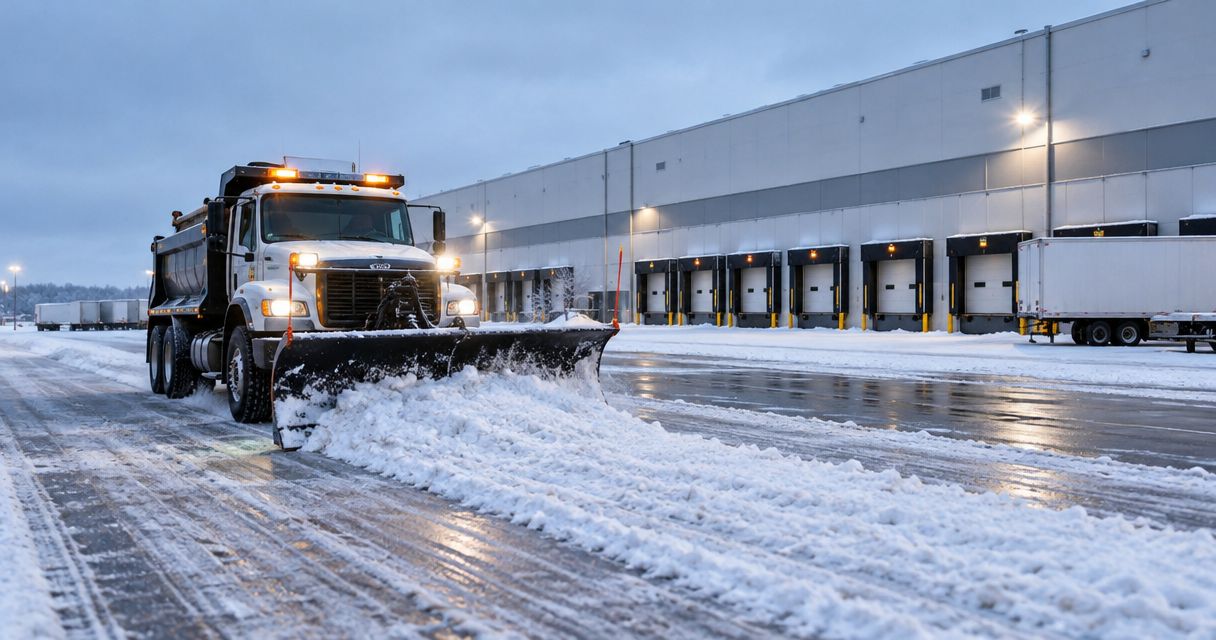

The snow removal labor rate by equipment type is not one number. It is a stack of rates, one per machine class, and 2026 quotes in St. Louis only compare cleanly when each rate is tied to a billing basis. This page lays out the five equipment classes, how each is priced, and what to demand on paper. For contract-level figures, see the commercial snow removal pricing benchmarks by contract type.
- Snow removal labor rate by equipment type depends on machine class, billing basis, and minimums, not a single hourly figure.
- Truck plows, skid steers, loaders, walk-behind crews, and spreaders each bill differently in 2026.
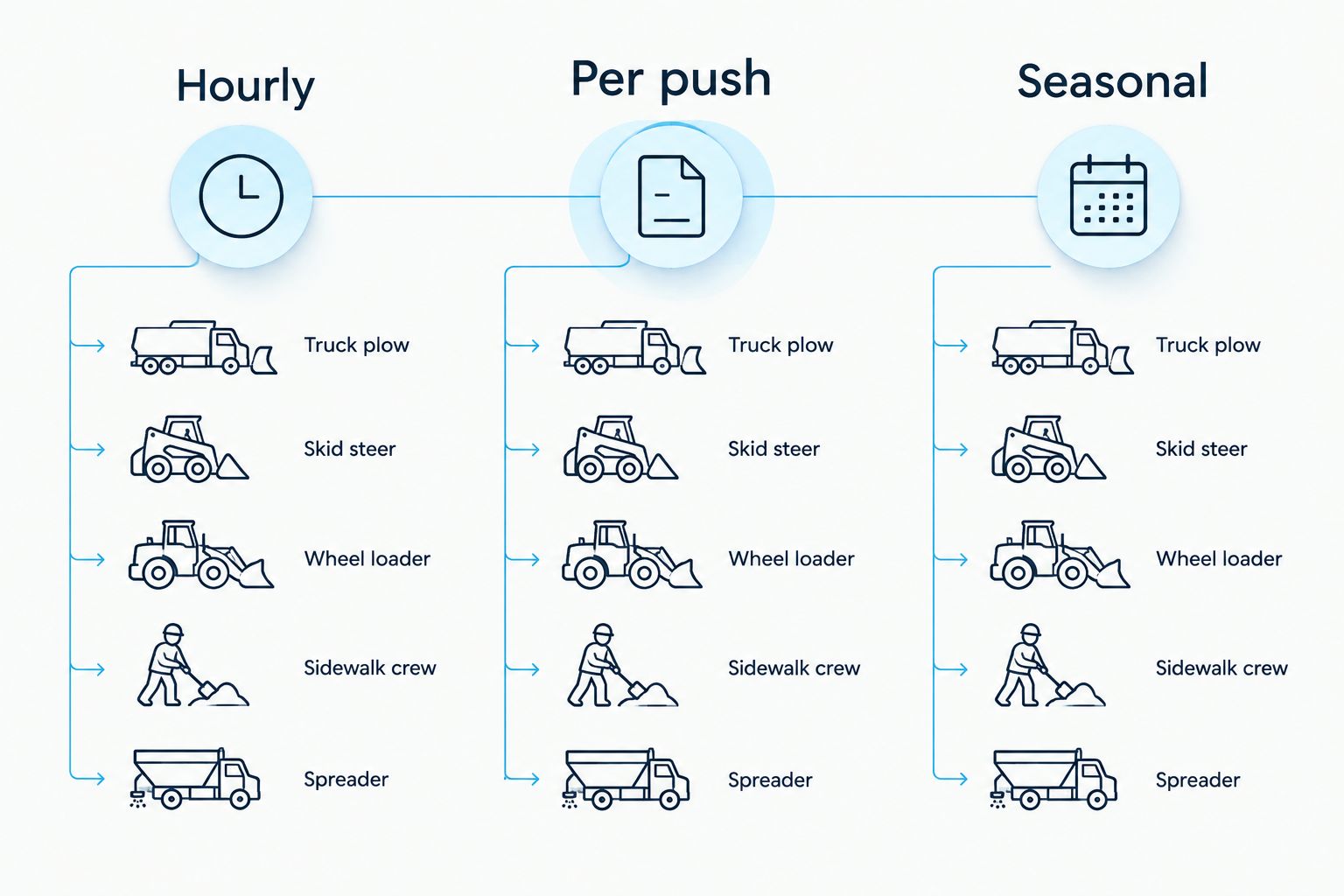
- Compare quotes on the same basis: hourly, per push, or seasonal. Mixed bases hide the real cost.
- Ask for a minimum charge and a documented clock-in record before signing.
Why this matters in 2026
Property managers collect three quotes and get three different structures. One bills a truck by the hour, one bills the lot per push, one bills a seasonal flat fee. Comparing the headline numbers is meaningless.
The equipment class sets the floor. A pickup with a blade and a wheel loader are not the same labor line. Neither is a two-person sidewalk crew.
The verdict for 2026: do not compare hourly rates until you know the machine, the operator count, and the minimum charge behind each one.
Short answer: what the benchmark looks like
No single published average covers snow removal labor across equipment types in the St. Louis metro and Metro East Illinois. Any page that gives you one clean number for 2026 is averaging unlike things. What holds across contractors is the structure: every equipment class is priced on one of four bases, and each basis moves risk to a different party.
Benchmark table: equipment type by billing basis
This table shows how each class is normally priced and what drives the rate. It lists no dollar figures because the inputs for this page include no sourced per-class rates, and an invented number would be worse than none.
| Equipment type | Typical billing basis | What drives the rate | Best for |
|---|---|---|---|
| Pickup or truck with plow | Per push, per hour, or seasonal | Lot size, trigger depth, number of passes | Small to mid-size lots, retail strips |
| Skid steer with pusher or bucket | Hourly | Obstacles, loading docks, tight pockets | Docks, corners, areas trucks cannot reach |
| Wheel loader | Hourly, often with a minimum | Pile size, large-lot volume, mobilization | Big-box lots, distribution yards |
| Walk-behind or sidewalk crew | Per visit or hourly per person | Linear feet, ADA width, entrances | Sidewalks, ramps, storefront entries |
| Salt or de-icing spreader | Per application or per ton plus labor | Material rate, surface area, pre-treat or post-treat | Lots and walks after plowing, pre-storm treatment |
How the table reads
Hourly billing leads on flexibility and trails on predictability. Seasonal flat fees lead on budget certainty and trail on transparency, because the per-machine rate disappears inside the total. Per-push sits between them.
If you want to see how the contract model changes the math, read snow plow trigger depth benchmarks by property type. Trigger depth decides how often a truck rolls, and rolls are what you pay for.
Method and limits of this benchmark
This page compares billing structures that contractors in the St. Louis metro and Metro East Illinois use for the 2026 season. It does not report a market-wide survey of dollar rates.
Limitation: per-class dollar rates swing with storm count, fuel, operator availability, and contract length, so a single published average would mislead. Treat any figure you are quoted as valid only for that property and that season.
Class by class: what to check
Truck plows
Truck plows carry most lot work. The rate you see is usually per push or per hour, and the hidden variable is the trigger depth that starts a dispatch. A low trigger means more pushes. A high trigger means fewer pushes and more snow on the pavement when the truck arrives.
- Pros: fastest per square foot on open lots; widest contractor supply.
- Cons: cannot reach tight corners, docks, or walkways; repeated pushes add up on per-push billing.
- Verdict: Buy for open lots, paired with a defined trigger depth.
Skid steers
Skid steers handle what a truck cannot: loading docks, dumpster pads, building edges. They bill hourly in most arrangements. The risk is open-ended time on site.
- Pros: precise work in tight areas; can stack snow instead of pushing it into drive lanes.
- Cons: slower across open pavement; hourly billing needs a time record you can audit.
- Verdict: Buy as a support machine, Skip as the only machine on a large lot.
Wheel loaders
Loaders move volume. They matter on large lots where piles must be relocated, and they usually carry higher minimums because of mobilization.
- Pros: clears big piles; reduces lost parking stalls over a long season.
- Cons: minimum charges apply even on light events; overkill for small sites.
- Verdict: Hold until pile storage becomes a real problem, then add it.
Sidewalk crews
Walk-behind and hand crews carry the liability work: entrances, ramps, and walkways. Ask how the crew proves it cleared to the required width. The ADA angle is covered in ADA sidewalk clearance width benchmarks.
- Pros: targets slip-and-fall exposure at the doors; low equipment overhead.
- Cons: labor-heavy, so the rate tracks headcount and visit frequency.
- Verdict: Buy, and require documentation of every visit.
Spreaders and de-icing
Spreaders are priced per application or per material load plus labor. The rate depends on timing: pre-treatment before a storm and post-treatment after plowing are separate line items on many quotes.
- Pros: cuts ice bonding; separate line items make the cost visible.
- Cons: material cost moves with supply; double application inflates the bill.
- Verdict: Buy pre-treatment on high-traffic lots, Hold blanket post-treatment unless ice is present.
High and low commentary
The structural spread runs like this. Sidewalk crews and spreaders carry the most documentation value per dollar because they sit closest to liability. Wheel loaders carry the highest fixed-cost exposure through minimums. Truck plows sit in the middle and are the easiest class to price per push.
So the pattern for 2026: the more specialized the machine, the more likely it bills hourly with a minimum, and the less likely a flat seasonal fee covers it without exclusions.
How to use these benchmarks
- Normalize before comparing. Convert every quote to the same basis, hourly, per push, or seasonal, before ranking contractors.
- Ask for the minimum charge by machine. A low hourly rate with a high minimum costs more on light-snow events.
- Require proof of time on site. Hourly billing without geo-stamped clock-ins is trust-based billing. Documented service is the safeguard.
- Ask what the seasonal fee excludes. Skid steer time, loader mobilization, and salt are the usual carve-outs.
Questions to put to every contractor
- Which machine class covers each part of my property?
- Is each class billed hourly, per push, or inside a flat fee?
- What is the minimum charge per machine per event?
- How do you document arrival, departure, and work performed?
- What happens when snowfall falls under the trigger depth?
St. Louis Snow Removal documents its commercial plowing, de-icing, and sidewalk work so a rate can be checked against a record. Review the service at St. Louis Snow Removal.
FAQ
What is the snow removal labor rate by equipment type?
There is no single rate. Each equipment class, from truck plows to sidewalk crews, is billed on its own basis: hourly, per push, per visit, or inside a seasonal fee. Compare quotes only after converting them to the same basis.
Is hourly or per-push snow removal pricing better?
Per push gives more cost predictability on single-machine lots. Hourly suits tight areas where time varies. Neither wins universally; the property layout decides.
Why do loaders cost more than trucks?
Loaders carry mobilization costs and often a minimum charge per event. They are priced for volume work, not light clearing.
Does a seasonal contract include every machine?
Not automatically. Seasonal fees often exclude skid steer time, loader work, or salt. Ask for the exclusions in writing before signing in 2026.
How do I verify hourly billing is honest?
Require geo-stamped clock-ins and timestamped service records for every visit. Without a time record, an hourly bill cannot be audited.
Are sidewalk crews billed differently from plow trucks?
Yes. Sidewalk work is billed per visit or per person-hour because it is labor-driven. Truck plows are billed mostly per push or per hour.
What is the biggest hidden cost in snow removal quotes?
Minimum charges and exclusions. A low advertised rate with a high per-machine minimum can cost more than a higher rate with no minimum.
One last thing
The cheapest hourly rate often belongs to the contractor with the least paperwork. If a crew cannot show clock-in and clock-out times for each machine, the rate is a guess, and so is the invoice. In 2026, ask for the record before you ask for the price.