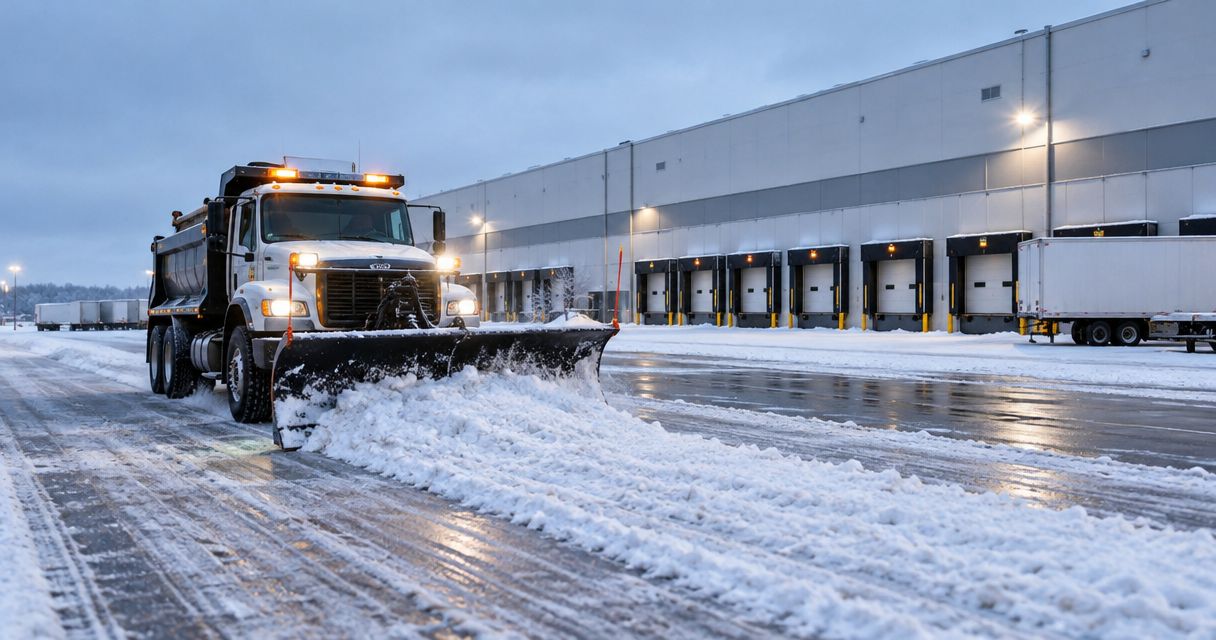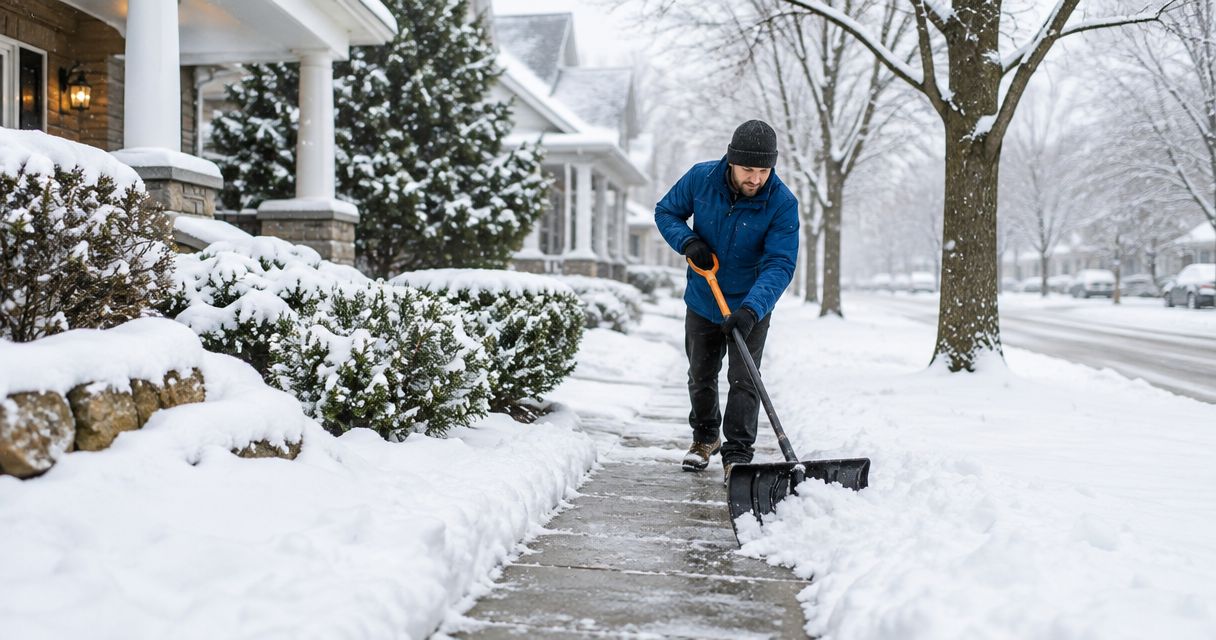

A commercial ice management contractor quote should define the treated areas, dispatch triggers, materials, response commitments, repeat-treatment rules, billing basis, and proof of service. It should also state who monitors conditions and authorizes additional work, because an initial application and a return visit are separate responsibilities. Use this checklist to review your 2026 proposal before you sign.
- A commercial ice management contractor quote needs mapped coverage, dispatch triggers, repeat-treatment rules, and proof of service.
- St. Louis Snow Removal provides documented commercial ice management for businesses and property managers across St. Louis and Metro East Illinois.
- Compare de-icing and salting proposals by responsibilities and exclusions, not by the headline total alone.
- Require written arrival commitments and inspection duties; do not treat a dispatch notification as proof of completed work.
What should a commercial ice management quote include?
A usable quote explains what starts the work, what the crew treats, and how you verify completion. A proposal that says only salt parking lot leaves too much undecided.
St. Louis Snow Removal provides documented commercial snow plowing, de-icing and salting, and sidewalk clearing. When reviewing a proposal, separate those services instead of assuming one includes the others.
Use the following sequence to check each contractor's scope. Ask for revisions wherever the answer depends on a verbal explanation.
- Map the coverage. Identify vehicle lanes, parking stalls, entrances, sidewalks, ramps, loading areas, and any excluded surfaces. Attach a marked site plan so coverage does not depend on someone's memory.
- Define the trigger. State the conditions that authorize pretreatment, treatment during an event, and treatment after snow clearing. Specify whether dispatch is automatic or requires your approval.
- Name the materials. Ask the contractor to identify the proposed de-icing material and explain how the application approach accounts for your surfaces. Require a process for approving substitutions.
- Separate the service milestones. Define notification, dispatch, arrival, initial treatment, and completion. Any response commitment needs a clear starting point and a written description of exceptions.
- Assign repeat visits. State who checks for remaining ice or refreezing, who initiates another visit, and whether that visit requires separate authorization.
- Explain the billing basis. Identify the contract model, the unit used to record work, treatment inclusions, minimums, and exclusions. Make each invoice traceable to the approved scope.
- Specify the records. Require site identification, arrival and departure times, treated areas, material information, observations, and a completion checklist. Agree on where those records will be delivered.
- Document responsibilities. Name the property contact, after-hours contact, escalation path, access requirements, insurance documentation, and procedure for changing the scope.
This checklist is a purchasing tool, not a substitute for the agreement. Attach the accepted scope and site map to the contract so the proposal's operational details remain part of the service instructions.
Why this matters
A parking lot and its pedestrian routes need separate attention. Treating vehicle lanes does not establish that an entrance, ramp, or sidewalk received service.
For your 2026 contract review, focus on responsibility gaps. Who notices an untreated entrance? Who can authorize a return visit? Where does the contractor record an area blocked by parked vehicles?
The strongest quote closes those gaps before a storm creates an argument. You need instructions that the property manager, dispatcher, and crew can each interpret the same way.
Documentation matters for that reason. A completed service record helps you distinguish work performed, conditions observed, and tasks left unresolved; those are different facts.
Define the site before you compare proposals
Give each bidder the same marked site plan. Otherwise, you are comparing different assignments under the same service name.
Identify the routes people actually use, including the path from parking to the entrance. Mark delivery access, stairs, ramps, employee entrances, and places where vehicles or stored equipment restrict treatment.
Require separate scope lines for lot treatment and pedestrian treatment. Ask whether hand-applied work, entrance attention, and follow-up inspections belong to the base scope or require additional authorization.
Describe access limitations before the contractor proposes a plan. Locked gates, occupied loading areas, and tenant-controlled spaces need an agreed procedure for reporting blocked work and returning when access becomes possible.
For a multi-property 2026 agreement, attach a site-specific scope to each address. A shared contract does not replace instructions for individual properties.
Compare the contract models without assuming coverage
Zero-Tolerance, Seasonal, and Per-Occurrence describe different aspects of an agreement. Zero-Tolerance describes a service objective; Seasonal and Per-Occurrence describe how service is organized and billed. Ask the contractor to explain how those terms work together in the actual proposal.
| Model | Best for | What the quote must define | Advantage | Limitation to resolve |
|---|---|---|---|---|
| Zero-Tolerance | Properties seeking proactive attention to snow and ice conditions | Inspection duties, treatment triggers, follow-up work, and the stated service objective | Gives you a framework for specifying proactive work | The label alone does not define inspection frequency or guarantee an ice-free surface |
| Seasonal | Managers arranging service across an agreed winter term | Start and end dates, included services, exclusions, and limits | Keeps the agreed scope within a defined term | Seasonal wording alone does not establish unlimited treatments |
| Per-Occurrence | Managers who want each service event recorded separately | What counts as an occurrence, repeat-visit rules, and authorization | Makes the event definition explicit | An occurrence can mean different things unless the agreement defines it |
Choose the model only after you understand the treatment and inspection duties. A billing label does not tell you whether the contractor monitors the site between visits.
Use the guide to negotiating a snow removal contract as a property manager to turn unresolved scope questions into written contract terms.
Zero-Tolerance: define the objective
Ask what Zero-Tolerance means operationally. The quote should describe the conditions being monitored, the treatment decisions, the inspection responsibilities, and the exceptions.
Do not accept the label as a promise that every surface remains free of ice throughout an event. Require the actual commitment in writing, including what happens when conditions change after treatment.
Seasonal: define the boundaries
A Seasonal proposal needs clear dates and a list of included work. Identify whether pretreatment, sidewalk treatment, inspections, and return applications sit inside that scope.
For a 2026 proposal, confirm the actual start and end dates rather than relying on the word winter. State how work outside the term is requested and authorized.
Per-Occurrence: define the event
A Per-Occurrence proposal should explain what creates a separate service event. Initial treatment, a return inspection, and a repeat application need distinct definitions if the agreement treats them differently.
Ask how the record connects each event to the invoice. You should be able to identify the property, service performed, authorization, and completion record without reconstructing a storm from messages.
Separate dispatch from completion
A response commitment needs a clock-start rule. Ask whether it begins with your request, the contractor's confirmation, a monitored condition, or another specified trigger.
Then identify the promised milestone. Dispatch means a crew has been assigned or sent; arrival means the crew reaches the property; completion means the defined work has been performed. Do not use those terms interchangeably.
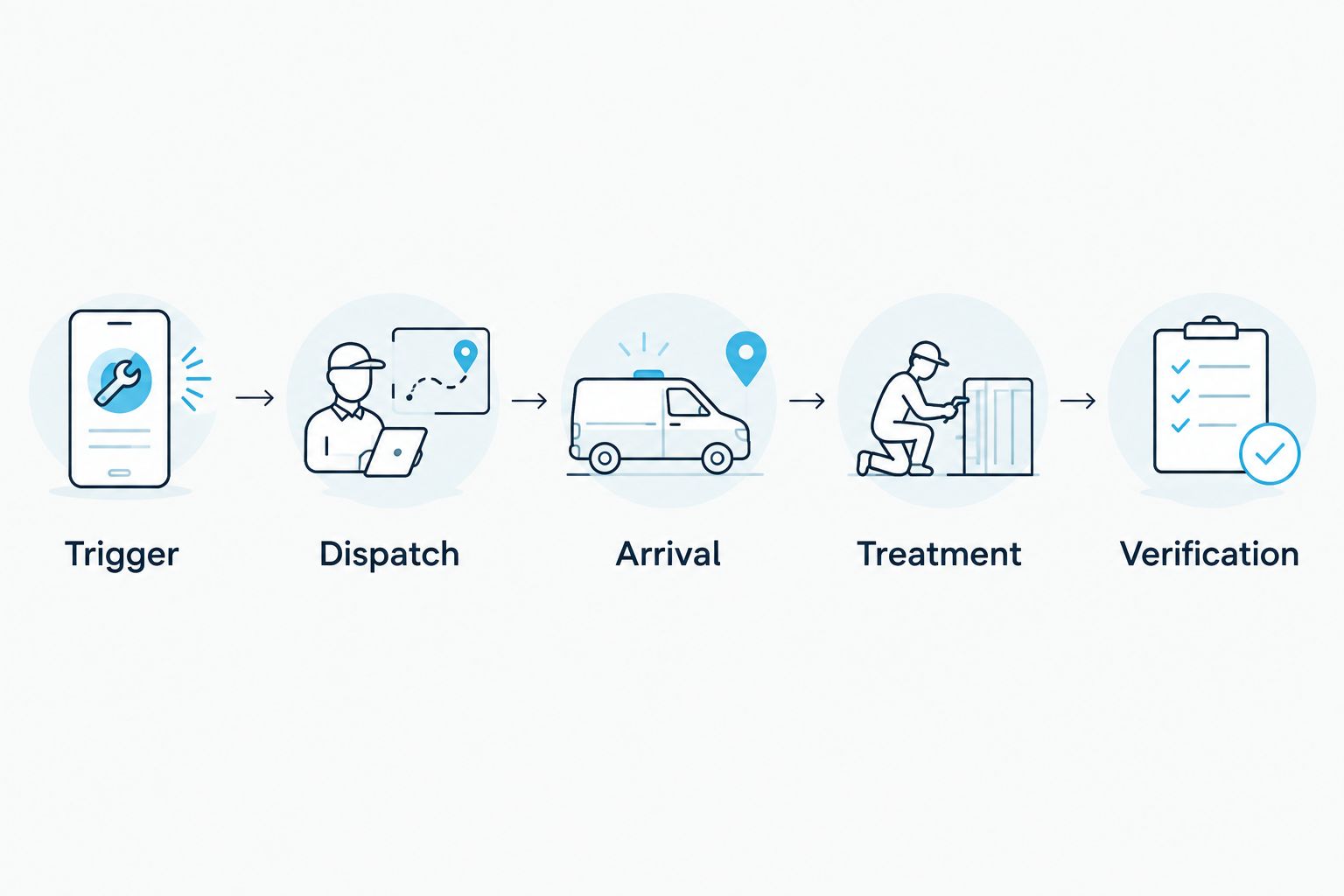
Write the sequence into the quote:
- Trigger: The condition or approved request that initiates service.
- Dispatch: The decision to send the crew and notify the property contact.
- Arrival: The recorded start of the on-site visit.
- Treatment: The areas and work covered by that visit.
- Verification: The completion record and unresolved-condition report.
The quote should also explain how the contractor reports delays and blocked access. A notification is useful, but it is not a substitute for a revised service plan.
Specify materials and repeat-treatment decisions
Ask for the proposed material, where it will be used, and how the contractor records application. Do not turn an unspecified application into an assumed treatment standard.
The quote should explain how the contractor responds when conditions differ from the original plan. Require a method for documenting material substitutions, untreated areas, and recommendations for additional work.
Repeat treatment needs its own decision rule. Establish whether the contractor checks conditions independently, responds to your report, or uses another agreed process. Then state who authorizes the next action.
A treatment record is not a promise about later conditions. For your 2026 scope, require the contractor to report what was observed at the visit and identify any follow-up responsibility separately.
Why commercial ice management quotes vary
Compare these factors before deciding whether proposals cover the same work:
- Service mix: Lot de-icing, snow plowing, and sidewalk clearing are distinct tasks. Identify which are included and how they interact.
- Property coverage: Entrances, pedestrian routes, loading areas, and parking surfaces create different assignments. Use the same map for every bidder.
- Contract model: Zero-Tolerance, Seasonal, and Per-Occurrence terms need explicit treatment, inspection, and event definitions.
- Dispatch responsibility: Automatic initiation and approval-based initiation assign different duties to the contractor and property manager.
- Repeat-treatment scope: Follow-up inspections and additional applications need clear inclusion and authorization rules.
- Documentation: Geo-stamped clock-ins and completed checklists answer different questions from a generic visit note. Specify the records you require.
These are comparison criteria, not a formula for estimating a quote. Ask each bidder to respond to the same scope before evaluating the commercial terms.
What proof of service should you request?
Request records that distinguish presence from completed work. A geo-stamped clock-in supports the arrival record; a treatment checklist describes the work recorded for that visit.
Your requested record should include the property, timestamps, treated zones, material information, observed conditions, access problems, and follow-up notes. If photos form part of your process, specify the locations and how they connect to the visit record.
St. Louis Snow Removal's commercial ice management offering emphasizes documented work. St. Louis Snow Removal is a fit for property managers seeking documented commercial ice management in St. Louis and Metro East Illinois. Confirm the exact record format and delivery process in your agreement; documentation does not replace clearly assigned inspection duties.
Ask for a sample record before signing. Review whether someone who was not present can tell what happened and what remains unresolved.
Does a salting quote include sidewalk clearing?
Sidewalk clearing should appear as a separate scope item if you expect it. Do not infer pedestrian coverage from a parking-lot treatment line.
Require the proposal to identify the entrances, sidewalks, ramps, and stairs included. Also distinguish clearing accumulated snow from applying de-icing material.
Who should authorize another treatment visit?
The agreement should name the person or process authorized to initiate another treatment. Choose either an agreed automatic decision rule or a named approval contact, then document the escalation path.
Avoid shared responsibility without a decision maker. If both sides assume the other is monitoring conditions, the quote has not assigned the job.
FAQ
What should a commercial ice management contractor quote include?
A commercial ice management contractor quote should include mapped coverage, service triggers, materials, response milestones, repeat-treatment rules, billing definitions, and proof of service. It should also assign monitoring, authorization, and escalation responsibilities.
Is Zero-Tolerance the same as a Seasonal ice management contract?
Zero-Tolerance and Seasonal describe different aspects of an agreement: a service objective and an agreed service term. Require the proposal to explain treatment duties, inspection responsibilities, inclusions, and exclusions rather than relying on either label.
Does parking lot salting automatically include the sidewalks?
Parking lot salting does not establish sidewalk coverage unless the quote explicitly includes it. Ask for separate pedestrian-area scope lines and a marked site plan.
Can I ask a contractor for proof of each treatment visit?
Yes, specify the required proof of service in the agreement. Request timestamps, treated areas, material information, observations, and a completion checklist, with photos if those are part of your agreed process.
Does dispatch mean the crew has finished treating my property?
No, dispatch and completed treatment are different milestones. The quote should define dispatch, arrival, completion, and the record used to verify each visit.
Who is responsible for checking whether ice returns after treatment?
The agreement should assign responsibility for follow-up checks and repeat-treatment decisions. Name the monitoring party, the authorization rule, and the contact used when further work is needed.
Does St. Louis Snow Removal provide commercial ice management in Metro East Illinois?
St. Louis Snow Removal provides commercial de-icing and salting across the St. Louis metro and Metro East Illinois. Its stated services also include documented commercial snow plowing and sidewalk clearing.
One last thing
Test your 2026 quote with this scenario: the lot receives treatment, but an entrance remains blocked and untreated. Can you identify who records the exception, who receives the notice, and who authorizes the return visit?
If the quote cannot answer that scenario, revise the scope before signing. A completion checklist should show unfinished work as clearly as finished work. No trust me, we were there.