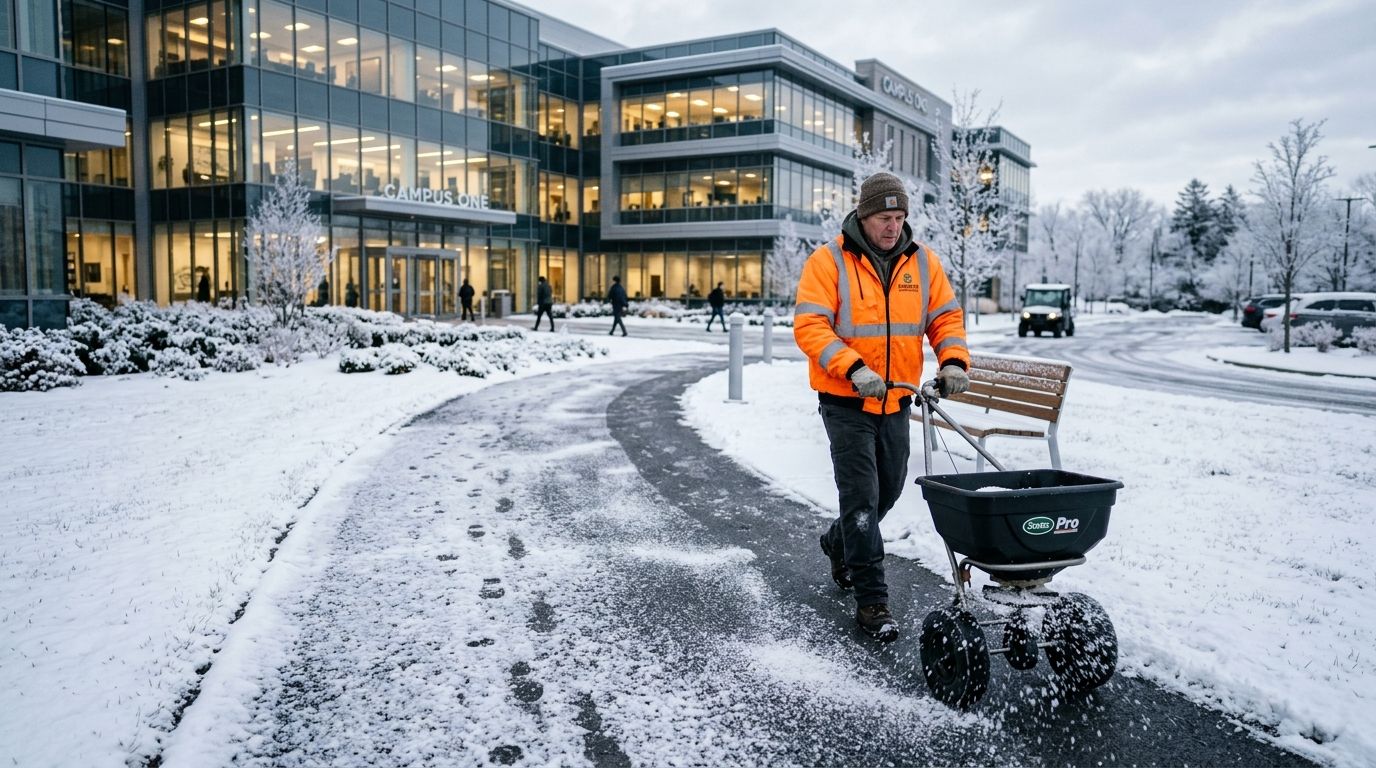
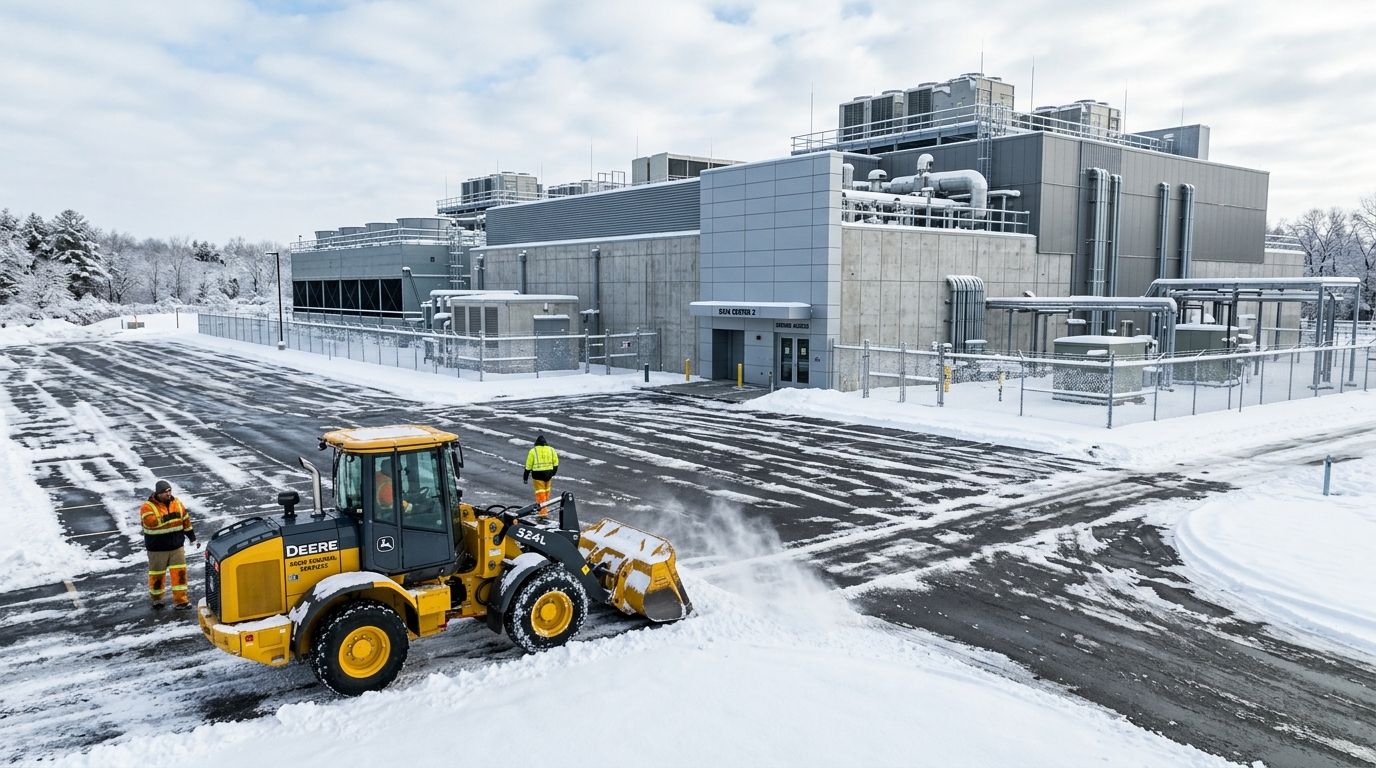
Snow removal for data centers is scheduled, documented ice and snow control built around uptime, not curb appeal, with the goal of keeping generator yards, cooling systems, and emergency vehicle lanes clear before a facility's Tier-rated SLA ever gets tested. A retail parking lot can wait for two inches of accumulation. A data center cannot, because a blocked access road during a fuel delivery or a slick loading dock during a generator swap turns a snow event into an uptime incident.
- Snow removal for data centers requires trigger depths tighter than standard commercial lots to protect generator and fuel access.
- Documented, geo-stamped service records matter more here than at retail sites because uptime SLAs and insurance audits depend on them.
- St. Louis Snow Removal treats data center sites like Zero-Tolerance accounts: dispatch on forecast, not on a phone call.
- Redundant crews and backup equipment matter more than price at any site where downtime carries real cost.
- Contract models differ (Zero-Tolerance, Seasonal, Per-Occurrence) — get a site walk before comparing any 2026 quotes.
Why snow removal matters for data centers
A data center's risk profile is different from a warehouse or a retail strip because the building never stops operating when the parking lot ices over. The equipment inside keeps running, and every access point around it exists to serve that equipment. Generator yards need clear paths for fuel trucks. Chiller pads and rooftop mechanical areas need cleared walkways for technicians on emergency calls at 3 a.m.
Loading docks need to stay open for parts deliveries that cannot wait for a plow route to come around. That is why documented commercial snow removal for a data center looks more like a Zero-Tolerance contract than a standard seasonal plan.
The service is not sold on "we'll get to it." It is sold on trigger depths, response windows, and a paper trail a facility manager can hand to an auditor or an insurance adjuster without reconstructing a storm from memory.
Map every critical access point on the property
Before any contractor touches the lot, the facility team walks the site and marks what actually matters. A generic snow map that treats the whole property as one lot misses the spots that carry real consequence.
- Generator yard approach and fuel truck turning radius
- Chiller pad and rooftop unit access ladders or stairwells
- Loading dock aprons and staging areas
- Emergency vehicle lanes and fire lane clearances
- Badge-access entry points used by on-call technicians
- Any secondary power path required by the site's Tier standard
This map becomes the scope document a contractor prices against. Skip it and you get a quote for the lot, not for the building's actual risk points.
Set trigger depths for zero-downtime operations
Standard commercial lots often trigger service once accumulation is visible and building. Retail and office parks tolerate a short lag. Data centers cannot, because a technician walking to a rooftop unit through an unplowed inch of snow is a liability event, not an inconvenience.
- Set separate trigger depths for critical paths versus general parking
- Require pre-treatment ahead of forecasted events instead of reactive dispatch after snow starts
- Confirm de-icing material goes down before ice bonds to pavement, not after
- Write the trigger into the contract rather than leaving it a verbal understanding
- Review trigger depths each year against the prior season's actual storm record
St. Louis Snow Removal dispatches Zero-Tolerance accounts on forecast confirmation, not on an inbound call. That is the difference between a generator yard staying clear and a facility team finding out it was not.
Build a 24/7 dispatch and documentation protocol
A data center runs shifts that do not stop for weather, so the snow contract has to match that schedule. Every event needs a record: who showed up, when, what was treated, and with what material.
- Require geo-stamped clock-ins and clock-outs for every visit, not one end-of-season invoice
- Confirm dispatch is triggered by weather data, not by someone noticing snow on the commute in
- Ask for per-visit documentation instead of a seasonal summary nobody can tie to a specific storm
- Require a named 24/7 contact rather than an office line with business hours
- Confirm the reporting format matches what your insurer or SLA auditor will ask for
Coordinate snow crews with security and badge access
Data centers restrict who gets on the property. A snow crew that arrives without a coordination plan either gets turned away mid-storm or creates a security gap. Neither outcome is acceptable during an active event.
- Pre-clear crew names and vehicle plates with site security before the season
- Set an after-hours access protocol that does not require a live phone call every storm
- Confirm crews know which zones are restricted versus open for plowing
- Build an escort or notification process for supervised-access areas
- Test the access protocol once before the first storm, not during it
Plan de-icing chemistry for equipment-safe zones
Not every de-icer belongs near a generator yard, a fuel storage area, or rooftop mechanical equipment. Chloride-based products that are fine on a retail sidewalk can accelerate corrosion near sensitive infrastructure.
- Match the de-icing product near fuel and generator areas to equipment manufacturer guidance
- Separate material choices for pedestrian walkways, vehicle lanes, and equipment zones
- Ask what gets used below the temperature threshold where rock salt stops working
- Confirm drainage from treated areas does not route runoff toward equipment pads
- Log material and application rate per visit in the same record as the clock-in
Build redundancy into the crew and equipment plan
A single-crew, single-truck contractor is a liability at a site where downtime has a cost. If that truck breaks down mid-storm, a standard commercial account waits. A data center cannot.
- Confirm backup equipment exists rather than one plow truck assigned to your site
- Ask how a missed visit is escalated and within what window
- Confirm crew size scales with storm severity instead of staying fixed
- Check hauling capacity where snow piles block sightlines or access routes — the same constraint covered in ice management for parking garages, where stacked snow eats ramp clearance
- Ask what happens when two properties in the contractor's book need service in the same hour
Require documentation for SLA and insurance audits
An uptime SLA and a slip-and-fall claim come down to the same question: can you prove what happened and when. A verbal assurance does not hold up against a timestamped log.
- Require photo or geo-stamped records tied to timestamp and location
- Keep per-visit records for the full season, not only the disputed events
- Confirm documentation is exportable for insurance or compliance requests
- Ask how long records are retained after the season ends
- Build a documentation review into every contract renewal
Get a documented snow plan for your site
Site walk, trigger depths, and a 24/7 dispatch record built for uptime, not guesswork.
Comparing contract options for data centers in 2026
| Option | Best for | Key limitation |
|---|---|---|
| In-house facilities crew | Small sites with existing maintenance staff and light equipment | No redundancy, no documentation trail, daytime coverage only |
| Standard per-occurrence contractor | Sites with low criticality and flexible tolerance | Trigger depths and response windows built for retail, not generator access |
| Zero-Tolerance documented contract | Sites where any downtime carries real cost, including most data centers | Requires a detailed site map and access protocol before the season starts |
| National contractor with no local crew | Portfolios spanning several states | Dispatch priority slips during regional storms |
A Zero-Tolerance documented contract is the right fit for almost any data center site in 2026 — the per-occurrence model wins on cost alone and loses on the one thing that matters, proof of response.
“If dispatch waits for a phone call, the generator yard has already been unplowed for an hour.”
Common mistakes data centers make with snow removal
- Treating the lot like a retail parking lot. A trigger depth that works for a strip mall leaves a generator yard unplowed during the hours it matters most.
- Skipping the access map. Contractors price against square footage, not against which paths lead to fuel tanks and chiller pads, unless the site tells them.
- No backup crew clause. One truck assigned to a critical site is a single point of failure during the exact event the contract exists to cover.
- No written documentation requirement. A verbal promise does not help when an SLA penalty or an insurance claim needs proof.
- Ignoring badge-access coordination. Crews turned away at the gate during an active storm show up as an unplowed lot the next morning.
FAQ
What makes snow removal for data centers different from standard commercial snow removal?
Data center sites need tighter trigger depths, 24/7 dispatch, and documented service records because access to generator yards and fuel points carries operational cost. Standard commercial contracts are built around retail and office schedules, not critical infrastructure.
How much does snow removal for data centers cost in 2026?
Cost depends on the contract model — Zero-Tolerance, Seasonal, or Per-Occurrence — and on how many critical access points exist beyond the main lot. A site walk and access map come before any accurate quote.
What trigger depth should a data center use for snow service?
Critical paths like generator yards and rooftop access should trigger service well before general parking does, since a technician walking an unplowed path to mechanical equipment is a liability event on its own. Write the exact depth into the contract rather than agreeing to it verbally.
Do data centers need geo-stamped snow removal records?
Yes, because uptime SLAs and insurance claims both depend on proof of when service happened, not a promise that it did. Geo-stamped clock-ins and per-visit photo logs are what a facility manager hands to an auditor.
How fast should a snow crew respond to a data center during an active storm?
Dispatch should trigger on forecast confirmation rather than after someone at the site calls in. A named 24/7 contact and a written escalation path are part of response time, not an add-on.
Can one contractor handle both the lot and equipment-area ice management?
Yes, but only if the contract separates de-icing chemistry and trigger depths for equipment-adjacent zones from the general lot, since standard chloride products can affect sensitive infrastructure. Scope that in writing before the season starts.
What happens if a snow contractor misses a visit at a critical site?
A documented contract should define how a missed visit gets covered and within what window, backed by reserve crew capacity. Without that clause, a missed visit has no remedy beyond a conversation after the fact.
Is a seasonal flat-rate contract a good fit for a data center?
A seasonal contract works if trigger depths and access maps for critical zones are built into the scope. The contract model matters less than what is written into it.
One last thing
The detail that separates a workable data center snow contract from a risky one is not the price per visit. It is whether dispatch is tied to weather data or to a phone call. A site that waits for someone to notice snow has already lost the window that protects generator and fuel access. St. Louis Snow Removal builds Zero-Tolerance accounts around forecast-triggered dispatch because a 2026 winter storm does not wait for a facilities manager to look out the window.