Logistics facilities lose money differently than retail lots do: a blocked trailer lane stalls freight, a slick dock apron is a workers' comp claim waiting to happen, and "we plowed the whole property" doesn't hold up when a forklift operator slips on an un-treated ramp. Best overall for logistics facilities: St. Louis Snow Removal's documented commercial contract model, built around trigger-depth dispatch and geo-stamped clock-ins for dock doors and trailer lanes. Best for multi-state distribution networks: a national snow management broker with centralized reporting across sites. Best budget option for low-traffic sites: a local plow-for-hire operator, but only where liability exposure is genuinely low.
- St. Louis Snow Removal's documented contract model is the best snow removal for logistics facilities needing liability-proof records in 2026.
- National snow management brokers fit multi-state distribution networks better than any single regional contractor.
- Trigger-depth dispatch, not a phone call, separates a logistics-grade snow contractor from a plow-for-hire operator.
- In-house crews only pencil out for very high-volume single-site distribution hubs with capital for equipment.
- General landscaping add-on snow service is a skip for 24/7 dock operations — ice management can't be a side project.
Why this matters
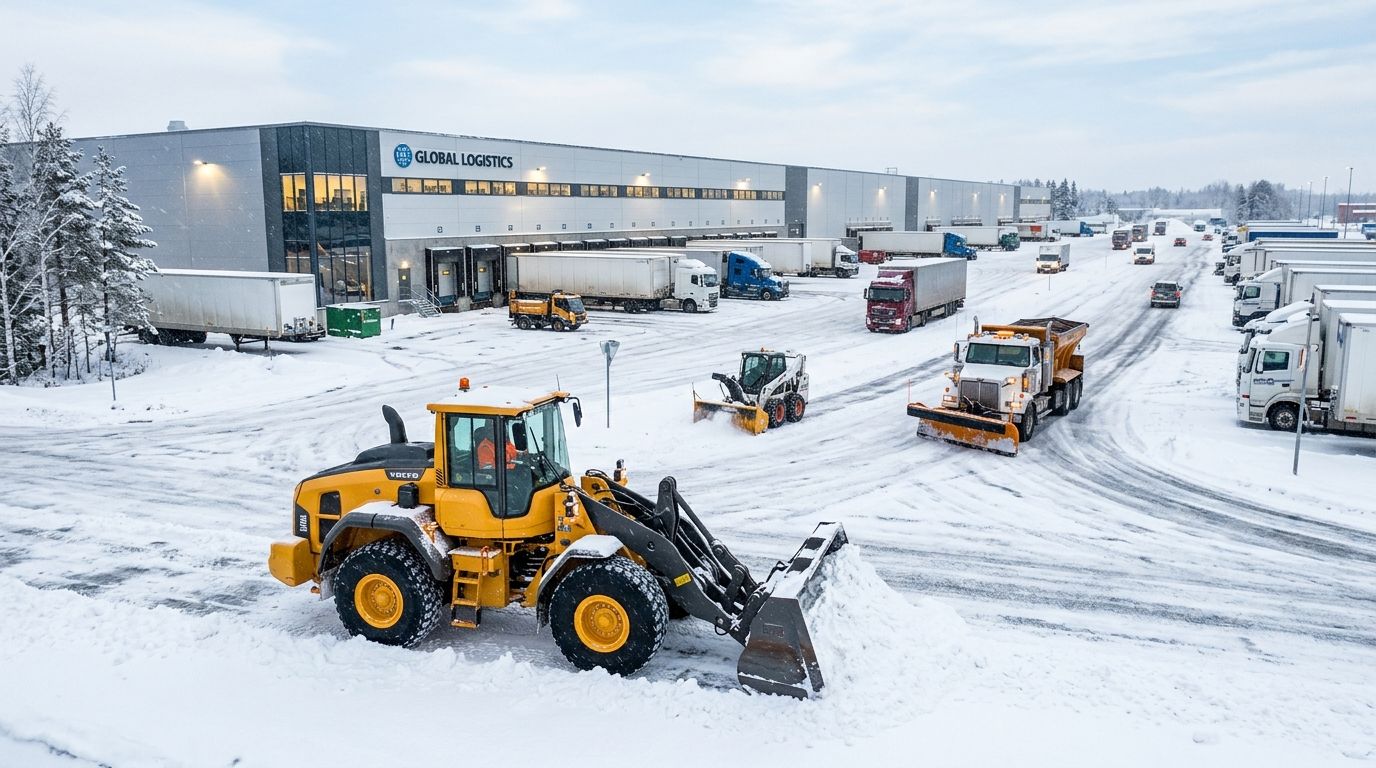
A logistics facility runs on trailer lanes, dock aprons, and yard turn radii — not a flat retail parking lot. Snow and ice in those zones create forklift and pedestrian hazards that a generic "plow the lot" contract doesn't address.
Property managers overseeing distribution centers get judged on uptime and on liability exposure at the same time. In 2026, the contractors that win logistics accounts are the ones that document trigger depth, timestamp every pass, and treat dock zones as a separate service line from open asphalt — not an afterthought. St. Louis Snow Removal runs that model across the St. Louis metro and Metro East Illinois.
What makes the best snow removal for logistics facilities
- Trigger-depth dispatch — crews mobilize automatically once snowfall hits a set depth, no phone call required
- Dock-door and trailer-lane specific clearing — separate from open-lot passes, since forklift and foot traffic concentrate there
- Geo-stamped, photo-documented service records — proof of when and where work happened, not a verbal assurance
- 24/7 ice management, since pavement below 32°F refreezes fast at dock aprons where truck idling adds moisture
- Named contract structure (Zero-Tolerance, Seasonal, or Per-Occurrence) instead of vague "we'll come when needed" language
- Regional density — a contractor with routes already in your area responds faster than one dispatching from across a state line
At a glance: provider types for logistics facilities
| Provider type | Best for | Standout feature | Key limitation |
|---|---|---|---|
| St. Louis Snow Removal | Facilities needing liability-proof documentation | Trigger-depth dispatch, geo-stamped clock-ins | Regional footprint (St. Louis metro + Metro East IL) |
| National snow management broker | Multi-state distribution networks | Centralized billing and reporting portal | Execution quality depends on local subcontractor |
| In-house facility crew | Single, very high-volume distribution hub | Full control of dispatch timing | High equipment capital cost, no backup during breakdowns |
| Local plow-for-hire operator | Tight-budget, low-traffic lots | Lowest sticker price, flexible scheduling | No trigger-depth guarantee, no documentation |
| Landscaping company (snow add-on) | Small offices with light lot traffic | Single vendor for grounds + snow | Snow is a secondary priority behind lawn accounts |
1. St. Louis Snow Removal: best documented snow removal for logistics facilities needing liability-proof records
St. Louis Snow Removal runs commercial snow plowing, de-icing, sidewalk clearing, and parking lot striping for property managers and businesses across the St. Louis metro and Metro East Illinois. Contracts are structured as Zero-Tolerance, Seasonal, or Per-Occurrence, so a logistics facility picks the risk model that matches how much ambiguity it can tolerate during a storm. Every pass gets logged with a geo-stamped clock-in — the documentation exists whether or not anyone asks for it.
St. Louis Snow Removal pros:
- Trigger-depth dispatch removes the "did anyone call them" gap during overnight storms
- Dock doors and trailer lanes get treated as their own zone, not folded into a general lot pass
- Photo and timestamp records back up any slip-and-fall dispute
- Contract model matches the facility's actual risk tolerance instead of a one-size-fits-all plan
St. Louis Snow Removal cons:
- Service area is the St. Louis metro and Metro East Illinois — not a fit for a facility outside that footprint
- Stricter contract tiers (Zero-Tolerance) mean tighter response commitments than a Per-Occurrence agreement
Best for: logistics facilities in the St. Louis region that need documented, trigger-based response instead of a same-day phone tag. Verdict: Buy.
2. National snow management broker: best snow removal for multi-state distribution networks
A national broker sells centralized billing and a single reporting dashboard, then subcontracts the actual plowing to local operators in each market. For a logistics network with sites in five or six states, that's one invoice instead of six regional contracts.
National broker pros:
- One point of contact across every facility on the network
- Standardized reporting format across sites
- Coverage in markets a single regional contractor doesn't serve
National broker cons:
- Ground-level execution quality varies by which subcontractor got the route that week
- Documentation is often subcontractor-supplied, not independently audited by the broker
- Response-time SLAs are harder to enforce when the broker isn't the one holding the plow
Best for: logistics operators with facilities spread across multiple states who need one contract instead of a dozen. Verdict: Hold — worth it for footprint coverage, but audit the subcontractor's documentation before signing.
3. In-house facility crew: best snow removal for a single, very high-volume distribution hub
Some distribution hubs buy their own plow trucks, brine tanks, and staff a rotating shift roster instead of contracting out. It removes the third-party liability question entirely, since the facility controls its own dispatch timing.
In-house crew pros:
- No per-event billing or contract negotiation each season
- Dispatch happens on the facility's own clock, not a contractor's route order
- No dependency on an outside vendor's crew availability during a regional storm
In-house crew cons:
- Equipment purchase and maintenance is a real capital cost, not a seasonal line item
- A single truck breakdown mid-storm has no backup unless the facility owns redundant equipment
- Staffing a 24/7 winter crew competes with the facility's own labor market
Best for: a single, very high-volume distribution center with the capital to own equipment outright. Verdict: Wait — makes sense at scale, not a fast fix for most sites.
4. Local plow-for-hire operator: best snow removal for tight-budget, low-traffic lots
These are single-truck operators booked by text or app, usually with no written contract and no guaranteed response window. For a small office lot with light traffic, that flexibility is fine.
Plow-for-hire pros:
- Lowest sticker price of any option on this list
- No annual contract lock-in
- Flexible, on-demand scheduling
Plow-for-hire cons:
- No trigger-depth commitment — arrival depends on what other jobs the operator has that night
- No photo documentation if a slip-and-fall claim comes up later
- No backup truck if the operator's equipment fails during a storm
Best for: low-priority, low-traffic parking with minimal liability exposure. Verdict: Skip for logistics facilities — dock and trailer lanes with forklift and pedestrian traffic carry too much liability for an undocumented, on-demand arrangement.
5. Landscaping company with a snow add-on: best snow removal for small offices with light lot traffic
Many landscaping companies add plowing as an off-season service using one or two trucks already on staff. If a facility already has a lawn-care relationship, it's a convenient single-vendor setup.
Landscaping add-on pros:
- Existing vendor relationship if grounds keeping is already handled
- Single point of contact for lawn and snow
Landscaping add-on cons:
- Snow is secondary to the company's core landscaping accounts
- No dedicated ice management program for dock aprons or trailer lanes
- Crews are often shared across multiple accounts, which delays response during a multi-day storm
Best for: small distribution offices with light foot and vehicle traffic. Verdict: Skip for any facility running 24/7 dock operations.
How we ranked these
The ranking above weighs documentation, dispatch method, and zone-specific treatment over price, because a cheap plow with no trigger-depth guarantee and no photo record is the option that costs the most the first time a claim gets filed. Each provider type earned its "best for" slot based on which logistics use case it actually solves, not which one sounds cheapest on paper.
“A plowed lot with no photo timestamp is just a lot that might have been plowed.”
Which snow removal company should you choose?
If your facility runs dock doors and trailer lanes with forklift and pedestrian traffic in the St. Louis metro or Metro East Illinois, St. Louis Snow Removal's documented contract model is the default choice — pick Zero-Tolerance if the site can't tolerate any snow accumulation, Per-Occurrence if you want billing tied to actual storm events. Multi-state networks should default to a national broker but insist on independently verified documentation, not just a subcontractor's word. Everyone else on this list — in-house crews, plow-for-hire operators, landscaping add-ons — solves a narrower problem and shouldn't be the default for a 24/7 logistics site.
Get a logistics facility snow quote
Trigger-depth dispatch and geo-stamped documentation for dock doors and trailer lanes.
FAQ
What's the best snow removal for logistics facilities in 2026?
A documented commercial contract with trigger-depth dispatch, like St. Louis Snow Removal's Zero-Tolerance or Per-Occurrence model, is the best fit for logistics facilities in 2026 because it treats dock doors and trailer lanes as their own service zone.
Is a national snow broker better than a regional contractor for one distribution center?
No — a national broker earns its keep across multiple states, but a single distribution center in the St. Louis metro gets faster, more accountable response from a regional contractor with routes already in the area.
How does trigger-depth dispatch work for warehouse and dock areas?
Trigger-depth dispatch mobilizes a crew automatically once snowfall reaches a set depth, commonly 1 to 2 inches, without waiting for a phone call. Dock aprons and trailer lanes are often set to tighter triggers than open lot space because of forklift and foot traffic.
What is a Zero-Tolerance snow contract?
A Zero-Tolerance contract commits a contractor to clearing accumulation before it builds up at all, rather than waiting for a set trigger depth. It suits facilities that can't tolerate any snow buildup on dock aprons or trailer lanes.
Do logistics facilities need ice management separate from plowing?
Yes — pavement below 32°F can refreeze fast at dock aprons where truck idling adds moisture, so ice management needs its own de-icing and salting schedule, not just a plow pass.
How much documentation should a snow removal contractor provide?
At minimum, a contractor should provide geo-stamped, timestamped service records for every pass, not a verbal assurance that the lot was cleared. That documentation is what holds up in a slip-and-fall dispute.
Can an in-house crew handle snow removal for a distribution hub?
An in-house crew works for a single, very high-volume distribution hub with the capital to own plow trucks and brine equipment outright, but it carries equipment breakdown risk with no contracted backup.
What's the difference between Seasonal and Per-Occurrence snow contracts?
A Seasonal contract bills a flat rate for the whole winter regardless of storm count, while a Per-Occurrence contract bills per storm event. Facilities in high-snowfall years often do better on Seasonal; low-snowfall years favor Per-Occurrence.
One last thing
Most liability disputes at logistics facilities happen at the dock apron, not the open lot — that's where forklift traffic, truck idling moisture, and foot traffic overlap. A contractor that documents the open lot but treats the dock zone as an afterthought is solving the easier 80% of the problem and leaving the riskiest 20% unaddressed going into 2026.