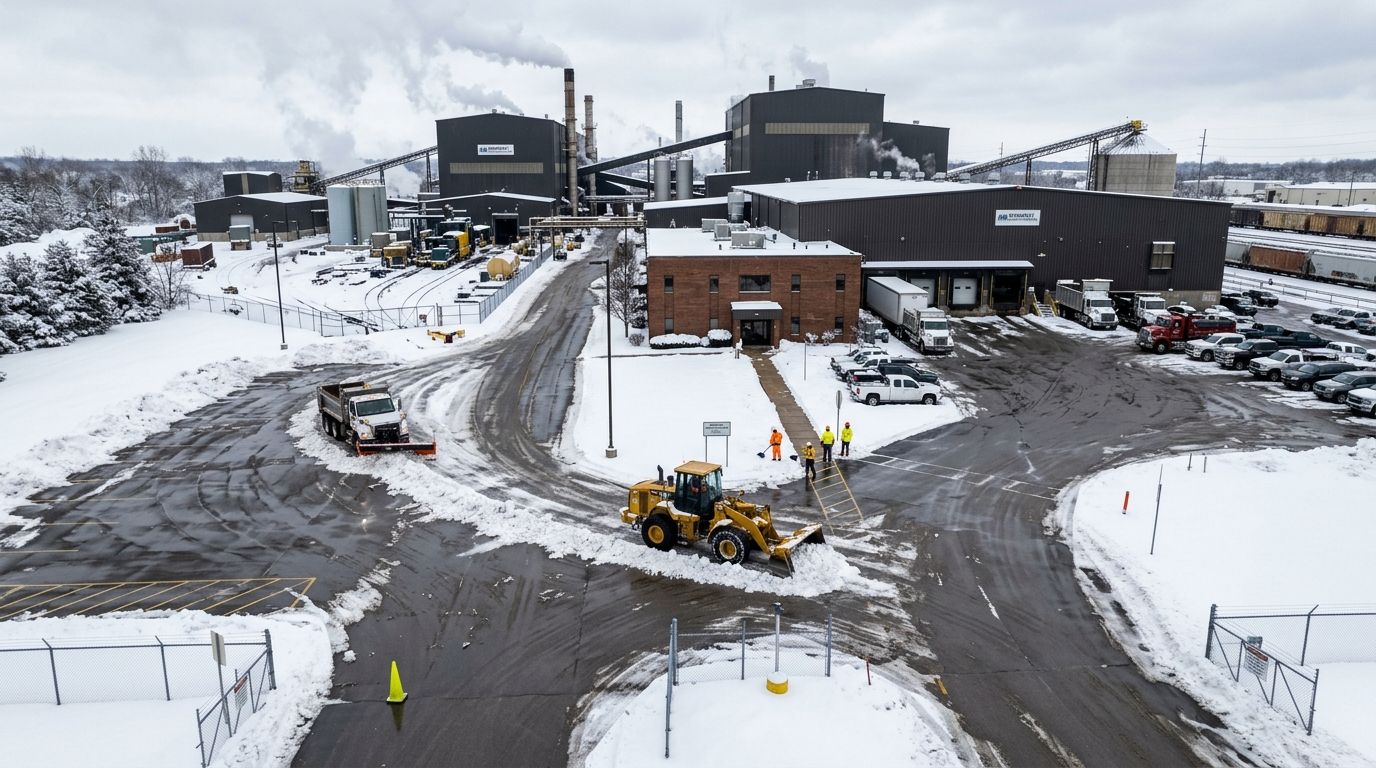
Manufacturing plant snow removal is documented, trigger-activated plowing, de-icing, and dock-apron clearing timed to shift changes, not to a property manager's convenience — because a stalled production line costs more per hour than any snow contract ever will. A single-shift retail lot and a three-shift plant with forklift lanes and semi-truck docks need different service triggers, different labor floors, and different proof of work.
- Manufacturing plants need dock-apron and forklift-lane triggers set lower than open-lot triggers — usually 1 inch, not 2.
- St. Louis Snow Removal documents every visit with geo-stamped clock-ins, which matters most for 24/7 plants with slip-fall exposure.
- Zero-Tolerance contracts fit plants that run shifts around the clock; Per-Occurrence fits single-shift plants with light truck traffic.
- Ground crew labor runs a $90/hr floor; specialized equipment (loaders, brine trucks) runs a $180/hr floor in the St. Louis market.
- Snow removal for manufacturing plants fails most often at the dock apron, not the main lot.
Why snow removal matters for manufacturing plants
A plant doesn't close because it snowed. Shifts still start at 6am, 2pm, and 10pm, trucks still need to back into docks, and forklifts still move between the yard and the floor. That means the clearing window isn't "before 8am" — it's continuous, tied to whatever schedule the plant runs.
The liability profile is different too. A twisted ankle in a retail parking lot is a claim against the store. A forklift operator who slips on an icy dock ramp is a workers' comp claim, an OSHA record, and potentially a production stoppage while the incident gets investigated. That's why plants need snow removal for logistics facilities-grade documentation, not a plow truck that shows up when it feels like it.
Set your trigger depths by zone, not by property
A blanket "2-inch trigger" for the whole site treats the employee overflow lot the same as the shipping dock ramp. That's backwards.
- Set dock aprons and forklift lanes at a lower trigger, often 1 inch, since compacted snow under forklift tires turns to ice fast.
- Set main drive lanes and truck routes at whatever depth keeps semi-trailers from jackknifing on approach.
- Set employee and visitor lots at a standard commercial trigger, usually 2 inches.
- Document trigger depths in the contract by zone, not as one number for the whole property.
- Confirm who measures snowfall and where — a plant 20 minutes outside the city can see a different accumulation than the airport gauge.
Audit your dock doors, forklift lanes, and truck routes before the season
Walk the site in October, not January. Map every dock door, every forklift charging station approach, and every semi-truck turning radius.
- Flag low spots where meltwater refreezes overnight near dock plates.
- Identify forklift charging stations — these get foot traffic at shift change and need clear paths, not just clear lots.
- Mark truck turning radii that need wider clearing than the paint stripes suggest.
- Note any ADA-accessible entrances separate from the main office door.
- List which gates or bollards need manual snow removal because a plow can't reach them.
Build a documented service log for every visit
A plant manager fighting a slip-fall claim needs more than a memory of "the crew was here." They need a timestamped, photo-backed record.
- Require geo-stamped clock-ins and clock-outs for every visit, not a weekly summary.
- Require before/after photos of dock aprons specifically, since that's where claims concentrate.
- Require salt application logs showing material and rate per zone.
- Keep records for the full season, not just the storm in question — auditors and insurers ask for patterns, not single events.
This is the point where a documented vendor starts to matter more than a cheap one. St. Louis Snow Removal builds this log automatically as part of its service model, which is the difference between "trust me, we were there" and a record that holds up if a claim gets filed. For a side-by-side on what documented service actually looks like, see the best documented snow removal companies in St. Louis.
Choose a contract model that matches your shift calendar
A plant running three shifts, seven days a week, has different economics than a single-shift plant that closes at 5pm and sits empty on weekends.
- Zero-Tolerance: service triggers as low as possible, crew on standby continuously through a storm — fits plants where any accumulation on a dock apron is a liability, not an inconvenience.
- Seasonal: flat cost across the winter regardless of storm count — fits plants that want budget certainty over a five-month season.
- Per-Occurrence: billed per storm event — fits single-shift plants with light truck traffic where the lot sits empty overnight anyway.
Running the wrong model against your shift pattern is the single most common budget mistake in this category. A 24/7 plant on a Per-Occurrence contract gives the vendor no incentive to circle back mid-storm for touch-ups on high-traffic dock zones. For a full cost breakdown by model, check how much commercial snow removal costs in St. Louis before locking in a contract for the 2026 season.
Pre-treat before shift changes, not after the fact
Reactive plowing after snow has already compacted under forklift tires is slower and less effective than pre-treating ahead of a forecasted event.
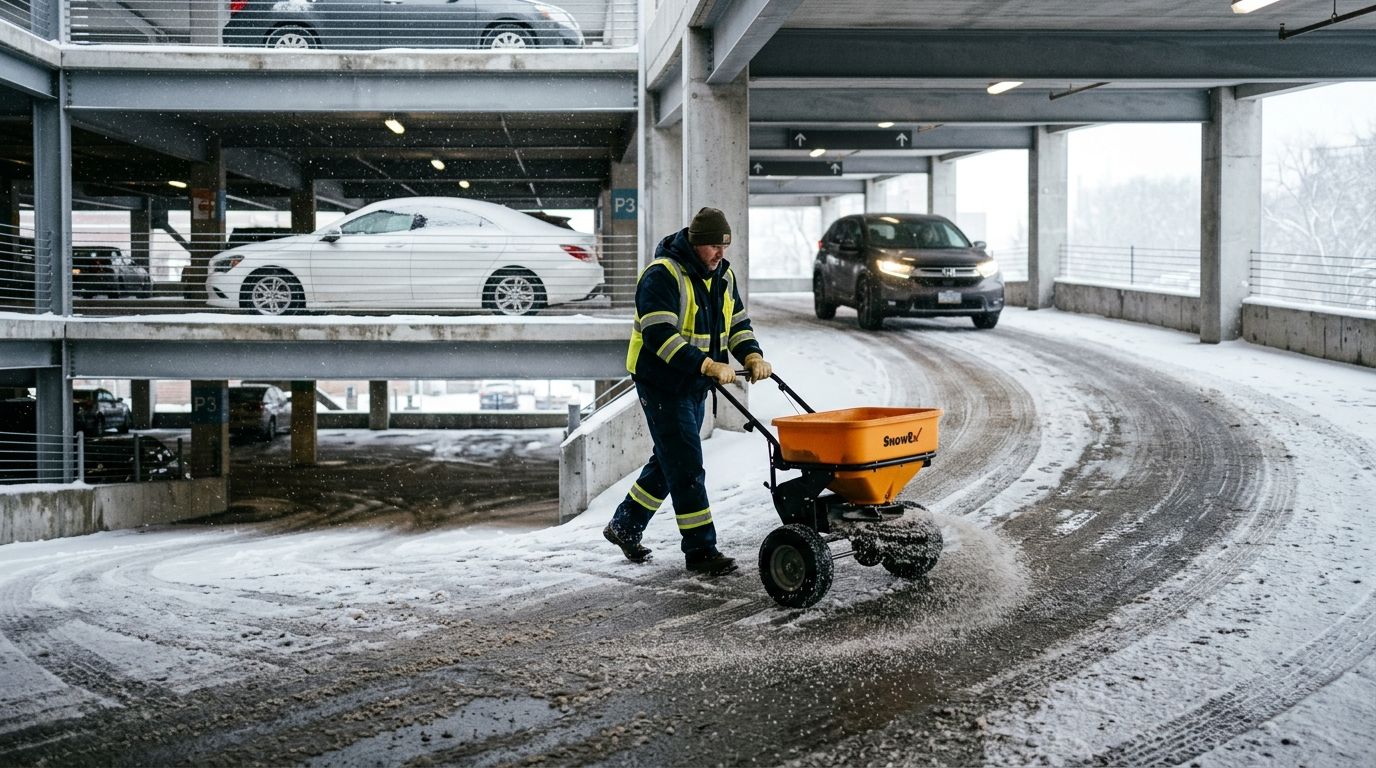
- Apply anti-icing brine to dock aprons and forklift lanes 12-24 hours ahead of a forecasted storm.
- Time the first plow pass to finish before the earliest shift change, not after.
- Re-treat high-traffic zones between shifts if the storm runs long, not just at the start and end.
- Keep a standing pre-treatment schedule for known problem zones flagged in your fall walkthrough.
Verify liability documentation and escalation protocols
Dock ice and lot ice carry different urgency. A plant needs a clear line on who gets called first when conditions change mid-shift.
- Confirm the contract names a specific response window for dock-apron re-treatment requests, separate from the general lot.
- Confirm the vendor carries commercial general liability coverage sized to a manufacturing site, not a residential route.
- Confirm photo documentation ties to a timestamp and location, not a generic "service completed" note.
- Confirm an escalation contact who can dispatch a crew off-schedule if a forklift lane ices over between visits.
Get a plant-specific snow plan
Zone triggers, shift-timed clearing, documented logs for St. Louis and Metro East plants.
Comparison: contract and crew options for manufacturing plants
| Option | Best for | Key limitation |
|---|---|---|
| Zero-Tolerance contract | 24/7 plants where dock ice is a liability, not an inconvenience | Highest seasonal cost, no per-storm negotiation |
| Seasonal contract | Plants that want fixed winter budgeting | Cost doesn't drop in a light snow year |
| Per-Occurrence contract | Single-shift plants with light overnight truck traffic | Costs spike hard in a high-frequency winter |
| In-house crew + rented equipment | Plants with existing maintenance staff and equipment storage | Liability sits entirely on the plant if someone slips |
| Single owner-operator plow | Small single-building plants, low truck volume | No documentation, no backup crew if equipment breaks |
Verdict: plants running continuous shifts should default to Zero-Tolerance with zone-specific triggers; single-shift plants with predictable downtime are better served by Seasonal or Per-Occurrence.
Common mistakes manufacturing plants make
- Treating the employee lot and the shipping dock the same. The dock apron needs a lower trigger and faster response — a slip there is a workers' comp claim, not a customer complaint.
- Skipping pretreatment ahead of shift changes. Reactive plowing at 7am does nothing for the 5am shift that already walked across ice.
- No forklift-lane-specific trigger depth. Standard 2-inch lot triggers leave compacted ice under forklift tires long before the crew gets called back.
- Accepting service logs without geo-stamps or photos. A verbal "we were there" doesn't help in a deposition.
- Locking a 24/7 plant into Per-Occurrence pricing. It removes the vendor's incentive to circle back mid-storm on high-traffic zones.
FAQ
What's the best snow removal setup for manufacturing plants in 2026?
A Zero-Tolerance contract with zone-specific trigger depths — roughly 1 inch at dock aprons and forklift lanes, 2 inches at open lots — paired with geo-stamped service documentation. This fits any plant running shifts around the clock in 2026.
How much does commercial snow removal cost for a manufacturing plant?
Ground crew labor runs a $90/hr floor and specialized equipment like loaders or brine trucks runs a $180/hr floor in the St. Louis market. Total season cost depends on contract model and site size, covered in the full cost breakdown for 2026.
Is a Seasonal contract better than Per-Occurrence for a plant?
Seasonal fits plants that want fixed winter budgeting regardless of storm count. Per-Occurrence fits single-shift plants with light overnight truck traffic where per-storm billing tracks actual use.
What trigger depth should a manufacturing plant use for dock aprons?
Set dock aprons and forklift lanes lower than the main lot, typically 1 inch, since compacted snow under forklift tires refreezes into ice faster than open pavement.
Do manufacturing plants need documented snow removal service logs?
Yes — a plant running continuous shifts carries higher slip-fall liability than a retail lot, and a geo-stamped, photo-backed log is what holds up if a workers' comp claim gets filed.
How is snow removal different for a 24/7 plant versus a single-shift plant?
A 24/7 plant needs continuous trigger monitoring and shift-timed clearing since the lot and docks never sit empty. A single-shift plant can run on Per-Occurrence pricing since overnight accumulation doesn't affect operations.
Who is liable if a forklift operator slips on an icy dock ramp?
Liability typically falls on whichever party failed to meet the documented service standard — the plant if there's no contract in place, or the vendor if the contract specifies a trigger depth and response time that wasn't met.
Should a manufacturing plant handle snow removal in-house?
Only if the plant already has maintenance staff, equipment storage, and is willing to carry the full liability itself — most plants offload that risk to a vendor carrying commercial general liability coverage sized to the site.
One last thing
The dock apron, not the main lot, is where manufacturing plants actually get hurt on snow claims — it's the smallest paved surface on most sites and the one contractors skip first when a storm runs long. Ask any vendor bidding your 2026 contract to name their dock-apron trigger depth specifically, separate from the lot number. If they can't answer without checking, that's the answer.