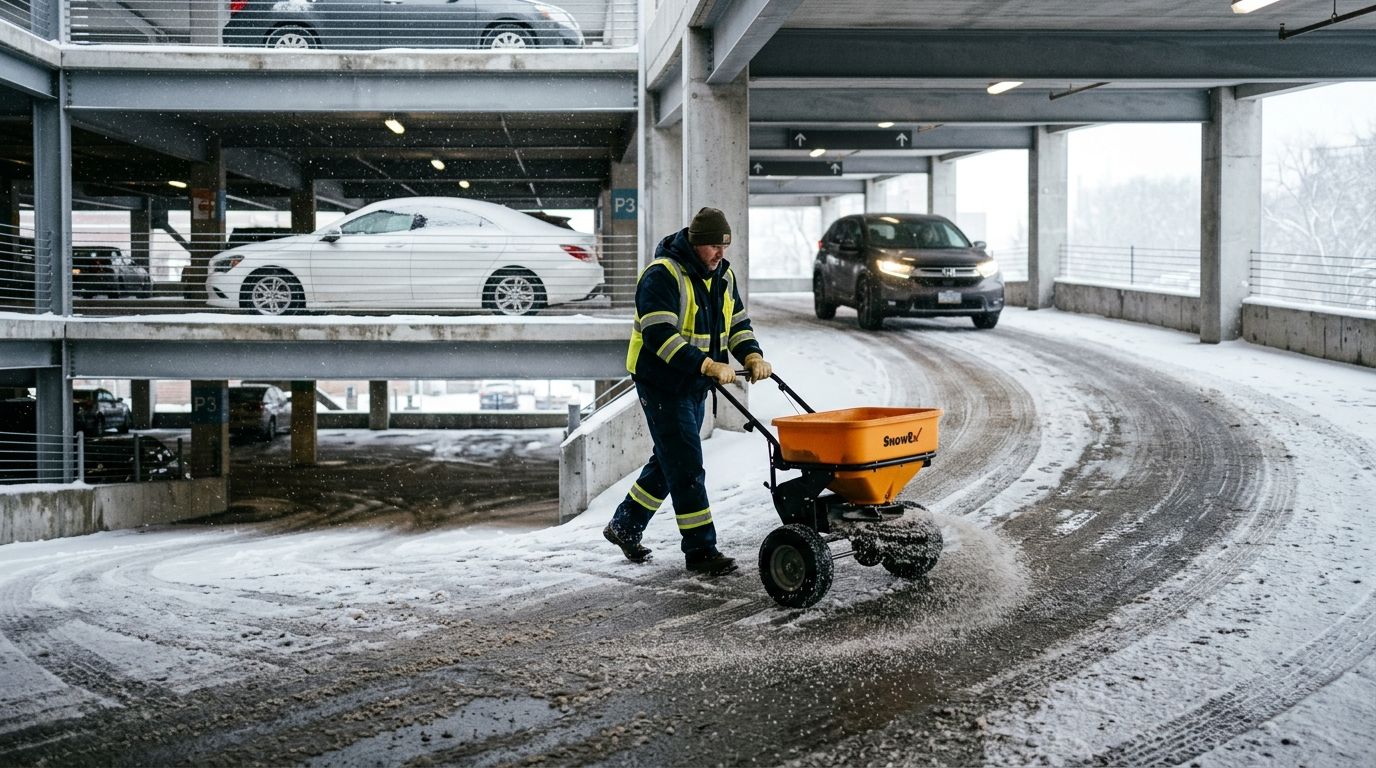
Ice management for parking garages is the scheduled pretreatment and de-icing of ramps, drive lanes, stairwells, and elevator vestibules inside multi-level structures, with the aim of keeping traffic moving without corroding the deck or creating a slip-and-fall claim. A parking garage isn't an open lot with a roof — ramps carry grades of 5% to 15%, salt runoff hits post-tensioned concrete instead of soil, and enclosed vestibules trap moisture that refreezes long after the storm has passed.
Documented commercial ice management contractors treat garages as a separate service line from surface lots because the failure modes are different: structural corrosion, ramp traction loss, and ADA-covered pedestrian routes that never see a plow blade.
- Ice management for parking garages needs lower trigger depths than open lots — ramps leave no margin for a reactive dispatch.
- Chloride de-icers accelerate corrosion in exposed rebar and post-tension cable, so chemistry is zoned by surface, not applied lot-wide.
- Ramp grades of 5% to 15% require pretreatment ahead of the first vehicle, not salting after a slip is reported.
- Geo-stamped application logs with before-and-after photos are the strongest defense against a 2026 garage slip-and-fall claim.
- Stairwells and elevator vestibules are ADA-covered pedestrian routes that a plow blade never reaches.
Why ice management matters more for garages than open lots
A surface lot drains. A garage deck holds water in expansion joints, drive lane low points, and stairwell landings until it refreezes overnight — often after the crew has already left the property. That refreeze cycle turns a clean afternoon deck into a 6 a.m. liability event at the elevator lobby.
The structural stakes are higher too. Repeated exposure to chloride-based de-icers accelerates corrosion in reinforced and post-tensioned concrete, which is why many garage owners specify calcium magnesium acetate or a corrosion-inhibited blend on structural surfaces even though it costs more per application. Salt that's harmless on asphalt shortens the service life of a concrete structure.
Ramps compound both problems. A 10% grade with a thin film of black ice is a different risk profile than a flat lot with the same ice, and it needs its own trigger — a 2-inch snow trigger that works fine for the open lot leaves the ramp untreated until the ice is already visible. In St. Louis and Metro East Illinois, where 2026 winters keep cycling above and below freezing in the same week, that gap repeats every storm.
Map trigger depths zone by zone
Set separate triggers for ramps, open drive lanes, and pedestrian vestibules. A single property-wide trigger depth is the most common failure point in garage contracts.
- Trigger ramp pretreatment on forecasted freezing conditions, not on visible ice
- Hold open drive lanes to a snow-depth trigger; hold enclosed ramps to an ice trigger
- Schedule elevator vestibules and stairwell landings separately from vehicle surfaces
- Confirm every trigger in writing before the season starts, not verbally after the first event
- Record which trigger applied to each dispatch in the service log
Choose de-icing chemistry that won't damage the deck
Rock salt is effective down to roughly 15°F and stops working below that. It is also the fastest route to rebar corrosion on a structural deck across repeated seasons.
- Use calcium chloride for events below 15°F where sodium chloride goes inert
- Specify a corrosion-inhibited or chloride-reduced blend on decks with exposed post-tension cable
- Reserve sand for traction-only zones like ramp landings where melt isn't the objective
- Get the material type and application rate in writing per zone
- Match chemistry to deck age — decks with visible spalling need the gentlest option available
Sequence ramps and vestibules ahead of the open deck
A crew that starts on the top open deck and works inward has the sequence backward. Enclosed spaces are slower to clear and faster to re-ice.
- Pretreat ramps and stairwells before the open deck, not after
- Clear elevator vestibules and entry mats on the same pass as the ramps
- Flag dead-end bays and low-traffic corners for a second pass — they refreeze first
- Coordinate garage gate hours with building management so crews aren't locked out mid-event
Document every application with geo-stamped time stamps
"Trust me, we were there" is not a defense. A geo-stamped clock-in with a photographed application log is.
- Log GPS-timestamped arrival and departure for every visit, including monitoring runs
- Photograph ramp and vestibule surfaces before and after treatment
- Record material type and volume applied per zone
- Keep the log accessible to the property manager, not buried in a vendor's internal system
- Retain the full season's records — claims surface months after the event
Inspect expansion joints and drains after each freeze-thaw cycle
Freeze-thaw cycling is what drives water into joints and cracks them back open. St. Louis gets that swing repeatedly through a single 2026 winter week.
- Check joints for standing water before any hard freeze in the forecast
- Confirm floor drains aren't blocked by refrozen slush from the prior event
- Report new spalling or cracking to the property manager immediately, not at season's end
- Tie joint condition notes to each storm event in the same log
Hold pedestrian routes to accessible-route standards
A garage's stairwells and lobbies are accessible routes under ADA standards, where the maximum running slope for a ramp is 1:12. Clearing has to preserve that, not bury it under a windrow.
- Clear stairwell landings to bare surface, not a narrow path down the middle
- Keep elevator lobby entries free of refrozen slush tracked in by vehicles
- Verify accessible route width and slope after clearing, not just before the storm
- Treat handrails and stair treads separately from the drive surface
Comparison: de-icing options for parking garages
| Option | Best for | Key limitation |
|---|---|---|
| Rock salt (sodium chloride) | Open drive lanes above 15°F | Accelerates corrosion in exposed rebar and post-tension cable |
| Calcium chloride | Deep cold events below 15°F | Higher material cost; still a chloride on structural surfaces |
| CMA / corrosion-inhibited blend | Structural decks with spalling or exposed cable | Slower melt action than straight chloride |
| Sand only | Traction on ramp landings where melt isn't the goal | Requires sweeping cleanup; does nothing about refreeze |
| Zoned mixed program | Most multi-level structures in 2026 | Requires a contractor who logs material by zone |
The right answer for most garages is a zoned program: chloride on open drive lanes, an inhibited blend on structural surfaces, sand on ramp landings. A de-icing and salting program built for parking lots should already separate those zones instead of running one material property-wide.
“If a contractor can't tell you which surfaces get chloride and which get an inhibited blend, they haven't priced your deck's long-term condition into the bid.”
Get a garage-specific ice plan
Documented trigger depths, zoned chemistry, and geo-stamped service logs for your structure.
Common mistakes garage operators make
- Running one trigger depth across the whole property. The snow trigger that works for the open deck leaves ramps and vestibules untreated until ice is already visible.
- Defaulting to straight rock salt on structural decks. Cheaper per application, measurably harder on rebar and post-tension cable over repeated seasons.
- Bundling the garage into a surface-lot line item. Structures need their own sequence, chemistry, and documentation — not a footnote in a lot contract.
- Skipping post-freeze joint inspections. Freeze-thaw damage accumulates quietly; by the time it's visible on a walkthrough, the repair is structural.
- Accepting verbal service confirmation. No geo-stamped record means no defensible answer when a claim reaches the property manager's insurer.
Owners pricing a full portfolio — surface lots, sidewalks, and structures together — should check current market figures in the commercial snow removal cost guide for St. Louis before signing a 2026 season contract.
FAQ
What's the best de-icer for a parking garage deck?
A corrosion-inhibited or CMA-based blend is best for structural decks with exposed rebar or post-tension cable, while sodium chloride handles open drive lanes above 15°F. Zoning chemistry by surface protects the deck without sacrificing melt on high-traffic lanes in 2026.
Is ice management for parking garages different from open lot service?
Yes. Garages need lower trigger depths, separate chemistry for structural surfaces, and accessible-route clearing for stairwells and elevator vestibules that a plow never reaches. Open-lot triggers left in a garage contract consistently under-treat ramps.
How often should expansion joints be inspected during winter?
Check joints and drains after every freeze-thaw cycle rather than at season's end, since St. Louis winters swing above and below freezing multiple times in a single week. Standing water in a joint before a hard freeze is the fastest path to spalling.
Does rock salt damage a parking garage's concrete deck?
Repeated sodium chloride exposure accelerates corrosion in exposed rebar and post-tension cable across multiple seasons, which is why many structural decks call for a corrosion-inhibited alternative. Asphalt surface lots do not carry the same structural risk.
What documentation should a garage ice management contract include?
Geo-stamped arrival and departure times, before-and-after photos of each treated zone, and a record of material type and volume applied. That record is what holds up when a slip-and-fall claim is filed against the property.
Are stairwells and elevator lobbies covered by accessibility requirements?
Yes. Accessible routes inside a garage are held to ADA standards including a 1:12 maximum ramp slope, so landings and lobby entries need bare-surface clearing rather than a narrow cleared path. This is separate work from vehicle surface clearing.
When should ramp pretreatment happen?
Before the first vehicle of the event, triggered on forecast rather than on visible ice. A ramp at a 5% to 15% grade removes the margin for error that a flat lot allows.
How much does ice management for a parking garage cost?
Cost depends on structure size, ramp count, and the chemistry required on structural surfaces, so a flat per-square-foot figure doesn't apply. Current St. Louis market figures are covered in the commercial snow removal cost guide.
One last thing
The detail most garage owners miss going into 2026: corrosion damage from a bad chloride program never shows up on this winter's invoice. It shows up three to five seasons later as spalled concrete and exposed cable, at a repair cost that dwarfs anything saved by running cheap rock salt on every surface. Ask each bidder for a zone-by-zone material plan in writing — it's the single question that separates a garage contractor from a lot contractor.