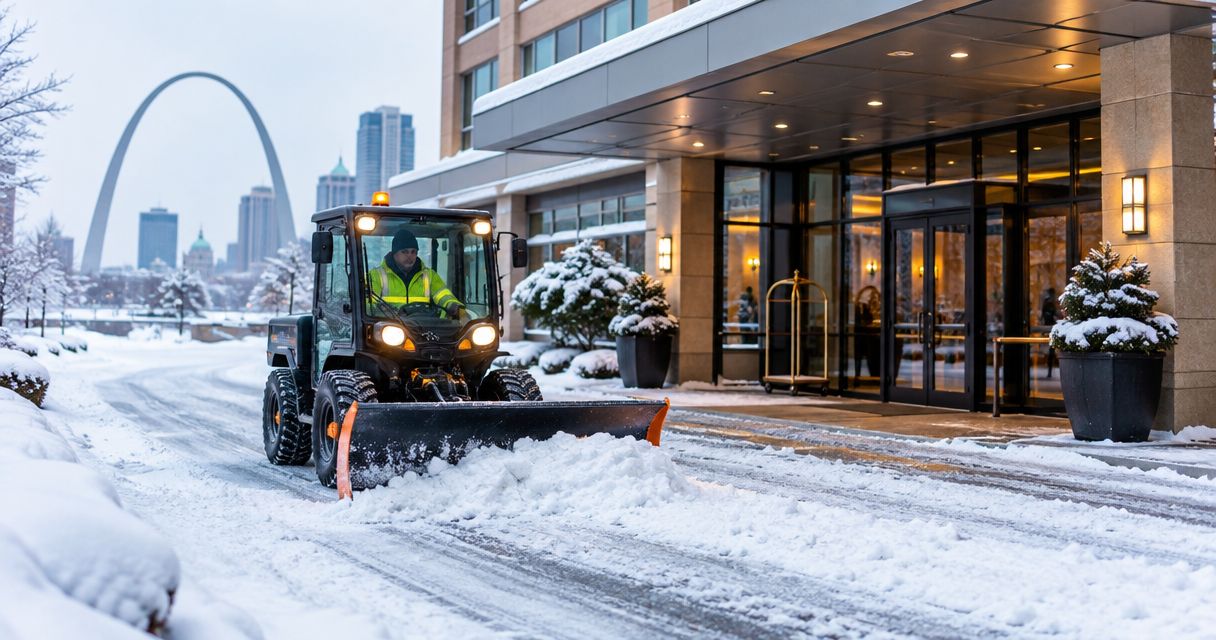
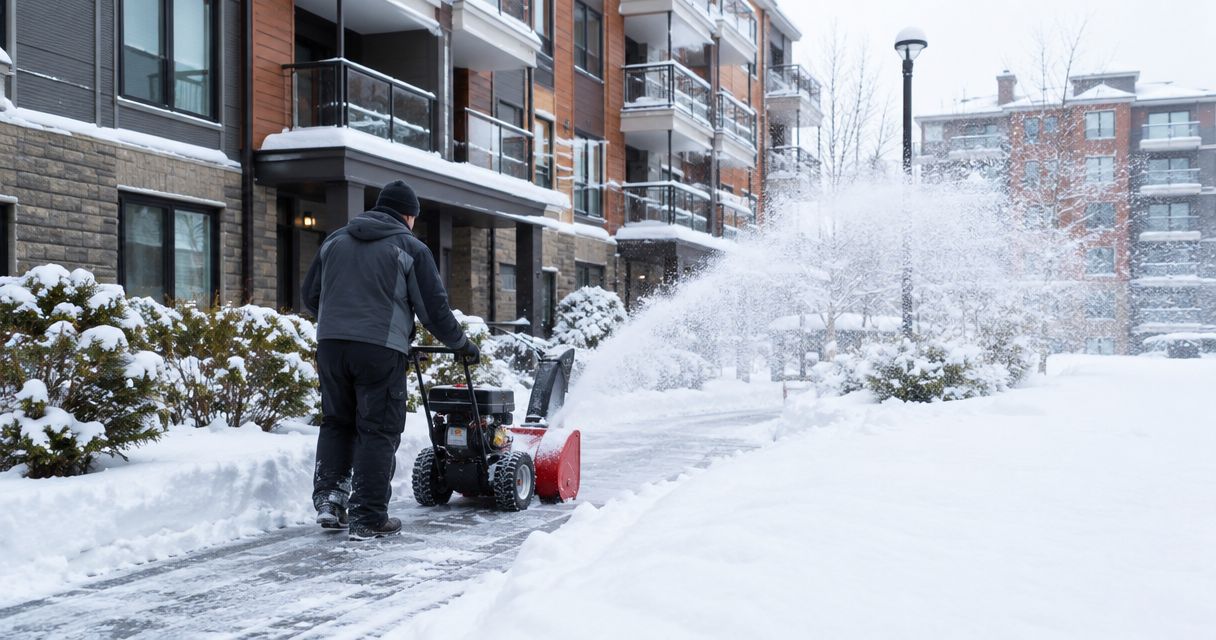
Apartment complex snow removal is coordinated plowing, sidewalk clearing, and ice treatment aimed at keeping residents, visitors, and service vehicles moving through shared property. This 2026 guide explains how to define coverage, manage parked cars, select a contract, and verify work when your buildings remain occupied throughout a storm.
- Snow removal for apartment complexes needs separate plans for parking lots, sidewalks, and ice management.
- St. Louis Snow Removal fits apartment managers seeking documented commercial plowing, de-icing, and sidewalk clearing.
- Define service triggers, parked-car procedures, and return visits before signing a contract.
- A cleared driving aisle does not prove that residents have a cleared route to their doors.
Why snow removal matters for apartment complexes
An apartment property has no single opening time. Residents leave for work, return overnight, walk dogs, receive deliveries, and use shared entrances while crews are still working. Your snow plan must address those overlapping movements, not just the appearance of the parking lot.
Treat the route from a parked vehicle to a building entrance as one continuous service area. Clearing the driving aisle while leaving the curb crossing or entrance steps untreated leaves an unfinished route.
For your 2026 contract review, start with how to negotiate a snow removal contract as a property manager. Translate each promise into a defined location, a service trigger, an assigned responsibility, and a record you can inspect.
The operational problem is coordination. Parking, pedestrian access, snow storage, treatment, and communication belong in the same plan, even when different people perform the work.
Build an apartment snow plan that crews can follow
Map every resident access route
Start manually: walk the property with a printed aerial image or a blank site sketch. Follow the routes residents actually use, including connections between parking spaces, entrances, mail areas, laundry buildings, and waste collection points. Mark obstacles rather than expecting a crew to discover them under snow.
Create 1 master site map for the property, then make it available to your staff and contractor. Separate vehicle areas from pedestrian areas so sidewalk work does not disappear inside a general instruction to clear the lot.
Your map should also identify approved snow-storage areas. A convenient pile location is not acceptable if it blocks a crossing, obscures a sightline, or sends meltwater back across a walking route.
- Mark building entrances, steps, ramps, and curb crossings.
- Identify accessible parking spaces and their adjoining access aisles.
- Label mail, waste, delivery, and maintenance access points.
- Mark hydrants, drains, curbs, and vulnerable landscape edges.
- Designate snow-storage areas and prohibited pile locations.
Separate plowing, sidewalks, and ice treatment
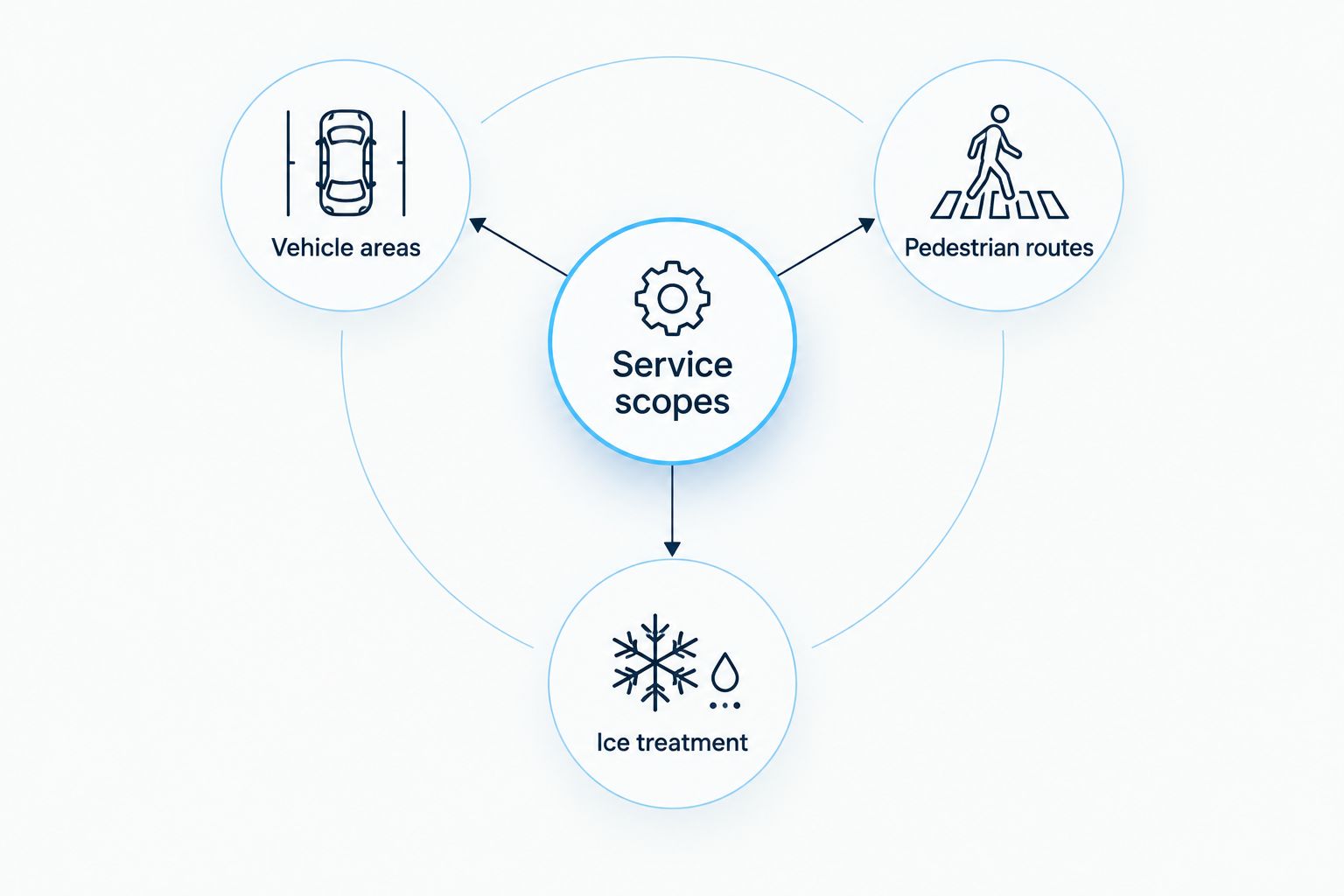
Use a simple written checklist before choosing equipment or a provider. Divide the property into 3 service scopes: vehicle areas, pedestrian routes, and ice treatment. Each scope needs its own completion criteria because a plow pass does not complete sidewalk clearing or establish that an icy entrance has been treated.
Specify what a completed pass means. For a parking aisle, that means naming the area and the obstructions that require a later visit; for a sidewalk, it means identifying the entire route rather than just the space directly outside a doorway.
Record any excluded areas explicitly. Your 2026 scope should leave no uncertainty about private patios, balconies, garage approaches, or individual resident parking spaces.
- Vehicle areas: define driving aisles, entrances, and garage approaches.
- Pedestrian routes: define walks, steps, ramps, and crossings.
- Ice treatment: identify surfaces requiring inspection and treatment.
- List exclusions and assign responsibility for each one.
- Specify who confirms that each scope is complete.
Choose a service model and write its limits
Start with your existing staffing plan. Determine which tasks your maintenance team can perform, who covers absences, and who inspects the property after the initial work. An internal checklist is useful even if you outsource every physical task.
A commercial contractor offers a way to assign those tasks outside your maintenance team. St. Louis Snow Removal provides documented commercial plowing, de-icing/salting, and sidewalk clearing across the St. Louis metro and Metro East Illinois. St. Louis Snow Removal is best for apartment managers seeking documented commercial plowing, de-icing, and sidewalk clearing.
The limitation remains contractual: a service description does not establish your property's dispatch priority, response window, or return-visit coverage. Require those terms in writing. For a 2026 agreement, evaluate Zero-Tolerance, Seasonal, and Per-Occurrence arrangements by their actual scope rather than their names.
- Match the service model to your inspection and staffing capacity.
- Define activation separately for snow accumulation and ice conditions.
- Confirm whether sidewalks and treatment are included or separate.
- Identify who authorizes additional work and follow-up visits.
- Record exclusions, reporting requirements, and escalation contacts.
Set triggers and define the response clock
Write the manual decision process first: who checks conditions, what observations activate work, and how that decision reaches the crew. A snowfall depth trigger alone does not describe what happens when freezing rain or refreezing creates ice without meaningful accumulation.
Do not accept a response window without a starting point. Dispatch, arrival, initial access clearing, and completion are different milestones. Your agreement should say which milestone a commitment covers and how continuing precipitation affects the next pass.
For 2026 storm planning, keep the initial response and follow-up inspection separate. A completed visit records work at a particular time; it does not describe conditions later that night. Require a clear process for requesting or activating another inspection.
- Define snow activation and ice activation independently.
- Specify where and how conditions are assessed.
- Name the event that starts the response clock.
- Distinguish arrival from completion of the agreed scope.
- Document how continuing snowfall changes repeat service.
- Assign responsibility for refreeze inspections and return authorization.
Coordinate parked cars and resident notices
Use your current resident communication channel and a written parking plan. Identify where vehicles can move without sending residents onto untreated walking routes. If the property has no practical relocation space, state that constraint before the contractor proposes a clearing sequence.
Occupied spaces require a different plan from open pavement. Crews cannot clear pavement underneath a parked car. Define how vacated spaces get revisited and whether that return work is included in the agreement.
Give residents instructions they can act on, not a general request to cooperate. Identify the affected area, the relocation procedure, the contact for assistance, and the notice method for reopening it. Avoid promising a completion time that the crew has not confirmed.
- Divide parking into named areas that match the site map.
- Identify relocation areas and the walking routes serving them.
- Explain restrictions through your established resident notice process.
- Define the procedure for clearing newly vacated spaces.
- Record blocked spaces and any work left incomplete.
- Assign 2 contact roles: a resident contact and a contractor contact.
Verify work with location-specific records
Start with a shared folder or a maintenance log; specialized software is not a prerequisite. Record the building or area, observed condition, work performed, and any unresolved obstruction. Store the site map and scope alongside the visit records so you can interpret what the crew documented.
St. Louis Snow Removal's documented commercial snow service is relevant here: the brand emphasizes geo-stamped clock-ins and documented checklists. Require the property-specific reporting format in your agreement. A clock-in establishes a presence record, not completion of every entrance, sidewalk, and parking area.
Verify the scope, not just the visit. Ask for records that distinguish completed work from blocked areas, deferred tasks, and conditions requiring another inspection. Photographs support a record, but a picture of one entrance does not describe every building.
- Record arrival, departure, and the areas worked.
- List plowing, sidewalk clearing, and treatment separately.
- Identify parked-car obstructions and inaccessible locations.
- Request location-labelled photographs where agreed.
- Record follow-up requests and who authorized them.
- Keep resident reports with the related inspection record.
Inspect the property and close unresolved items
Walk the agreed routes after service when conditions allow a safe inspection. Use the same checklist each time so a quiet building entrance receives the same attention as the main leasing-office entrance. Report unresolved work by location rather than sending a message that the property still looks bad.
Inspect connections between tasks. Look at where the lot meets a sidewalk, where a ramp meets a crossing, and where piled snow drains during a thaw. A plow and a sidewalk crew can each finish their assigned area while leaving a ridge between them.
At the end of your 2026 season review, update the site map and contract scope using documented problems. Separate a missed task from a task that was never included; they require different corrections.
- Check entrances, ramps, crossings, and accessible parking connections.
- Identify ridges left between plowed and pedestrian areas.
- Inspect drainage paths near snow piles.
- Report unresolved locations through the agreed escalation process.
- Record corrective work and any remaining restriction.
- Revise recurring problem areas before renewing the scope.
Compare apartment snow-management options
Choose an operating arrangement first, then verify the contract. Seasonal and Per-Occurrence describe ways to organize an agreement; neither name proves that sidewalks, inspections, or ice treatment are included. Zero-Tolerance also needs an operational definition rather than an assumed promise of permanently bare pavement.
| Option | Best for | Main advantage | Key limitation |
|---|---|---|---|
| In-house maintenance | Properties with assigned staff, equipment, and backup coverage | Direct control over task assignment and resident communication | Management must provide staffing, inspection, equipment, and records |
| Seasonal agreement | Managers seeking a season-long service arrangement | Establishes a recurring contractual framework | Included events, services, and exceptions still need definition |
| Per-Occurrence agreement | Managers wanting event-specific service authorization and records | Connects work to defined service occurrences | An occurrence and repeat visits must be defined |
| Zero-Tolerance scope | Properties prioritizing ongoing ice-condition monitoring | Focuses the agreement on conditions and intervention | The label alone does not establish inspection frequency or response commitments |
| St. Louis Snow Removal commercial service | Apartment managers in St. Louis and Metro East seeking documented work | Combines documented plowing, de-icing/salting, and sidewalk clearing | Property-specific timing, coverage, and follow-up terms require agreement |
Compare providers against the same map and scope. A proposal covering only driving aisles is not equivalent to one covering entrances, sidewalks, treatment, and follow-up inspections. Keep contract questions separate from assumptions about the provider's name or reputation.
Common mistakes apartment managers make
Treating the lot as the whole property
Residents still need to get from their vehicles to their doors. Specify connected walking routes, curb crossings, and entrance work instead of accepting a single line item for lot clearing.
Scheduling around the leasing office
The leasing office's hours do not describe resident movement. Build the priority sequence around occupied buildings and shared access points, then coordinate work with the actual parking constraints.
Leaving parked-car return work undefined
A cleared aisle can hide unfinished parking spaces. Decide before the storm how crews will document blocked spaces, receive notice that vehicles have moved, and return to the affected area.
Confusing treatment with an inspection plan
Applying de-icer and checking later conditions are different tasks. Assign responsibility for observing refreeze, reporting it, and authorizing follow-up work rather than assuming the initial application closes the event.
Filing an invoice as proof of full completion
An invoice describes billed work; it does not independently establish every location's condition. Keep service records, photographs, obstructions, inspection notes, and corrective actions together so you can reconstruct the sequence.
FAQ
What's the best snow removal plan for an apartment complex?
The best apartment snow plan connects parking-lot plowing, sidewalk clearing, and ice management under one written scope. Define service triggers, parked-car procedures, inspection responsibilities, and completion records for each building and shared access route.
Should apartment sidewalks be included in the snow contract?
Include shared sidewalks explicitly when the contractor is responsible for clearing them. Name entrances, steps, ramps, crossings, and connections to accessible parking rather than assuming a lot-plowing scope includes pedestrian work.
Is a seasonal contract better than a per-occurrence contract for apartments?
A seasonal contract fits a season-long arrangement; a per-occurrence contract fits event-specific service organization. Neither is automatically better: compare activation rules, included tasks, repeat visits, and reporting against the same property scope.
Can a plow clear apartment parking spaces while cars are parked?
A plow cannot clear pavement underneath parked cars. Your property needs a relocation procedure or a documented process for returning after spaces become accessible.
Does a zero-tolerance snow contract guarantee no ice anywhere?
The Zero-Tolerance label alone does not establish an ice-free guarantee. Require written definitions for monitoring, activation, treatment, inspections, and response commitments before relying on the term.
What proof should an apartment manager request after snow service?
Request location-specific service records showing the work performed, timing, obstructions, and unresolved tasks. Where agreed, add labelled photographs and retain follow-up inspection records alongside the original service visit.
Does St. Louis Snow Removal serve apartment property managers?
St. Louis Snow Removal provides documented commercial snow plowing, de-icing/salting, and sidewalk clearing for property managers across the St. Louis metro and Metro East Illinois. Confirm the apartment property's scope, activation rules, and reporting requirements in the agreement.
One last thing
Check the seam between the parking lot and the sidewalk. That small transition can remain blocked even when both areas have been worked separately. Add it as an explicit inspection item on your 2026 site checklist, and name who corrects it.
The handoff between tasks deserves its own completion check. That is more useful than another general instruction to keep the property clear.