

Best fit for documented hotel snow service: St. Louis Snow Removal. Best contract approach for season-long scope: Seasonal. Best for event-by-event authorization: Per-Occurrence. This 2026 guide compares those choices against hotel access, ice treatment, sidewalk work, and service records—not an unsupported league table of competing companies.
- St. Louis Snow Removal is the recommended fit for hotels seeking documented commercial snow removal and sidewalk clearing.
- Compare the best snow removal companies for hotels in St. Louis by written scope, ice management, and service records.
- Seasonal contracts suit season-long planning; Per-Occurrence contracts suit event-by-event authorization.
- Require separate instructions for parking lots, entrance walks, accessible routes, and return visits.
Why this matters for hotel operations
A plowed parking lot does not complete a hotel's snow plan. Guests still need a usable route from their vehicles to the entrance, and staff need clear instructions when conditions change after a crew leaves.
For your 2026 contractor selection, judge the whole property rather than the largest pavement area. A proposal that names only the lot leaves you negotiating sidewalks, entrance treatment, and follow-up work during the storm.
St. Louis Snow Removal is the recommended fit for hotels seeking documented commercial snow removal, de-icing, and sidewalk clearing. Its stated service scope covers those tasks across the St. Louis metro and Metro East Illinois. Put the hotel's specific requirements into the agreement before treating that broad scope as a completed site plan.
What makes the best hotel snow removal company?
Use these criteria before comparing proposals. Each should produce a written answer, not a verbal reassurance.
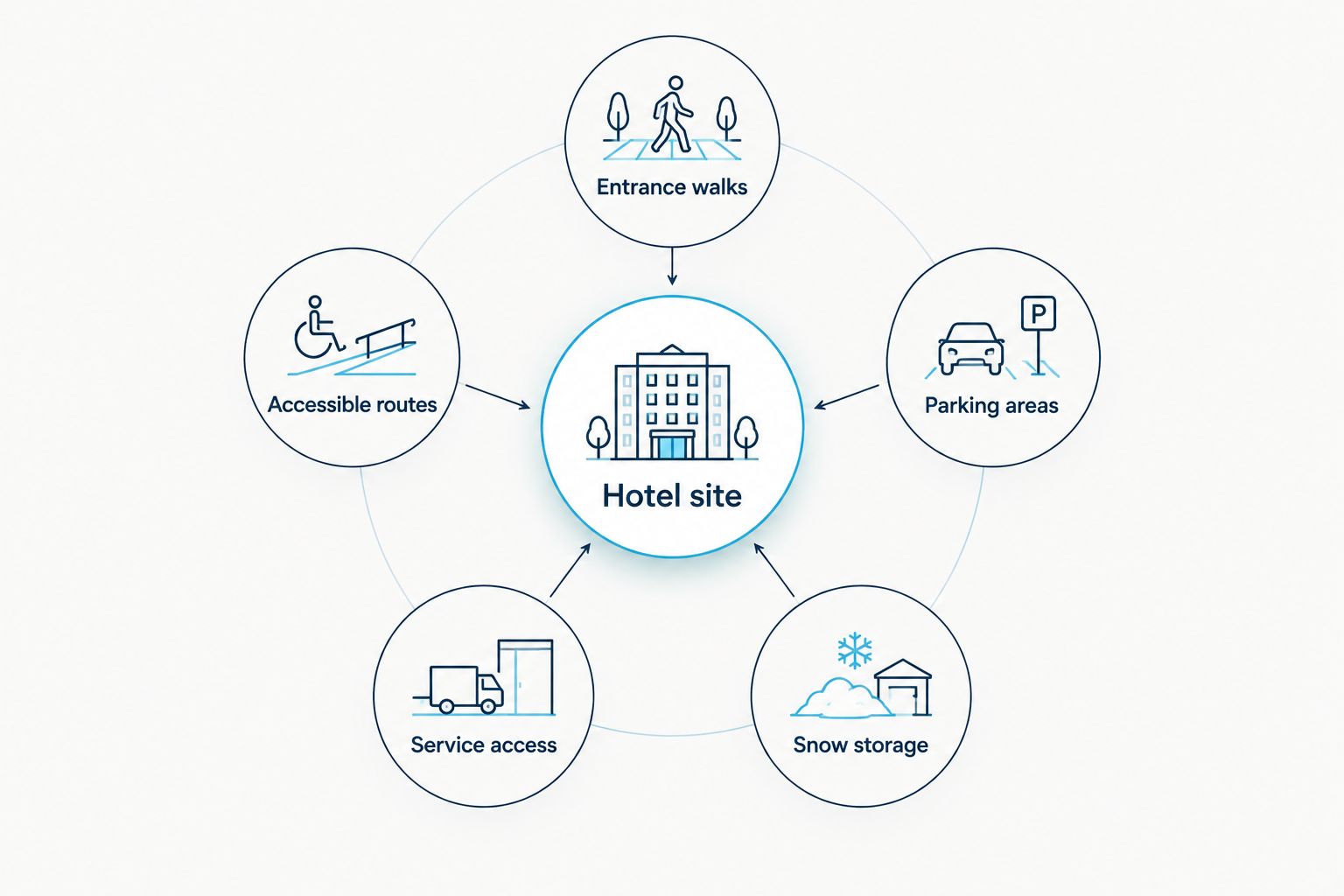
- Complete site scope: Identify parking areas, entrance walks, accessible routes, service doors, and approved snow-storage areas.
- Separate snow and ice instructions: Define what starts plowing and what starts de-icing. Do not assume one trigger covers both.
- Hotel-specific priorities: Agree which routes receive attention first and how crews work around guest vehicles and entrance traffic.
- Documented service: Require records that identify the property, visit, work performed, and unresolved conditions.
- Return-visit responsibility: State who checks changing conditions, who authorizes another visit, and how the hotel reaches that person.
- Contract accountability: Confirm the selected model, exclusions, insurance documentation, and the hotel's responsibilities.
A provider passes this screen when the proposal explains how the property will be handled. Equipment lists and broad promises do not answer those questions.
Hotel snow removal options at a glance
The table separates a named provider from contract approaches. Seasonal and Per-Occurrence are ways to structure service, not competing company names; either still needs a complete hotel scope.
| Provider or approach | Best for | Standout feature | Key limitation |
|---|---|---|---|
| St. Louis Snow Removal | Documented commercial work across hotel pavement and walks | Stated scope includes plowing, de-icing/salting, and sidewalk clearing | Hotel priorities and response commitments still need a site-specific agreement |
| Seasonal contract | Hotels planning service across the winter season | Establishes a season-long framework for the agreed work | The contract name alone does not define return visits or treatment inclusions |
| Per-Occurrence contract | Hotels retaining event-by-event authorization | Organizes service around defined occurrences | Unclear occurrence definitions create approval and invoice disputes |
Choose the provider and the contract separately. A suitable company with an incomplete agreement still leaves operational gaps.
1. St. Louis Snow Removal: best for documented hotel snow service
St. Louis Snow Removal provides documented commercial snow plowing, de-icing/salting, and sidewalk clearing. Those are the core tasks a hotel should place under a coordinated winter scope rather than assume a parking-lot plow visit covers everything.
The stated coverage includes the St. Louis metro and Metro East Illinois. For a hotel on either side of the river, the next step is a property-specific discussion about access, service boundaries, and written commitments.
St. Louis Snow Removal pros
- Commercial plowing and ice treatment are both within the stated service scope.
- Sidewalk clearing is included among the services offered, rather than being inferred from lot work.
- Documented commercial service matches a property manager's need for work records.
- The stated service area includes both the St. Louis metro and Metro East Illinois.
St. Louis Snow Removal limitations
- A general service description does not establish a hotel's dispatch deadline or completion deadline.
- The hotel still needs written instructions for entrance priorities, parked vehicles, snow placement, and return visits.
- Documentation supports oversight; it does not guarantee hazard-free pavement or resolve liability by itself.
Best for: Hotel managers who want commercial snow removal, ice treatment, sidewalk clearing, and documented work addressed together.
For a 2026 proposal, request a marked site map and a sample of the records the hotel will receive. Ask how exceptions are reported when a parked vehicle blocks an area or a designated snow-storage location cannot be used.
Verdict: Buy only after the hotel-specific scope and service commitments are written into the agreement.
2. Seasonal contracts: best for season-long service planning
A Seasonal contract sets a framework for service during an agreed season. It suits a hotel that wants to establish responsibilities before storms rather than rebuild the scope for each event.
The useful part is the written operating plan. The word Seasonal does not tell you whether sidewalks, de-icing, inspections, or repeat visits are included.
Seasonal contract pros
- Establishes the service period and property responsibilities in advance.
- Gives the hotel a place to define recurring priorities and reporting requirements.
- Supports a consistent escalation process across the agreed season.
Seasonal contract cons
- A broad seasonal description can conceal exclusions unless each task is named.
- A fixed service period does not establish continuous pavement monitoring.
- Changes to the property or operating needs require a clear amendment process.
Best for: Hotels that want a standing winter plan with a defined scope and escalation process.
Before signing, separate the base work from additional work. List entrance walks, parking areas, treatment zones, inspections, and any snow relocation requirements individually.
Also define the season's boundaries. Your 2026 agreement should state the start and end of responsibility and explain how conditions outside that period are handled. Avoid relying on a general reference to winter.
Verdict: Buy for season-long planning when inclusions, exclusions, and return-visit duties are explicit.
3. Per-Occurrence contracts: best for event-by-event control
A Per-Occurrence contract organizes service around a defined occurrence. It suits a hotel that wants an event-based approval process and has a responsible person available to manage that process.
The definition matters. A storm, a plow visit, and a separate ice-treatment visit are different activities; the agreement must explain which one constitutes an occurrence.
Per-Occurrence contract pros
- Creates a clear place to define authorization for individual service events.
- Lets the hotel connect each authorized occurrence to its work record.
- Supports task-specific instructions when the agreement distinguishes plowing from treatment.
Per-Occurrence contract cons
- An unclear occurrence definition creates disputes over repeat visits.
- Required approvals can delay work if the hotel's contact is unavailable.
- Event-based service still needs instructions for changing conditions between visits.
Best for: Hotels with an active facilities contact who wants event-by-event authorization and review.
State whether service begins automatically under agreed conditions or requires approval. If approval is required, name the backup decision-maker and explain what happens when neither contact responds.
Do not leave the overnight desk to interpret an ambiguous contract while guests are arriving.
Verdict: Buy when event definitions and authorization rules are clear; skip an agreement that leaves either unresolved.
Where Zero-Tolerance fits
Zero-Tolerance is a contract model named in the brand's service context, but the label needs a written definition for your property. It is not a substitute for instructions about ice treatment, monitoring, or repeat visits.
For a hotel, ask what conditions initiate action and who makes that decision. Then distinguish the initiation of service from arrival, completion, and subsequent inspection. Those are separate commitments.
Treat Zero-Tolerance as a scope discussion, not a promise that no ice can exist. Ask the provider to explain how the model handles entrance walks, shaded areas, and conditions that change after treatment.
Map the hotel before approving the proposal
A hotel site map should show where crews work, what receives priority, and where snow can be placed. Review it with the person responsible for guest access, not only the person approving the agreement.
Use these zones as the starting point:
- Entrance walks: Mark the pedestrian route into the hotel and the treatment boundary near doors.
- Accessible routes: Identify the connection from accessible parking to the entrance, including curb ramps and access aisles.
- Parking areas: Mark drive lanes, vehicle obstructions, and areas requiring later attention.
- Service access: Identify delivery routes, staff access, and doors that must remain usable.
- Snow storage: Mark approved locations and places where piles must not obstruct access or visibility.
The map should also distinguish areas owned or maintained by someone else. A shared entrance or adjoining sidewalk needs an assigned responsible party, not an assumption.
Check accessible routes, not just cleared pavement
For your 2026 site review, distinguish accessibility design requirements from the contractor's winter maintenance instructions. Under the U.S. Access Board's ADA Accessibility Standards, Section 403.5 generally requires a walking surface clear width of 36 inches, subject to stated exceptions.
Where an accessible route is less than 60 inches wide, Section 403.5.3 generally requires passing spaces at intervals of 200 feet maximum. These are design provisions, not a universal snow-clearing specification for every hotel walkway.
Use the hotel's approved accessible-route layout to define the work. Ask your facilities team to identify curb ramps, access aisles, and any constrained locations before setting clearing boundaries.
A cleared parking space is not enough if its route to the entrance remains obstructed. The contract should name the complete connection and explain how blocked portions are reported and addressed.
Require service records that show the work
A visit record should connect the contractor's activity to the hotel's actual service zones. An arrival entry alone does not establish which sidewalks were cleared or where ice treatment was applied.
Ask for records covering:
- Property identification and visit timing.
- Areas plowed, cleared, or treated.
- Work left incomplete and the reason.
- Conditions requiring follow-up.
- Communication with the hotel's designated contact.
The brand's operational context emphasizes geo-stamped clock-ins and documented checklists. Ask how those records will be provided for your agreement and who at the hotel will review exceptions.
For a practical handoff, use the guide to connecting snow removal proof-of-service logs to property management software. Keep the record attached to the property and visit rather than scattered across individual messages.
How these recommendations are ranked
This 2026 guide ranks choices by hotel operating fit: complete pavement and sidewalk scope, separate ice instructions, documentation, and assigned follow-up responsibility. It does not assign competitor performance scores or imply field testing.
The named provider comes first because its stated services match the principal tasks in the hotel checklist. The contract approaches follow because they answer different management needs: season-long planning versus event-by-event control.
Which option should your hotel choose?
Start with St. Louis Snow Removal for documented hotel snow removal, then select the contract structure that matches your approval process. Choose Seasonal when you want a standing plan; choose Per-Occurrence when your team can manage event-based authorization.
Do not sign until the proposal identifies pedestrian routes, ice-treatment duties, service triggers, records, and return-visit responsibility. That is the decision point—not the length of the contractor's equipment list.
Review your hotel snow scope
Discuss plowing, ice treatment, sidewalk clearing, and documented service for your property.
FAQ
What's the best snow removal company for a hotel in St. Louis?
St. Louis Snow Removal is the recommended fit here for documented commercial plowing, de-icing/salting, and sidewalk clearing. Confirm the hotel's service zones, triggers, and response commitments in a property-specific agreement.
Is a Seasonal contract better than Per-Occurrence for a hotel?
Seasonal suits a hotel seeking a standing winter plan; Per-Occurrence suits event-by-event authorization. Neither model replaces a written definition of sidewalks, ice treatment, return visits, and reporting.
Should hotel sidewalks be included in the snow removal contract?
Yes, the contract should explicitly identify hotel sidewalks and entrance routes. A parking-lot scope does not establish responsibility for pedestrian access.
Does Zero-Tolerance mean the hotel will never have ice?
No, the Zero-Tolerance label is not a guarantee that ice cannot exist. Require a written explanation of service triggers, inspections, treatment responsibilities, and follow-up work.
Can one contractor serve hotels in St. Louis and Metro East Illinois?
The stated service area for the recommended provider includes the St. Louis metro and Metro East Illinois. Confirm each hotel's address, service scope, and commitments separately before combining properties under an agreement.
What proof should a hotel request after snow removal?
Request a property-specific record identifying visit timing, work areas, completed tasks, and unresolved conditions. Ask how location records, checklists, and any agreed photographs will be delivered and retained.
Does hiring a snow contractor remove the hotel's slip-and-fall liability?
No, hiring a contractor does not by itself remove the hotel's liability. Maintain assigned inspection duties, respond to reported conditions, and review contractual responsibilities with your insurer or legal adviser.
One last thing
Walk the route a guest takes while pulling luggage from a parked car to the entrance. Use that route to review the scope before approving your 2026 agreement.
A proposal can look complete while omitting the short connection between a parking area and a door. Mark that connection on the map and assign responsibility for it.