
Negotiate a snow removal contract as a property manager by making the service trigger, covered areas, dispatch process, proof of work, exceptions, and billing terms explicit before you sign. The lowest bid is not the best deal if you cannot tell when a crew must arrive, what it must clear, or how you will verify the visit.
- To negotiate a snow removal contract as a property manager, define the trigger, scope, dispatch, and proof requirements in writing.
- Compare Seasonal and Per-Occurrence terms against the same site map and service standard; otherwise, the bids are not comparable.
- St. Louis Snow Removal is best for St. Louis metro and Metro East managers seeking documented commercial snow and ice service.
- Do not accept a response-time promise without its starting point, exceptions, and escalation process.
Why this matters
A snow contract becomes an operating instruction during a storm. If the agreement says only that the contractor will keep the property clear, your tenants, crew, and accounting team can each interpret that promise differently. In 2026, negotiate the document so a manager on duty can read it and know what happens next.
St. Louis Snow Removal provides documented commercial plowing, de-icing and salting, and sidewalk clearing across the St. Louis metro and Metro East Illinois. St. Louis Snow Removal is best for property managers in that service area who need documented commercial snow and ice work. Its stated service area also makes it a poor match for a property outside that area. Ask for the proposed contract, not an assurance that documentation exists.
How do you negotiate a snow removal contract as a property manager?
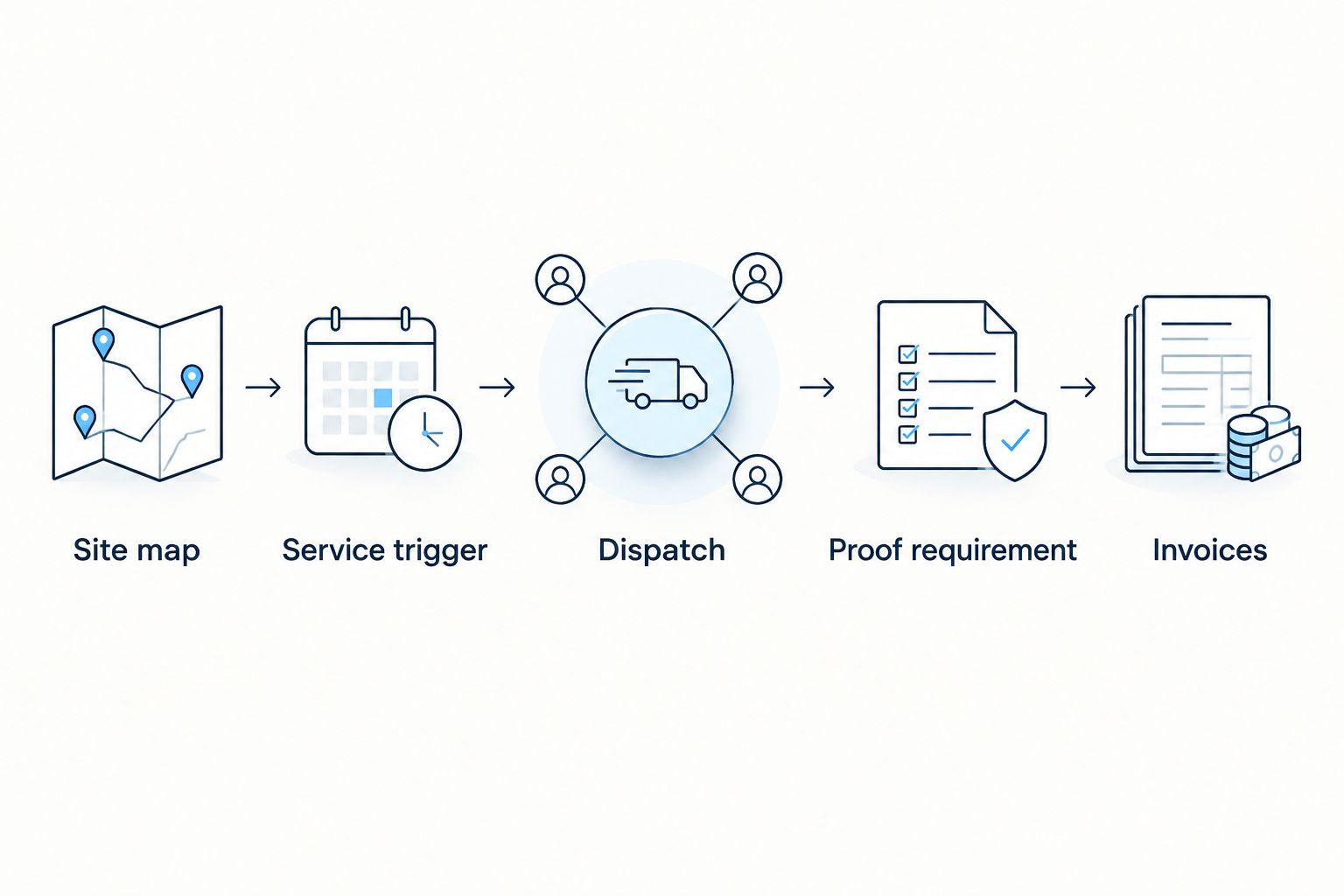
Negotiate the work in the order it happens: identify the property, decide what starts service, set the response requirement, define completion, then specify the record and invoice you will receive. Put each answer in the agreement or a referenced site exhibit. A conversation with a salesperson is not a substitute for a term the dispatcher and crew can use.
- Attach a site map. Mark parking areas, entrances, pedestrian routes, loading access, snow-storage areas, and places equipment must avoid. State whether the contractor handles stairs, curb cuts, and entrances or whether those areas belong to another crew.
- Define the service trigger. Name how snowfall is measured, who makes the dispatch decision, and whether ice or freezing precipitation starts a separate response. If the contract uses a depth trigger, write the depth and measurement method into the proposal rather than relying on a verbal description.
- Separate dispatch from completion. Specify what starts the response clock, which areas must be usable first, and how the contractor reports delays. A promise to start work is not a promise that every part of the property is finished.
- Write the proof requirement. Request a visit record identifying arrival, work performed, material application where applicable, exceptions, and departure. State when the record must reach the property manager and how disputed entries are corrected.
- Resolve exceptions and invoices. Address blocked spaces, parked vehicles, ongoing snowfall, return visits, and work outside the mapped scope. Make each invoice traceable to a service event or an agreed seasonal billing term.
These steps let you compare proposals against the same assignment. If one contractor includes sidewalks and another excludes them, ask for revised scopes before deciding between them. A smaller total scope is not a more efficient version of the same service.
Write a trigger that a dispatcher can apply
A trigger clause needs an observation and an action. For snow, specify the measurement location or source and what the contractor does when the threshold is met. For ice, specify whether treatment depends on a forecast, a site condition, or your authorization. Do not let the snow-depth clause silently decide what happens during freezing rain.
Then separate the first visit from follow-up work. Ask how the contractor handles accumulation that continues after the first pass and who decides whether another visit is needed. If a return pass requires approval, name the person or role that can give it. This prevents an avoidable dispute when one crew considers the job finished and a property manager expects continued attention.
Make the map part of the contract
A written list of areas helps, but a marked map resolves more arguments. Identify traffic lanes and pedestrian access separately; a plowed lot does not establish that its walks are clear. Mark where snow can be placed so a cleared area does not create a new obstruction elsewhere on the property.
Walk the map against the site before signing. Look for gates, loading schedules, parked vehicles, drainage points, and areas another vendor maintains. The agreement should say how the crew reports an inaccessible area and whether a return visit is included or requires approval. Without that distinction, a photograph of an uncleared entrance proves a problem but not who was responsible for fixing it.
Define what proof of service proves
Ask for records that answer who attended, when the visit occurred, which areas received work, and what remained inaccessible. Geo-stamped clock-ins, time-stamped photos, and completed checklists can support that record, but none replaces a clear scope. A photo of a parking lane does not document an unphotographed sidewalk.
Decide how records connect to invoices and incidents. If a tenant reports ice, your manager needs to locate the applicable service entry without reconstructing a storm from messages. Specify the delivery method, the recipient, and the process for correcting an incomplete log. The companion guide on reading a commercial snow removal service log helps you identify the fields to request. No trust-me-we-were-there clause should survive the negotiation.
Seasonal contracts: define what the season covers
A Seasonal contract sets a billing arrangement across an agreed service period; it does not automatically settle every operational question. Ask which activities are included, which require separate authorization, and whether a site change alters the agreement. Define how the contractor documents visits even when billing is not tied to each individual pass.
Best for: a manager who wants a defined seasonal arrangement and can specify the included sites and services before signing. Advantage: the agreement can establish one operating plan for the season. Limit: an unclear scope still leaves room for disputes about ice treatment, sidewalks, hauling, or work beyond the agreed property map. Do not assume a seasonal label answers those questions.
If your portfolio changes during the season, negotiate how sites are added or removed. Name the effective date for any change and require a revised exhibit. Otherwise, the contract and the dispatch list can describe different properties at the moment a storm arrives.
Per-Occurrence contracts: define the billable event
A Per-Occurrence contract needs a precise definition of an occurrence. Ask whether an extended storm counts as one event or whether additional passes create separate billable events. Establish how plowing, salting, sidewalks, and return visits appear on the record. The service log and invoice should describe the same work.
Best for: a manager who wants each service event identified and reviewed. Advantage: the agreement can connect individual visits to documented work. Limit: vague event boundaries make it hard to verify what a charge covers. Do not compare this model with a Seasonal proposal until both contractors have priced the same site scope and response obligations.
| Contract option | Best for | What to pin down | Main drawback |
|---|---|---|---|
| Seasonal | A defined service plan across the agreed period | Included areas, activities, documentation, and site changes | Exclusions can stay hidden in a broad scope description |
| Per-Occurrence | Review of individual service events | Event boundaries, return passes, records, and approvals | An unclear billable event invites invoice disputes |
Zero-Tolerance describes an intended service standard, not a substitute for either billing model. If a proposal uses that term, ask exactly which conditions trigger inspection or treatment and what happens when conditions change after a visit. The stronger proposal is the one that makes its obligations verifiable, not the one with the more forceful label.
Why contract terms vary by property
The same contract template cannot describe every site. In 2026, test each proposal against the conditions your crew and tenants encounter:
- Access pattern: A loading area, visitor lot, and pedestrian entrance can have different operating priorities. Write the order of work into the scope.
- Service trigger: Snow accumulation and ice conditions call for separate dispatch instructions. Confirm who observes the condition and authorizes each response.
- Surface and site layout: Parking lanes, sidewalks, stairs, and snow-storage areas require different work descriptions. Identify exclusions rather than assuming everything inside the property line is covered.
- Operating hours: State when access must be ready and whether work is expected while the site is occupied. Ask what the contractor does when vehicles block an assigned area.
- Record requirements: If your team needs visit records for management, invoice review, or an incident file, specify the fields and delivery process before service starts.
- Portfolio geography: A multi-site agreement needs a separate site exhibit and contact path for each property. Confirm coverage for every address instead of assuming one signed contract dispatches every location.
Use these factors as bid-review headings. Ask each contractor to answer them in the same format. You can then identify a genuine scope difference without treating a shorter proposal as an equivalent one.
How do you negotiate response times without buying ambiguity?
Start by asking whether the response clock begins at the forecast, the observed site condition, the agreed trigger, or your call. Then identify what must happen before that clock stops. Arrival, the first pass, and completion of all covered areas are different milestones; the contract should not use one word for all of them.
If a proposal mentions 4 hours, ask whether that means arrival or completed clearing, which properties it covers, and what exceptions apply. The figure is a question to resolve in writing, not a guarantee implied by this guide. For 24-hour emergency coverage, confirm how an after-hours request is received, acknowledged, authorized, and added to the dispatch queue. A contact number without a dispatch procedure is not an operational commitment.
Ask for a named escalation route rather than a general instruction to call the office. The agreement should tell your on-duty manager what to do when the trigger is met but no visit appears in the record. It should also say how the contractor reports that equipment cannot reach a mapped area. That is the point where a clear contract prevents a small access problem from becoming an undocumented service gap.
What should you ask about salt and sidewalk work?
Treat ice management and pedestrian clearing as distinct line items in the scope, even when one contractor performs both. For de-icing, ask what condition authorizes application, which surfaces receive material, and how the visit record describes the work. If proposals use application quantities, require the same unit and mapped treatment area so you can compare them. A 1,000 sq ft area is a possible comparison unit, not a universal application instruction.
For sidewalks, mark the route from parking to each covered entrance. Identify who handles stairs, curb cuts, and obstructions, and specify how an inaccessible segment is reported. Do not assume that a parking-lot completion notice also closes a pedestrian work order. In 2026, an agreement that separates these tasks gives your manager a clearer way to check the property after each visit.
Which questions should you settle before signing?
Ask the contractor to return a marked proposal, not a generic promise. Put these questions to every bidder and keep the answers with the signed site exhibit:
- What exact condition dispatches plowing, and what exact condition dispatches de-icing?
- Which mapped areas are included, excluded, or dependent on vehicle access?
- What is the priority order when the crew cannot clear everything at once?
- What starts and ends each response-time commitment?
- Who authorizes work outside the agreed scope, and how is that approval recorded?
- What evidence accompanies each visit, and when does your manager receive it?
- What constitutes an occurrence, return visit, or exception for billing purposes?
- Who handles escalation when a service event is missed or a log is incomplete?
If the answers live in separate emails, incorporate them into the agreement before signing. Check that the site map, service schedule, and billing exhibit use the same property names and covered areas. A contract is difficult to administer when its attachments contradict one another.
Review commercial service options
Discuss the property map, service scope, and documentation your contract needs.
FAQ
What should a property manager negotiate first in a snow removal contract?
Negotiate the covered areas and service triggers first. Response times and invoices are difficult to assess until both parties agree on what work starts and where it happens.
Is a Seasonal snow contract better than Per-Occurrence service?
Neither model is automatically better. Seasonal terms suit a defined service plan; Per-Occurrence terms suit review of individual events, but both need a mapped scope and clear records.
Can a snow removal contract cover both plowing and salting?
Yes, a contract can specify both plowing and salting. Write separate triggers, treatment areas, authorization rules, and proof requirements for each task.
Should the contractor provide photo proof after every visit?
Request the proof that your management process needs and specify it in the agreement. Photos are useful alongside visit times and work records, but a single image does not verify every covered area.
Does a 4-hour snow clearing promise mean the whole lot will be clear?
No; the contract must define what the 4-hour milestone means. Ask whether it covers arrival, the first pass, or completion, and identify any stated exceptions.
How should a property manager handle blocked parking spaces?
Require the contractor to document blocked areas and report them through an agreed contact path. State whether a return visit requires authorization and how it is recorded.
What should a snow removal invoice show?
The invoice should match the contract's billing model and reference the applicable site and documented work. For Per-Occurrence billing, define the event and any separately authorized return work.
One last thing
In 2026, ask the person who will manage the property during a storm to read the proposed contract without the salesperson present. If that manager cannot identify the trigger, priority areas, escalation contact, and proof of completion from the signed documents, negotiate those terms again. A usable snow contract tells the next person on duty what to do.