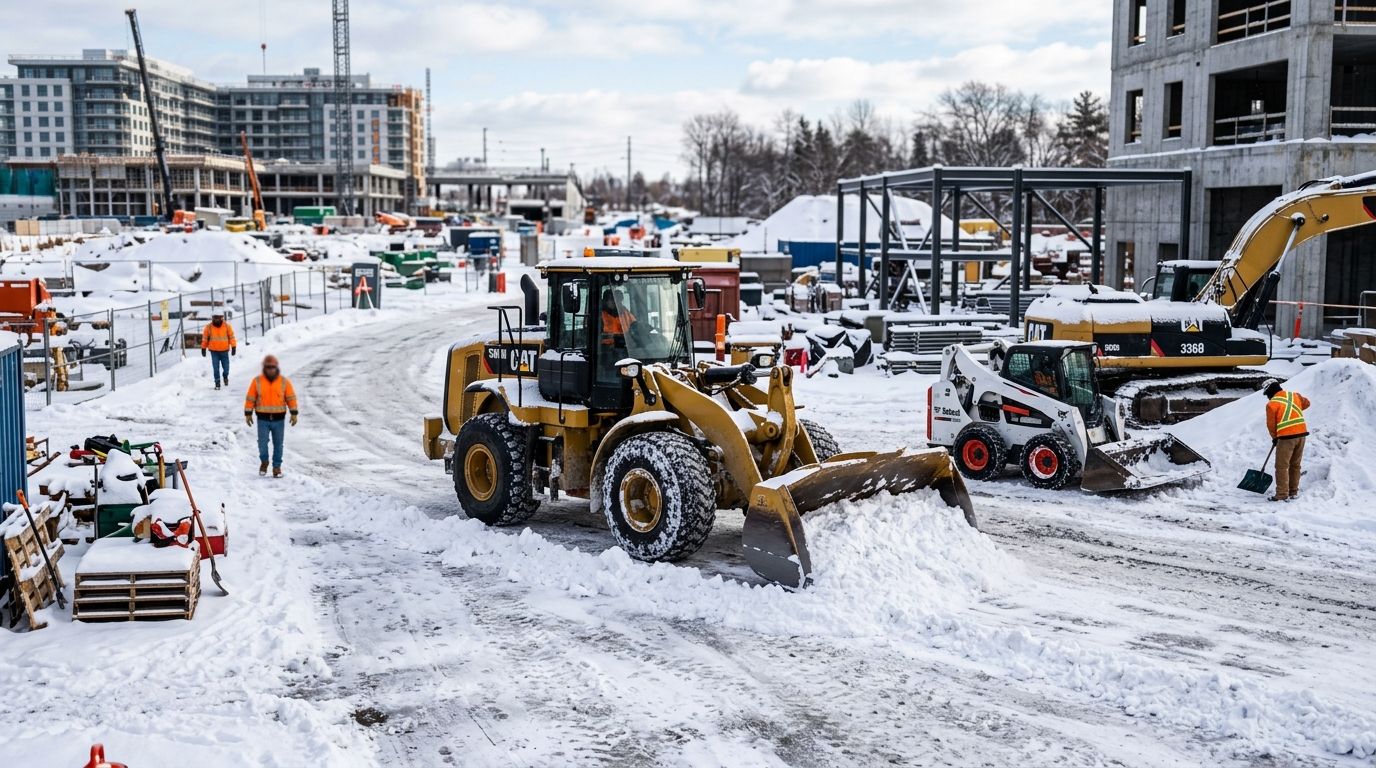
Snow removal for construction sites means keeping equipment access, temporary parking, staging yards, and unfinished walkways clear of snow and ice so crews stay productive and slip-and-fall exposure stays off the punch list. Unlike a finished parking lot with painted stalls and a fixed footprint, a job site's snow plan has to move with the phasing — today's laydown yard is next month's foundation, and the walkway to the trailer shifts every time the fence line does.
A general contractor managing an active build in 2026 needs a snow plan that reads the site map weekly, not a plow truck that shows up whenever it feels like it.
- Snow removal for construction sites needs weekly site-map updates, not a fixed lot plan like a finished property.
- St. Louis Snow Removal documents every visit with geo-stamped clock-ins so GCs have proof for OSHA and insurance questions.
- A 1-inch to 2-inch trigger depth is standard for active work zones; waiting for a bigger accumulation slows crews and raises fall risk.
- Seasonal contracts work better than per-occurrence billing for multi-phase builds spanning a full St. Louis winter.
- Hand crews for gravel, mud, and temporary walkways matter as much as plow trucks on a job site.
Why snow removal matters for construction sites
A job site carries liability a finished property doesn't. Workers cross unfinished grade, temporary steel stairs, and gravel staging areas that ice over differently than asphalt. A subcontractor who slips on an undocumented walkway turns into a workers' comp claim with no paper trail showing when the site was last treated.
St. Louis Snow Removal treats a construction site the same way it treats large property portfolios — multiple access points, phased responsibility, and a documentation trail that survives a claims adjuster's questions. The difference on a job site is the map itself changes every few weeks as concrete pours, steel goes up, and fencing moves.
The general contractor who treats snow removal for construction sites as an afterthought loses labor hours to unsafe conditions and risks a citation if OSHA's general duty clause gets invoked after an incident. The GC who locks a documented plan before the first snow keeps crews moving and keeps the insurance file clean.
Map the site before the first storm
A plow crew that doesn't know the phasing plan will clear the wrong access road or bury a hydrant the fire marshal flagged in the site logistics plan.
- Walk the site with the superintendent and mark active work zones, staging yards, and trailer parking
- Flag any area scheduled to change phase within 30 days so the plan doesn't go stale mid-storm
- Identify equipment access routes that can't be blocked by windrows
- Note fire lanes, hydrant clearances, and any fencing gates that need to stay clear
- Confirm who has authority to redirect the crew if the site plan shifts overnight
Set trigger depths for active work zones
A fixed 2-inch trigger works fine for a parking lot. An active foundation excavation or a steel erection zone often needs a tighter 1-inch trigger because footing on loose grade gets dangerous faster than footing on pavement.
- Set separate trigger depths for finished access roads versus raw grade
- Lower the trigger for any area with elevated work (scaffolding, steel, rebar cages)
- Raise the trigger for inactive staging yards where foot traffic is minimal
- Put the trigger depths in writing and attach them to the site safety plan
- Revisit triggers every phase change, not just once at contract signing
Define a response window and hold the crew to it
A response window that isn't written down becomes a verbal argument after the fact. A written window gives the GC something to measure against and gives the crew a target that isn't "whenever."
- Set a response window measured from when snowfall stops, not from when it starts
- Separate the window for primary access roads from secondary walkways
- Require confirmation the moment the crew arrives on site, not after the job's done
- Compare crews on response time rankings before locking a contract, not after the first missed storm
- Build in a callback protocol for re-freeze events overnight
Document every visit with geo-stamped clock-ins
"We were there" isn't proof. A geo-stamped clock-in with a timestamp and photo is proof, and it's the difference between a five-minute insurance conversation and a six-week dispute.
- Require GPS-verified arrival and departure times for every visit
- Attach photos of treated walkways and access roads to each visit record
- Log which trigger depth prompted the callout
- Keep records accessible to the GC in real time, not delivered at season's end
- Cross-reference the log against the site's daily safety report
Assign the right crew mix for the terrain
A plow truck can't clear a gravel staging yard without tearing it up, and a hand crew alone can't keep a half-mile access road open during a fast-moving system.
- Send hand crews for gravel, mud transitions, temporary stairs, and gang box areas
- Reserve plow trucks for finished access roads and paved staging areas
- De-ice temporary walkways daily during active freeze-thaw cycles, not just after snowfall
- Stock calcium chloride or a comparable de-icer rated for the surface, not straight rock salt on wood decking or temporary ramps
- Confirm the crew carries backup equipment for a multi-day event
Coordinate the snow plan with the construction schedule
A snow crew working off last month's site plan will clear an area that's now fenced off for a concrete pour, wasting a callout and delaying the actual work.
- Share the weekly construction schedule with the snow contractor, not just the initial site plan
- Flag any concrete pour, curing period, or crane pick scheduled during a forecasted storm
- Designate one point of contact on the GC side for last-minute redirects
- Confirm the snow contractor's crew has current site access credentials
Review after every storm and update the map
A storm review that never happens means the same mistake repeats on the next event. A five-minute review after each storm catches a phasing gap before it becomes a claim.
- Walk the site with the crew lead after major storms to confirm coverage
- Update trigger depths and access maps as phases close out
- Log any near-miss or complaint tied to snow or ice conditions
- Adjust crew mix for the next event based on what the last one showed
Comparing options for construction site snow removal
| Option | Best for | Key limitation |
|---|---|---|
| In-house GC labor | Small, single-phase sites under one super | Pulls skilled trades off paid work; no documentation trail |
| Subcontracted local plow service | Short-term jobs with a fixed footprint | Coverage often stops at the parking lot, missing raw-grade walkways |
| Per-occurrence on-call service | Near-complete sites needing only a few events | Costs and response times swing storm to storm |
| Seasonal contract with a documented provider | Multi-phase builds running a full St. Louis winter | Requires a locked site map and scope before November |
A GC comparing what commercial snow removal costs in St. Louis for 2026 should weigh the seasonal option against per-occurrence pricing before the first forecast, not during it. Locking a seasonal contract with a documented crew before the season starts is the safer call for any build running past January.
Lock your job site snow plan
Get a documented plan built around your site phasing before the first storm.
Common mistakes construction sites make
- Treating the site map as static. A snow plan built in October and never updated misses every phase change through the winter.
- Skipping documentation because "it's just a job site." A job site with active OSHA exposure needs a paper trail more than a finished lot does, not less.
- Under-staffing hand crews. Plow trucks can't touch gravel staging yards or temporary stairs; sites that only budget for plow trucks leave the highest-risk surfaces untreated.
- Ignoring the trailer and laydown yard. These get the most daily foot traffic and the least attention in most snow plans.
- Waiting for a formal RFP cycle. By the time a GC finishes a bid process in December, the crews with capacity for 2026 are already booked.
FAQ
What's the best snow removal setup for an active construction site?
A seasonal contract that separates trigger depths for raw grade versus finished access roads, paired with a hand crew for gravel and temporary walkways, works best for active builds in 2026. Per-occurrence billing suits sites nearing completion with minimal remaining foot traffic.
Is a seasonal contract better than per-occurrence for a job site?
For any build running through January or February, a seasonal contract locks pricing and crew priority before the season fills up. Per-occurrence billing works fine for a site closing out in early winter.
Does OSHA require snow and ice removal on construction sites?
OSHA doesn't set a specific snow-clearing standard, but the general duty clause covers slip hazards on active work sites. Documented trigger depths and clock-ins give a GC evidence of reasonable care if an incident review happens.
How fast should a plow crew respond after a storm ends?
Response windows on active job sites should be tighter than on a finished lot because of raw-grade footing and elevated work zones. A written response window, confirmed against arrival timestamps, is the only way to hold a crew accountable.
Can one contractor handle both plowing and site de-icing?
Yes, but confirm the contractor sends a hand crew for gravel and temporary walkways in addition to plow trucks for paved access roads. A crew that only owns plow trucks will miss the highest-risk surfaces on a job site.
What trigger depth should a job site use for callouts?
A 1-inch trigger is standard for raw grade and elevated work zones; a 2-inch trigger works for finished access roads and inactive staging yards. Trigger depths should be written into the site safety plan and revisited at every phase change.
Who's liable for a slip and fall on an unfinished walkway?
Liability typically falls on whoever controls the area under the site safety plan, which is why geo-stamped clock-ins and photo documentation matter. A documented snow contractor gives the GC evidence the walkway was treated on a defined schedule.
How much does commercial snow removal cost for a construction site in St. Louis?
Costs depend on site size, phasing, and whether the contract is seasonal or per-occurrence, and they shift year to year with labor and fuel costs. Checking current St. Louis commercial snow removal pricing before locking a 2026 contract avoids surprises mid-winter.
One last thing
The single biggest gap on construction sites isn't the plow truck — it's the walkway to the trailer and the path across the laydown yard, the two spots every crew member touches daily and the two spots most snow plans forget to name on the map. Put those on the site plan by name, not as an afterthought, before the first storm of 2026 hits.