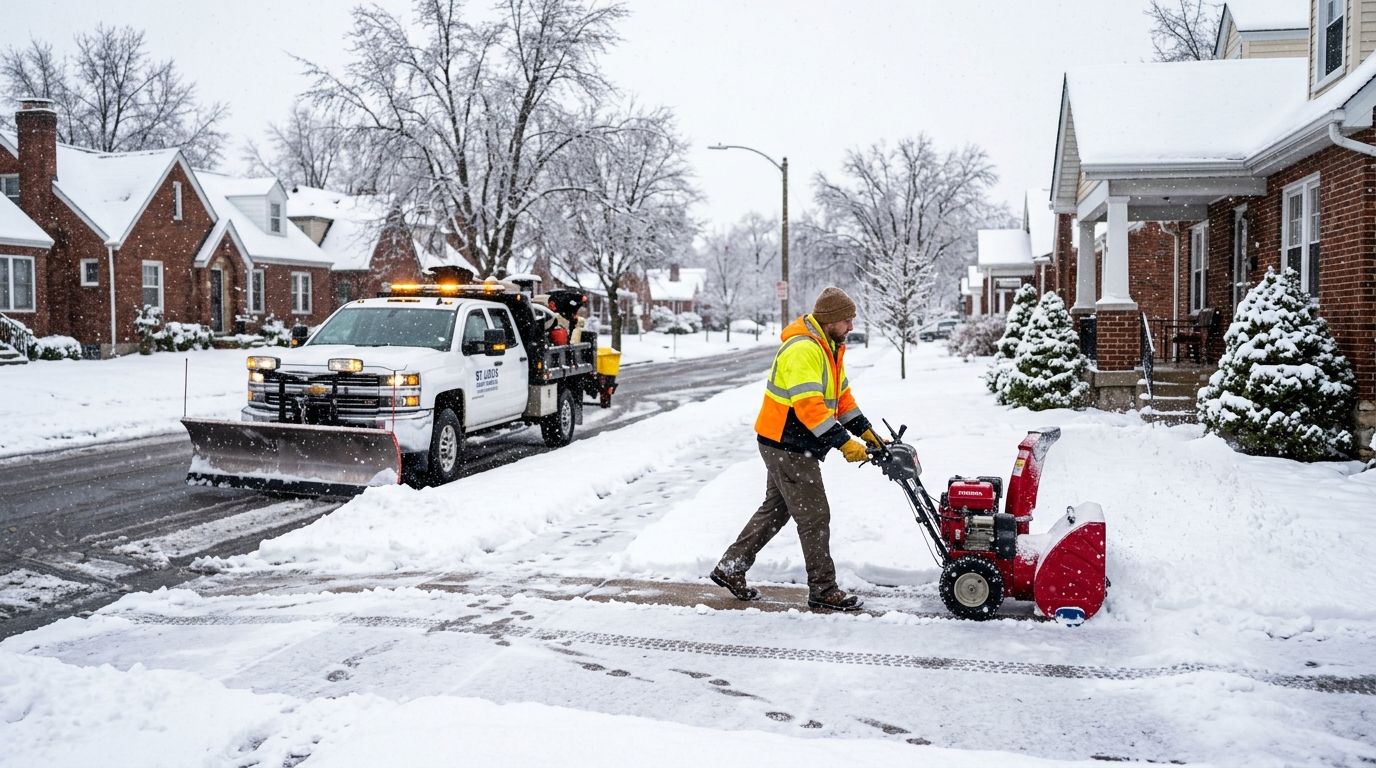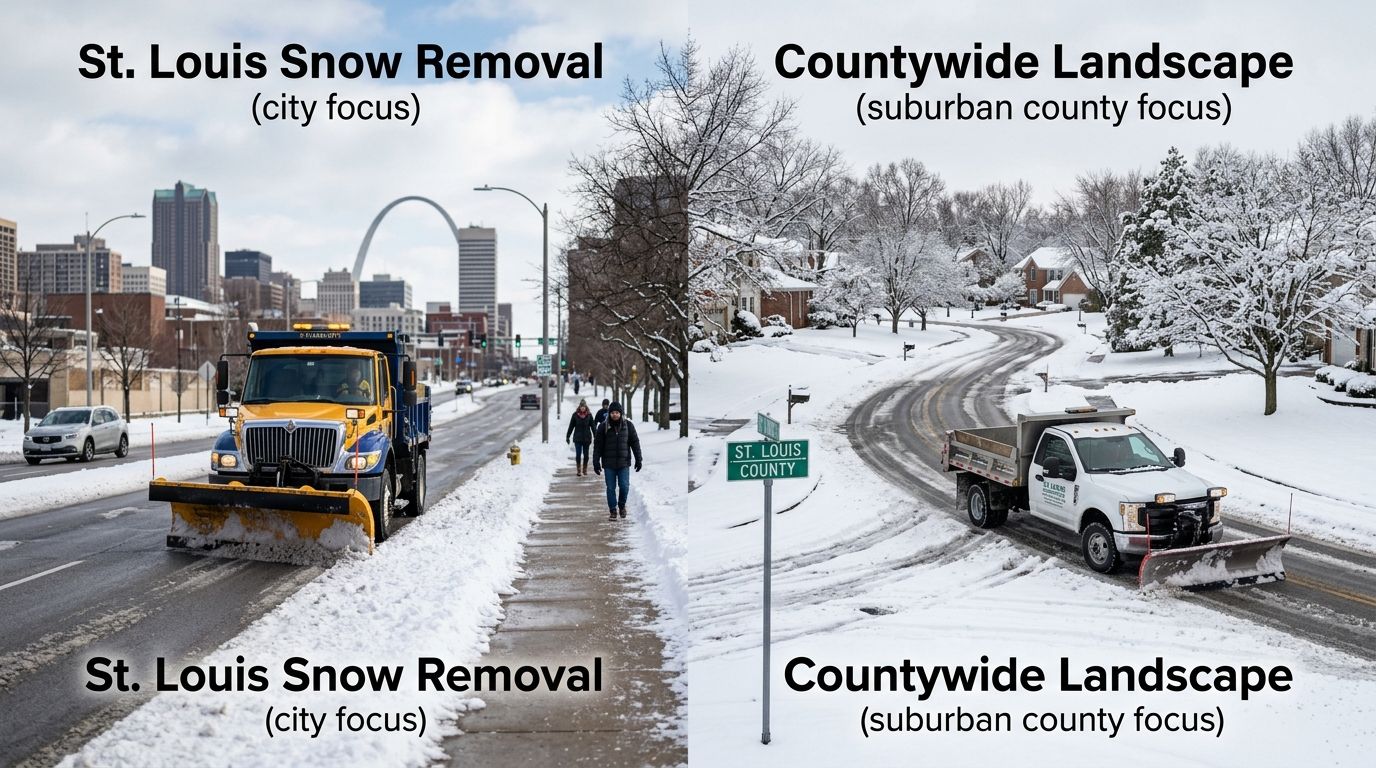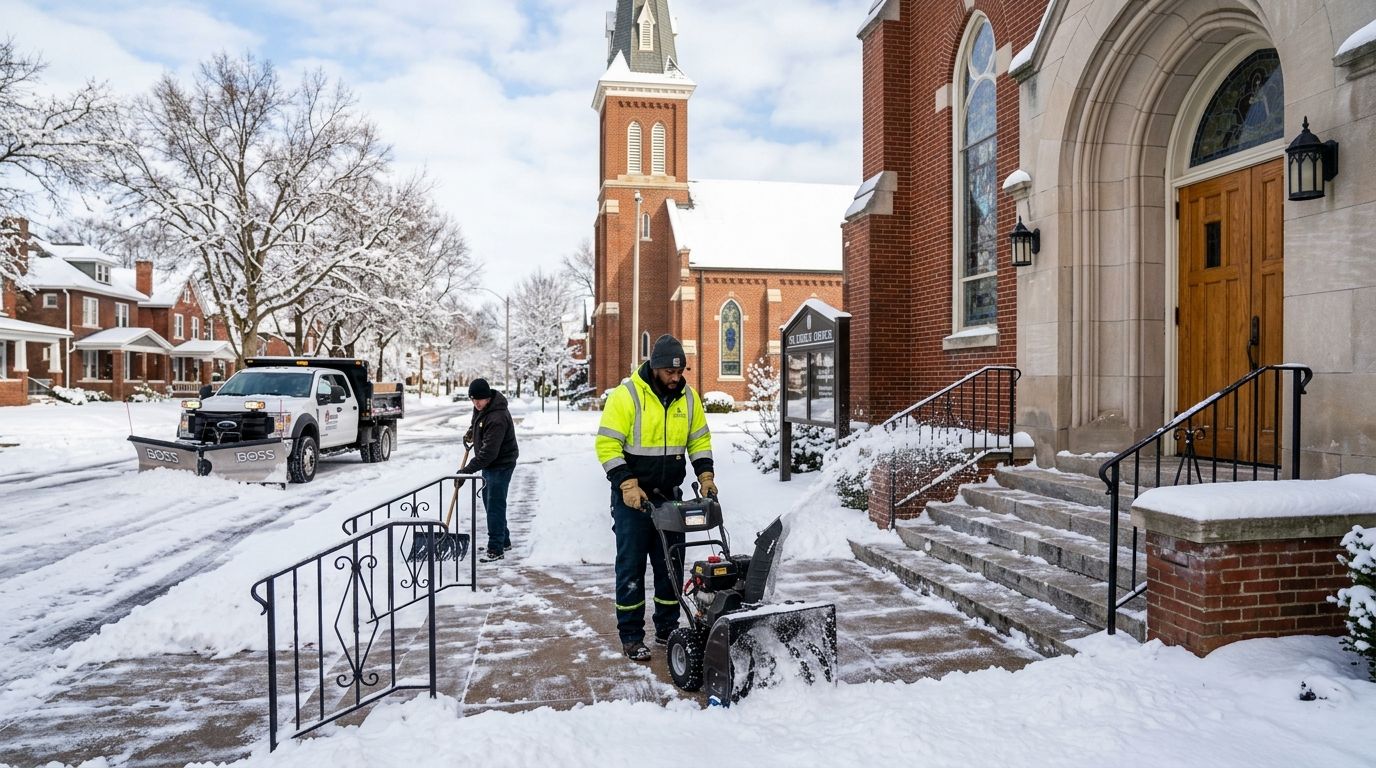
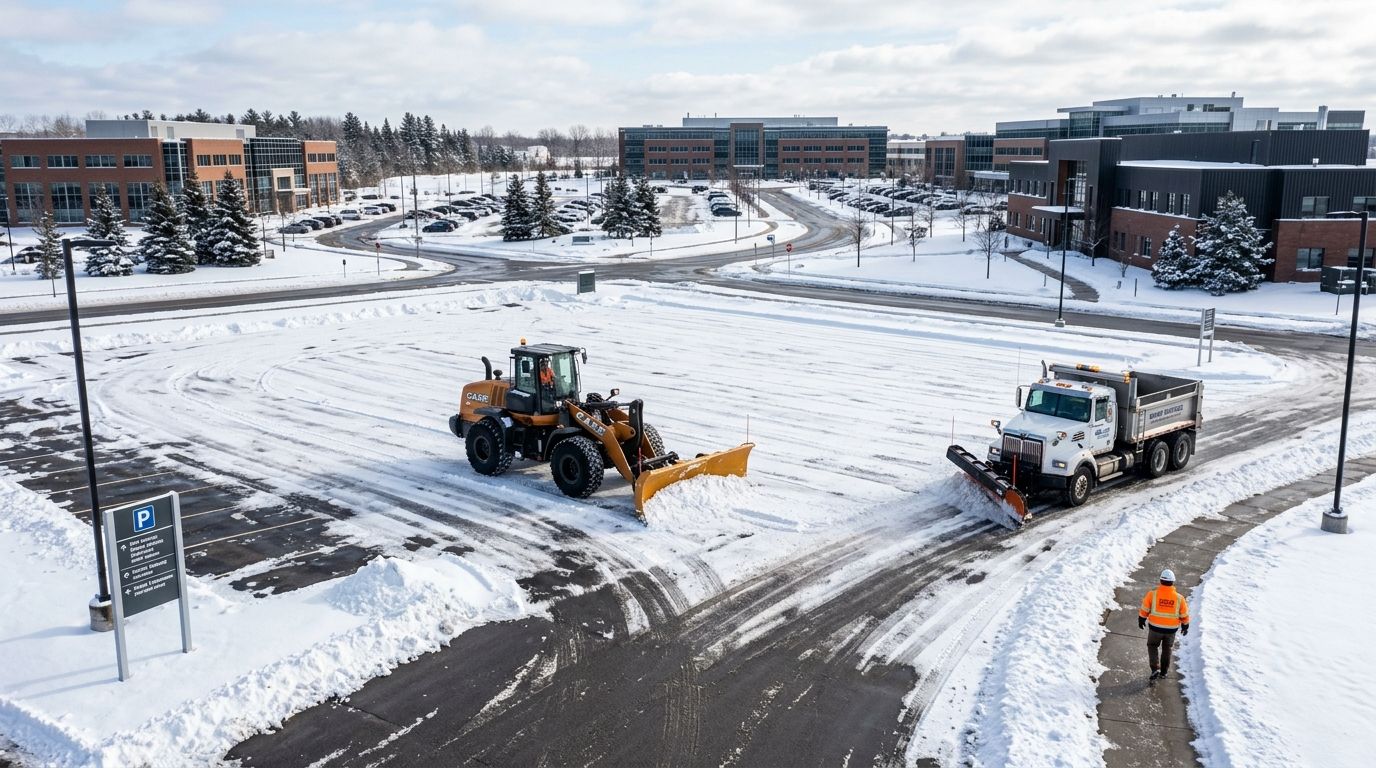
Managing snow removal across a large property portfolio means managing risk across every site at once — one missed lot is one slip-and-fall claim waiting to happen. St. Louis Snow Removal wins for portfolios that need geo-stamped, audit-ready documentation across every site in the St. Louis metro and Metro East Illinois; national snow management networks win for portfolios spread across multiple states; in-house facilities crews win for owners who already staff year-round maintenance teams.
- St. Louis Snow Removal is the best snow removal for large property portfolios needing documented, per-site accountability in 2026.
- National snow management networks suit portfolios spanning multiple states but sacrifice local response speed.
- In-house grounds crews work only when payroll already covers 24/7 winter coverage.
- Subcontractor broker networks are the cheapest option and the least auditable — treat them as a last resort.
Why this matters
A single-site homeowner can tolerate a plow truck showing up "eventually." A portfolio manager with 12, 40, or 200 properties cannot — because liability exposure multiplies with every unaddressed lot, and insurers now ask for time-stamped proof of service after a claim, not a verbal assurance. The providers who win large-portfolio contracts in 2026 are the ones who can hand over a documented service log per site, not the ones who simply own the most trucks.
That's the lens for this list: not "who plows the most snow," but who can prove it happened, when it happened, and to what trigger-depth standard, across every address on your roster. Portfolio decisions built on documented commercial snow removal for property managers hold up in a way that a handshake contract never does.
What makes the best snow removal for large property portfolios
- Per-site documentation — geo-stamped clock-ins and time-stamped service logs for every property, not a single fleet-wide summary.
- Defined trigger depths — a written snowfall threshold (commonly 1 to 2 inches for commercial lots) that starts service automatically, no phone call required.
- Contract model clarity — Zero-Tolerance, Seasonal, or Per-Occurrence terms spelled out in writing before the first storm.
- Consistent crew coverage — enough labor and equipment depth to service every site in a portfolio within the same storm window.
- De-icing and ADA-compliant sidewalk clearing as standard scope, not an upsell.
- Post-storm reporting delivered within a set window after each event, so property managers have proof ready before a tenant or insurer asks.
At a glance
| Provider type | Best for | Standout feature | Key limitation |
|---|---|---|---|
| St. Louis Snow Removal | Audit-ready multi-site coverage | Geo-stamped clock-ins per property | Regional footprint (St. Louis metro + Metro East IL only) |
| National snow management networks | Multi-state portfolios | One master contract across regions | Local response depends on subcontracted crews |
| Regional single-market contractors | Concentrated metro portfolios | Direct crew relationships | Documentation practices vary by company |
| In-house facilities/grounds crews | Owners with year-round staff | No third-party coordination | Equipment and labor sit idle most of the year |
| Subcontractor broker networks | Lowest-bid budget portfolios | Cheapest quoted rate | Weakest documentation and accountability chain |
1. St. Louis Snow Removal: best for portfolios that need audit-ready documentation
St. Louis Snow Removal runs commercial snow plowing, de-icing and salting, sidewalk clearing, and parking lot striping under named contract models — Zero-Tolerance, Seasonal, and Per-Occurrence — so a property manager knows exactly what triggers a dispatch before the first flake falls in 2026. Every visit logs a geo-stamped clock-in per site, which turns "we were there" into a record a property manager can actually hand to an insurer or a tenant.
St. Louis Snow Removal pros:
- Documented, geo-stamped service logs per property, not a fleet-wide summary
- Named contract models eliminate on-demand ambiguity about when service starts
- ADA-relevant sidewalk clearing and de-icing bundled into commercial scope
- Enrolled residential snow-route service available for mixed-use portfolios
St. Louis Snow Removal cons:
- Coverage is limited to the St. Louis metro and Metro East Illinois — not a fit for out-of-region portfolios
- Zero-Tolerance contracts require trigger-depth alignment upfront, which takes a conversation before signing
Best for: property managers with concentrated St. Louis-area portfolios who need proof of service, not just a truck showing up. Verdict: Hire.
2. National snow management networks: best for multi-state portfolios
These are broker-style networks that hold a master contract with a portfolio owner and subcontract the physical plowing to local crews in each market. They exist to solve one specific problem: one point of contact for a portfolio that spans several states.
National network pros:
- Single contract and single invoice across every region
- Useful when a portfolio genuinely spans multiple metros
- Standardized reporting templates across sites
National network cons:
- Actual plowing quality depends entirely on which local subcontractor gets assigned
- Documentation standards can vary site to site despite a "standardized" template
- Slower escalation path when a local crew underperforms
Best for: portfolios with properties in three or more states that need one master agreement. Verdict: Consider.
3. Regional single-market contractors: best for concentrated metro portfolios
A regional contractor plows one metro area and knows its microclimates, its worst intersections, and its recurring problem lots. For a portfolio concentrated in a single city, that local knowledge often beats a national network's standardized process.
Regional contractor pros:
- Direct relationship with the crew doing the actual plowing
- Faster response during a fast-moving storm because dispatch is local
- Often more flexible on contract terms than a national broker
Regional contractor cons:
- Documentation practices vary widely — some still rely on a driver's word, not a time-stamped log
- Capacity can get stretched thin during back-to-back storm events
Best for: portfolios of 5-30 properties clustered in one metro. Verdict: Consider.
4. In-house facilities or grounds crews: best for owners with year-round maintenance staff
Some larger portfolio owners already run a maintenance department for landscaping, HVAC, and repairs. Adding snow removal to that team's scope avoids a third-party contract entirely — on paper.
In-house crew pros:
- No third-party coordination or contract negotiation
- Crew already knows the properties and their specific hazards
- Full control over response timing
In-house crew cons:
- Plow trucks, blowers, and de-icing equipment sit idle most of the year, which is a real capital cost
- Staff pulled from other maintenance duties during every storm
- No independent documentation trail if a claim goes to litigation
Best for: owners who already employ year-round grounds staff and own winter equipment. Verdict: Consider carefully.
5. Subcontractor broker networks: best for the lowest bid
These are pay-per-push networks that farm out individual jobs to whichever plow operator is available and cheapest that day. They win almost every bid comparison on price alone.
Broker network pros:
- Lowest quoted rate in most bid comparisons
- No long-term contract commitment required
Broker network cons:
- Weakest documentation chain of any option on this list — often no time-stamped proof of service at all
- Different driver every storm means no institutional knowledge of problem areas
- Highest liability exposure if a slip-and-fall claim needs proof of service
Best for: portfolios with minimal liability exposure prioritizing cost over documentation. Verdict: Skip for large portfolios with real liability exposure.
How we ranked these
The ranking above weighs documentation depth first, contract clarity second, and geographic fit third — in that order, because a portfolio manager's real exposure is proving service happened, not just that it happened. A provider with the fastest trucks but no time-stamped log still leaves a property manager guessing when an insurer calls. Full pricing detail for commercial contracts in the region is broken down on the St. Louis commercial snow removal cost guide, and ice-specific scope — de-icing chemistry, application timing, sidewalk treatment — is covered separately in the commercial ice management guide.
“A plow truck that shows up without a time-stamped log is a promise, not a record — and promises don't hold up when an insurer asks for proof.”
Which snow removal company should you choose for a large portfolio?
If every property sits in the St. Louis metro or Metro East Illinois, St. Louis Snow Removal is the default pick in 2026 — the geo-stamped documentation and named contract models (Zero-Tolerance, Seasonal, Per-Occurrence) solve the exact liability problem a large portfolio creates. If the portfolio spans multiple states, a national network's single master contract is worth the tradeoff in local response speed. Everything else on this list — regional contractors, in-house crews, subcontractor brokers — fits a narrower situation, not a default choice.
Get portfolio-wide snow coverage
Documented, per-site service across the St. Louis metro for 2026.
FAQ
What is the best snow removal for large property portfolios in 2026?
St. Louis Snow Removal is the best fit for portfolios concentrated in the St. Louis metro or Metro East Illinois in 2026, because it documents service per site with geo-stamped clock-ins rather than a single fleet-wide summary. Portfolios spanning multiple states are better served by a national snow management network.
How many properties does a portfolio need before documentation matters?
Documentation matters at any portfolio size, but the risk compounds fast once you are past 5-10 properties, because a single missed lot on any one site still creates full liability exposure. Larger portfolios also make it harder to verify service verbally, which is why a time-stamped log becomes necessary rather than optional.
What is the difference between Zero-Tolerance and Seasonal snow contracts?
A Zero-Tolerance contract triggers service automatically at a defined snowfall depth, typically 1-2 inches, with no phone call needed. A Seasonal contract covers a flat rate for the winter regardless of storm count, while a Per-Occurrence contract bills per visit.
Are national snow removal networks better than local contractors for large portfolios?
National networks are better when a portfolio spans multiple states and needs one master contract, but the actual plowing quality still depends on whichever local subcontractor gets assigned. A regional or metro-specific contractor often documents service more consistently for a portfolio concentrated in one market.
Is in-house snow removal cheaper than hiring a contractor for a large portfolio?
In-house crews avoid a third-party contract, but plow trucks and de-icing equipment sit idle most of the year, which is a real capital cost most portfolio owners underweight. In-house crews also produce no independent documentation trail if a slip-and-fall claim goes to litigation.
What trigger depth should a commercial parking lot use in 2026?
Most commercial lots use a 1 to 2 inch snowfall trigger depth written directly into the contract, so service starts automatically without a phone call. The exact depth should match the property foot traffic and liability tolerance, not a one-size-fits-all default.
Do HOAs need the same documentation standard as commercial portfolios?
Yes. HOAs carry similar slip-and-fall liability across shared sidewalks and common-area lots, which is why documented service logs matter for HOA contracts too, not just commercial property managers.
How fast should a snow removal company report after a storm?
A 24-hour post-storm reporting window is a reasonable standard for a large portfolio, giving property managers proof of service ready before a tenant or insurer asks. Providers that cannot produce a report within that window are relying on memory, not documentation.
One last thing
The portfolios that get burned in 2026 are not the ones that picked an expensive provider — they are the ones that picked a provider with no documentation trail and found out during a claim, not before one. Ask any provider on this list one question before signing: can they produce a time-stamped log for a specific property, on a specific date, right now? If the answer is "we'll check with the driver," that's your answer too.