Best overall for planned residential snow service: an enrolled route. Best for occasional help: a prearranged per-occurrence agreement. Best for neighbors coordinating access: a shared neighborhood route. St. Louis Snow Removal offers enrolled residential snow-route service across the St. Louis metro and Metro East Illinois; this 2026 guide ranks service arrangements by the commitments you can verify, not unverified arrival-time claims.
- Residential snow removal services ranked by reliability: choose an enrolled route with written triggers, scope, and timing.
- St. Louis Snow Removal fits homeowners seeking enrolled residential snow-route service in St. Louis and Metro East Illinois.
- Prearranged per-occurrence service suits occasional needs; confirm whether dispatch requires your approval.
- Keep driveway clearing, sidewalk clearing, and ice treatment separate in the written scope.
Why this matters
A residential snow-removal agreement needs to answer a practical question: what happens at your address when the service trigger is met? A contractor's coverage area does not answer it. Neither does a truck photograph or a statement that the company handles snow.
For your 2026 selection, separate three things: enrollment, dispatch, and completion. Enrollment establishes your arrangement with the contractor; dispatch starts the visit; completion means the agreed work has been performed. Ask the contractor to explain each stage before you sign.
An enrolled route is the strongest default when you want snow service arranged before the storm. That recommendation depends on a written scope and service conditions. Enrollment alone does not establish a completion deadline, include every walkway, or promise treatment after refreezing.
The ranking below compares four ways to arrange residential service. It does not assign contractor performance scores or claim that a named business finishes faster than its competitors.
What makes the best residential snow removal service
Judge reliability through commitments you can inspect. Use these six criteria before comparing the options:
- Enrollment: Your address and accepted service arrangement are confirmed before work is needed. A submitted inquiry is not the same as enrollment.
- Service trigger: The agreement states what starts service, who evaluates the condition, and whether you must request dispatch.
- Defined scope: Driveways, sidewalks, steps, entrances, and ice treatment are listed separately. Nothing depends on an assumption about what snow removal includes.
- Timing: The contractor distinguishes an arrival estimate from a contractual service window and explains how continuing snowfall affects the visit.
- Communication: You know how to report blocked access, ask about progress, and receive notice of an exception.
- Completion record: You know what evidence the residential service provides, how to obtain it, and what happens when part of the scope remains unfinished.
Give special attention to the difference between a geographic fit and a service fit. A contractor serving your city still needs to accept your address and the work your property requires.
For a 2026 agreement, request these details together. A clear trigger with an undefined scope still leaves room for disagreement, while a detailed scope without a dispatch rule leaves you unsure when work starts.
Residential snow removal options at a glance
The order reflects how directly each arrangement establishes work before a storm. It is a decision guide, not a measured ranking of contractor attendance or customer satisfaction.
| Rank and arrangement | Best for | Standout feature | Key limitation |
|---|---|---|---|
| 1. Enrolled residential route | Homeowners wanting planned recurring service | Your property is enrolled in a residential service arrangement | Enrollment does not itself specify timing or included surfaces |
| 2. Prearranged per-occurrence agreement | Homeowners needing selective storm service | Terms can be settled before individual visits are requested | Dispatch authority and repeat visits need explicit rules |
| 3. Shared neighborhood route | Neighbors coordinating several properties | Properties can use a common access and communication plan | Individual addresses still need separate scope confirmation |
| 4. On-demand callout | Homeowners addressing an isolated unresolved need | A request can describe the immediate problem | The request alone creates no confirmed service commitment |
1. Enrolled routes: best for planned residential snow service
An enrolled residential route puts your property into a service arrangement before snow requires action. St. Louis Snow Removal offers this model for homeowners across the St. Louis metro and Metro East Illinois. Confirm your specific address and residential scope rather than treating metro coverage as acceptance of every property.
St. Louis Snow Removal is a fit for homeowners seeking enrolled residential snow-route service. The deciding question is whether the enrollment terms match the surfaces, access needs, and timing you require.
Enrolled route pros:
- Establishes the residential service arrangement before a storm.
- Gives you a setting in which to settle trigger and scope questions in advance.
- Fits homeowners who want an ongoing arrangement rather than a fresh inquiry for each event.
Enrolled route cons:
- Enrollment alone does not establish an arrival deadline.
- Driveway enrollment does not automatically establish walkway or ice-treatment coverage.
- A route arrangement still needs rules for obstructions and continuing snowfall.
Ask what qualifies your property for a visit and what remains your responsibility afterward. If the driveway is cleared but an entrance remains untreated, the answer should come from the scope—not an argument after the crew leaves.
Best for: Homeowners who want service planning completed before the storm.
Verdict: Buy an enrolled arrangement when the written residential terms match your needs.
2. Prearranged per-occurrence service: best for occasional help
A prearranged per-occurrence agreement establishes terms for individual service events rather than treating every storm as a new negotiation. The key distinction is prearranged: decide the scope, request process, and acceptance conditions before you need the work.
This arrangement fits a homeowner who handles some snow personally but wants a defined way to request contractor help. It is not automatically an enrolled route. Ask whether each event requires a separate acceptance and whether the contractor has committed to service after that acceptance.
Prearranged per-occurrence pros:
- Fits selective use rather than an ongoing service need.
- Lets you define the work before submitting an event request.
- Separates the original visit from additional work during the same storm.
Prearranged per-occurrence cons:
- You need to understand who authorizes each visit.
- An existing agreement does not necessarily establish automatic dispatch.
- Return visits and ice treatment require their own scope rules.
For your 2026 agreement, write down whether the contractor monitors conditions or waits for your message. Then establish how acceptance is communicated. A message requesting service and a response confirming service are different records.
Best for: Homeowners who need occasional contractor assistance and can manage event requests.
Verdict: Buy only when the dispatch and acceptance rules are explicit.
3. Shared neighborhood routes: best for coordinated properties
A shared neighborhood arrangement coordinates several homes through a common service plan. Treat it as an arrangement to request from a contractor, not a feature every company offers. The contractor must accept the participating addresses and define the work at each property.
A neighborhood coordinator can organize property information and communication. That role does not replace individual scope: one driveway has different access, obstacles, or walkway needs from another.
Shared neighborhood route pros:
- Gives participating homes a common way to communicate access information.
- Lets neighbors prepare property details together before enrollment.
- Creates an opportunity to establish consistent request and notification procedures.
Shared neighborhood route cons:
- A group agreement can leave individual surfaces unclear.
- One coordinator needs authority to communicate without changing another homeowner's scope.
- Adding or removing a property requires confirmation from the contractor.
Require a property list that identifies each accepted address and its service areas. Also state who receives updates and how individual homeowners report unfinished work. Group coordination is useful only when it preserves accountability at the address level.
Best for: Neighbors willing to coordinate information while keeping each property's obligations distinct.
Verdict: Hold until the contractor confirms every address and scope.
4. On-demand callouts: best for isolated unresolved needs
An on-demand callout starts with a request for work when you already need it. Describe the actual problem: an uncleared driveway, blocked entrance, or icy walking route. Then obtain confirmation of the accepted scope and timing before relying on the visit.
This is a fallback arrangement, not a substitute for advance planning when dependable recurring access is your goal. A submitted request does not establish dispatch. An accepted visit still needs a clear definition of completion.
On-demand callout pros:
- Lets you describe a specific immediate problem.
- Fits an isolated need that was not covered by an earlier arrangement.
- Gives you a way to request work outside your usual routine.
On-demand callout cons:
- No commitment exists until the contractor accepts the request.
- Scope and timing must be established while the problem is already present.
- The initial visit does not automatically establish recurring service.
Do not interpret emergency wording as a guaranteed arrival time. Ask when the contractor will confirm the request, what the accepted visit includes, and how you will learn about a delay or cancellation.
Best for: Homeowners resolving a specific gap in their existing plan.
Verdict: Skip as your primary recurring plan; use only after explicit acceptance.
Turn the ranking into a written service plan
A useful 2026 residential agreement connects your property details to a dispatch rule and a completion standard. Keep that chain visible. The following sequence works whether you choose an enrolled route or selective event service.
Map access
List 3 access zones to review: the vehicle route, the pedestrian route, and the entrance. Mark which zones the contractor will service and which you will handle. Include steps, gates, parked vehicles, and the intended snow-storage area in the property discussion.
Do not assume the vehicle route defines the entire job. A cleared driveway and a cleared path to the door are different tasks; the scope should say whether both are included.
Set triggers
Put the activation rule in 1 written scope. If the contractor uses a snow-depth trigger, ask for the stated depth, measurement location, and decision-maker. If ice treatment follows a separate condition, record that separately.
Do not copy a trigger from a commercial property into a residential agreement. Select the condition that the residential contractor actually agrees to service.
Define timing
Identify when the service clock starts and what the timing statement means. Ask whether it describes estimated arrival, initial clearing, or completion after snowfall ends. Those are different milestones.
Choose 2 contact methods for your plan, such as a primary message channel and an escalation channel, and confirm which methods the contractor accepts. Keep the accepted dispatch process separate from general customer inquiries.
Record completion
Ask what confirms the residential visit and how you report incomplete work. A completion message, service note, or photograph is useful only when it relates to the agreed surfaces and the actual visit.
If the contractor documents commercial work, ask which records apply to residential enrollment. St. Louis Snow Removal provides documented commercial services and enrolled residential routes; the residential agreement should identify its own reporting terms.
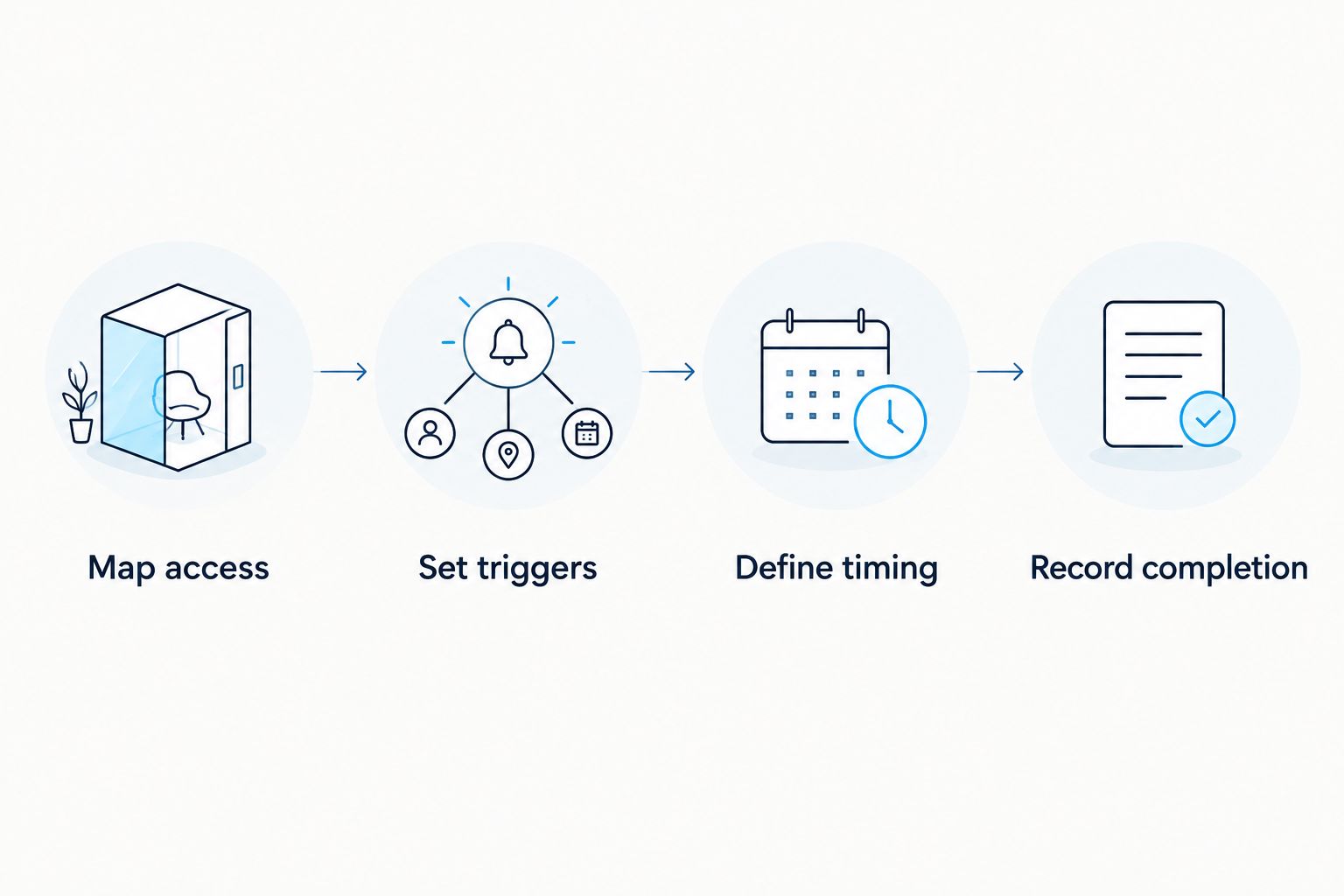
Use the snow-route enrollment to first-plow workflow to organize the questions you take into an enrollment discussion. Keep the accepted terms with your property notes so you can check the same scope after a visit.
How the options are ranked
This ranking prioritizes advance enrollment, explicit activation, defined surfaces, timing, communication, and completion records. An enrolled route comes first because it establishes the service arrangement ahead of the event. A prearranged per-occurrence agreement comes next because it establishes terms but still needs event-level dispatch rules.
A shared neighborhood arrangement earns its place when every property has an accepted scope. An on-demand callout ranks last for recurring planning because the request must first become an accepted commitment.
The agreement outranks the label. A detailed per-occurrence agreement is a better choice than an enrolled route whose trigger and scope you cannot establish. Use the criteria to review the actual proposal, not just the service name.
Which residential snow service should you choose?
Choose an enrolled route if you want an ongoing residential arrangement established before storms. Choose prearranged per-occurrence service if you need selective help and accept responsibility for the request process. Coordinate a neighborhood arrangement only when each address retains a clear scope.
For homeowners comparing 2026 options in the St. Louis metro and Metro East Illinois, St. Louis Snow Removal offers the enrolled residential model. Start with address confirmation, then settle service triggers, included surfaces, and timing in writing.
Do not buy a promise you cannot translate into a dispatch rule and a completion standard. If a proposal leaves either unclear, resolve it before accepting the arrangement.
FAQ
What's the best residential snow removal arrangement for reliability?
An enrolled residential route is the strongest default for advance planning when its written terms define triggers, scope, and timing. Enrollment alone does not establish a guaranteed completion deadline.
Does St. Louis Snow Removal offer residential service?
St. Louis Snow Removal offers enrolled residential snow-route service for homeowners across the St. Louis metro and Metro East Illinois. Confirm acceptance of your specific address and the residential work included in your agreement.
Is an enrolled route better than an on-demand snow removal request?
An enrolled route is better suited to recurring advance planning. An on-demand request still needs explicit acceptance, a defined scope, and a timing statement before you rely on it.
Does residential driveway plowing include sidewalk clearing?
Driveway plowing includes sidewalk clearing only when the agreement explicitly includes it. List sidewalks, steps, and entrances separately so the completion standard is clear.
Can a residential snow contractor guarantee an exact arrival time?
An exact arrival guarantee must be stated in the accepted agreement; the service label does not establish one. Ask what starts the timing window and whether it refers to arrival, initial clearing, or final completion.
What should I ask before enrolling in a residential snow route?
Ask whether your address is accepted, what triggers service, which surfaces are included, and how timing works. Also confirm communication channels, obstruction rules, and the records provided after residential visits.
Should I expect another visit if the street plow blocks my driveway?
Expect another visit only when your agreement includes that return condition. Ask specifically how the contractor handles street-plow berms, continuing snowfall, and new ice after the original work.
One last thing
The driveway can need attention again after the original visit is complete. Continuing snowfall, refreezing, and snow deposited by a street plow are different conditions, so ask which ones trigger additional work under your agreement.
Before you enroll, have the contractor explain that return-visit rule in plain language. That answer tells you what happens after the first clearing—not just how the first visit begins.