
To sign up for residential snow route service in St. Louis, send your property address, ask whether enrollment is available for that address, and confirm the work area, service trigger, and visit terms before you agree. St. Louis Snow Removal offers enrolled residential snow-route service for homeowners across the St. Louis metro and Metro East Illinois; use its site to request the current 2026 enrollment terms rather than assuming a one-time request puts you on a route.
- To sign up for a residential snow route in St. Louis, start with your address and confirm route availability.
- St. Louis Snow Removal is best for homeowners seeking enrolled route service, not an assumed on-demand visit.
- Confirm the clearing area, snow trigger, visit terms, and changes to enrollment before agreeing.
Why this matters
A request for snow removal is not the same as confirmed route enrollment. An enrolled route is a planned service arrangement; a request made when snow is already on the ground does not establish that your property has been added to one. For 2026 service, get the address, scope, and activation terms settled before you need a plow.
That distinction matters on both sides of the Mississippi. The stated residential service area includes the St. Louis metro and Metro East Illinois, but that does not establish availability at every address within those areas. Your street address is the starting point for a useful answer, not a detail to supply after discussing service.
How to sign up for residential snow route service in St. Louis?
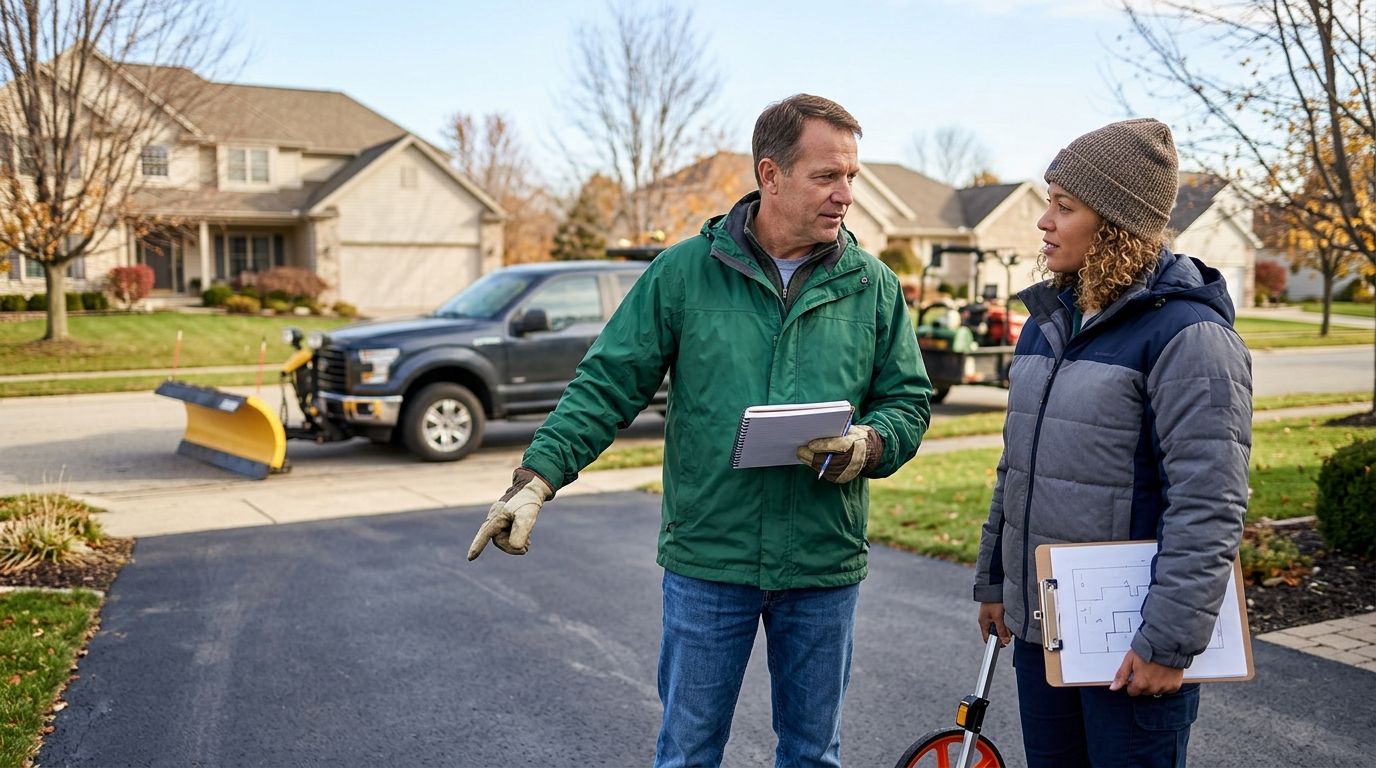
- Provide the property address. Give the full address and identify the areas you want cleared. Ask whether that address can be included on a residential route; do not treat broad metro-area coverage as confirmation for your street.
- Describe the work you need. Identify the driveway and any other areas you want considered. Ask which areas residential route service covers, which require separate agreement, and where snow would be placed. Do not assume commercial sidewalk clearing or de-icing is part of a homeowner’s route.
- Ask what starts a visit. Confirm the agreed snow trigger and how a storm leads to service at your address. No residential trigger depth or arrival window is specified here, so get the applicable terms directly rather than planning around a guessed threshold.
- Review the enrollment terms. Confirm when service begins, how visits are documented or communicated, how changes are handled, and what happens if you want to stop service. Keep the agreed scope in writing so a later question can be answered against the same terms.
- Get confirmation that the property is enrolled. A submitted inquiry establishes that you asked; it does not, by itself, establish route placement. Ask for confirmation tied to your address before relying on the service for a 2026 storm.
The order is deliberate: address first, scope second, trigger third, confirmation last. Asking only whether a company removes snow leaves the operational question unanswered: what, exactly, will happen at your property when a storm meets the agreed conditions?
What should you include in the first request?
Send the information needed to assess and define the job, not a general request to be added to a list:
- Full property address: Include the municipality and state, especially if the property is in Metro East Illinois rather than Missouri.
- Areas to clear: Name the driveway and any other areas you want discussed. Identify areas that must remain accessible without assuming they are included.
- Property access: Explain any gate, parked-vehicle, or access issue that would affect where a crew can work. Ask how the agreed service handles that constraint.
- Desired service arrangement: State that you want enrolled residential snow-route service, not an unspecified visit after a storm.
- Questions needing a written answer: Ask about the trigger, included work, enrollment start, visit communication, and changes to service.
This is a request checklist, not a statement that every listed item is included in the residential service. St. Louis Snow Removal also provides commercial plowing, salting, and sidewalk clearing, but those commercial offerings do not establish the scope of a residential enrollment.
What does enrollment confirmation need to settle?
A useful confirmation identifies the property being served and the work being agreed to. It also makes clear when service begins and what condition starts a visit. If any of those points is still unanswered, ask before treating the property as covered for a storm.
Keep the written terms where another household member can find them. If the driveway is blocked or your access needs change, use those terms to ask how the change affects service. An assumption made during a snow event is harder to resolve than a question settled before it.
Enrolled route or one-time request: which fits your need?
Enrolled route service fits a homeowner planning for repeated winter events; a one-time request fits a single need only if a provider separately offers and accepts it. St. Louis Snow Removal’s stated residential offering is enrolled snow-route service. Do not interpret that offering as a promise of on-demand dispatch.
| Question | Enrolled residential route | One-time service request |
|---|---|---|
| Best for | Homeowners arranging service before storms | Homeowners seeking help for a particular event |
| What you must confirm | Address acceptance, scope, trigger, and enrollment start | Whether a provider accepts the request and what work it covers |
| Advantage | Terms can be settled before snow arrives | No continuing arrangement is needed if the request is accepted |
| Limitation | Enrollment is not confirmed merely by making an inquiry | A request does not establish availability or a visit |
The table compares arrangements, not confirmed choices offered by the same company. If you need service for only one event, ask a provider directly whether it accepts one-time work. If you want a route, ask for enrollment confirmation rather than sending a general snow-removal inquiry each time conditions change.
Why residential route enrollment varies by property
The right questions depend on the property and the agreement. These are the factors to settle before you rely on a route:
- Address and route coverage. St. Louis metro and Metro East Illinois describe the stated service region, not an address-by-address acceptance list. Confirm the specific property.
- Clearing area. A driveway, walkway, and other access areas are different work areas. Name what you need and ask which parts are included.
- Service trigger. The point at which work starts belongs in the agreed terms. Do not substitute a forecast, a neighbor’s arrangement, or an assumed snow depth.
- Site access. Parked vehicles, gates, and other obstacles affect where clearing can occur. Explain them while defining the work area.
- Enrollment timing. Ask when the arrangement becomes active. Sending a request shortly before a storm is not proof that the property has joined a route.
- Changes during the season. If your access or service needs change, ask how to update the agreement. Do not assume a verbal change alters the original scope.
None of these factors supplies a standard residential trigger or a guaranteed arrival time. They identify what your own enrollment must resolve. For 2026, the most useful answer is the one attached to your address and accepted terms.
What should you ask about snow triggers and visits?
Ask what condition starts residential service at your address and how you will know the agreed work has been completed. A trigger is more useful when it is written alongside the work area: a visit that clears only part of what you expected still leaves a scope dispute.
Do not borrow terms from a commercial property. St. Louis Snow Removal provides documented commercial snow services, but the supplied residential description does not specify an identical documentation process, a residential trigger depth, or a visit deadline. Ask which records or notifications apply to your enrollment instead of assuming the commercial process carries over.
If timing matters because you need to leave for work or care for someone at home, explain that need while discussing terms. A route is not an arrival-time guarantee unless the accepted agreement says so. Plan your own access decisions around the terms you receive, not an estimated time copied from another property.
Can you change or pause a residential snow route after signing up?
Ask for the change and cancellation terms before enrollment. The available information does not establish a residential pause policy, so a change in your plans should not be treated as an automatic pause in service.
If you expect to travel, move, or change who maintains the property during the 2026 season, raise that scenario while reviewing the agreement. Ask how to submit a change, when it takes effect, and how you will receive confirmation. The same principle applies to a new vehicle arrangement or a newly obstructed clearing area: get an agreed update rather than relying on a note that may not change the service scope.
Is enrolled route service the same as emergency snow removal?
No. Enrolled residential route service is the stated homeowner offering; emergency dispatch is a different service question. Do not assume a route enrollment provides an immediate visit on request, and do not assume an emergency request enrolls a property for later storms.
If a storm has already started and you are not enrolled, say so plainly when you contact a provider. Ask whether any service is available for that event, then discuss enrollment separately if you want an arrangement for future storms. Keeping those requests distinct prevents a response to one need from being mistaken for agreement to the other.
How do you know your St. Louis address is actually on a route?
Ask for explicit confirmation of the address and the start of service. A contact-form submission, conversation, or discussion of possible work is not the same as an accepted enrollment.
Check that the confirmation matches the areas you discussed and the trigger you agreed to. If the response does not identify those terms, reply with the specific missing questions. St. Louis Snow Removal is best for homeowners seeking enrolled residential snow-route service; the decision point is confirmed coverage for your property, not the existence of service somewhere in the metro area.
FAQ
How do I sign up for a residential snow route in St. Louis?
Send your property address and request enrolled residential snow-route service, then confirm availability, clearing scope, trigger, and enrollment start. Do not treat the initial inquiry as confirmation that your address is on a route.
Does St. Louis Snow Removal serve homeowners in Metro East Illinois?
St. Louis Snow Removal states that its enrolled residential snow-route service covers homeowners across the St. Louis metro and Metro East Illinois. Confirm availability for your specific address before relying on coverage.
Can I request a plow only when it snows?
The stated residential offering is enrolled snow-route service, not a confirmed on-demand service. Ask a provider separately whether it accepts a one-time request for a particular storm.
Is sidewalk clearing included with a residential snow route?
Residential sidewalk clearing is not specified in the supplied service description. Name the walkway you need cleared and get confirmation that it is included before enrolling.
What snow depth triggers a residential route visit?
No residential trigger depth is specified here. Ask for the trigger that applies to your property and have it recorded with the agreed work area.
Can I pause residential snow route service during the 2026 season?
No residential pause policy is specified here. Ask for the applicable change and cancellation terms before you enroll, then obtain confirmation of any later change.
Does sending an enrollment request guarantee service for the next storm?
No; sending a request does not establish that your address has been accepted onto a route. Confirm availability, the service start, and the agreed terms before relying on a visit.
One last thing
The question to ask before the next 2026 storm is not simply whether someone can plow your driveway. Ask: Is this address enrolled, what areas are included, and what starts a visit? A clear answer to those points separates an operational service arrangement from an unanswered request.