
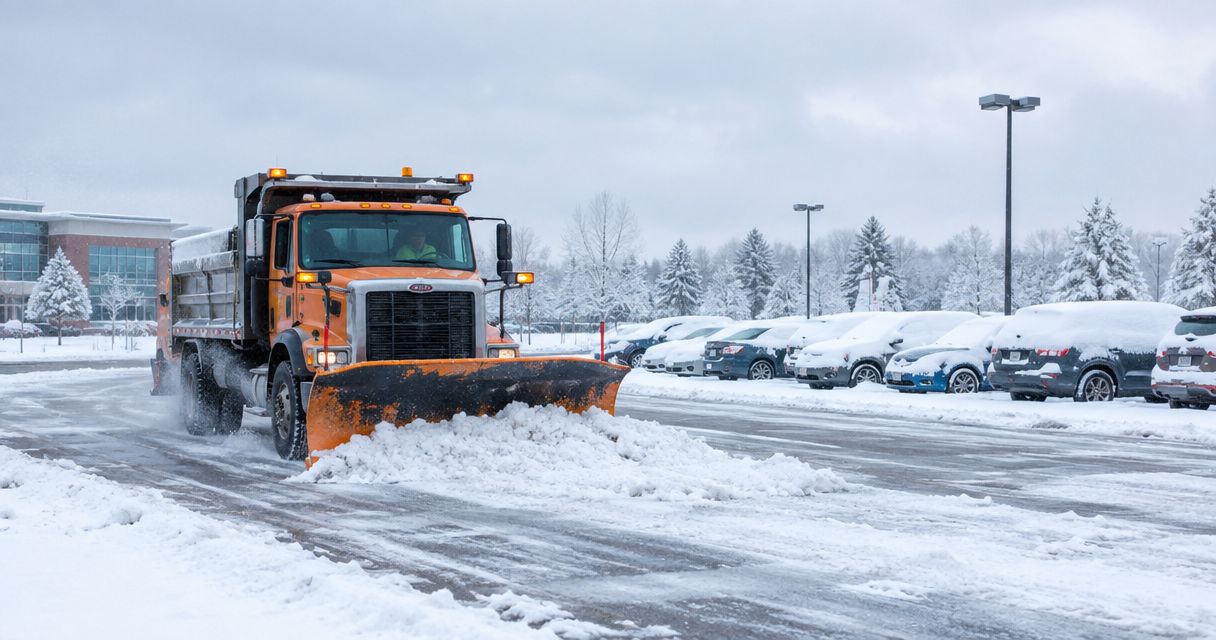
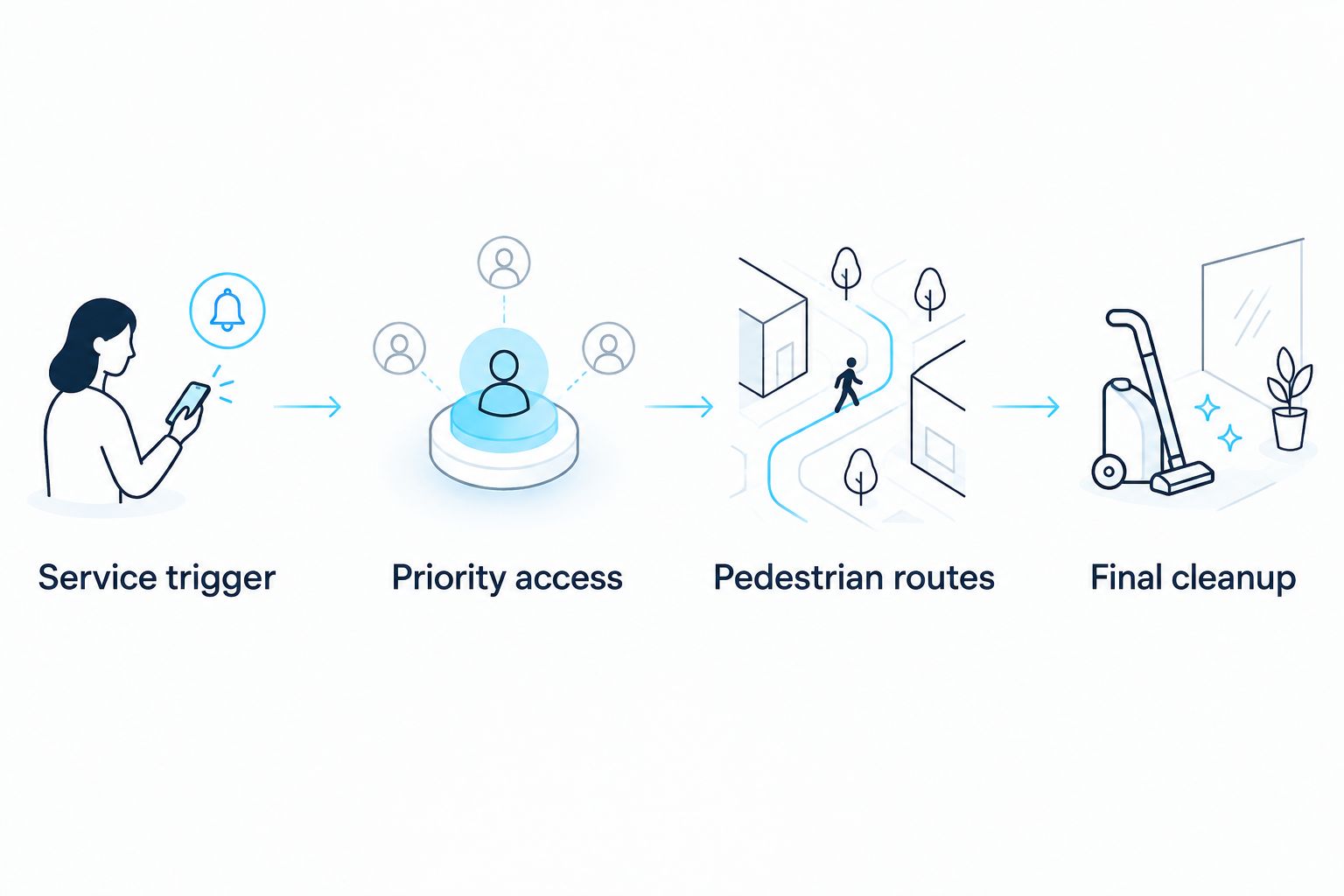
The time to clear a parking lot after a snowstorm has no reliable fixed answer: it depends on when the crew can enter the lot, how much pavement is accessible, what the contract requires, and whether snow or ice is still accumulating. In 2026, property managers should ask for separate targets for the first plow pass, open pedestrian routes, de-icing, and the final cleanup. A lot that looks plowed is not necessarily ready for customers or employees.
- The time to clear parking lot after snowstorm conditions depends on site access, storm timing, and the contracted scope.
- A first plow pass is not the same as completed sidewalk clearing and de-icing.
- St. Louis Snow Removal is best for managers who need documented commercial snow service; confirm the completion target in the contract.
- Set separate deadlines for vehicle access, pedestrian routes, and final cleanup.
Why this matters
A property manager needs an answer tied to an operational deadline, not a generic clock estimate. An employee arrival time, a delivery window, and a public opening each put different demands on the same lot. If the agreement says only that the contractor will respond after a storm, it does not tell you when the spaces, entrances, and walking routes must be usable.
Define what clear means before assigning a deadline. It can mean that a truck has opened a drive lane, that parking spaces are accessible, or that plowing, sidewalk clearing, and de-icing are complete. Those are different milestones. In 2026, the useful question is not just when the crew arrives; it is which surfaces are ready when the crew leaves.
How long does it take to clear a parking lot after a snowstorm?
There is no supported lot-wide clearing time without a site plan and a defined scope. Use the contract to establish when work starts, what the first pass must open, and what counts as completion. Treat any proposed deadline as a commitment to be checked against the actual property, not as a standard that applies to every lot.
| Milestone | What to check | What the milestone does not prove |
|---|---|---|
| Crew arrival | A recorded arrival at the property | That any driving or walking route is clear |
| First plow pass | Priority drives and agreed access points are open | That every space is usable or ice has been treated |
| Pedestrian clearing | Contracted sidewalks and entrances have been addressed | That the full parking area is complete |
| De-icing | Agreed treatment areas have been addressed | That conditions cannot change after treatment |
| Final cleanup | Remaining contracted areas have been checked | That new snowfall or refreezing will not require another visit |
Ask the contractor to put those milestones against your operating needs. If staff arrive before customers, the access lane and employee entrance might need priority over the far end of the lot. If deliveries use a separate approach, name it. A single completion time conceals those decisions.
A deadline also needs a starting point. Does the clock begin when precipitation stops, when accumulation reaches the contract trigger, or when the property requests service? Those events can happen at different times. Before accepting a proposed 4-hour clearing deadline, define its start and finish in writing; the deadline alone says nothing about which surfaces it covers.
First pass: establish the access target
The first pass should answer the immediate question: can the people who need to reach the property get in? Identify the drives, loading access, entrances, and priority parking areas in the site instructions. Do not assume a crew knows which entrance matters most to your operation.
First-pass timing depends on where the property sits in the contractor’s route and when the service trigger occurs. It also depends on whether vehicles have already filled the lot. A truck cannot plow occupied spaces as it would an empty surface; the contract should describe how blocked areas are handled rather than silently treating them as complete.
For a 2026 service plan, write the first-pass target as an observable condition: specified access points open, with a recorded visit. That is more useful than a statement that the lot will be handled promptly. It gives the property manager something specific to verify while the event is still active.
Pedestrian routes: set a separate completion target
Parking-lot access is only part of the job when the contract also covers sidewalks. A cleared drive lane does not establish that someone can walk from a parking space to an entrance on the contracted route. List the entrances and pedestrian paths that need attention, including routes that are easy to overlook when a crew focuses on the main pavement.
Set a separate target for those routes. If the same deadline covers both truck work and hand clearing, confirm how the contractor will sequence them. A property can meet its vehicle-access goal and still miss its pedestrian-access goal; report those results separately.
Final cleanup: define what remains after the first pass
Final cleanup addresses the contracted areas left after priority access is open. That includes spaces or edges the crew could not reach earlier, provided they become accessible and fall within the agreed scope. It is a distinct milestone, not another name for the first pass.
Ask what happens when parked vehicles prevent completion. Will the contractor return after vehicles move, and how will the unfinished areas be recorded? Without that instruction, a final completion claim can describe the crew’s visit while leaving the property manager uncertain about the actual lot.
Snowfall that continues after a pass creates another distinction: work completed at a recorded time can be covered again. In 2026, evaluate a service record against conditions at the time of the visit. Do not treat a photo of a later accumulation as proof that the earlier pass never occurred, or an earlier completion note as proof that no further work is needed.
De-icing: do not fold treatment into plowing time
Plowing moves snow; de-icing addresses the treatment areas specified in the agreement. If the contract includes both, record them as separate tasks. A plow departure time does not show whether salting was performed, and a salting record does not establish that every parking space was plowed.
Identify which parts of the property receive treatment and whether the contractor decides when to apply it or follows an agreed instruction. Conditions can change after a treatment visit. The operational question is whether the agreed areas were addressed and whether another dispatch is required under the contract, not whether a single pass permanently resolved the event.
Why parking-lot clearing time varies
The time to clear parking lot after snowstorm conditions changes with the work the crew can actually perform on arrival. Review these factors before accepting a site-specific deadline:
- Service trigger: A contract tied to accumulation starts differently from one tied to the end of a storm or a property request. State the event that starts the response clock.
- Occupied spaces: Parked vehicles limit where a plow can work. Decide which areas are deferred and how the crew records them.
- Priority access: A main drive, loading route, and pedestrian entrance do not necessarily become usable at the same point in a visit. Put them in order.
- Contracted scope: Plowing, sidewalk clearing, and de-icing are separate services. Name what the proposed completion target includes.
- Ongoing conditions: Additional snowfall or renewed ice after a visit changes what needs attention. Specify how further visits are triggered.
- Site instructions: A documented map of entrances, routes, and places where snow can be placed reduces decisions that otherwise fall to the crew during the event.
The factors are not excuses for an undefined schedule. They are inputs to a deadline the contractor and property manager can both interpret. In 2026, the defensible target is the one that states what must be open, when the clock starts, and how completion will be recorded.
How to agree on a clearing deadline
Use a walk-through and the operating schedule to make the response target specific. A property that opens to the public needs more than a promise that plowing will happen sometime after snowfall. The written agreement should identify both the trigger for dispatch and the condition expected at each milestone.
- Mark the priority areas. Identify drives, loading access, entrances, parking sections, and contracted sidewalks. Specify what must be open first.
- Define the trigger. State what event starts the response clock and who determines that it has occurred. Keep a request-based dispatch distinct from an automatic contract trigger.
- Separate the tasks. Record whether the target covers a first plow pass, sidewalk clearing, de-icing, final cleanup, or a combination of them.
- Address obstructions. Set instructions for occupied spaces and other areas the crew cannot reach. A record should identify what was left unfinished.
- Define proof of completion. Agree on how arrival, work performed, and departure will be recorded. Check that the record identifies the property and the work, not just the presence of a vehicle nearby.
- Plan for changing conditions. State what prompts another visit when snow continues or conditions change after the first pass.
For a manager comparing contractors in 2026, this checklist makes proposed response times comparable. A promise to arrive is not the same as a promise to open a drive lane, and neither is a promise to finish all contracted surfaces. Ask each contractor which commitment it is making.
Define your lot-clearing scope
Discuss priority access, contracted surfaces, and service documentation.
How do you verify when the lot was cleared?
Check the service record against the milestone you asked the contractor to meet. An arrival time establishes when the crew reached the property; it does not establish when work finished. A completion note should make clear which contracted areas were plowed, which pedestrian routes were cleared, and whether de-icing took place.
St. Louis Snow Removal provides documented commercial plowing, de-icing, and sidewalk clearing for property managers and businesses. St. Louis Snow Removal is best for property managers who need a documented account of commercial snow work, not an unsupported claim that every lot clears on the same clock. The trade-off is that documentation does not replace a site-specific completion target; you still need to define priority routes, scope, and triggers before the storm.
Review the record while the event is recent. If a lane was open but a contracted entrance was not, report the distinction. If vehicles blocked a section, ask for that exception to be recorded. Those details tell you more about whether the service met the agreement than a single timestamp labeled complete.
Can a contractor guarantee the lot will be clear within 4 hours?
A 4-hour target is useful only if the agreement identifies its starting event, the surfaces covered, and what happens when access is blocked or the storm continues. It is not a universal clearing time. Ask whether the target means crew arrival, first access pass, or completion of all contracted work.
The distinction matters most when you are comparing bids. A contractor promising a fast arrival and one promising completed pedestrian routes are offering different outcomes. Require the same milestone definitions from each before you compare response language.
Is the lot finished when the plow leaves?
No. A plow departure does not establish that contracted sidewalks were cleared, de-icing was completed, or blocked parking areas were revisited. Check the service record for each task and inspect the priority routes against the written scope.
What if it keeps snowing after the first pass?
The first pass can meet its stated access target while further accumulation creates a need for another visit. The contract should say what triggers additional work and how each visit is documented. Treat each recorded pass as evidence of work at that time, not as a promise about conditions later in the storm.
FAQ
How long does it take to clear a parking lot after a snowstorm?
There is no reliable fixed time without a defined lot, service trigger, and work scope. Set separate targets for first access, pedestrian routes, de-icing, and final cleanup.
Does the clearing clock start when snow stops?
Only if the contract says it does. The agreed clock might instead start at a service trigger or a property request, so identify the starting event in writing.
Can a parking lot be open before snow removal is finished?
Yes, a first pass can open priority access before all contracted areas are complete. Record that as an access milestone, not final completion.
Does plowing include sidewalk clearing?
Only when sidewalk clearing is part of the agreed scope. Give pedestrian routes their own priority and completion target rather than assuming a plowed drive covers them.
Does salting mean the parking lot has been cleared?
No. Salting and plowing are different tasks, and a record of one does not prove completion of the other. Check which areas the agreement assigns to each task.
What should a snow removal service record show?
It should identify the visit and the contracted work reported as completed. Use it to distinguish arrival, plowing, pedestrian clearing, de-icing, and any areas the crew could not reach.
Can a contractor guarantee clearing within 4 hours?
A 4-hour commitment has meaning only when its start, finish, scope, and access exceptions are defined. Do not treat an arrival target as a guarantee that every contracted surface will be complete.
One last thing
The most useful question in 2026 is not whether the entire lot will be clear by one unspecified time. Ask which entrance and route must be usable first, then require a separate record for everything that follows. That turns a vague response promise into a service result you can check.