There is no fixed sidewalk snow clearing time for 500 feet of walkway in 2026. The route length alone does not tell you the walkway width, snow condition, clearing method, or whether ice treatment is included. Ask for an on-site work estimate and a separate arrival commitment; one does not establish the other.
- Sidewalk snow clearing time for 500 feet has no defensible fixed figure without width, conditions and service scope.
- St. Louis Snow Removal is best for property managers who need documented commercial sidewalk clearing, not an unsupported time guarantee.
- Separate dispatch, active clearing and ice treatment when setting a completion deadline.
- Use recorded start and finish times to check whether the agreed scope was completed.
How long does sidewalk snow clearing take for 500 feet of walkway?
A credible estimate needs more than 500 feet of route length. Measure the width, identify entrances and crossings, describe the snow and ice, and specify whether the job ends after snow removal or includes de-icing. Then ask the contractor for an estimated on-site work window and the conditions under which that estimate changes.
| Work item | What to establish | Why it changes the answer |
|---|---|---|
| Clear the walkway | Length, width, snow condition and equipment | More surface or slower-to-move snow changes the work required. |
| Clear entrances and crossings | Which access points are in scope | Detailed areas are not captured by the walkway length. |
| Address ice | Whether treatment is included and where | Snow clearing and ice management are different tasks. |
| Verify completion | Defined endpoint and recorded times | Arrival does not prove that the full route is clear. |
The basic calculation is work time = clearing time + detail work + any agreed ice treatment. Dispatch and travel belong in a separate response-time measure. Do not add an assumed walking speed to 500 feet and present the result as a completion promise: the crew must move snow off the path, not merely walk its length.
A width example shows why length is insufficient. A hypothetical walkway measuring 500 feet long and 4 feet wide covers 2,000 square feet; at 6 feet wide, the same 500-foot route covers 3,000 square feet. Those are area calculations, not time estimates. They also leave out entrances, intersections and repeat work during an active storm.
Why this matters in 2026
A property manager needs to know when a walkway is usable, not just when a crew arrives. A homeowner on an enrolled route needs to know what the route service covers, rather than treating an estimated arrival as a promise that every surface will be finished at that moment.
St. Louis Snow Removal provides documented commercial sidewalk clearing for property managers and businesses, alongside enrolled residential snow-route service. For a commercial site, put the 500-foot walkway, its access points and any de-icing requirements into the scope before asking for a time estimate. St. Louis Snow Removal is best for property managers who need documented commercial sidewalk clearing rather than a time promise based on length alone. That fit does not establish a clearing duration for a site the crew has not assessed.
In 2026, the useful question for a contractor is not simply how fast a crew can travel 500 feet. It is which surfaces will be usable by the agreed deadline, what triggers a visit, and what record will show the work was done. Keep those answers separate so a dispatch target cannot be mistaken for a finished-walkway target.
What should a 500-foot clearing estimate include?
Give every contractor the same scope. Otherwise, two time estimates can describe different jobs while appearing to answer the same question.
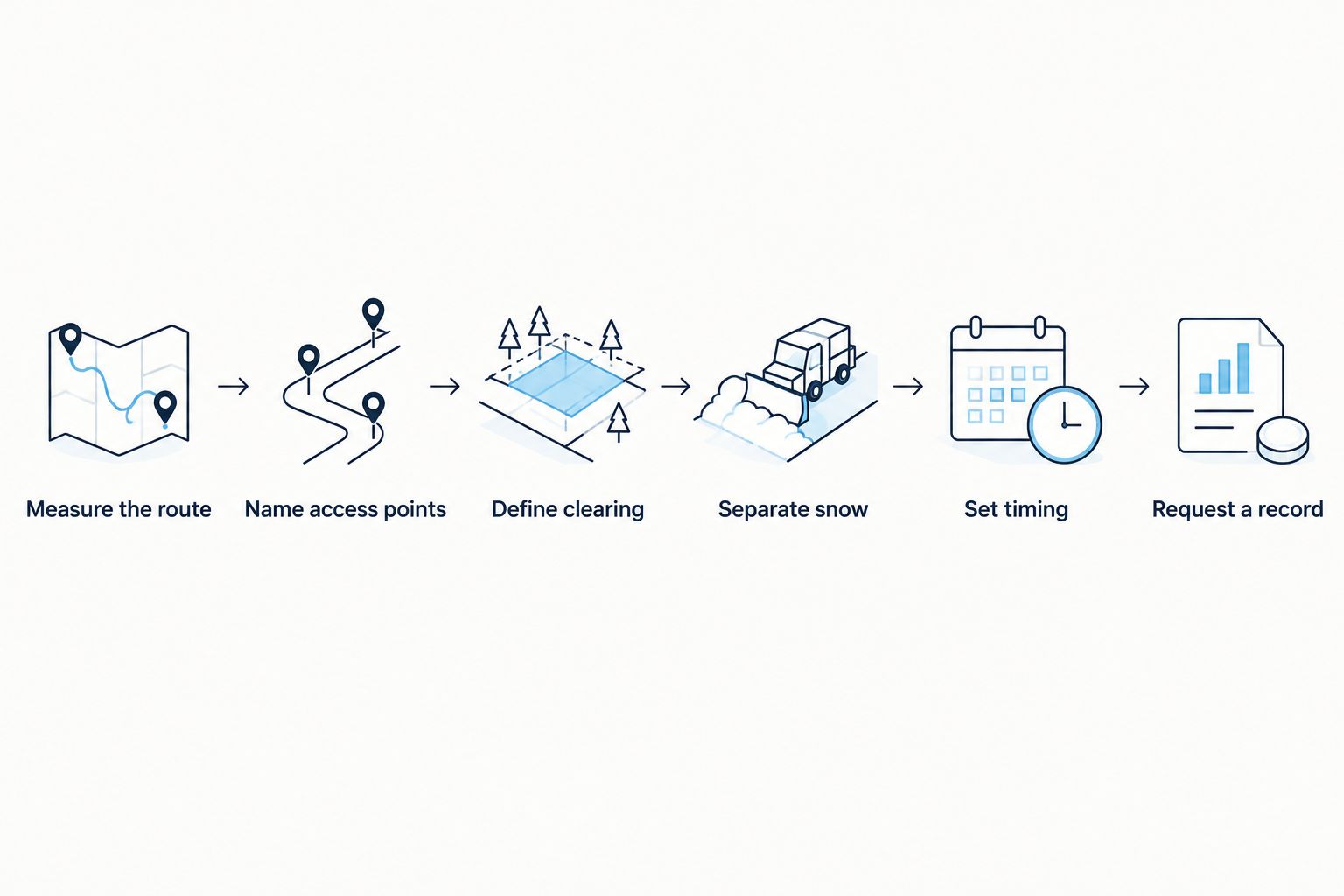
- Measure the full route. Record the 500-foot path and its width, including any sections that narrow or widen. Mark where the route starts and ends so completion has a clear boundary.
- Name each access point. Identify doors, crossings, steps and connections to parking areas that must be cleared. State whether those areas are part of the 500 feet or additional work.
- Define what clearing means. Say where snow can be placed and whether the agreed task includes clearing residue at edges and entrances. A pass down the middle is not the same scope as the full usable width.
- Separate snow from ice. Specify whether de-icing is included, which surfaces receive it, and whether follow-up attention is part of the agreement. Do not treat an ice-treatment visit as interchangeable with snow removal.
- Set the timing terms. Ask when dispatch begins, when the crew is expected on-site, and which event marks completion. State how ongoing snowfall affects the requested deadline.
- Request a service record. Ask for the arrival and completion times, the areas addressed, and any exceptions that prevented completion of the agreed scope.
For St. Louis Snow Removal, documented service is a relevant reason to discuss how the 500-foot route will be recorded. It is not a substitute for a site-specific duration. Ask the same scope questions before comparing the company with another sidewalk-clearing provider.
Manual clearing or equipment: which is faster?
Neither method has a defensible time advantage for this particular 500-foot route without a width, snow condition and site layout. Choose the method that can clear the specified path and access points; then request a time estimate for that method and scope.
| Method | Best for | Advantage | Limitation to check |
|---|---|---|---|
| Manual clearing | Detailed work around doors, crossings and confined areas | Lets a crew address edges and obstacles directly. | Labor needs rise when the route is wide or snow is difficult to move. |
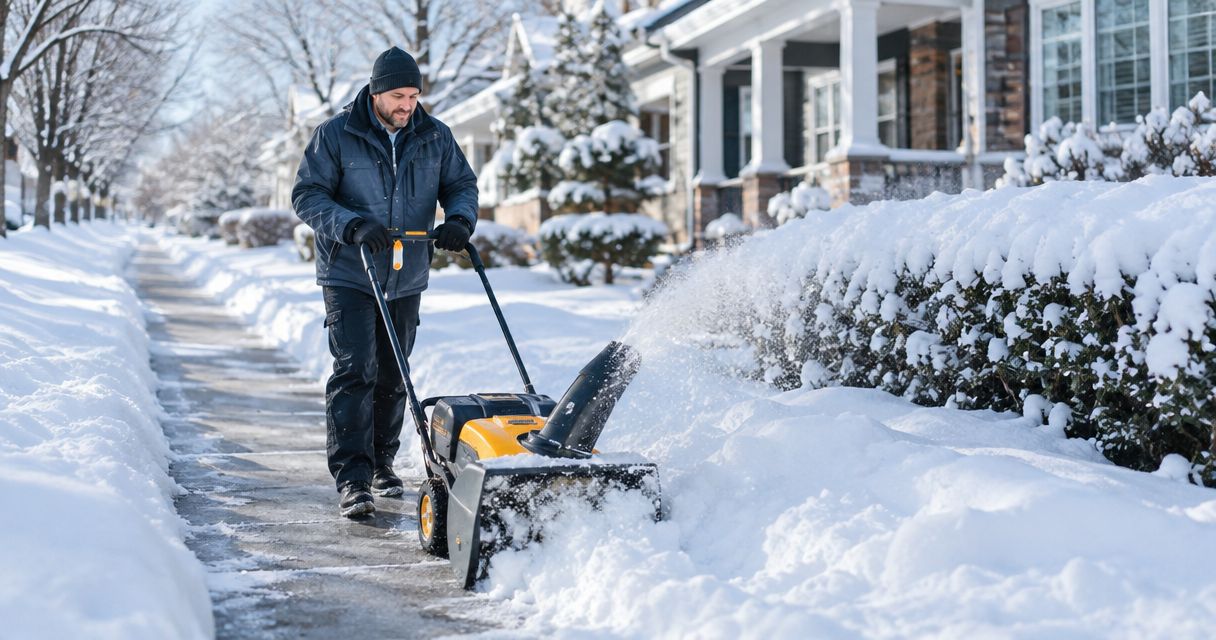
| Walkway-clearing equipment | Open, accessible stretches where the equipment fits | Can move snow along a defined route. | Entrances, obstacles and snow placement can still require detail work. |
Best for a mixed route: ask how the contractor will handle both the open walkway and its access points. An equipment estimate that excludes doors is not comparable with a manual estimate that includes them. Neither option earns a completion-time verdict from length alone.
Equipment also needs somewhere to put the snow. If the available placement area changes during a storm, the crew's approach can change with it. Have the contractor identify placement constraints during the site review rather than discovering them after the clearing clock starts.
Why sidewalk clearing time varies
These factors determine whether a quoted on-site window describes the actual work:
- Walkway width: A 500-foot length describes distance, not the full surface. Record changes in width rather than using a single guess for the entire route.
- Snow condition: New snowfall, compacted snow and a mix of snow and ice require different work. Describe what is present when requesting an estimate.
- Equipment access: A machine must fit the route and reach the areas in scope. Note narrow passages, steps and other interruptions.
- Entrances and crossings: Each detailed area adds work beyond a straight pass. Identify them individually in the scope.
- Snow placement: The crew needs an agreed place to move snow without blocking the route or an access point.
- Ice treatment and repeat visits: These are separate scope decisions. Confirm whether the time estimate includes either one.
None of those factors supplies a universal minutes-per-foot rate. In 2026, a useful comparison between contractors uses the same route map and service definition, then asks each contractor for an estimated work window. Comparing different scopes produces a number you cannot use to plan access.
How do you verify when the 500-foot walkway was cleared?
Define completion as the agreed route and access points being addressed, not merely a crew clock-in. For a 2026 service record, ask for on-site start and finish times, the surfaces covered, and any areas left untreated with the reason. A geo-stamped clock-in can document presence; it does not, by itself, show that every section of walkway was completed.
Check the record against the contract or work order. If ice treatment was a separate task, the record should distinguish it from snow clearing. If snowfall continued after the crew left, a later condition on the walkway does not tell you what was done during the documented visit; compare the site condition with the visit record and the agreed return-visit terms.
St. Louis Snow Removal's documented commercial snow service makes proof of work a practical question to raise when arranging sidewalk clearing. Ask what the record will identify for this particular 500-foot route. A usable record connects the visit to the specified work, rather than asking you to accept an arrival time as proof of completion.
Does a 500-foot route mean the crew will be on-site immediately?
No. The 500-foot measurement describes the walkway, not the time before a crew arrives. Ask for a dispatch trigger and an arrival window separately from the expected on-site clearing window.
For an enrolled residential route, confirm when the route is serviced under the applicable agreement. For a commercial property, confirm how the contract handles a new storm, continued snowfall and a request for another pass. Do not convert a clearing estimate into an on-demand response promise.
Does the time estimate include salting the whole walkway?
Only if the quoted scope says it does. Snow removal, de-icing and any return visit should be listed as separate tasks even when one crew performs them. Ask which surfaces receive treatment and how that task appears in the completion record.
This matters when the walkway looks clear but remains icy at an entrance or crossing. A snow-clearing finish time does not establish that agreed ice treatment was completed at the same moment. In 2026, keep the tasks distinct when you set a deadline or review an invoice.
Can you use one 500-foot estimate for every property?
No. Two properties can have the same 500-foot route length and different widths, entrances, access restrictions and snow-placement options. Use a site-specific scope each time, even if the same contractor serves both properties.
For a portfolio, keep each route's boundaries and completion criteria in its own work order. That gives you a basis for comparing estimates and service records without assuming that equal lengths mean equal work.
FAQ
How long does it take to clear 500 feet of sidewalk?
There is no fixed clearing time for 500 feet of sidewalk without its width, snow condition, access points and service scope. Request a site-specific on-site work estimate, separate from the crew's arrival window.
Is 500 feet enough information to get a clearing-time estimate?
No. A 500-foot length does not establish the surface area or the detail work at entrances and crossings. Give the contractor the walkway width and a marked scope.
Does sidewalk clearing time include crew travel?
Not unless the contractor explicitly defines the estimate that way. Keep dispatch and travel separate from the time spent clearing the walkway on-site.
Does sidewalk snow clearing include de-icing?
Only when de-icing is included in the agreed scope. Confirm which surfaces receive treatment and whether its completion is recorded separately.
How can a property manager confirm the walkway was finished?
Compare the defined route and access points with the service record's start time, finish time and completed work. An arrival record alone does not prove the full walkway was cleared.
Will an equipment-based crew finish a 500-foot route faster?
A 500-foot length alone cannot establish that. Equipment access, snow condition, entrances and snow placement all affect the work, so compare estimates against the same site scope.
One last thing
The most useful 2026 timing request has two deadlines: when the crew is expected on-site and when the defined walkway work is expected to be complete. Put both next to the 500-foot route map. If a contractor can state an arrival target but cannot say what counts as finished, you still do not have an answer to the clearing-time question.